
Most premeds misunderstand pediatrics clinic volunteering: it is not “playing with kids”; it is learning to work with families under real clinical constraints.
If you treat it like babysitting, you will walk away with a cute story and almost no physician-level skills. If you treat it like an apprenticeship in family-centered care, you will walk away with habits and insights that will serve you in residency and beyond.
Let me break this down specifically.
Why Pediatrics Clinic Volunteering Is Different from Other Clinical Roles
Traditional hospital volunteering often orbits tasks and logistics: transporting patients, delivering blankets, stocking carts. Useful, but distant from how physicians actually think and interact.
Outpatient pediatrics is different. You are stepping into a micro-ecosystem where:
- The “patient” is both the child and the family unit.
- Communication is triadic: child–parent–clinician.
- The stakes cover both immediate symptoms and long-term development, safety, and family dynamics.
- Time is compressed: 15–20 minute visits, multiple competing agendas.
In this space, a future physician should not be asking: “How can I help with office tasks?” but rather, “How does a pediatrician manage a visit when the parent is sleep-deprived, the child is scared, the schedule is behind, and there is a vaccine conversation on the table?”
Pediatrics clinic volunteering, if approached correctly, becomes your laboratory for learning:
- How to read parents and caregivers quickly.
- How to adjust your communication level for toddlers, school-age children, and adolescents.
- How to support adherence (medications, follow-up, lifestyle) when the parent controls implementation.
- How to think about safety, social risk, and red flags without overstepping your role.
Core Roles You Can Play in a Pediatric Clinic (Realistically)
You are not the doctor, and you must not pretend to be. That is non-negotiable.
But you are not “just a volunteer” either if you approach it deliberately. Your actual impact and learning depend on fitting into defined, appropriate roles.
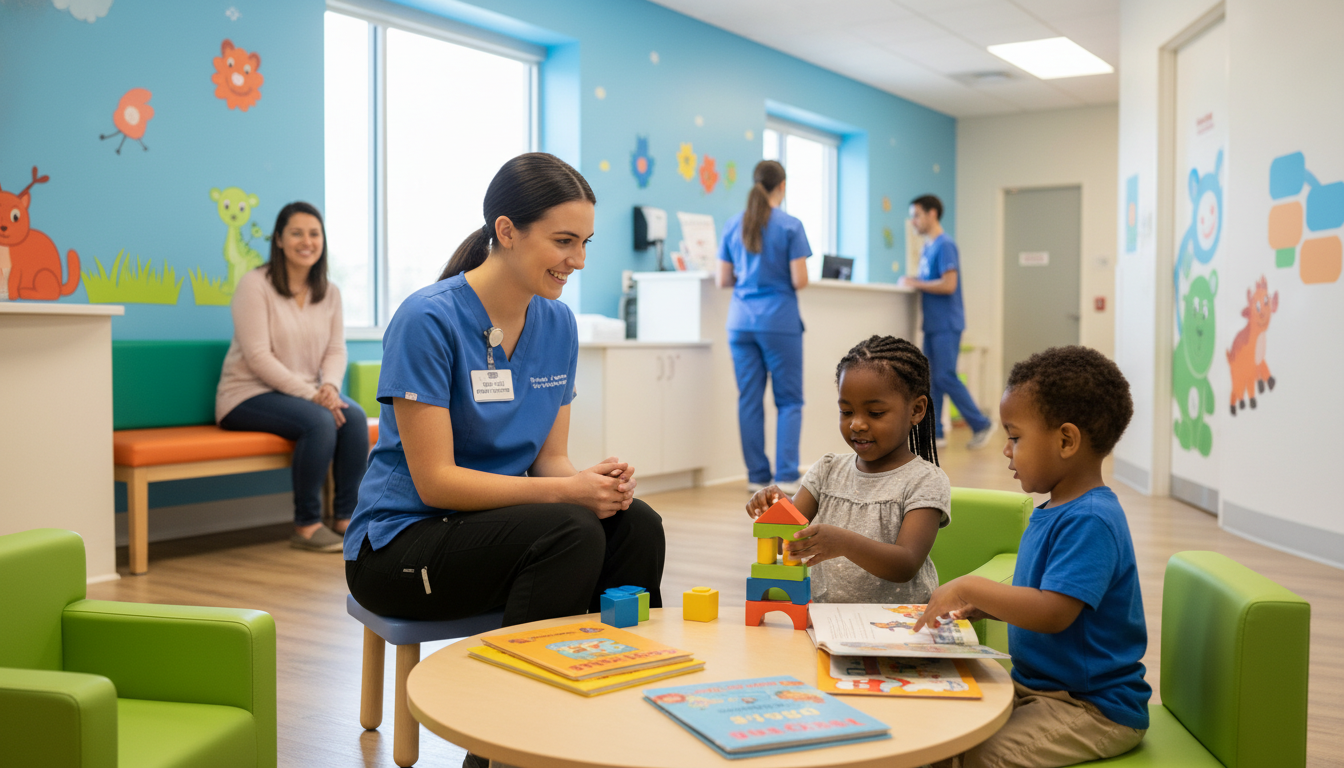
1. Front-End Family Support in Waiting Areas
In many pediatric clinics, the “waiting room chaos” is very real. Overbooked schedules, siblings in tow, anxious parents; you have a live environment for honing skills.
Typical tasks:
- Greeting families, helping with check-in kiosks or paperwork (if allowed).
- Orienting families: bathrooms, play area rules, approximate wait times.
- Engaging children with books, toys, or quiet activities to reduce anxiety and noise.
- Identifying when a parent seems distressed, confused, or lost and alerting staff.
Learning focus:
- Observing nonverbal signals from parents: frustration, confusion, embarrassment.
- Practicing concise, respectful communication: one or two sentences that calm, clarify, or redirect.
- Seeing how socio-economic and cultural differences play out in real time (e.g., a caregiver struggling with forms, a grandparent who speaks limited English, a foster parent missing medical history).
Example: You notice a parent filling out developmental screening forms (like the Ages and Stages Questionnaire) looking overwhelmed. As a volunteer, you do not interpret the form, but you can say, “Those forms can feel long. If you have questions, the nurse can go through any parts that are confusing. You are not expected to know every answer exactly.” That sentence alone can reduce anxiety and set up a better clinical encounter.
2. In-Room Support (When Policies Allow It)
Some clinics permit volunteers in exam rooms; others do not. If they do, this is your highest-yield educational space.
You might:
- Help the nurse or MA with set-up (cleaning toys, prepping handouts, resetting the room).
- Observe physical exams and history-taking with permission.
- Assist in developmentally appropriate distraction: reading a book during vaccinations, engaging a toddler while the provider speaks to the parent.
- Support transitions: helping a family gather belongings, ensuring they know where to go for labs or vaccines.
Learning focus:
- Watching how pediatricians shift language: baby well-visit vs teenager with depression vs toddler with recurrent otitis.
- How they handle vaccine hesitancy, discipline questions, feeding concerns, screen-time conflicts.
- How they explicitly involve the child (“Can I listen to your heart?”) even when the parent is the primary historian.
You should be mentally cataloging phrases that work:
- “What worries you most about this?”
- “Can you walk me through what a typical mealtime looks like?”
- “Let us ask [child’s name] first, then we will check in with you.”
As a volunteer, you listen and study the choreography, not try to contribute clinically.
3. Developmental and Educational Support Activities
Many pediatric clinics run integrated services: literacy promotion (e.g., Reach Out and Read), nutrition counseling, asthma education, or obesity-prevention programs.
You might be asked to:
- Distribute age-appropriate books and model dialogic reading briefly with parents.
- Demonstrate inhaler spacer use under nurse supervision (if you have been trained and the clinic policy permits).
- Assist with growth chart handouts or healthy snack education.
Learning focus:
- Realizing how much of pediatrics is anticipatory guidance rather than acute disease.
- Seeing how physicians and staff tailor messages for parents with different health literacy levels.
- Connecting basic science and pathophysiology (e.g., asthma) with actual patient barriers (affording meds, using devices correctly, avoiding triggers).
The Central Skill: Family-Centered Communication
You will not learn “pediatric medicine” in a premed volunteer role. You can, however, build robust foundations in pediatric communication—which is where many new physicians struggle badly.

1. Recognizing the Triadic Relationship
Adult medicine is mostly dyadic: clinician–patient. In pediatrics, there is always a third party, and sometimes more (grandparents, foster parents, social workers).
As a future physician, observe:
- Whom does the pediatrician look at when asking different types of questions?
- How is consent and assent navigated as children become older?
- How does the physician validate the parent’s concern while encouraging the child to speak?
You might see:
- For a 4-year-old: largely speaking with the parent, but involving the child for simple choices: “Which arm do you want your shot in?”
- For a 10-year-old: asking both parent and child, introducing simple privacy concepts.
- For a 16-year-old: asking the parent to step out for part of the visit to discuss confidential topics.
In your reflection and future applications, you should be able to concretely describe witnessing this evolution.
2. Language Level and Framing
Watch for:
- How pediatricians translate medical terms into parent language: “an ear infection” instead of “acute otitis media,” followed by when they switch back to more technical export language if the parent is medically trained.
- How they avoid blame when discussing weight, screen time, sleep, or discipline.
- How they handle conflicting internet advice vs evidence-based recommendations.
You will see good and suboptimal examples. Catalogue both.
Example contrast:
- Poor: “You should not give her juice; it is bad for her teeth and weight.”
- Better: “Many parents are surprised how much sugar is in juice. For most kids, water with meals and snacks works best to protect their teeth and help maintain a healthy weight. If she loves juice, we can talk about ways to cut back gradually.”
As a volunteer, you are not delivering this counseling, but you can learn the rhythms and approach.
3. Managing Emotion: Parent Anxiety, Guilt, and Frustration
Pediatrics is loaded with parental emotion: fear when a child is sick, guilt about missing signs, frustration with systems.
You should be observing:
- How staff de-escalate an angry parent who has waited too long.
- How a physician responds when a parent breaks down over developmental concerns.
- How the team navigates suspected abuse or neglect without confrontation in front of the child.
Example scenario: A parent is angry because “no one is listening” about their child’s behavior. The pediatrician says, “You have been dealing with this for months; of course you are frustrated. Let us go through step by step what you have tried and what has or has not helped, and then we will talk about next options together.” Simple, but powerful framing.
As a volunteer, your emotional regulation matters too. If a parent vents to you, your job is not to defend the clinic or give clinical advice. It is to listen briefly, avoid arguing, and hand off appropriately: “That sounds really stressful. Let me let the nurse know you have some concerns you want to talk through.”
Working with Specific Age Groups: What to Watch and Practice
You are not performing exams or making diagnoses, but you are learning how children at different ages interact with healthcare, and how families differ.
Infants and Toddlers (0–3 years)
Common clinic scenarios:
- Well-child visits: vaccines, growth, milestones.
- Feeding issues, sleep problems, recurrent infections.
Focus for you:
- How providers use simple, repetitive language and soothing voice tones.
- Techniques for examining children who are crying or clinging to parents.
- How they integrate objective developmental screening tools into conversations.
Practical actions as a volunteer:
- Offering a toy or book to an anxious toddler in the waiting area.
- Keeping extra supplies of wipes, diapers (if the clinic provides them), or blankets organized.
- Stepping back physically to avoid crowding the child if they seem distressed, while observing from an unobtrusive position.
School-Age Children (4–12 years)
Here, social context emerges more strongly: school performance, bullying, ADHD, sports injuries.
Watch:
- How clinicians explain diagnoses like ADHD to parents vs the child.
- How they encourage the child to contribute: “Tell me what happens when you try to fall asleep.”
- How school and family intersect—504 plans, IEPs, behavioral strategies.
As a volunteer, you can:
- Notice reading materials: are there age-appropriate health education resources?
- Help explain logistics to families after the visit: where to drop off school forms, how follow-up works (without giving medical advice).
Adolescents (13–18+ years)
This is where many premeds see the sharpest learning curve.
You will see:
- Conversations about sexual health, substance use, mental health, and identity.
- Negotiation of confidentiality between teen and parent.
- Screening tools like PHQ-9, CRAFFT, or GAD-7 in use.
Your key tasks:
- Maintain strict boundaries. You do not engage in private, sensitive conversations beyond basic rapport. You follow clinic policies.
- Observe how physicians create a safe space: normalizing questions, avoiding shock or judgment, clearly stating confidentiality limits (“I will not share this with your parents unless I am worried about your safety”).
- Learn how they handle parent requests to be present when it is not appropriate.
You may find this challenging. That is the point. This is exactly the type of scenario that will separate a well-trained future physician from someone who struggles in adolescence-focused encounters in clerkships.
Handling Diverse Family Structures and Social Contexts
Pediatrics will expose you to complexity you will never see in a single OSCE.
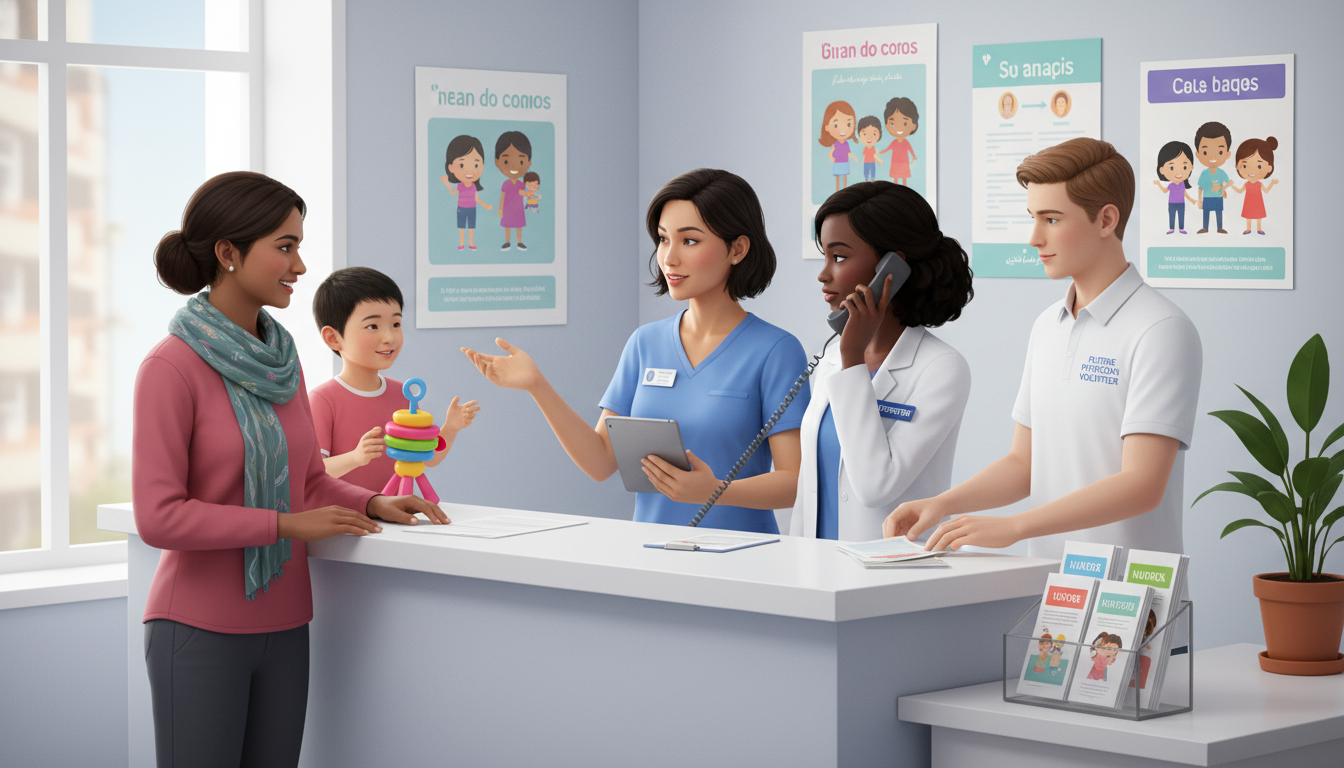
1. Non-Traditional or Complex Caregiver Roles
You may see:
- Grandparents as primary caregivers.
- Foster parents with limited medical history access.
- Split custody situations where one parent disagrees with the plan.
- Group-home staff accompanying patients.
As a volunteer, you:
- Address caregivers respectfully, avoiding assumptions about “mom” or “dad” until they self-identify.
- Observe how staff verify legal guardianship and consent rights.
- See how clinicians navigate disagreements about vaccines, psych meds, or discipline when caregivers differ.
Your reflection later should not just say “I learned to work with many types of families.” It should include concrete examples:
“In clinic I saw visits where a grandmother was the primary caregiver but did not have up-to-date custody paperwork, and the staff had to balance safety, legal requirements, and the child’s immediate needs.”
2. Language Barriers and Cultural Nuances
This is where many future physicians either develop strong habits or cement weak ones.
Watch for:
- Use of professional interpreters vs ad-hoc family translation.
- How clinicians slow down, chunk information, and use visuals or models.
- How cultural beliefs about illness, vaccines, or mental health surface in conversation.
Your role:
- Never interpret medical information unless you are the formally designated, trained interpreter (which you will almost certainly not be as a premed).
- Avoid side conversations that might undermine the official message.
- Help with non-clinical support: directing families physically where to go, organizing forms, showing them where to wait for labs.
Pay close attention to how physicians handle culturally sensitive disagreements without dismissiveness. This is advanced communication. You get a front-row seat.
3. Social Determinants and Hidden Risk
Pediatrics clinic is where the gap between “textbook medicine” and lived reality becomes obvious.
Common red flags:
- Missed appointments, difficulty filling prescriptions, frequent ER visits.
- Reports of food insecurity, unsafe housing, or domestic violence.
- School absence, behavior changes, or unexplained injuries.
As a volunteer, you do not investigate or confront. You watch:
- How the team screens for social determinants of health in a routine way.
- How social workers, case managers, or community health workers are brought in.
- How clinicians frame difficult questions in a non-accusatory way.
You may overhear, with permission, questions like:
- “Sometimes families run out of food at the end of the month. Has that been happening for you recently?”
- “Who lives at home with you and [child’s name]?”
This is the reality of pediatrics. You are learning that “working with families” often means working with everything surrounding them: schools, housing, public benefits, legal constraints, and cultural context.
Boundaries, Ethics, and Professionalism: Where Volunteers Go Wrong
You are there to learn and to support the clinic, not to show off future-doctor energy.
1. Scope of Role
Common mistakes:
- Offering medical advice (“My cousin had this and they used…”).
- Answering parent questions beyond your training (“That rash looks like…,” “It is probably just a virus”).
- Accessing or glancing at charts you are not authorized to view.
Your rule set should be:
- If the question involves diagnosis, prognosis, or treatment, your only acceptable response is something like:
“I am a volunteer, so I cannot give medical advice. I will let the nurse/doctor know your question.” - If you are given access to the EHR for certain tasks, you only open records necessary for that task, and you never share details with others.
Learn to be comfortable saying, “I do not know,” and redirecting. That humility is far more physician-like than pretending competence.
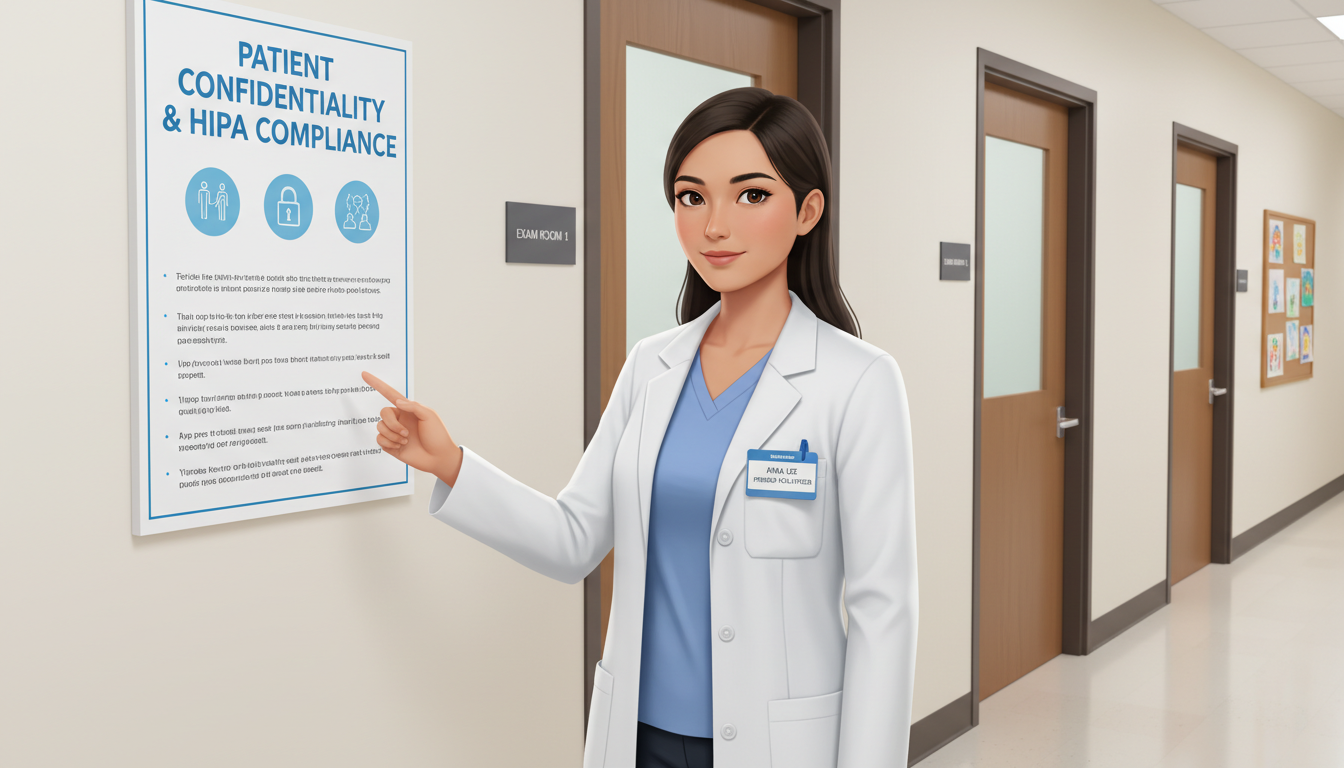
2. Privacy and HIPAA in a Family Context
You must internalize:
- Discussing a child’s condition in a hallway is not acceptable.
- Recognizing that adolescents may have confidentiality rights that parents are not fully aware of, but you do not unilaterally educate or override parents. You follow clinic policy.
- Keeping stories de-identified when reflecting or writing about experiences.
If you plan to use an anecdote in a personal statement, you remove or change identifiable details: age, location, specific diagnosis patterns, family composition. Admissions committees respect candidates who show ethical awareness here.
3. Emotional Boundaries
You will see difficult things: suspected abuse, neglect, severe chronic illness, parental breakdowns.
You are allowed to feel affected. You are not allowed to:
- Interrogate families about sensitive issues.
- Share “shocking” stories with friends.
- Post anything on social media that could even hint at specific patients.
When in doubt, debrief with the volunteer coordinator, not with peers outside the clinical setting.
Converting Clinic Time into Future-Physician Skills
You are not just collecting hours. You are building a mental model of clinical practice and physician identity.
1. Structured Reflection During and After Shifts
Immediately after a shift, ask yourself:
- What was one interaction where I saw excellent family-centered communication?
- What was one moment that made me uncomfortable, and why?
- What did I learn about balancing child autonomy with parental authority?
- Where did social factors clearly shape clinical care?
Write brief, protected reflections—no names, no unique identifiers. Over time, themes will emerge: communication, systems barriers, cultural differences, chronic disease management.
Those themes become raw material for:
- Personal statements.
- Secondary essays (e.g., “Tell us about a time you worked with a population different from your own”).
- MMI responses about ethical dilemmas, patient communication, or dealing with conflict.
2. Pattern Recognition Across Visits
You will start to notice recurring patterns:
- Reassurance visits vs true emergencies.
- Vaccine hesitancy scripts: the same myths, the same fears, the same successful responses.
- Behavioral concerns that were actually manifestations of school or family stress.
As a future physician, pattern recognition is your core cognitive skill. Start now.
Example: You might notice that almost every parent of a toddler mentions screen time. Over weeks, you watch how different pediatricians handle it, from prescriptive (“No screens under 2”) to collaborative (“Tell me what screens look like in a typical day, then we will brainstorm small changes.”). You see which approach leads to better acceptance from parents.
3. Linking to Your Future Specialty Interests
Even if you never plan to be a pediatrician, these skills are transferable.
- Family medicine: identical triadic dynamics, particularly with children and older adults.
- Emergency medicine: dealing with anxious families, working fast without losing empathy.
- Psychiatry: observing developmental trajectories, early mental health symptoms.
- Surgery or subspecialties: many will still see pediatric cases or interact with parents during pre-op and post-op.
Admissions committees do not need you to declare pediatrics as your forever choice. They do want to see that you extracted physician-level learning from your experiences.
When you describe your pediatrics volunteering, move beyond “I like kids” to:
- “I learned how to navigate communication through parents while still respecting the child as a patient.”
- “I saw how social and family factors determined whether a perfectly reasonable medical plan could actually be implemented.”
- “I began practicing how to remain within my role while still providing genuine support to families.”
How to Evaluate and Choose a Pediatrics Clinic Volunteer Role
Not all “pediatrics experiences” are equal. Some are glorified daycare; others are deeply clinical.
Look for:
- Direct exposure to clinical flow: Are volunteers allowed near or inside clinical areas, even if only for observation? Or are you confined to a separate child-care space disconnected from care?
- Supervision clarity: Is there a named supervisor (RN, MA, physician, coordinator) responsible for your training and feedback?
- Defined responsibilities: Are your tasks clearly articulated, avoiding vagueness like “help where needed,” which often devolves to unstructured, low-yield tasks?
- Educational orientation: Do they offer occasional teaching moments, debriefs, or shadowing opportunities?
If you are already in a role that is underutilizing you, have a structured conversation:
- Propose specific, appropriate tasks: organizing anticipatory guidance materials, restocking education handouts, helping with book programs, or facilitating structured activities in the waiting room that align with clinic goals.
- Ask whether limited in-room observation could be arranged under clear rules.
- Clarify any doubts about confidentiality and communication norms.
You demonstrate initiative without entitlement. That attitude alone is something physicians notice.
Key Takeaways
- Pediatrics clinic volunteering is fundamentally about learning to work with families, not just children—triadic communication, emotion management, and social context are your core lessons.
- Your value and growth come from clearly defined, role-appropriate actions: supporting workflow, observing high-quality communication, and reflecting systematically on what you see.
- The habits you build—respecting boundaries, recognizing social determinants, and adapting communication across ages—translate directly into stronger clinical performance in any specialty you eventually choose.