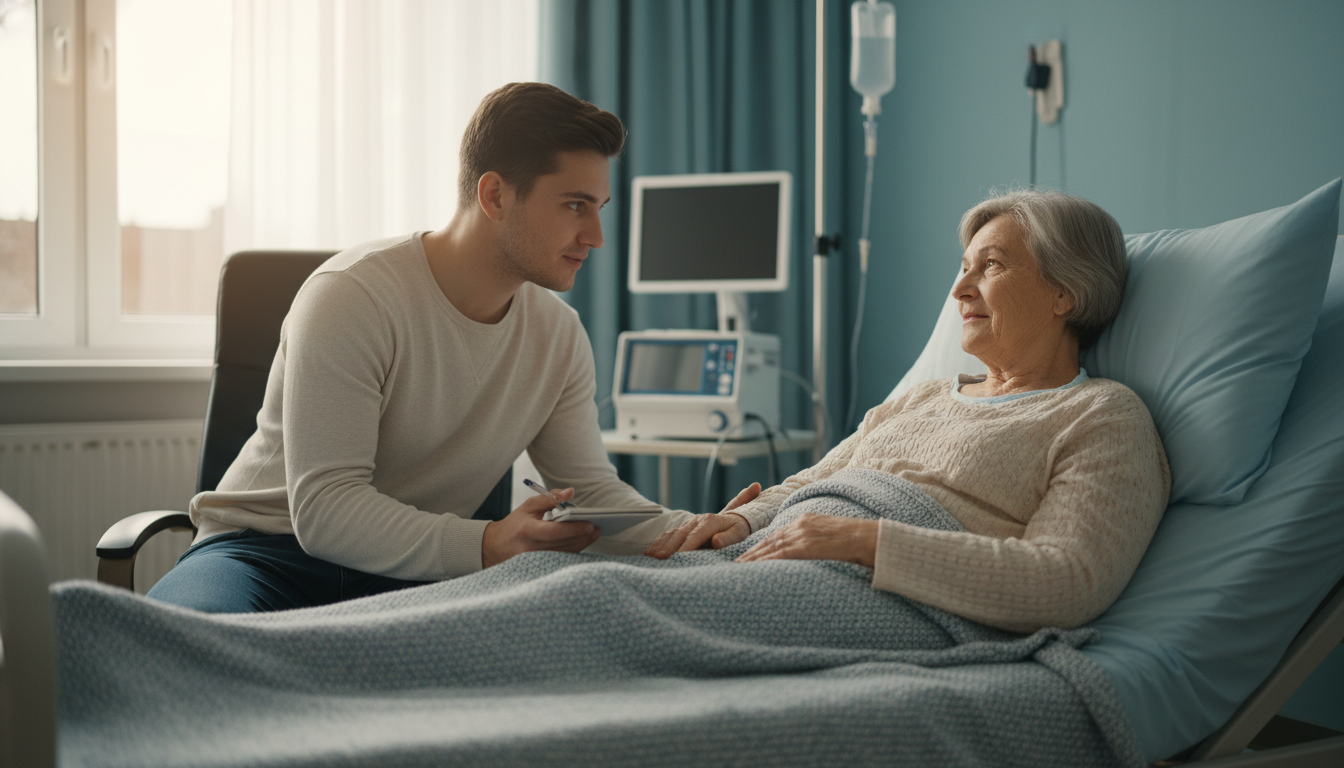
It is a Tuesday evening, 6:45 PM. You are standing outside a quiet hospital unit with the sign “Palliative Care / Comfort Care” on the wall. You have your volunteer badge, a small notebook in your pocket, and a knot in your stomach. You are not here to draw blood, start IVs, or scrub into cases. You are here to sit. To listen. To talk to patients who are seriously ill, some at the very end of life.
You are wondering: “What exactly am I going to do here? And will any of this make me a better future physician, or will I just feel awkward and useless?”
Let me break this down very specifically.
Clinical volunteering in palliative care is one of the most powerful—and underused—ways to build high‑level communication skills before medical school or early in training. These are not the “be nice and smile” soft skills you already know. They are the same core communication competencies tested in OSCEs, assessed in clerkship evaluations, and expected in residency: delivering difficult information, responding to strong emotions, aligning care with values, and staying present in uncomfortable conversations.
We will walk through:
- The specific communication skills you will gain in palliative care volunteering
- What those skills actually look like in real encounters
- How they map to what admissions committees, OSCE examiners, and residency programs look for
- Concrete strategies to practice and document these skills
Why Palliative Care Is a Communication Lab (Not Just “Sad Volunteering”)
Palliative care is not synonymous with “giving up” or “just hospice.” Clinically, it is specialized medical care for people living with serious illness, focused on symptom control, quality of life, and goals of care—at any stage of disease.
From a premed or early medical student perspective, palliative units, inpatient consult services, and outpatient clinics function as a living communication laboratory.
Three reasons:
High‑stakes conversations are the norm, not the exception.
On oncology wards, ICUs, or transplant units, those conversations happen intermittently. In palliative care, they happen every day: bad news, changes in prognosis, decisions about feeding tubes, DNR orders, and hospice enrollment. Even if you are “just observing,” you see the architecture of complex conversations repeatedly.Time is used differently.
Many palliative teams deliberately allocate more time per encounter. That means you can observe how clinicians build rapport, how they sit with silence, how they circle back to patients’ fears. This is the stuff that is invisible in a rushed 10‑minute clinic visit.Patients and families are emotionally open.
Serious illness strips away a lot of social filtering. People talk about fear, anger, regrets, faith, family conflict. As a volunteer, you gain practice entering conversations that are already emotionally charged, not surface‑level small talk.
You will not be managing morphine drips. Your core clinical tool here is communication.
Core Communication Skills You’ll Build in Palliative Care Volunteering
We will walk through the main skill domains and what they look like for a premed or early medical student volunteer.

1. Deep, Structured Listening (Beyond “Nodding Along”)
Most premeds describe themselves as “good listeners.” In palliative care, that gets stress‑tested.
You will learn:
How to invite a narrative
Instead of, “How are you?” you start hearing and using questions like:- “Can you tell me what the last couple of weeks have been like for you?”
- “What has been the hardest part of this hospital stay so far?”
These questions open doors. Patients talk about pain, but also about fear of being a burden, worries about their children, spiritual distress. You are learning to ask questions that expand, not shut down, the conversation.
How to track a story with multiple threads
A patient might shift from talking about dyspnea, to an estranged son, to a fear of suffocation at night. Structured listening means you mentally tag those threads—symptom, relationship, existential fear—and circle back:
“Earlier you mentioned you sometimes feel afraid of not being able to breathe at night. What is that experience like for you?”How to sit with silence
In palliative care rooms, you will experience 10–20 second silences after a hard statement: “They told me it is stage IV now.” Early on, every cell in your body will want to fill that space. Over time, you learn silence as an active tool: it gives patients room to continue, process, or cry. This is a highly valued clinical communication skill.
Admissions committees and OSCE graders watch for this. They are listening for whether you interrupt, whether you allow a patient to complete thoughts, whether you use silence constructively. Palliative volunteering gives you hundreds of micro‑reps.
2. Eliciting Values and Goals (Without Sounding Like a Checklist)
Palliative care revolves around aligning medical treatments with what matters to the patient. As a volunteer, you are not leading goals‑of‑care meetings, but you are often the person with time to talk about life outside the hospital.
You will learn:
How to explore identity and priorities
Common volunteer‑level questions:- “Outside of the hospital, what does a good day look like for you?”
- “What are you most hoping to get back to?”
- “Who are the important people in your life who are part of your care?”
These questions uncover roles (parent, grandparent, caregiver), activities (teaching, gardening, attending church), and priorities (mental clarity vs pain relief, being at home vs hospital-based care). This is the raw material for goals of care.
How to hear “coded” goals
A patient might say, “I just want to be strong enough to walk my daughter down the aisle in June.” Clinically, that is a goal with a time frame and emotional weight. As a volunteer, you learn to recognize that this is not small talk; it is central to decision‑making.How to bring values into the room gently
You will see palliative clinicians use bridging phrases you can emulate in lower‑stakes conversations:- “Given what you have told me about how important [X] is to you…”
- “How do you see your current treatments fitting with what you want for the time ahead?”
While you will not be negotiating chemotherapy options, you will start thinking the same way: “What does this person actually want, and how do I help surface that?”
This maps directly to medical school competencies around “patient‑centered care” and “shared decision making.” When you later write about your experience, you can articulate this concretely instead of generically.
3. Responding to Emotion in Real Time
One of the most specific communication skill sets in palliative care is affective communication—responding to expressed emotion.
You will hear:
- “I am so angry this is happening to me.”
- “I am tired of being in pain all the time.”
- “I do not want my kids to see me like this.”
- “I am scared of dying.”
As a volunteer, your job is not to fix these. Your job is to recognize, validate, and make space.
You will practice:
Naming and validating emotions
- “It sounds like you are really scared about what comes next.”
- “I can hear how frustrated you are with all the hospitalizations.”
- “Anyone in your situation would feel overwhelmed.”
This looks trivial on paper. In a real room with a crying family member, it is not. Having practiced these phrases out loud makes an enormous difference later, when you are an M3 on an inpatient medicine team.
Avoiding premature reassurance
Your instinct may be to say, “It will be okay,” or “The doctors are doing everything they can.” Palliative clinicians model a different pattern:- First, reflect: “This is a lot to carry.”
- Then, anchor: “You are not going through this alone. The team is here with you.”
- Then, explore: “When is this fear strongest for you?”
You will see how quickly premature reassurance shuts conversation down, and how validation keeps it open.
Handling tears without panic
At some point, a patient or family member will start crying while you are there. You learn baseline skills: offer tissues, do not rush to change the subject, ask, “Would you like me to sit with you for a bit?” This translates directly to clinical professionalism.
If you plan to mention palliative volunteering in interviews, this is a strong area: you can provide a specific scenario demonstrating growth in handling strong emotion.
4. Communicating Across Families, Cultures, and Roles
Palliative care is rarely one-on-one. It is often one‑on‑many: patient, spouse, adult children, sometimes clergy, sometimes multiple providers.
You will gain exposure to:
Family dynamics under stress
- Adult children disagreeing about “doing everything” vs focusing on comfort
- A spouse who wants details while the patient does not
- A family member who dominates the conversation while others stay silent
You are learning to listen to what is said and what is not said.
Different cultural and spiritual frameworks for illness and death
In a palliative setting, you will see:- Families who insist on “not telling Mom the full diagnosis”
- Patients who frame illness as a spiritual trial or test
- Norms around decision-making (e.g., elder male relative speaks for the group)
Your role as a volunteer is not to challenge these, but to understand that “patient autonomy” can look different across cultures. This awareness is a critical piece of cultural humility training.
Interdisciplinary team communication
Palliative teams often include physicians, nurses, social workers, chaplains, and sometimes psychologists, music therapists, or volunteers. You watch how they:- Present updates succinctly during family meetings
- Signal disagreement respectfully in front of families
- Reinforce each other’s messages instead of contradicting them
You are essentially observing collaborative communication that you will later need on wards, in sign-outs, and in consultations.
5. Professional Boundaries and Self‑Disclosure
Palliative care challenges the boundary line between human connection and professional distance more than most fields.
As a volunteer, you will need to learn:
When and how to share about yourself
Patients often ask: “Do you have kids?” “What are you studying?” “Have you ever had someone close to you die?” You cannot simply answer every question fully.You learn small, bounded disclosures that keep the focus on the patient:
- “I am a pre-med student and I volunteer here once a week.”
- “Yes, I have lost someone close, and that is part of why I value being here with patients. Tell me more about your [spouse/parent/child].”
Where to set emotional limits
You will meet patients who remind you of your own grandparents or who die soon after a powerful conversation. You will need to find a way to process that grief without withdrawing completely or burning out.Good programs build in debriefing; if not, you will have to advocate for it. Being able to say, “I’ve learned to seek debriefs after especially tough encounters” is a maturity signal in applications and interviews.
How to say goodbye
Patients change units, go home, or transition to hospice frequently. Learning to end relationships respectfully and clearly—“I am finishing my shift now, but I have really valued our conversations”—is a form of professional closure that you will later need at the end of rotations or care episodes.
This may not feel like a “communication skill” in the classic sense, but evaluators notice it. They pay attention to whether you are appropriately empathetic and appropriately boundaried.
6. Observing Advanced Communication Frameworks in Action
Even as a volunteer, you will overhear parts of highly structured conversations. When palliative attendings or fellows communicate, they often use well‑studied frameworks without labeling them.
You might see components of:
SPIKES for delivering bad news
- S: Setting up the conversation (sitting, privacy, tissues ready)
- P: Assessing Perception (“What is your understanding of what’s been going on?”)
- I: Invitation (“Would you like me to go into the details?”)
- K: Knowledge (clear, concise explanation)
- E: Emotions with Empathy (“I can see this is very hard news to hear.”)
- S: Strategy and Summary
NURSE statements for responding to emotion
- N: Name the emotion (“You seem really upset.”)
- U: Understand (“Given everything, that makes sense.”)
- R: Respect (“You’ve been incredibly strong through this.”)
- S: Support (“We are here with you in this.”)
- E: Explore (“Tell me more about what is worrying you most.”)
Ask–Tell–Ask loops
- Ask what the patient knows
- Tell information in digestible chunks
- Ask for reaction and understanding
While you will not be the one using full frameworks in high‑stakes settings, you can start practicing micro‑elements: checking understanding, using plain language, chunking information. Later, when you formally learn these tools in medical school communication courses, they will feel familiar rather than theoretical.
How These Skills Translate to Premed, MMI, and Medical School
You are not spending these hours just to feel emotionally drained on Thursday nights. Let us map communication skills from palliative volunteering to specific future contexts.
1. Personal Statement and Activity Descriptions
Instead of:
“I developed strong communication and empathy skills through hospice volunteering.”
You can write:
“On an inpatient palliative care unit, I learned to sit with patients and families during conversations about prognosis and goals of care. Initially, I rushed to fill silences and offered reassurance. Over time, with mentorship from the palliative team, I became more comfortable allowing silence, naming emotions (“It sounds like you’re scared of what comes next”), and eliciting what mattered most to patients (“What would a good day look like for you now?”). These experiences shaped my understanding of patient‑centered communication far more than any textbook.”
This is specific, credible, and clearly connected to future physician communication roles.
2. MMI and Traditional Interviews
Palliative experiences are especially valuable for:
Ethical scenarios: “A patient refuses a life‑saving treatment,” “Family does not want the patient informed of diagnosis,” “Resource allocation in end‑of‑life care.” You can reference real observations to ground your answers.
Behavioral questions: “Tell me about a time you dealt with a difficult conversation,” “Describe a challenging interaction with a patient or family.” You have rich, authentic stories that go beyond “I volunteered at a food bank.”
“Why medicine?” questions: You can articulate how serious illness conversations convinced you that medicine is not only about fixing physiology, but also about guiding patients and families through uncertainty.
3. Early Medical School and OSCEs
Your palliative volunteering gives you a head start in:
Standardized patient encounters regarding:
- Breaking bad news (cancer diagnoses, missed diagnoses)
- Discussing code status or advance directives
- Responding to anger (“I have been waiting for three hours!”) or fear (“Am I dying?”)
Clerkship feedback domains like:
- “Demonstrates empathy and compassion”
- “Communicates effectively with patients and families”
- “Respects patient values and preferences”
Most classmates will be learning these skills for the first time in a simulated room with an actor. You will already have seen the non‑scripted version.
Making the Most of Your Palliative Care Volunteering
Not all palliative volunteering is structured equally. Some programs will orient you carefully; others will hand you a badge and say, “Go visit rooms.”
Here is how to intentionally build communication skills rather than just log hours.

1. Choose Roles That Emphasize Conversation
Look for:
- Inpatient palliative care units where volunteers are explicitly tasked with patient/family visits
- Hospice inpatient units or residential hospice homes
- Outpatient palliative clinics that allow students to room patients and sit in on visits
- Certified hospice volunteer roles that include direct patient interaction at home
Ask directly during onboarding: “Will my role involve speaking with patients and families, or primarily logistics/clerical work?”
2. Request Explicit Communication Feedback
You are surrounded by experts in difficult conversations. Use that.
Before visiting rooms, ask:
“Are there particular communication skills I should be practicing today when I talk with patients?”After an encounter that a clinician observed, ask:
“Could you give me feedback on how I handled the silence/tears/that question they asked?”
Write down key phrases you hear attendings or social workers use. Try them yourself later in appropriate, lower‑stakes contexts.
3. Keep a Brief Reflective Log
This is not a diary. It is a tool.
After each shift, note:
- One specific phrase you used that worked well—or did not
- One emotional response you struggled with (anger, hopelessness, denial)
- One example of a clinician handling a hard moment effectively
Over months, you will see patterns in your growth. This gives you concrete material for secondaries, interviews, or future OSCE reflections.
4. Know Your Limits and Scope
You are not:
- Giving medical advice
- Answering prognosis questions
- Negotiating treatment options
- Counseling in a psychotherapeutic sense
You are:
- Listening
- Reflecting emotion
- Asking open questions about experience and values
- Offering presence and simple comfort measures (water, blanket, music, reading aloud, etc.)
- Escalating concerns to the nurse or team when needed
When unsure, default to: “That is a very important question. I am a volunteer, so I am not the best person to answer, but I can let your nurse or doctor know this is on your mind.”
5. Attend Family Meetings If Allowed
If your site allows it, sitting in on family meetings is like a master class.
Watch for:
- How the clinician opens the meeting and clarifies purpose
- The sequence of: what the family understands → medical update → prognosis discussion → eliciting values → recommendations
- How emotion is handled when there is disagreement
Even if you do not say a word, the communicative structure will stick with you.
FAQs
1. I am worried palliative care will be too emotionally heavy. Will it hurt my mental health?
Palliative care is emotionally intense, but not uniformly sad. Many conversations focus on gratitude, life review, and meaningful connection. That said, if you have recent unresolved grief or trauma, it may hit close to home. Good programs provide orientation and debriefing; if yours does not, you should actively seek support from supervisors or mentors. Recognizing your own limits and asking for help is itself a professional skill.
2. Will admissions committees see “palliative care” or “hospice” volunteering as less clinically relevant than hospital or ED volunteering?
No. Many admissions officers view palliative or hospice experience as high‑yield for communication, professionalism, and insight into the healthcare system. The key is how you articulate it: emphasize specific skills (responding to emotion, discussing goals, observing family dynamics) rather than only describing “it was meaningful” or “it taught me empathy.” If you can tie these experiences to your understanding of the physician’s role, it is an asset.
3. I am premed with limited medical knowledge. What if patients ask me medical questions I cannot answer?
This will happen. The correct response is honest and boundaried: acknowledge the importance of the question, admit your role limitations, and offer to relay the concern. For example: “That is an important question about your treatment. I am a volunteer, so I do not have access to all your medical information, but I can let your nurse know you are wondering about this.” Clinicians respect volunteers who know their scope.
4. How can I describe specific communication skills from palliative care in my applications without violating patient confidentiality?
De‑identify thoroughly and focus on your actions and learning, not on unique patient details. Use general descriptors (“an older patient with advanced lung disease,” “a middle‑aged parent with metastatic cancer”) and avoid names, dates, or rare conditions. Emphasize phrases you used, decisions you made, how you handled silence or emotion. The richness should come from process, not from identifiable clinical details.
5. If I volunteer in palliative care, does that mean I am committing to a career in palliative medicine?
Not at all. The communication skills you develop—listening deeply, responding to emotion, eliciting values, working with families—are core to every specialty, from emergency medicine to surgery to psychiatry. Many surgeons and intensivists, for example, emphasize how palliative training improved their practice. You can pursue any field and still carry forward what you learned from these early palliative experiences.
Key takeaways:
- Palliative care volunteering functions as a high‑intensity communication laboratory where you practice skills that admissions committees and future supervisors explicitly value.
- You will not be managing medications, but you will be learning to listen deeply, handle emotion, elicit values, and observe advanced communication frameworks in real time.
- If you approach it intentionally—with feedback, reflection, and clear boundaries—this experience can become one of the most formative parts of your premedical or early medical education.