
Only 11–15% of premed and medical school applicants have substantial leadership roles in student‑run free clinics, yet that small cohort is dramatically over‑represented among competitive acceptances and strong MSPE narratives.
That discrepancy is not an accident.
Student‑run free clinic (SRFC) work sits at a powerful intersection: clinical exposure, longitudinal patient care, leadership, health systems thinking, and service to the underserved. When structured well, it becomes one of the highest-yield experiences for both premeds and medical students. When approached passively, it turns into “shadowing with extra steps.”
(See also: Emergency Department Volunteering for insights on clinical volunteering.)
Let me break this down specifically: how to use SRFCs not just as volunteering, but as a structured arena to develop and demonstrate leadership, continuity of care, and real clinical judgment appropriate to your level.
1. Understanding What Makes Student‑Run Free Clinics Unique
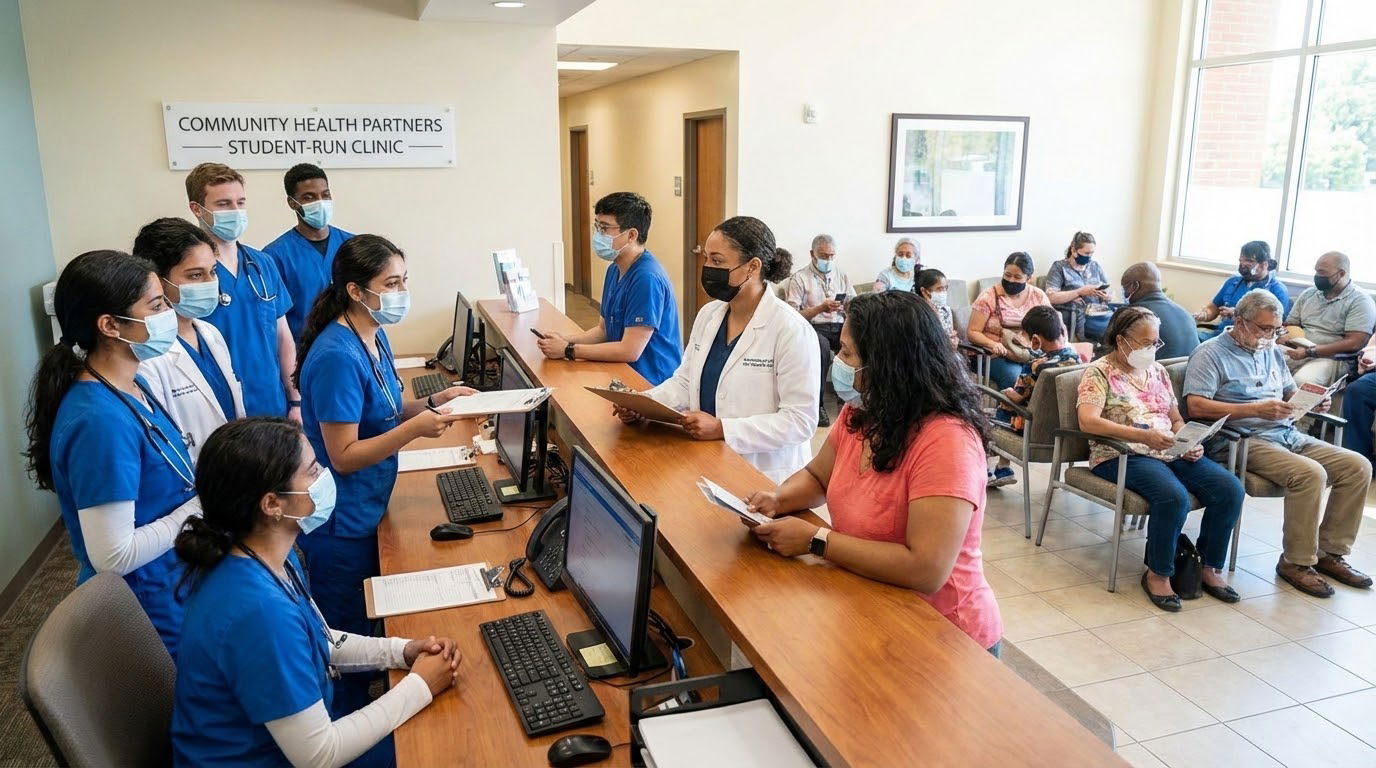
Most applicants describe SRFCs in vague terms: “I volunteered at a student clinic serving the underserved.” Admissions committees and future program directors read that line thousands of times.
The leverage comes from understanding what is structurally unique about SRFCs and then positioning yourself to sit at those leverage points.
Core distinctives:
Student ownership of operations
- Scheduling
- Workflow design
- EMR templates and documentation norms
- Referral pathways
- Follow‑up systems
Built‑in longitudinal potential
- Same students staffing clinic on a rotating schedule
- Patients who return for chronic disease management: diabetes, hypertension, depression, chronic pain
- Opportunities for panel‑style follow‑up even in a volunteer setting
Early exposure to systems issues
- Pharmacy access and 340B or discount programs
- Insurance enrollment / Medicaid navigation
- Social determinants of health (transportation, food insecurity, housing)
Direct leadership lanes
- Clinic coordinator / director roles
- Quality improvement (QI) projects with real patient‑level outcomes
- Interprofessional collaboration (e.g., med, NP, PA, pharmacy, social work students)
When you grasp that SRFCs are micro health‑systems, you can stop acting like an extra set of hands and instead position yourself as a junior systems designer and steward of continuity of care.
2. Entering as a Premed: How to Start Strategically
Premeds often underestimate how much they can do in SRFCs because they feel “too early” or “underqualified.” That mindset leads to under‑utilization of a very powerful environment.
Step 1: Choose the Right Clinic Environment
When evaluating SRFC options (or similar community clinics) consider:
Governance structure
- Is there a formal student leadership board?
- Are there clear roles such as “Operations Lead,” “EMR Lead,” “Patient Navigation Lead,” “QI Lead”?
Patient population
- Chronic disease heavy vs. mainly acute episodic care
- Language needs (Spanish, Mandarin, Arabic, etc.)
- Urban vs. rural resource constraints
Faculty engagement level
- Are attendings physically present and interested in teaching?
- Are they comfortable letting students run portions of the visit within scope?
If you have a choice, favor clinics with:
- A defined leadership hierarchy
- Chronic disease follow‑up potential
- Robust pre‑med participation (or the desire to build it)
Step 2: Position Yourself Intentionally in the First 3–6 Months
Your initial goals are not glamorous. They are observational and process‑oriented:
Focus on:
Mastering front‑line roles
- Check‑in, vitals, rooming, documentation support
- Confirming medication lists and allergies accurately
- Learning the EMR or documentation system meticulously
Studying workflow frictions
- Where are patients waiting unnecessarily?
- Where do charts get lost or incomplete?
- What confuses new volunteers repeatedly?
Building trust with leadership
- Show up reliably to scheduled shifts
- Volunteer for less popular shifts (late evenings, weekends)
- Ask process‑focused questions: “How do we track no‑shows?” rather than “How can I see more exciting cases?”
The paradox: the more competent you become at basic operations, the faster you will be invited into leadership and quality‑focused roles.
Step 3: Set a Longitudinal Intention Early
Even as a premed, you can pursue longitudinal engagement if the clinic structure allows it:
- Commit to a minimum of 9–12 months of involvement.
- Try to secure a stable weekly or biweekly shift.
- Ask leadership: “Is there a way we track returning patients, and can I be involved in improving follow‑up?”
You are quietly positioning yourself for continuity‑of‑care stories that almost no other premed can tell persuasively.
3. Transitioning in Medical School: From Volunteer to Clinical Leader
Now the stakes rise. You are no longer just helping the clinic run. You are part of the clinical learning environment, with real educational and evaluative implications.
Layer 1: Clinical Exposure Anchored in Responsibility
In many SRFCs, MS1s and MS2s serve as:
- Intake / history students
- Physical exam students
- Student clinicians under supervision
Rather than treating this as extra practice for OSCEs, approach it as:
- Early team‑based patient ownership within scope
- A testing ground for your clinical reasoning narrative
- A socially complex environment where patient trust is harder to earn (due to language, financial, or immigration issues)
Ask attendings proactively:
- “What specific part of the encounter would be most helpful for me to take the lead on today?”
- “Can I present my assessment and plan, recognizing you will refine it?”
You are not just collecting “patient contact hours.” You are collecting decision‑making reps under supervision.
Layer 2: Structured Leadership Roles That Matter
Typical SRFC leadership positions for medical students:
- Clinic Director / Co‑Director
- Operations Coordinator
- Volunteer Coordinator
- Referrals / Social Services Lead
- QI / Research Lead
- Education / Training Lead
Not all leadership is equal from a developmental standpoint. The highest yield roles usually involve:
Longitudinal systems oversight
- Managing the clinic schedule and capacity
- Designing or revising intake forms to capture better clinical data
- Creating follow‑up protocols for chronic disease
Cross‑functional responsibility
- Interfacing with:
- Faculty supervisors
- Pharmacy / medication programs
- Social work or community partners
- Institutional leadership (e.g., medical school administration)
- Interfacing with:
Measurable outcomes
- Reduced no‑show rates
- Improved A1c among enrolled diabetics
- Increased vaccination rates
- Decreased time from positive screening (e.g., depression) to treatment initiation
When you consider a leadership position, ask the current role‑holder:
- “How do you measure success in this role?”
- “What specific systems have you changed in the last year?”
If they cannot answer clearly, either:
- Plan to redefine the role with measurable goals, or
- Consider a different position with clearer impact potential.
4. Building True Longitudinal Care in a Volunteer Clinic

Longitudinal care is the single most under‑leveraged aspect of SRFCs.
Most students experience visits as isolated snapshots: “New patient with uncontrolled hypertension. We started medication.” Then they never see that patient again.
To turn SRFC work into continuity‑of‑care experience, you need structure.
Strategy 1: Patient Panel or Micro‑Panel Concept
Even in a volunteer clinic, you can establish a “micro‑panel” model:
Identify patients with:
- Diabetes
- Hypertension
- Asthma/COPD
- Depression or anxiety
- Stable but chronic pain
Work with clinic leadership to:
- Tag these patients in the EMR or tracking sheet.
- Create a student continuity list where each patient is “assigned” to a student as a longitudinal care partner (within supervision boundaries).
Your role is not to be the physician. It is to be:
- The narrative memory of the patient’s course.
- The logistics navigator ensuring labs, follow‑ups, and referrals occur.
- The communication bridge between visits.
Concrete actions:
- Call patients before and after visits to confirm meds and answer logistical questions.
- Track key metrics (A1c, BP readings, PHQ‑9 scores) over time.
- Document your involvement systematically so others can see the timeline.
Strategy 2: Follow‑Up Protocols You Can Own
Many SRFCs fail at follow‑up because no one “owns” longitudinal tasks.
You can propose and run:
Lab Result Follow‑Up Protocol
- Create a standardized process:
- How quickly are labs reviewed?
- Who calls patients with results?
- How is patient understanding documented?
- As a student leader, you can be the primary caller under pre‑specified scripts and supervision.
- Create a standardized process:
Missed Appointment Workflow
- Develop a 2‑ or 3‑step outreach process:
- Phone call within 48 hours.
- Second attempt via text or email.
- Outreach letter for chronic issue patients.
- Develop a 2‑ or 3‑step outreach process:
Chronic Disease Registry
- Simple spreadsheet or EMR report:
- List of all patients with A1c > 9 or BP > 160/100.
- Date of last visit.
- Date of next scheduled visit.
- Student point person.
- Simple spreadsheet or EMR report:
This gives you very concrete data for personal narratives:
“Over 9 months, I coordinated follow‑up for 27 patients with uncontrolled diabetes, resulting in a mean A1c reduction from 10.2 to 8.7 among those with at least 2 follow‑ups.”
Strategy 3: Continuity Narratives for Applications
When it comes time for personal statements or interviews, you do not want generic stories. You want a tightly constructed continuity vignette.
Structure your narrative:
Initial encounter
- Present a patient with a clear clinical and social complexity.
- Anchor in specific metrics: BP, A1c, PHQ‑9.
Longitudinal involvement
- Describe concrete touchpoints:
- Multiple visits
- Phone follow‑ups
- Coordination with social work or pharmacy
- Emphasize how your role evolved as you recognized systemic gaps.
- Describe concrete touchpoints:
Outcome and reflection
- Show real results (improved numbers, stabilized condition, successful referral).
- Reflect on:
- Systems issues
- Trust building
- How this shaped your sense of physician identity
The best continuity stories in SRFCs usually combine:
- Chronic disease management
- Social determinants of health
- System improvement
- Personal growth in clinical judgment and humility
5. Leadership That Counts: From “Position Holder” to “System Architect”
Many students list impressive‑sounding titles that, under scrutiny, amount to little actual change. Admissions committees and program directors now probe for evidence of leadership, not just positions.
Let us separate nominal from substantive leadership.
Nominal Leadership Indicators
- Title such as “Co‑Director,” “Volunteer Coordinator,” “Outreach Chair”
- Monthly meetings with vague agendas
- Tasks concentrated on:
- Emails
- Scheduling
- Reminders
Nominal roles are not worthless, but they are only explicitly impressive if you transform them into system architect roles.
System Architect Leadership Indicators
These are the questions to ask yourself:
Did I design or redesign a process?
- Example:
- Created a standardized intake form that added depression and food insecurity screening, with a defined response pathway.
- Example:
Can I show metrics that changed?
- Example:
- Reduced average check‑in to rooming time from 42 to 24 minutes.
- Increased influenza vaccination rate from 18% to 52% in the eligible population.
- Example:
Did my work outlast my tenure?
- Example:
- Developed a training manual and orientation curriculum for new volunteers.
- Implemented an EMR template that is still in use after leadership turnover.
- Example:
Did I manage up and across, not just down?
- Example:
- Negotiated with the hospital pharmacy for low‑cost generics.
- Presented annual outcomes to medical school leadership or funders.
- Example:
Now, let us look at what this can look like in practice.
Example: Operations Coordinator Turned Quality Lead
Initial job description:
- Schedule volunteers
- Confirm attending coverage
- Maintain simple waitlist
Transformed role:
- Mapped entire clinic workflow with time stamps.
- Identified “black holes” where charts stalled.
- Piloted:
- Pre‑visit chart prep
- Mid‑clinic huddles
- Post‑clinic debrief tracking “near misses”
Outcome:
- New triage system that prioritized unstable vitals and high‑risk symptoms.
- Documented reduction in patient walkouts and incomplete visits.
This is the sort of leadership story that will support strong MSPE language like:
“Demonstrated exceptional initiative in re‑engineering our student‑run clinic workflow, leading to measurable improvements in patient throughput and safety.”
6. Integrating Research and QI Without Losing the Soul of the Clinic
Some SRFCs drift into becoming research engines that happen to see patients. Others reject data collection entirely and miss opportunities for improvement.
The middle path is deliberate, ethical, and improves care.
Distinguish QI from Research Early
Quality Improvement (QI)
- Aim: Improve local processes and outcomes.
- Usually exempt or expedited IRB.
- Examples:
- Increasing colon cancer screening rates.
- Reducing medication errors in documentation.
Research
- Aim: Generate generalizable knowledge.
- Requires full IRB and consent process if beyond de‑identified retrospective work.
- Examples:
- Studying impact of SRFC involvement on student empathy.
- Multi‑site comparison of chronic disease outcomes in student clinics.
For premeds and early medical students, QI projects are usually higher yield and more embedded in leadership roles.
Designing a High‑Yield QI Project in an SRFC
Pick a focus tightly linked to clinic mission
- Chronic disease control
- Preventive care rates
- No‑show rates
- Language access quality
Define a simple, trackable outcome
- Example: percentage of eligible patients who receive depression screening and have documented follow‑up plan.
Use PDSA (Plan‑Do‑Study‑Act) cycles
- Plan: Introduce PHQ‑2 at intake.
- Do: Implement for 4 clinic nights.
- Study: Review completion rates and follow‑up documentation.
- Act: Revise form placement and volunteer training based on observed barriers.
Embed the QI project into leadership structure
- Assign clear roles:
- Data tracking
- Volunteer training
- Patient education materials
- Assign clear roles:
Document results succinctly
- Pre‑intervention: 18% documented depression screens.
- Post‑intervention (3 months): 71%, with 85% of positives receiving a follow‑up plan.
This becomes:
- Strong CV/QI entry
- Concrete interview discussion
- Foundation for later research if appropriate
7. Professional Identity Formation and Boundaries

There is a risk in SRFCs that students over‑identify with physician roles or experience boundary confusion. You want to grow into professional identity, not role‑play it prematurely.
Key issues:
Scope of practice
- Be crystal clear:
- Premeds: Never independently give medical advice. You can explain logistics, resources, and attendings’ plans.
- Pre‑clinical med students: Work under direct supervision, frame everything as “Here is what we are thinking; the physician will confirm.”
- Clinical med students: Present plans but defer final decisions to attending.
- Be crystal clear:
Emotional load and burnout
- SRFC patients often carry heavy burdens: unstable housing, trauma, financial insecurity.
- Build in:
- Post‑clinic debriefs with faculty
- Peer discussion spaces focused on processing, not venting
- Watch for:
- Compassion fatigue
- “Savior” narratives that overstate your role
Ethical complexity
- Limited resources force choices:
- Which medications can patients actually afford?
- Which referrals are realistically accessible?
- Use attendings and social workers as thought partners for these decisions.
- Reflect explicitly:
- What would I like to offer?
- What can we truly provide?
- How do I communicate those constraints honestly?
- Limited resources force choices:
Professional identity in SRFCs forms at the intersection of idealism and constraint. That tension, when acknowledged, matures your understanding of medicine more than almost any classroom exercise.
8. Translating SRFC Experience into Applications and Interviews
Having done all this work, you must convert it into language that admissions committees and program directors instantly understand as substantive.
For Premed Applications (MD/DO)
On AMCAS/AACOMAS “Most Meaningful Experiences”:
- Emphasize:
- Longitudinal involvement (months/years, not shifts)
- Specific leadership roles with outcomes
- Continuity stories with 1–2 named conditions (e.g., “hypertension and depression care coordination”)
Use concrete sentences such as:
- “Over two years, I coordinated follow‑up for 40+ patients at our student‑run clinic, leading a project that reduced missed lab result follow‑ups from 23% to 5%.”
- “I co‑developed a workflow integrating PHQ‑2 depression screening into intake, which increased screening rates from 10% to 68% over 6 months.”
For Medical School/MSPE and Residency Applications
Focus on:
Systems thinking:
- “Designed and implemented a diabetes registry for our SRFC, allowing risk‑stratified follow‑up and enabling a pilot A1c improvement project.”
Teaching and mentorship:
- “Created an orientation curriculum for new student volunteers, including checklists, case‑based teaching, and safety protocols.”
Clinical judgment (within level):
- “Under attending supervision, led initial evaluations and presentations for patients with uncontrolled chronic conditions, refining differential diagnoses and management plans with preceptors.”
In interviews, be prepared for follow‑ups:
- “What specifically did you change in the clinic?”
- “How did you know your intervention worked?”
- “What was one unintended consequence of a change you implemented?”
- “Tell me about a time you recognized the limit of what your clinic could provide, and how you handled that with a patient.”
If you can answer those with specifics, your SRFC experience will stand out immediately from generic volunteering.
FAQ (Exactly 6 Questions)
1. As a premed, will admissions committees really value student‑run clinic experience if I am not doing “real” clinical work yet?
Yes, if it is structured and longitudinal. They do not expect you to diagnose or prescribe. They look for:
- Consistent engagement over time
- Concrete responsibilities (intake, navigation, follow‑up calls)
- Evidence of understanding systems barriers and patient complexity
If you can show that you helped the clinic function and improved patient follow‑up, that is far more impressive than passive shadowing.
2. How many hours at a student‑run clinic are “enough” for medical school or residency applications?
There is no universal threshold, but patterns matter more than totals. A common high‑yield pattern:
- Premed: ~2–4 hours per week for 9–18 months.
- Med student: 2–3 clinic sessions per month plus a leadership role for at least one year.
Commitment depth (leadership, continuity, QI) usually matters more than simply accumulating 200–300 hours.
3. What if my clinic is disorganized and has no obvious way to create longitudinal care or QI projects?
That scenario is more common than students admit. Start by:
- Mapping current processes (check‑in, documentation, follow‑up)
- Identifying one small, high‑impact gap (e.g., lost phone numbers, poor lab tracking)
- Proposing a micro‑intervention with simple measures to monitor change
You do not need a perfectly organized clinic to lead. In fact, messy systems often offer the best opportunities for visible, meaningful improvement.
4. How do I avoid overstepping or misrepresenting my role when I talk about SRFC experiences?
Use precise language:
- “I coordinated,” “I tracked,” “I assisted with,” “I presented under supervision”
Avoid: - “I managed this patient’s hypertension” (say “I helped coordinate their hypertension care within our clinic under attending supervision”).
In interviews, explicitly acknowledge the attending’s role in final decisions. Showing respect for scope and hierarchy signals professionalism.
5. Is it better to be a clinic leader at a student‑run free clinic or to participate in other types of clinical research instead?
They serve different purposes. SRFC leadership develops:
- Systems thinking
- Operational leadership
- Hands‑on patient interaction and continuity
Clinical research develops: - Hypothesis‑driven thinking
- Data analysis and scholarly output
Highly competitive applicants often have both, but if you must choose, select the one that better aligns with your authentic interests and that you can commit to longitudinally enough to show depth, not just a title.
6. How can I continue leveraging SRFC experience after I leave the clinic or graduate?
You carry forward:
- Specific stories of system redesign and patient continuity
- Skills in workflow mapping, QI methodologies, and interprofessional coordination
- A framework for thinking about access and equity issues
As you progress to residency and beyond, these translate directly into quality committees, population health initiatives, and leadership tracks. For now, ensure you have clear documentation (presentations, protocols, outcome summaries) so you can reference and build on your work even after formal involvement ends.
With a deliberate approach to leadership and continuity in student‑run free clinics, you are building more than an application bullet point. You are constructing an early version of how you will function as a physician inside complex systems, with real patients who depend on your follow‑through. Once those foundations are stable, you will be ready to tackle more advanced arenas of clinical responsibility—sub‑internships, chief roles, and system‑level projects that shape care at scale. But that is a next chapter in your trajectory.