Roughly one in five Medicare patients returns to the hospital within 30 days of discharge. That number has barely moved in a decade, despite a thousand quality improvement initiatives. The reason is simple: we keep treating discharge planning as an administrative checkbox instead of a clinical skill with dramatically different execution depending on where you train.
Let me break this down specifically.
This article is for educational purposes only. It is not financial advice, not legal advice, and not tax advice. Figures vary by individual circumstances, so consult a qualified professional before acting.
The Data-Driven Reality: Why Discharge Planning Differs
Here is the uncomfortable data. Academic medical centers (AMCs) and community hospitals do not operate at different scales, they operate with fundamentally different discharge philosophies. Studies from the Agency for Healthcare Research and Quality (AHRQ) consistently show that 30-day readmission rates hover between 15% and 22% nationally, but the drivers are setting-specific.
In academic centers, the average length of stay (LOS) runs roughly 5.8 days for common conditions like pneumonia or CHF exacerbation. Community hospitals? Closer to 4.2 days. That 1.6-day difference is not just about efficiency, it correlates directly with discharge complexity. Shorter LOS in community settings often means patients leave with less inpatient optimization and rely more heavily on outpatient follow-up within 48 hours.
The premise I want you to internalize: Academic centers prioritize "safety net" capabilities. They assume the patient has complex social determinants, limited insurance, and needs extensive coordination before they can safely leave. Community centers prioritize "efficiency" and "local resource integration." They assume the patient has a primary care doctor, family nearby, and will follow up locally within the week.
The core tension is this: comprehensive care versus the reality of limited resources. Every discharge decision is a negotiation between what the patient actually needs and what the system can provide in a 24-hour window.
The Academic Ecosystem: The 'Safety Net' Model
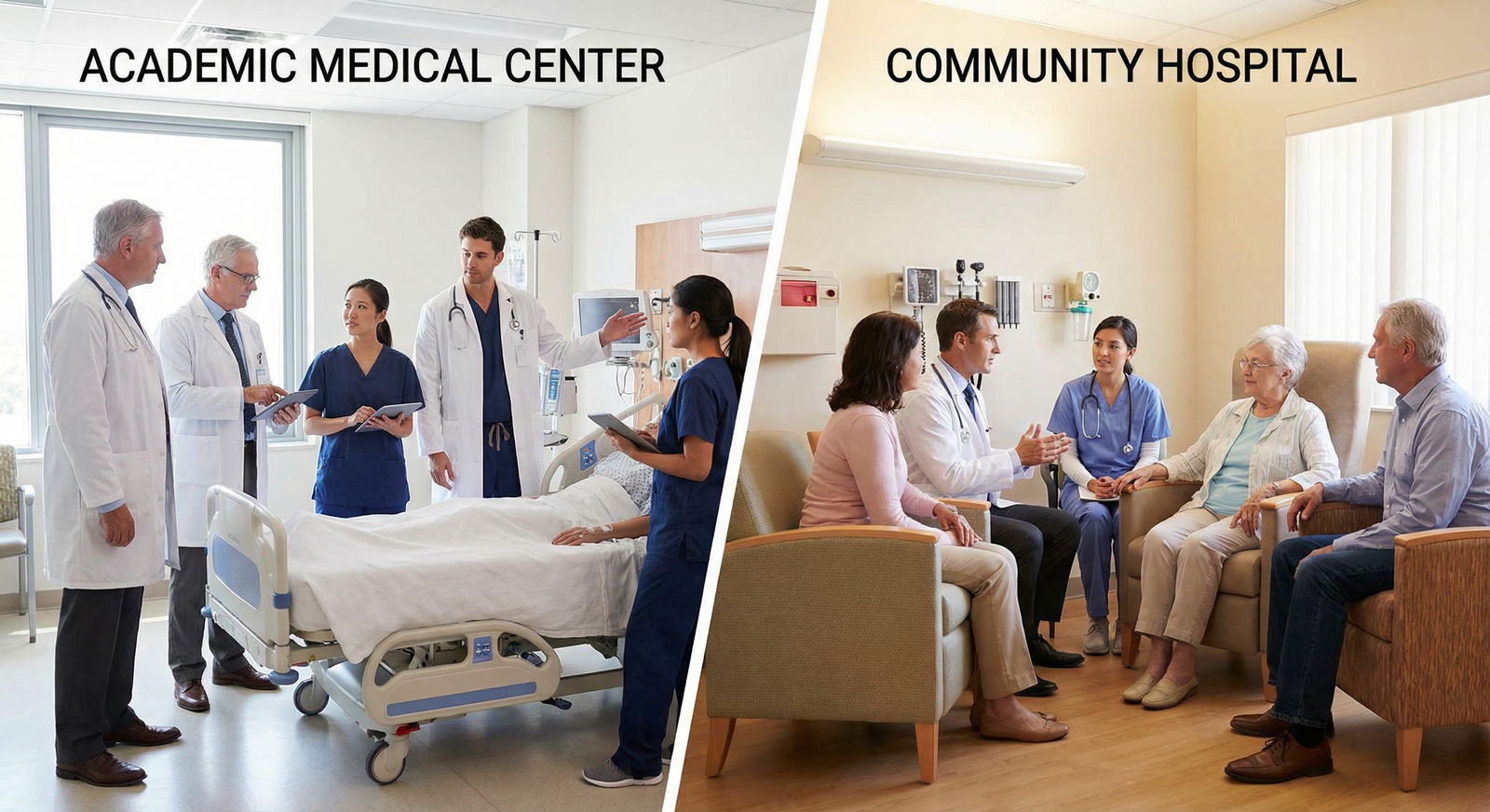
Academic centers run discharge planning like a relay race with too many runners. Let me walk you through the actual hierarchy.
The attending physician signs off on the plan. The resident writes the orders. The social worker coordinates logistics. The case manager handles insurance authorizations. The pharmacist reviews medications. The nutritionist weighs in on dietary needs. That is six professional touchpoints before the patient hits the elevator.
The "Discharge Planner" or "Case Manager" in an academic setting functions as a gatekeeper, and I mean that literally. They screen every admission for social determinants of health: Is the patient homeless? Do they have working heat at home? Can they afford their medications? Will they qualify for skilled nursing facility coverage under Medicare? If any answer raises concern, the case manager flags the team and discharge stalls until a safe plan exists.
This is where the "teaching moment" gets real. Residents write the discharge summary in academic settings, and I will tell you why that matters. The summary is typically more detailed than its community counterpart because residents are documenting for two audiences simultaneously: the attending who will review it, and their own learning. A first-year resident writing a CHF discharge summary is forced to think through every medication reconciliation, every follow-up appointment, every weight-monitoring parameter. That repetition builds clinical judgment.
The ancillary services available in academic settings border on luxurious compared to community. Pharmacy consults are standard, a clinical pharmacist reviews every discharge medication list for interactions, dosing errors, and cost barriers. Nutritionists round on complex patients. Transitional care nurses call patients within 48 hours of discharge. These resources exist because academic centers have graduate medical education (GME) funding and research infrastructure that community hospitals structurally lack.
The downside? All this coordination takes time. Discharges at AMCs routinely get pushed to late afternoon or next-morning because the team is waiting on a social work assessment, a home health agency confirmation, or a specialist sign-off.
The Community Model: The Physician-Led Approach
Community hospitals operate on a fundamentally different premise: the physician is the case manager. In solo or small group practices, which still dominate community settings, the attending physician handles discharge planning from admission to follow-up. There is no resident to write the orders. No fellow to coordinate. Just the doctor, the bedside nurse, and sometimes a part-time social worker covering the entire hospital.
Here is what that actually looks like at 2 PM on a Friday.
The community physician has three patients ready for discharge. They need to: call the primary care doctor for a handoff, write the discharge summary themselves, arrange transport (often relying on family members because hospital transport is not staffed), confirm the patient understands their medications, and document follow-up. The social worker, if available, might handle the skilled nursing facility placement. But "available" is the operative word, many critical access hospitals share one social worker across the entire facility.
The constraints are real. Limited social work staff. Reliance on family for transportation. Pressure to discharge quickly to free beds for the next admission. Community hospitals operate on razor-thin margins (often 1-3% operating margins), and every empty bed represents lost revenue.
But here is the nuance the academic folks consistently miss: community physicians often know the local nursing homes and rehab facilities personally. They have the cell phone number of the medical director at every SNF in a 30-mile radius. That kind of "warm handoff" creates a different continuity of care, informal, relationship-based, and frequently more reliable than a faxed discharge summary to a facility the discharging physician has never visited.
Deconstructing the Roles: Who Does What?
This is where the rubber meets the road. Let me compare the actual job descriptions across settings.
Social Workers (SW)
In academics, social workers are proactive and omnipresent. Most academic floors have a dedicated SW with a caseload of 15-20 patients. They attend rounds. They screen for housing instability, food insecurity, and insurance gaps. They coordinate with skilled nursing facilities, home health agencies, and sometimes homeless shelters. The SW is often the first person to flag a discharge barrier.
In community settings, social workers are reactive and scarce. A typical community hospital might have one or two SWs covering the entire facility. They intervene when the physician requests help, usually for placement issues or complex insurance authorization. Day-to-day discharge coordination falls on the bedside nurse and the physician.
The ratio difference is stark. Academic centers often run a 1:1 SW-to-floor ratio. Community centers frequently operate at 1:10 or worse.
Case Managers
Academic centers have dedicated case managers assigned to specific floors or service lines. A medicine floor has a medicine case manager. A cardiology floor has a cardiology case manager. They know the DRGs, the expected LOS, and the discharge milestones for their patients intimately.
Community centers centralize case management. One or two case managers handle every admission across the hospital. They review charts remotely, flag potential discharge delays, and assist the physician, but they are not physically present on the floor.
Pharmacists
This one will annoy community docs, but it is true: ward pharmacists are a luxury most community hospitals cannot afford. In academic settings, clinical pharmacists round with the team, review every medication list for appropriateness, check renal dosing, flag duplications, and counsel patients on new prescriptions before discharge.
In community settings, pharmacists are confined to the basement, the "pharmacy." They verify orders and dispense medications, but they do not round. They do not do medication reconciliation at the bedside. The community physician handles that, sometimes well, sometimes not. I have personally seen community physicians miss a metformin dose adjustment in a patient with acute kidney injury simply because nobody else was reviewing the med list with fresh eyes.
Discharge Summary Authorship
This is the simplest distinction. Academic = Resident (with attending attestation). Community = Attending (with perhaps a hospitalist or APP assist).
The academic discharge summary is typically longer, more detailed, and structured around the resident's learning objectives. The community discharge summary is typically shorter, more practical, and structured around the immediate handoff to the receiving provider.
Neither is "better" in absolute terms. But residents coming out of academic training often struggle with efficiency in documentation. Community physicians often struggle with the comprehensiveness expected by academic attendings when their patients transfer in. There is a documentation culture gap that nobody talks about explicitly but everyone feels.
The Future of Handoffs: Value-Based Care and Telehealth
Here is where I get slightly opinionated. The discharge planning model we have been running for 30 years is dying. Not slowly, it is actively dying under the weight of value-based care contracts and readmission penalties.
The Hospital Readmissions Reduction Program (HRRP) penalizes hospitals with excess 30-day readmissions for CHF, pneumonia, COPD, MI, hip/knee surgery, and CABG. Penalties can hit 3% of Medicare reimbursement. That is not a rounding error for community hospitals operating on 2% margins.
This pressure is forcing both settings to evolve. Academic centers are adopting community-style efficiency, morning discharges, streamlined SW processes, standardized discharge checklists. Community centers are adopting academic-style safety nets, investing in pharmacists, hiring dedicated case managers, building transitional care programs.
Telehealth is the disruptor that will reshape the community model entirely. Remote patient monitoring (RPM) post-discharge, daily weight checks, blood pressure monitoring, symptom questionnaires, allows community physicians to catch decompensation before it becomes a readmission. A CHF patient goes home with a Bluetooth scale and a tablet. The data streams to a nurse navigator who calls the patient if their weight spikes 3 pounds in 24 hours. That single intervention can prevent a $14,000 admission.
The hybrid model is inevitable. Academic centers will keep their SW and pharmacy depth but adopt faster discharge pathways. Community centers will keep their local relationships but invest in remote monitoring and care coordination. The distinction that defined residency training for a generation is blurring, and that is probably good for patients.
But one thing cannot be hybridized: the discharge checklist itself. Regardless of setting, every patient needs medication reconciliation, follow-up appointments scheduled before discharge, patient education in their primary language, and a clear plan for what to do if symptoms worsen. Standardization saves lives. Personalization of relationships saves systems. You need both.
The medical students and residents reading this should understand one thing: your discharge planning habits right now are shaped almost entirely by your training environment. If you train at an academic center, you will be shocked by how unsupported you feel in a community job. If you train in a community setting, you will be shocked by how inefficient academic workflows feel. Neither reaction is wrong. Both are predictable. The future of safe discharges belongs to physicians who can operate fluently in both models.
Key Takeaways
- In Academic settings, discharge planning is a team sport involving residents, attendings, and dedicated social workers; in Community settings, it is often a solo effort led by the physician.
- Academic centers provide a broader safety net for complex social determinants of health, while community centers excel at local resource integration and warm handoffs.
- The documentation and complexity of the discharge summary are typically higher in academic settings due to the teaching nature of the environment.