
Community vs. Academic Programs: What Future Healthcare Professionals Should Consider
Choosing the right residency program is one of the most defining decisions in any healthcare career. For medical students preparing for the Match, this often means deciding between community-based and academic medical centers. Both settings can provide excellent training—but they differ in culture, patient mix, research expectations, and career pathways.
Understanding these differences is essential if you want to align your residency training with your long-term goals in Clinical Practice, Community Health, or Academic Medicine.
This guide breaks down the key distinctions between community and academic residency programs, explores how they affect your day-to-day experience and future opportunities, and offers practical tips to help you decide which path is right for you.
Defining Community vs. Academic Residency Programs
Before comparing the pros and cons, it’s important to clarify what people actually mean when they say “community program” and “academic program.” In reality, programs exist along a spectrum, but these broad categories are still useful for thinking about fit.
What Are Community Residency Programs?
Community residency programs are typically based at non-university-affiliated hospitals or health systems, often in smaller cities or suburban/rural areas. Some may be loosely affiliated with a medical school but do not function as large academic medical centers.
Common features of community programs:
Smaller training environment
- Fewer residents per class and often fewer fellowships on site
- More direct contact with attending physicians
- Less competition among trainees for procedures and clinical exposure
Strong focus on primary care and generalist training
- Many are built around Family Medicine, Internal Medicine, Pediatrics, Psychiatry, and OB/Gyn
- Emphasis on broad, comprehensive care rather than narrow subspecialization
- Ideal for those drawn to Community Health, rural practice, or underserved urban populations
High level of hands-on responsibility
- Residents often function as primary clinicians for their patients
- Earlier autonomy in decision making and patient management
- Frequent continuity with the same patients and families over time
Flexibility and responsiveness
- Smaller leadership structure can adapt schedules, rotations, or curricula more quickly
- Resident feedback may translate into changes sooner than in large institutions
Local community integration
- Strong relationships with local clinics, FQHCs (Federally Qualified Health Centers), and community organizations
- Direct involvement in public health initiatives, outreach, and longitudinal community projects
Community programs can be especially appealing if you envision future Healthcare Careers rooted in long-term patient relationships and local impact.
What Are Academic Residency Programs?
Academic residency programs are anchored in university-affiliated teaching hospitals or large tertiary/quaternary medical centers. They sit at the intersection of clinical care, research, and education.
Common features of academic programs:
Large, complex institutions
- High patient volume with tertiary and quaternary referrals
- Exposure to rare diseases, advanced procedures, and cutting-edge technologies
- Multiple residency programs and fellowships under one umbrella
Strong emphasis on research and scholarship
- Structured opportunities in clinical, translational, or basic science research
- Access to research mentors, statisticians, and institutional review boards
- Encouragement or requirement to produce posters, presentations, and publications
Wide range of specialties and subspecialties
- Robust fellowships (Cardiology, GI, Heme/Onc, Critical Care, etc.)
- Direct exposure to subspecialists and subspecialty clinics early in training
- Clear pipeline into Academic Medicine and subspecialty careers
Highly structured curriculum
- Formal didactics, grand rounds, journal clubs, simulation labs
- Milestone-based assessments, frequent evaluations, and standardized competencies
- Often more defined tracks (e.g., clinician-educator, research, global health)
For students interested in subspecialty training, health policy leadership, or academic faculty roles, academic programs often provide a strategic training environment.
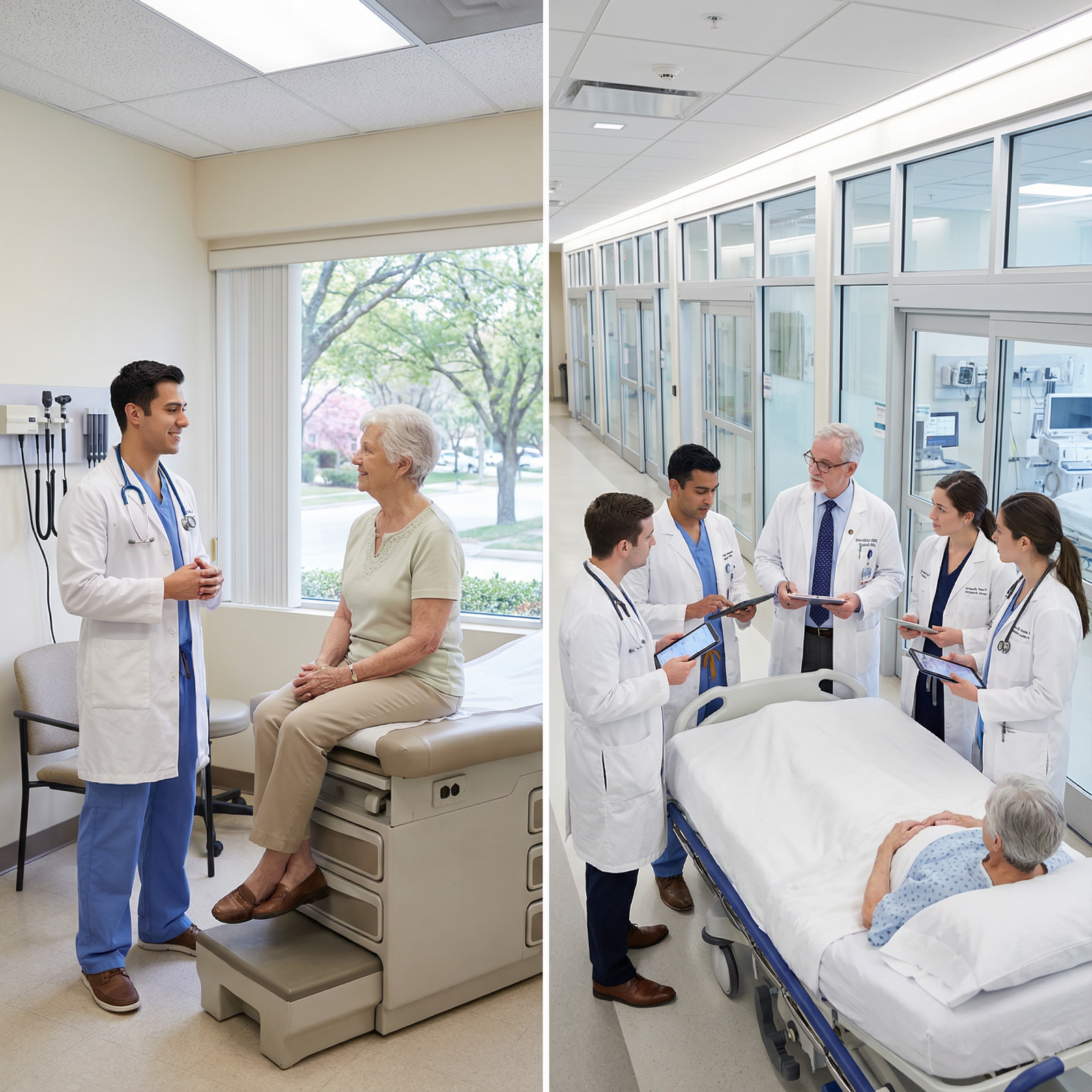
Key Factors to Consider When Choosing Between Community and Academic Programs
Your decision should be guided by more than reputation or location. Think systematically about how each training environment will shape your future.
1. Career Goals: Where Do You See Yourself in 10 Years?
Your long-term vision is the most important lens through which to view community vs. academic programs.
If your goals are community-focused
Consider leaning toward a community program if you imagine yourself:
- Practicing broad-scope Family Medicine, Internal Medicine, or Pediatrics
- Serving in rural or underserved urban areas
- Building long-term relationships with a panel of patients and families
- Leading quality improvement or population-health initiatives at a local level
- Becoming a medical director of a clinic, FQHC, or community hospital
Community programs often emphasize:
- Breadth of clinical exposure rather than subspecialty depth
- Practical, “real-world” skills: managing resource limitations, coordinating care, and working with social services
- Community Health projects that connect you to local public health departments or nonprofit organizations
If your goals are specialization or Academic Medicine
An academic program may be a better match if you envision:
- Pursuing a competitive fellowship (e.g., Cardiology, GI, Heme/Onc, Neonatology, Surgical subspecialties)
- Building a career in research, clinical trials, or translational science
- Becoming a clinician-educator or residency/fellowship program director
- Working in large academic centers or tertiary referral hospitals
- Leading guideline development, national QI collaboratives, or policy work
Academic programs typically provide:
- Easier access to mentors who are national leaders in their fields
- Structured research time and support for abstracts, posters, and manuscripts
- Visibility through conferences, grand rounds, and institutional networks
Action step:
Before you rank programs, write a brief “future self” paragraph: where you want to practice, what your ideal clinical week looks like, and whether you see research, teaching, or Community Health leadership as core parts of your identity. Use that as a filter during interviews and ranking.
2. Work–Life Balance and Residency Culture
Work–life balance can vary widely across both community and academic programs, but there are some trends worth considering.
Typical patterns in community programs
- Often smaller call pools but sometimes heavier service needs if staffing is lean
- May offer more predictable schedules in outpatient-heavy specialties
- Culture may emphasize wellness, family life, and staying in the local community long-term
- Less pressure to publish or constantly be “building your CV” outside of clinical hours
Residents sometimes report that community programs feel more like a “family,” with closer relationships among residents and attendings—which can be protective in a demanding training environment.
Typical patterns in academic programs
- Rotations can be intense, especially at large tertiary care centers with high-acuity patients
- Frequent exposure to overnight calls, ICUs, and complex inpatient services
- Additional expectations for research, teaching, or scholarly output can compete with limited free time
- However, many academic centers have robust wellness initiatives, protected time for mental health appointments, and system-level support structures
Action step:
On interview day—whether virtual or in person—ask current residents direct, specific questions:
- “How often do you leave on time on non-call days?”
- “What changes has the program made recently in response to resident feedback?”
- “How does the program handle coverage when residents are ill or burnt out?”
Listen to how they answer, not just what they say.
3. Learning Environment and Educational Resources
You’ll spend thousands of hours in clinical and educational settings during residency. The learning culture matters.
Community program learning environment
- High-volume, hands-on training:
- You are often the primary decision-maker with close attending backup
- You may gain comfort quickly with common procedures (e.g., central lines, joint injections, office procedures)
- Mentorship in a small community:
- Easy access to attendings who know you well and can offer personalized guidance
- Graduates often stay local, building a strong regional network
- Less subspecialty saturation:
- Generalists may manage conditions that would automatically be referred in academic centers
- This can build confidence and breadth of practice, especially for generalist careers
Academic program learning environment
- Extensive formal teaching:
- Daily or weekly noon conferences, grand rounds, morbidity & mortality (M&M) conferences
- Access to simulation labs, standardized patient experiences, and advanced diagnostic tools
- Rich multidisciplinary exposure:
- Work closely with pharmacists, social workers, case managers, and multiple specialty consult teams
- Frequent exposure to complex diagnostic dilemmas and cutting-edge therapies
- Research and academic skill-building:
- Opportunities to learn study design, critical appraisal, and biostatistics
- Mentored QI projects that can lead to regional or national presentations
Action step:
Review program websites and ask for sample schedules and conference calendars. Notice:
- How often are teaching conferences protected?
- Is there a structured curriculum in evidence-based medicine, QI, and leadership?
- Are there tracks that align with your interests (global health, medical education, health equity)?
4. Future Job Prospects and Networking
Both community and academic programs can lead to strong career outcomes, but the types of networks they generate can differ.
Community program advantages
- Local and regional job pipelines
- Many community hospitals and clinics prefer to hire graduates who trained locally and understand the patient population
- Networking with local healthcare leaders, hospital administrators, and clinic directors often begins in residency
- Employers value broad skill sets
- Graduates are often seen as “ready to practice” generalists
- Rural and underserved areas especially appreciate residents trained in community settings
Academic program advantages
- Nationally recognized institutional names
- Can open doors for fellowships or competitive jobs in academic centers
- Alumni networks often span multiple regions and countries
- Direct connections to fellowship directors and subspecialists
- Subspecialty mentorship and letters from well-known faculty carry weight in the fellowship Match
- Opportunities to present research at national meetings and build a recognizable CV
Action step:
Look at each program’s graduate outcomes:
- Where do alumni practice (geographically and by practice type)?
- What percentage go into fellowship vs. primary care practice?
- How many hold leadership positions in hospital systems or Academic Medicine?
5. Financial and Practical Considerations
While residency salaries at accredited programs within a region are usually similar, other financial and logistical factors can differ.
Financial realities to examine
- Cost of living in the program’s location
- Urban academic centers may have higher housing and commuting costs
- Some community programs in smaller cities or rural areas offer more affordable living
- Loan repayment and incentive programs
- Community-based programs serving Health Professional Shortage Areas (HPSAs) may offer:
- Loan repayment opportunities through federal or state programs
- Retention bonuses for staying in the community after graduation
- Academic centers may participate in similar programs but often focus more on academic funding (e.g., research grants)
- Community-based programs serving Health Professional Shortage Areas (HPSAs) may offer:
- Moonlighting opportunities
- Some community hospitals allow supervised or independent moonlighting later in residency
- Academic centers vary widely; some restrict moonlighting due to duty-hour concerns or institutional policy
Action step:
Ask each program:
- “Does your institution participate in federal or state loan repayment programs?”
- “Are residents permitted to moonlight, and if so, in what settings?”
- “What is the typical take-home pay after taxes and benefits, and what does typical rent look like here?”
Combine this with your personal debt load and family responsibilities when deciding how finances factor into your ranking.
6. Curriculum Design and Training Style
Finally, consider how you like to learn and what type of supervision and autonomy helps you thrive.
Hands-on, service-heavy vs. research-oriented training
Community programs
- Strong focus on clinical service, continuity clinics, and practical procedures
- Research is often possible, but infrastructure may be less robust and more self-directed
- QI and community health projects are common and can be highly impactful locally
Academic programs
- Integration of clinical duties with structured scholarly work
- Formal mentorship programs for residents interested in research, teaching, or leadership
- May offer protected research time, research tracks, or clinician-investigator pathways
Autonomy and supervision
- Earlier autonomy in community settings
- You may be the first and sometimes only trainee on a service
- Decisions are often made directly between resident and attending
- Layered supervision in academic centers
- Team structure may include interns, residents, fellows, and attendings
- Learning how to function within complex teams can prepare you for leadership roles in large health systems
Action step:
Reflect honestly on how you function under pressure and how much structure you prefer. You might thrive with high autonomy and close contact with a small group of faculty—or you might do best in a large, layered team with diverse teaching styles and subspecialty input.
Real-World Examples: How Program Choice Shapes Careers
Case examples can help make these differences more concrete.
Case Study 1: A Family Medicine Resident Focused on Community Health
Background:
Kelly ranked a community-based Family Medicine residency in a mid-sized town as her top choice. She grew up nearby and wanted to return to serve the community she knew well.
Residency Experience:
- High continuity with patients in a community clinic, including prenatal care, pediatric visits, and chronic disease management
- Active involvement in a local diabetes prevention program and a school-based health initiative
- Close mentorship from a small core faculty, many of whom had been in the community for decades
- Limited but meaningful opportunities for small-scale QI and practice-based research projects
Outcome:
Kelly joined a local multispecialty clinic after residency and eventually became medical director for its Community Health initiatives. Her strong clinical skills, deep knowledge of local resources, and long-term relationships with patients made her a leader in regional public health efforts.
Case Study 2: An Internal Medicine Resident Pursuing Academic Cardiology
Background:
David knew early on that he was passionate about cardiology and research. He ranked a large academic Internal Medicine program at a university hospital known for its strong Cardiology fellowship.
Residency Experience:
- Rotations on advanced heart failure, transplant, and cardiac ICU services
- Protected time in his second and third years for research in outcomes and quality of care
- Multiple abstracts presented at national conferences and co-authorship on peer-reviewed publications
- Strong letters of recommendation from recognized leaders in Cardiology
Outcome:
David matched into a competitive Cardiology fellowship at the same academic center, later joining the faculty. He now splits his time between clinical practice, teaching residents and fellows, and leading multi-center research trials.
These narratives highlight that both community and academic Residency Programs can lead to fulfilling, impactful Healthcare Careers—the key is selecting an environment aligned with your aspirations.

FAQ: Community vs. Academic Residency Programs
1. Are community residency programs viewed as “less competitive” or “less prestigious”?
Not necessarily. Some community programs are extremely competitive, especially in desirable locations or specialties. Program quality is not defined solely by academic affiliation but by:
- Board pass rates
- Accreditation status and citations
- Faculty engagement and teaching quality
- Resident satisfaction and career outcomes
Residency directors and employers primarily care about how well-trained and professional you are, not just the label of community vs. academic.
2. Can I match into a competitive fellowship if I train in a community program?
Yes, many residents from community programs successfully match into competitive fellowships. To maximize your chances:
- Seek out programs with a track record of fellowship placements in your field of interest
- Identify faculty who are willing to mentor you in research or scholarly projects
- Attend regional and national conferences and present your work
- Build strong clinical evaluations and letters of recommendation
If fellowship is a priority, ask programs directly about recent fellowship match lists and research opportunities during your interviews.
3. Is it possible to switch from a community program to an academic one (or vice versa)?
Switching residency programs is possible but not guaranteed and often complicated. It usually requires:
- A clear reason for the transfer (e.g., family relocation, change in career goals)
- Available openings at the receiving program
- Strong evaluations and support from your current program leadership
If you think you might eventually want an academic career but prefer a community setting initially, it’s often better to choose a community program with solid academic ties, visiting professor series, or research collaborations. That way, you don’t rely on transferring to access academic opportunities.
4. Which type of program offers better work–life balance?
Work–life balance varies more by individual program than by category. Some community programs are extremely busy due to lean staffing; some academic programs have progressive scheduling and strong wellness initiatives.
To assess balance:
- Ask residents about their typical weekly hours and how often they feel overwhelmed
- Review call schedules and rotation intensity on program materials
- Ask about vacation policies, parental leave, and how the program supports mental health
Avoid making assumptions based only on “community” or “academic” labels—dig into the specifics.
5. How should I prioritize factors like location, program type, and career goals when ranking?
A practical approach:
Non-negotiables first
- Geographic constraints (family, visas, partner’s job)
- Program accreditation and board pass rates
Career alignment next
- If you know you want a subspecialty or Academic Medicine, tilt toward academic or hybrid programs
- If you see yourself in long-term Community Health practice, prioritize strong community programs
Fit and culture last—but not least
- Resident happiness, support systems, and mentorship
- Work–life balance and local cost of living
Ultimately, the “best” program is the one where you will thrive, grow, and move confidently toward your version of a meaningful healthcare career—whether that’s in a neighborhood clinic or a major academic medical center.
By thoughtfully comparing community and academic programs through the lenses of career goals, learning style, work–life balance, and long-term vision, you can make a residency choice that sets you up for success in both your professional development and personal well-being.