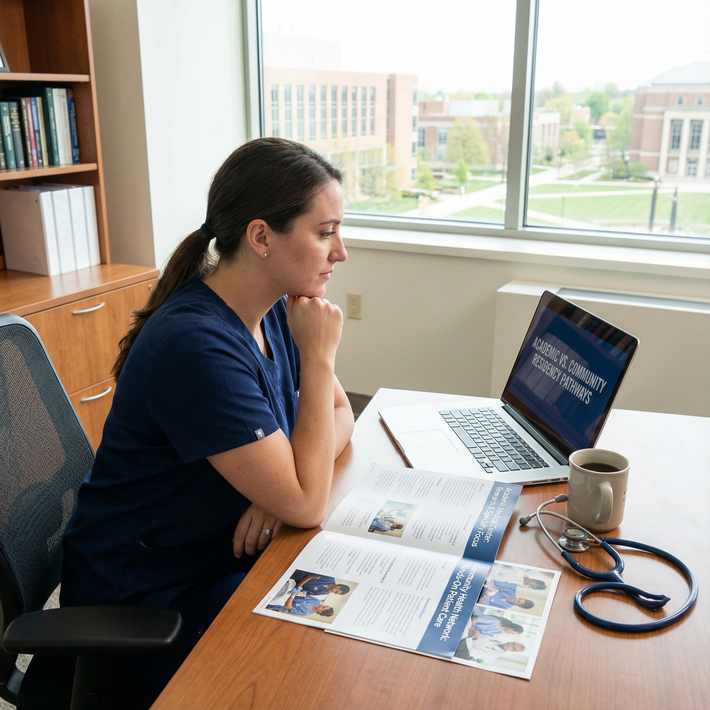
Are you choosing between community and academic programs the same way everyone else does, even though you may need a preliminary year? If so, stop. That's how people make bad rank lists.
A prelim year changes the whole decision. Maybe you're applying to an advanced specialty and need a PGY-1 year no matter what. Maybe you're not fully sure you'll match into your target field. Maybe you're building a backup plan because you’re being realistic, not pessimistic. All of those are normal. I’ve seen applicants get themselves in trouble by treating a prelim spot like a generic placeholder year. It isn’t. It’s an audition year, a repair year, a launch year, or all three at once.
That means you should judge community and academic programs differently than someone who’s choosing a full categorical path. Your job is not to chase the label that sounds fancier at dinner. Your job is to find the setting that gives you four things: strong letters, stable supervision, reliable clinical volume, and a workable bridge into your next application cycle.
If a program can’t help you do those things, I don’t care how impressive the hospital lobby looks. It’s the wrong program for this situation.
When a Preliminary Year Should Change the Way You Compare Programs
A prelim year forces you to think one move ahead. Not just “Where will I train?” but “What will this year let me become by next September?”
That’s the right lens.
If you may need to reapply, or if your specialty path includes an advanced match, then your PGY-1 environment matters in a very specific way. You need people who will actually know your work well enough to write useful letters. Not vague letters. Not “pleasant team member, showed up on time” letters. Real letters. The kind that say you carried patients, improved quickly, handled pressure, and functioned like someone worth betting on.
This is where community versus academic starts to matter differently.
A community program may give you tighter supervision, faster trust, more face time with attendings, and more direct ownership of patient care. That can be gold if what you need is a year of clean clinical performance and strong evaluations.
An academic program may give you subspecialty exposure, research access, name recognition, and a bigger network. That can be the better play if your next application depends on specialty-specific letters or academic productivity.
But don’t reduce this to prestige versus not-prestige. That’s lazy thinking. The real question is simpler: where will you be seen, supported, and positioned best for the next step?
If you're a likely reapplicant, choose the place where someone will notice that you're excellent. That matters more than the logo on the badge.
How Community Programs Can Help If You Need a Prelim Year
Community programs are often underrated for prelim applicants. I’ll say it plainly: for a lot of people, they are the smarter choice.
Why? Because you’re less likely to disappear.
In many community settings, faculty know who the prelims are. They work with you directly. You may have fewer layers between intern and attending. You may get more hands-on responsibility earlier. There’s often less competition for procedures, less jockeying among armies of fellows and senior residents, and more chances to be the dependable intern everyone trusts by October.
That matters. A lot.
If your goal is to prove that you are clinically solid, reliable, coachable, and worth a second look, a strong community year can do that beautifully. I’ve seen applicants rescue an application this way. They came in after a disappointing match, worked hard, earned trust, got blunt feedback early, improved fast, and left with letters that actually said something.
The tradeoffs are real, though. Community programs may have fewer subspecialty services, fewer built-in research opportunities, and less brand recognition with some future departments. If you need a radiation oncology mentor, a niche surgical subspecialist, or a string of publications before reapplying, a smaller hospital may simply not have the infrastructure.
So who fits best here?
Usually:
- Applicants who need a strong clinical redemption year
- Applicants who do best with close supervision and clear expectations
- Applicants whose next step depends more on evaluations and performance than on research
- Applicants who want a realistic backup plan and stable training environment
If that sounds like you, don’t let prestige talk you out of a good community prelim. A year where people know your name is better than a year where no one remembers you.

How Academic Programs Can Be the Better Move for a Preliminary Year
Now the other side. Academic prelim years can absolutely be the right move. In some situations, they are the obvious move.
If your future application needs specialty flexibility, subspecialty exposure, research access, or a stronger institutional name, academic programs have an edge. A big one.
Let’s say you’re aiming for dermatology, radiology, anesthesiology, neurology, PM&R, ophthalmology, or a competitive surgical path and you're worried you may need to strengthen your file while completing intern year. Being in an academic center can give you access to the exact people who matter next: subspecialty attendings, program directors, researchers, and departments that regularly feed into your target field.
That access is not automatic. But it exists.
You may be able to pick up a project. You may rotate with faculty in your desired specialty. You may get a letter from someone whose name carries real weight. You may see complex cases that sharpen both your knowledge and your interview story. If your next cycle depends on saying, “Here’s what I did this year to become a stronger candidate,” academic centers often give you more ways to build that story.
But here’s the downside. Academic prelims can be crowded, impersonal, and service-heavy. That's the truth. You can be one intern among many, covering endless pages, doing the work nobody glamorous wants to talk about. If you sit back and wait for mentorship to happen, it may never happen. Nobody is coming to rescue your career because you happen to wear a famous badge.
And competition is real. You may be surrounded by categorical residents, fellows, research years, and ambitious co-interns all trying to get noticed. That can be energizing. It can also bury you.
Academic is worth it when you need:
- Research or scholarly work for the next application
- Letters from subspecialists in your target field
- Exposure to complex or niche patient populations
- Networking within a department that may influence your next match
If you don't need those things, the academic label can become expensive noise. Busy, prestigious noise. Not helpful noise.
The Decision Framework: Match Your Prelim Year to Your Next Application
Here’s the framework I’d use if I were in your shoes.
Start with the next application, not the current one.
Ask yourself:
What specialty am I realistically targeting next?
Be honest. Not fantasy honest. Actual honest. If your target field rewards research, specialty-specific letters, and institutional networking, lean academic. If it rewards strong intern performance and dependable clinical evaluations, community may be stronger.What is my actual weakness right now?
Weak board scores? Thin research? No specialty mentors? Average clinical evaluations? You need a prelim year that fixes the right problem. Don’t choose a program that improves the wrong part of your application.Do I need research, letters, or pure clinical volume most?
This is where people get sloppy. They say they want “a strong program.” Meaningless phrase. You need something specific:- Research access
- Specialty exposure
- Letter writers
- Autonomy
- Stable evaluations
- Time and structure to reapply
How much structure do I need to succeed?
Some applicants thrive in large systems and can hustle for mentors. Others need direct faculty oversight and regular feedback. Know yourself. Don’t cosplay as someone more self-directed than you really are.Will this schedule let me survive the next application cycle?
You may need time for ERAS, interviews, personal statement updates, and possibly research follow-up. A chaotic prelim year with zero support can wreck your reapplication even if the hospital name sounds impressive.
Here’s the simple rule: choose the program that best supports your next match, not the one that looks best on paper.
That means comparing community and academic programs across a few real-world factors:
- Mentorship: Who actually knows prelims and writes letters?
- Autonomy: Will you be trusted enough to show growth?
- Schedule stability: Can you manage a reapplication year without drowning?
- Subspecialty access: Can you meet the people your target field cares about?
- Reputation in your desired specialty: Not hospital-wide prestige. Specialty-specific credibility.
- Track record: Have prelims from this program moved on successfully?
A community prelim with committed attendings and a history of helping reapplicants beats an academic prelim that treats you like temporary labor. Every time.
Questions to Ask Before You Rank Either Type of Program
Interview day is not the time to ask fluffy questions. Skip “What makes your program unique?” Everybody has a canned answer. Ask the questions that expose whether prelims are supported or used.
Here’s what I’d ask directly:
- Who supervises preliminary interns most closely?
- How are prelim evaluations handled, and how often do interns get feedback?
- Who writes letters for prelims?
- Do prelims get access to mentors in other departments?
- Have prior prelims successfully matched into advanced or competitive specialties?
- Are prelims mainly on service-heavy rotations, or do they get meaningful teaching time?
- How flexible is the schedule during reapplication season?
- If I need a specialty-specific letter, how realistic is it to get one here?
- Are rotation assignments fixed early or constantly changing?
- For visa applicants: has the program supported residents in my situation before?
Red flags? Easy.
Bad signs include:
- Vague answers about mentorship
- No clear process for feedback
- Nobody can tell you where prior prelims ended up
- Rotations are disorganized
- Residents say prelims are “kind of on their own”
- The whole vibe suggests prelims are extra labor, not trainees worth developing
And don’t ignore practical life issues. Commute. Call burden. Parking. Housing cost. Family support. A brutal prelim year in the wrong city with no flexibility can quietly wreck your chances in the next cycle. Logistics matter because exhaustion matters.
What to Do Next
If you're building a rank list and a prelim year may be part of your path, do this now:
Write down your likely next-step specialty.
Not your dream in the abstract. Your likely target.Identify the one or two biggest weaknesses in your application.
Clinical performance? Research? Specialty letters? Board scores won’t improve during intern year, so be realistic about what this year can actually fix.Sort every program by what it offers for next cycle.
Strong letter potential. Mentorship. Research access. Stable schedule. Specialty connections. Actual outcomes.Reach out with follow-up questions if anything is vague.
Vague is usually bad. Clarity is a feature.Rank based on fit for your next application, not prestige theater.
The right prelim year is the one that gives you traction. That’s it.
A prelim year can absolutely help you. I’ve seen it turn a shaky application into a successful one. But only if you choose the setting on purpose. Community and academic programs are not interchangeable. Treat them like different tools. Pick the one that solves your problem.