The way most students “choose” between academic and community residency programs is backward. They look at the logo first and their actual career needs second. That is how you end up miserable in a big-name program that never fit you—or undertrained in a small program that capped your options before you even started.
You need a decision algorithm, not vibes.
What follows is exactly that: a structured, practical way to pick between academic and community programs, step by step, with clear tie‑breakers. If you work through this honestly, you will know which side of the fence you belong on—and how to handle hybrids.
Step 1: Get brutally clear on your endgame
You cannot choose the right training environment if you are fuzzy about where you are headed. So start there.
Forget buzzwords like “prestige,” “well-rounded,” and “exposure.” Those are useless without context. You need hard answers to four questions.
Write these down. Actually write them.
- Do you want a fellowship?
- Do you want a research‑heavy or academic career?
- Do you care about brand name for future jobs?
- How much do you value lifestyle and autonomy during residency?
Now, use this quick scoring system. For each statement, rate yourself 1–5:
1 = strongly disagree, 5 = strongly agree.
- “I want a competitive fellowship (cards, GI, heme/onc, ortho subspecialty, derm fellowships, etc.).”
- “I want a career at a university, academic center, or major tertiary hospital.”
- “I enjoy research enough to keep doing it in residency.”
- “I would trade some lifestyle and autonomy for stronger academic credentials.”
- “I’m comfortable being in a big, sometimes bureaucratic system if it opens doors later.”
Then:
- “I want to be done after residency and go straight into practice.”
- “I prioritize operative/clinical volume and independence over research.”
- “I care more about being a strong, efficient clinician than about publications.”
- “I’d rather have fewer hoops and committees, more direct patient care.”
- “Lifestyle and location matter more to me than national prestige.”
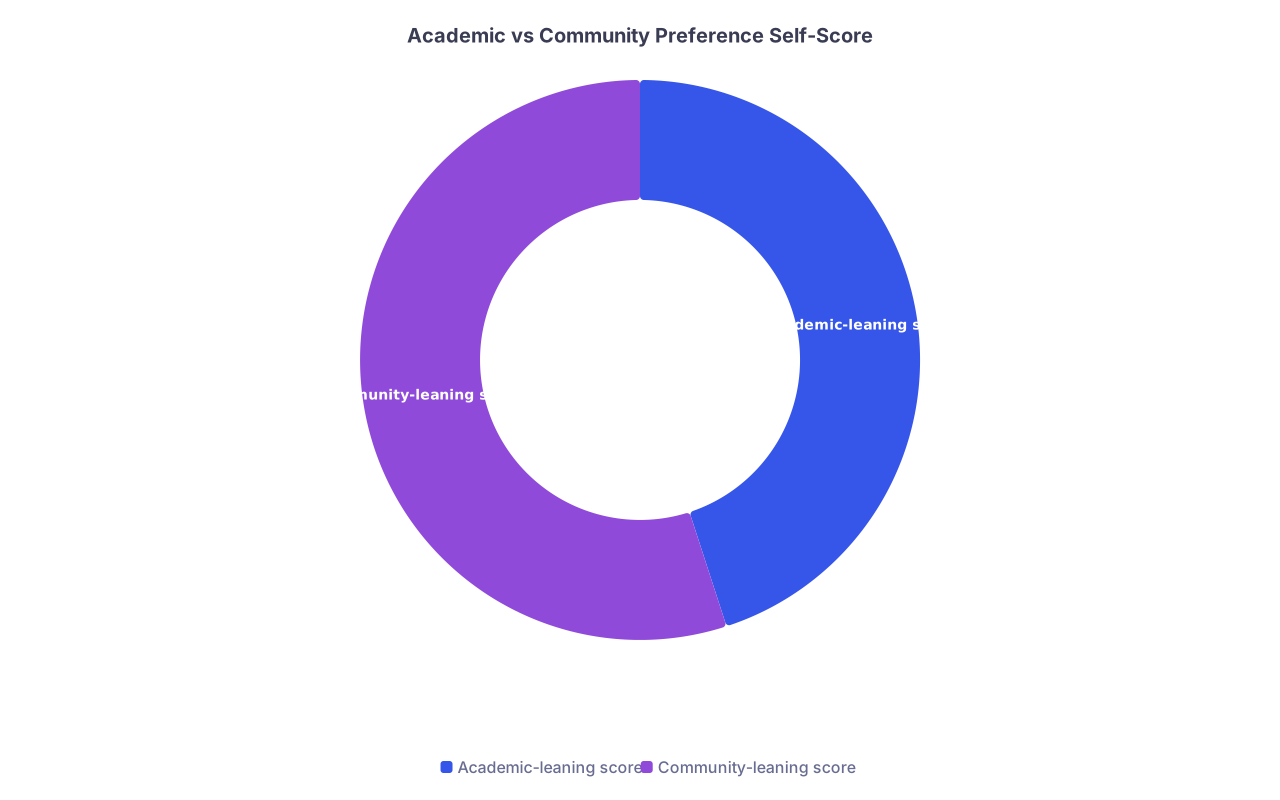
Now do the math:
- Academic-leaning score = sum of first 5.
- Community-leaning score = sum of last 5.
| Category | Value |
|---|---|
| Academic-leaning score | 18 |
| Community-leaning score | 22 |
If:
- Academic score ≥ 20 and academic > community by ≥ 3 points → You are clearly academic‑leaning.
- Community score ≥ 20 and community > academic by ≥ 3 points → You are clearly community‑leaning.
- Difference < 3 or both scores in the 16–22 range → You are genuinely conflicted and need a more detailed algorithm (next steps).
This first pass already tells you something critical: if you scored heavily academic and you are telling yourself “I just want a chill community program,” you are lying to yourself or trying to avoid the work/competition. Do not sabotage your future because you are tired in MS4.
Step 2: Understand what “academic” vs “community” actually means
Too many people argue over these labels without understanding what they map to in day‑to‑day life.
Academic programs – what you are really signing up for
Typical profile:
- Usually tied to a medical school or large university hospital.
- Tertiary or quaternary referral center.
- Multiple fellowships in-house.
- Lots of subspecialists and multidisciplinary conferences.
- Structured research infrastructure.
What it usually means for you:
- More complex and rare pathology.
- Tons of consults, transfers, and “zebras.”
- More layers of hierarchy: interns, seniors, fellows, attendings.
- More frequent conferences, M&Ms, journal clubs.
- Research is not optional if you want top fellowships; it is expected.
- Attendings may be more specialized and sometimes less focused on bread‑and‑butter community practice patterns.
Upside:
- Stronger fellowship placement, especially for competitive fellowships.
- Name recognition on your CV.
- Easier to stay in academic medicine.
- Better access to mentors who are known nationally.
Downside:
- You are one of many. Easy to get lost.
- Can be more malignant or high‑pressure (not always, but commonly).
- Less autonomy early; fellows and seniors may do the interesting parts.
- Lifestyle can be rough, especially in surgical and competitive fields.
Community programs – what you are really signing up for
Typical profile:
- Standalone community hospital or small system, maybe with a university “affiliation.”
- Service‑heavy, high patient volume.
- Fewer or no in‑house fellowships.
- Attendings often split time between the hospital and private practice.
What it usually means for you:
- Bread‑and‑butter pathology in high volume.
- You are closer to attendings; hierarchy is flatter.
- Earlier autonomy: you are the one doing procedures, not just watching.
- Less formal research infrastructure (but not zero opportunity).
- Often better lifestyle, especially if the program is not a regional powerhouse.
Upside:
- You become very efficient clinically.
- More hands‑on experience and procedural volume in many fields.
- Often a better place to prepare for community practice or hospitalist work.
- Can be more supportive and “family” culture.
Downside:
- Fellowship placement may be weaker or very variable.
- You must hustle harder for research and academic visibility.
- Less exposure to rare, ultra‑complex cases.
- The name on your badge will not impress every fellowship or big‑name employer.
Now the obvious point: there are hybrids.
- “Academic-community” programs (community hospital with strong university tie‑in).
- Big community programs with powerful fellowship match track records.
- Academic programs that behave like community programs in certain specialties.
So stop chasing labels and start chasing fit to function.
Step 3: Run your situation through this decision algorithm
Here is the actual algorithm you can follow. Read it like a flowchart.

| Step | Description |
|---|---|
| Step 1 | Start |
| Step 2 | Prioritize academic programs |
| Step 3 | High volume community or hybrid with proven match |
| Step 4 | Prioritize community or hybrid |
| Step 5 | Want competitive fellowship? |
| Step 6 | Have strong research now? |
| Step 7 | Plan community practice only? |
| Step 8 | Willing to do research in residency? |
| Step 9 | Care about academic career? |
| Step 10 | Lifestyle and autonomy priority? |
Now I will walk you through each branch with real‑world detail.
Branch 1: You want a competitive fellowship
By “competitive,” I mean things like:
- Cards, GI, heme/onc, PCCM, interventional specialties (for IM).
- Derm, plastics, ortho subspecialties, ENT fellowships.
- Certain neuro fellowships, IR, high‑end pain, etc.
Ask: Do I already have strong research and academic signals?
- Multiple first‑author pubs.
- Solid abstracts, posters at national meetings.
- Strong letters from known academic figures.
- Great board scores (Step 2, etc.).
If yes:
You should lean academic. Period.
You already showed you can play the academic game. Academic programs will give you:
- Additional research output.
- In‑house fellowship connections.
- Nationally recognized faculty who can call program directors personally.
If no and you are willing to build that in residency:
You still lean academic, but you can also consider:
- Strong hybrid community‑academic programs with:
- Clear proof of fellowship match success.
- Protected research time.
- Ties to university faculty.
If no and you are not willing to do research:
Then academic‑type fellowships will be an uphill battle regardless. Your move is:
- Look for:
- High‑volume community programs that consistently send a few graduates into fellowships.
- Programs that allow you to tack on a research year or a chief year with scholarly focus if you change your mind.
- Accept that you will need:
- Great clinical letters.
- Strategic away rotations.
- Possibly an extra year later if you really want a top‑tier fellowship.
Branch 2: You want to go straight into practice
If you are very clear you want:
- Hospitalist medicine.
- Outpatient primary care.
- General surgery going straight into practice.
- General OB/GYN, EM, psych, etc. in a community setting.
Then academic prestige becomes optional. Not useless—but not central.
You should then:
- Prioritize programs that will make you a dangerous clinician:
- High patient load.
- Senior autonomy.
- Lots of real‑world, bread‑and‑butter cases.
- Look hard at community and hybrid programs.
Many of the best practicing clinicians I know trained at:
- Busy county hospitals.
- Large community systems.
- “No‑name” programs that quietly produce beasts clinically.
What you do not want in this scenario:
- A name‑brand academic program where you function as a note machine while fellows do all the actual procedures and decisions.
Step 4: Compare specific program features with a simple scoring tool
Once you roughly know your leaning (academic vs community vs hybrid), you still have to compare individual programs.
Here is a practical scoring framework I use when advising students. You can adapt the weights depending on your goals.
| Factor | Weight (1–3) | Program A Score (1–5) | Program B Score (1–5) |
|---|---|---|---|
| Fellowship outcomes | 3 | 4 | 2 |
| Clinical volume/autonomy | 3 | 3 | 5 |
| Research infrastructure | 2 | 5 | 2 |
| Reputation/brand | 2 | 4 | 2 |
| Culture/support | 3 | 3 | 4 |
| Location/lifestyle | 2 | 2 | 4 |
How to use it:
- Pick 5–7 factors that matter to you.
- Assign each a weight:
- 3 = critical
- 2 = important
- 1 = nice‑to‑have
- Score each program 1–5 on each factor after interviews and research.
- Multiply weight × score, sum across.
Whichever program ends higher usually aligns better with your actual priorities—not your ego.
Step 5: Examine five non‑negotiable domains
Enough abstraction. Let us get tactical. When you are stuck deciding between an academic and a community list, drill down into these five domains.
1. Fellowship match data (if relevant)
Do not accept hand‑wavy answers like “Our residents do very well in fellowship.” Demand numbers.
Ask programs directly:
- “In the last 5 years, how many residents applied to [your desired fellowship] and how many matched?”
- “Where did they match?”
- “How many went to academic vs community practices?”
Red flags:
- They cannot give you specifics.
- They only list one superstar match from years ago.
- They keep changing the subject to “general success” or “board pass rates.”
For fellowship‑bound applicants:
- Favor:
- Academic programs with established pipelines.
- Community programs that can name recent fellows at solid places (e.g., “Three of our last five applied to heme/onc, matched at [known programs].”).
2. Autonomy and procedural/operative volume
There is a reason many surgery, EM, and IM residents choose strong community programs: autonomy and volume.
Ask current residents:
- “When did you first start doing X independently?”
- “On a typical call night, how many patients are you responsible for?”
- “Who does the central lines/LPs/airways/EGDs/operative portions?”
- “Do fellows ever take cases from residents?”
Typical patterns:
- Academic:
- More fellows = more competition for procedures.
- Often later autonomy, especially in subspecialized services.
- Community:
- Earlier autonomy.
- Attendings want you to function like a junior associate by PGY‑3.
If your endgame is being clinically excellent in a high‑volume practice, this matters more than logos.
3. Research and academic infrastructure
Be honest: will you actually do research?
If yes, you should see:
- Dedicated research coordinator or office.
- Regular research meetings.
- Faculty with active grants or frequent publications.
- Clear resident projects and poster output.
If a community program cannot offer that easily, you are accepting a trade‑off. Sometimes that trade‑off is smart. Sometimes it cripples your fellowship competitiveness.
If no, you just want a CV that is “enough,” then:
- A hybrid or community program with a few easy, supported projects is fine.
- You do not need R01‑level labs and weekly journal clubs.
4. Culture and support
This is where many applicants make a catastrophic mistake chasing prestige.
A mildly less prestigious program that:
- Protects your education.
- Has approachable attendings.
- Backs you for fellowship or jobs.
- Has residents who are tired but not broken.
…will beat a big‑name malignant environment every single time in long‑term career satisfaction.
On interview day, ask residents:
- “If you had to choose again, would you pick this place?”
- “Who leaves early when work is done—the interns or the seniors?”
- “What happens when someone is struggling?”
- “How often do residents fail boards or leave the program?”
If people hesitate, dodge, or laugh nervously, pay attention.
5. Location and life logistics
Do not pretend this does not matter. It does.
- Partner, kids, family support.
- Cost of living.
- Commute.
- Proximity to an airport if you care about away rotations, conferences, or long‑distance relationships.
I have watched extremely capable people burn out harder in “dream” coastal academic programs because they were isolated, broke, and commuting 90 minutes each way.
A slightly less fancy program near family or in a city you can actually live in is often the smarter move.
Step 6: Decide how to rank mixed lists (academic + community)
Most applicants do not end up with a pure academic list or pure community list. You will probably have a mix.
Here is how to rank them when you are torn:
- Put all programs in one list.
- For each program, write one sentence:
“If I match here, my most likely career path is: ______.” - Ask yourself:
- “Am I okay if that path becomes my reality?”
- Not “Is it ideal?” but “Can I live with this?”
Then, layer in this tie‑breaker priority order:
Safety for your actual career goal.
- For fellowship‑bound: programs that reliably place people into your fellowship area go higher.
- For practice‑bound: programs that clearly produce confident clinicians go higher.
Culture and support.
- Toxic brand‑name programs go below solid mid‑tier programs where residents are thriving.
Location/life.
- Sort programs with similar training quality by place you can actually live.
Prestige.
- Use it as a tie‑breaker, not a primary driver.
If your #1 academic choice and your #1 community choice feel neck and neck:
- Ask: “Which worst‑case scenario is more acceptable?”
- Academic path that is more research‑heavy, less autonomy, but top fellowship doors.
- Community path with better lifestyle, more autonomy, but possibly narrower fellowship reach.
Rank higher the program whose “worst‑case” you can live with.
Step 7: Handle three common real‑world scenarios
Let me walk through three classic conflicts I see every year.
Scenario 1: Mid‑tier academic vs strong community with great autonomy
You want cardiology. You have:
- A couple of posters, one low‑impact paper.
- Solid Step 2 (e.g., 245).
- Decent but not insane application.
You are choosing between:
- Academic Program A:
- University hospital, moderate fellowships.
- Less autonomy early, known to be busy and somewhat disorganized.
- Community Program B:
- High volume, tons of procedures.
- Sends 1–3 residents to cards every year, some to academic institutions.
Algorithm answer:
- If Program B has documented cardiology match success, supportive mentors, and at least some research option:
- Rank B higher if you value being clinically strong and do not care about T20 names.
- If Program A has in‑house cardiology with a history of taking residents, and you genuinely like research:
- Rank A higher.
Scenario 2: Name‑brand academic vs smaller hybrid near family
You are not sure about fellowship. Maybe hospitalist, maybe heme/onc if you fall in love with it.
Options:
- Academic Program C:
- Big name. Coastal city. High COL. No built‑in support system.
- Hybrid Program D:
- University‑affiliated community program.
- Resident‑reported strong culture. Family 20 minutes away.
Algorithm answer:
- You are undecided; you need flexibility.
- If both can reasonably place people into heme/onc and D has better lifestyle and support:
- Rank D higher.
- Your odds of thriving, exploring options, and not burning out are probably higher there.
Scenario 3: Community program only vs low‑tier academic safety
Your application is weaker:
- Low Step 2 or pass/fail with some red flags.
- Limited research.
- A few interviews: one small academic, two community.
You still think you want a competitive fellowship.
Algorithm answer:
- You must first secure a residency spot, full stop.
- Rank in order of:
- Where you are most likely to match.
- Among those, where you will get the strongest letters and clinical training.
- Then, accept that you may need:
- Extra research during or after residency.
- A chief year or research year.
- More hustle than your classmates.
You can absolutely still get there. But you cannot do that if you go unmatched chasing a fantasy.
Step 8: Use your interviews surgically
Most applicants float through interview day collecting vibes. You are going to collect data.
Here is a concrete script of questions to ask at both academic and community programs:
To current residents:
- “What do graduates actually do? Rough percentages to fellowship vs practice?”
- “Who writes the strongest letters here for [fellowship or job type]?”
- “When did you start feeling like you were really the doctor in charge?”
- “If you could change one thing about this program, what would it be?”
To program leadership:
- “Can you walk me through your fellowship placement in the last 5 years for [field]?”
- “What specific support is there for resident research, if I want to pursue it?”
- “How do you handle residents who are struggling clinically or personally?”
- “What do you think differentiates your graduates from those at purely academic [or purely community] programs?”
If they get defensive or vague around fellowship and outcomes, that tells you something. Believe what they actually say, not what you wish they meant.
Step 9: Do a ruthless reality check with someone objective
Most people cannot see their own blind spots. You are no exception.
Before you lock your list:
- Draft your rank list.
- Write a one‑paragraph rationale for your top 5.
- Bring it to:
- A trusted faculty advisor who knows your file.
- Or a senior resident who has no stake in where you match.
Ask them directly:
- “Given my actual record and goals, does this list make sense?”
- “Where am I overvaluing name and undervaluing fit or outcomes?”
- “If I told you I matched at #1, what future would you predict for me?”
If their prediction for your future at your #1 sounds like your nightmare, re‑rank. Do not get cute.
Step 10: Make the decision, then commit to making it the right one
Here is the part nobody tells you: plenty of people thrive out of community programs and underperform out of elite academic programs. The program is a multiplier, not a replacement, for your own drive.
Once you choose:
If you go academic:
- Milk the research and mentorship.
- Protect your clinical development by seeking autonomy where you can.
- Guard against becoming just a cog in the machine.
If you go community:
- Become clinically excellent.
- Strategically build some academic signals if you want fellowship:
- Case reports.
- Quality improvement projects.
- Regional and national conference presentations.
- Network actively; you do not have built‑in brand equity, so you create it.
The wrong way to live is spending 3–7 years whining that your program is not perfect. No program is.
Open a new document right now, list the programs on your interview list, and for each one write: “If I train here, my most likely career path is ______.” Then apply the algorithm above and reorder your list based on the worst‑case acceptable future, not the shiniest name.