You've got the MD acceptance letter sitting on your desk. You should be celebrating. Instead, you're lying awake at 2 AM refreshing a DO program's match day dashboard because their residency placement numbers look better than the MD school you just committed to.
Stop. Breathe. Let's sort this out before you make a decision you'll regret, in either direction.
This article is for educational purposes only. It is not financial advice, not legal advice, and not tax advice. Figures vary by individual circumstances, so consult a qualified professional before acting.
The Immediate Dilemma: Offer in Hand, Doubt Creeping In
Here's the scenario I see play out every spring. You get an MD acceptance. Great. Your family posts it on Facebook. Your premed advisor gives you the firm handshake. Then you start browsing match lists from a DO school you'd been waitlisted at, or maybe turned down, and notice their students are landing competitive specialties at rates that make your MD school's placement look mediocre.
Suddenly the MD prestige feels hollow. You're wondering if you picked the wrong horse.
Let me be blunt: the fear you're feeling isn't really about DO versus MD. It's about not wanting to screw up the next four years of your life. That's valid. But the way you're processing it, comparing school logos instead of comparing career trajectories, is going to lead you to a bad call.
Here's what matters in 2025 and beyond: after the 2020 ACGME merger that unified all graduate medical education under one accreditation body, the degree type on your diploma matters far less to residency program directors than it did even five years ago. What they care about now is whether you can pass boards, function clinically, and not be a liability on their service.
A DO program with a 97% match rate into your target specialty isn't a consolation prize. It's a strategic advantage. An MD program with a 94% overall match rate but weak mentorship and a toxic Step 1 prep culture? That's a trap dressed in prestige.
The core argument: In today's Unified Residency Match, your individual performance, scores, clinical grades, letters, networking, determines your outcome. The degree is background noise. The question isn't "MD or DO?" It's "which school will make me a better applicant?"
Why Your Anxiety Is Misplaced: The Reality of the Single Accreditation System
The 2020 ACGME merger wasn't cosmetic. It fundamentally changed how residency programs screen applicants. Before the merger, there were two separate accreditation tracks, ACGME for MDs and AOA for DOs, and program directors had to choose which pool to draw from. Some MD-heavy programs simply didn't consider DO applicants. That world is dead.
Now every residency program falls under ACGME accreditation. The same ERAS application portal. The same Match algorithm. Program directors aren't sitting in faculty meetings debating whether to "let in DOs this year." They're looking at your USMLE or COMLEX scores, your clinical evaluations, your letters, and whether you seem like someone who can handle their call schedule.
The "hidden bias" you've heard about? It exists, but it's shrinking and concentrated among older faculty who trained before the merger. A 65-year-old program director might still have a vague preference for MD applicants. A 40-year-old associate PD? They don't care. They went to residency alongside DOs. They've worked with DO attendings. They want competent residents, not pedigree validation.
Look at those numbers. A one-point difference in aggregate Step 1 pass rates. The variance within each degree type, between top and bottom schools, is dramatically larger than the variance between degree types. A well-supported DO student at a school with strong board prep will outscore a struggling MD student at a school with poor mentorship every single time.
Here's what most premeds miss: a strong DO match rate often reflects a program's specific culture of mentorship, board preparation, and faculty investment in student outcomes. That culture benefits you regardless of the letters after your name. A school that pulls its students across the finish line at 96% match into competitive specialties isn't doing that with magic. They're doing it with structured COMLEX/USMLE prep, dedicated faculty advisors, clinical rotation sites that actually teach, and a Dean's office that fights for its students.
That same infrastructure at an MD school? If it's there, great. If it's not, if the MD school relies on prestige to carry students through, you'll feel the gap when boards roll around.
When a DO Program Actually Makes Sense (And When It Doesn't)
Let's get specific. Because "it depends" is useless advice when you're staring at two deposits and a deadline.
Scenario A: The Competitive Specialty Gap
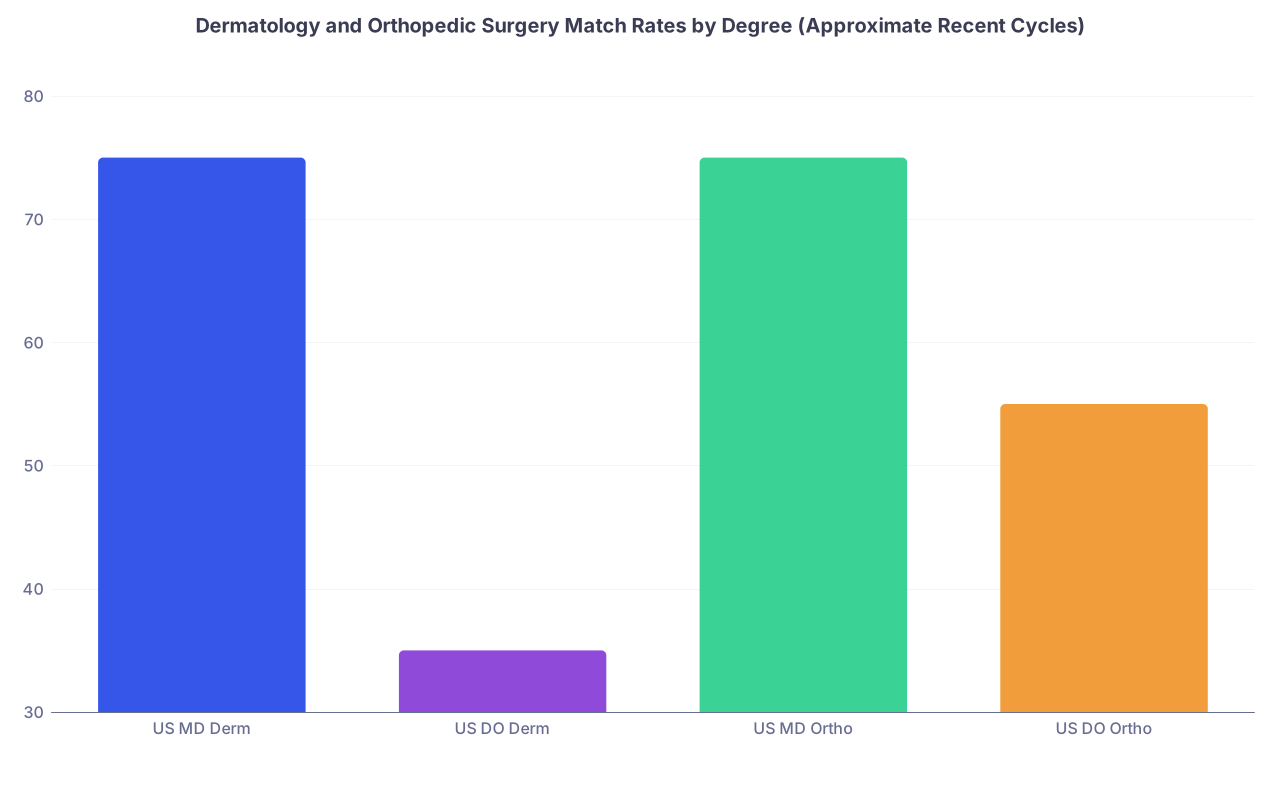
You want Dermatology. Plastic Surgery. Orthopedic Surgery. Integrated surgical subspecialties where the match rate hovers around 1-2% nationally and every applicant has a 260+ Step score.
In this scenario, the MD school might genuinely be the safer play, if it has the infrastructure to support that goal. Look at three things:
- Average Step 2 CK scores at the MD school. Are they competitive for your target specialty?
- Alumni placement in that specific specialty over the last 3-5 years. Not overall match rate, specialty-specific.
- Away rotation opportunities and faculty connections. Does the school have relationships with the programs you'd want to rotate at?
If the MD school's students are matching into Derm and Plastics every year, and the DO school hasn't placed a student there in a decade, the MD offer is your better bet. Prestige isn't the reason, track record and network are.
But here's the twist: if the MD school also hasn't placed anyone in Derm in five years, and their average Step 2 is 245, the prestige argument evaporates. You're choosing between two schools that won't get you where you want to go. Pick the one that'll make you a better doctor for your backup plan.
Scenario B: The Primary Care and Broad-Based Specialty Route
Internal Medicine. Pediatrics. Family Medicine. Emergency Medicine. Psychiatry. Neurology. Anesthesia.
This is where the DO program with superior match statistics starts looking genuinely better than a generic MD offer. Here's why: these specialties don't filter by degree type. They filter by competence. And a DO school that's posting 98% match rates into IM and Peds residencies at strong academic centers is clearly doing something right in their clinical training and board preparation.
A DO program with exceptional residency placement in these specialties means:
- Faculty who write meaningful letters of recommendation
- Clinical sites where students actually get hands-on experience
- Board prep that produces competitive COMLEX and USMLE scores
- A Dean's office that knows how to advocate for its applicants
If the MD school you're considering has weaker match outcomes in these same specialties, lower placement rates, worse clinical sites, students who feel adrift during rotations, the DO school is the objectively better career move.
The Match Rate Metric: Read It Correctly
A school can boast "99% match rate!" while half their graduates are scrambling into preliminary positions they didn't want. Or SOAPing into unrelated fields. Or matching into community programs when they wanted academic training.
What you need: specialty-specific match data and program placement records. Where do graduates actually end up? Do they match at places you'd want to train? Are they getting their first-choice specialty, or are they taking whatever they can get?
Request this data directly. Email the admissions office. Ask current students. If a school won't share granular match data, that's a red flag regardless of which degree they offer.
The Financial Reality Nobody Wants to Discuss
If the DO program offers significantly lower tuition, scholarship support, or in-state rates while the MD school means $50,000 more in loans over four years, that's not a minor consideration. That's a lifestyle constraint that affects everything, where you can afford to live during residency, whether you can take a research year, whether you'll feel pressured to chase higher-paying specialties you don't actually want.
Lower debt + equivalent or better outcomes = better life. Full stop. A physician who graduates with $200K in loans has options that a physician with $400K in loans doesn't. Don't let prestige talk you into a financial hole.
Action Plan: How to Audit These Numbers Yourself
Don't trust the admissions brochure. Don't trust the match list PDF with suspicious formatting and selective reporting. Here's how you actually verify outcomes.
Pull the GMEC reports. Go to the ACGME website and the individual program pages. Look at the most recent data on resident placement. The aggregate numbers tell you less than the specialty breakdowns.
Find the alumni tracker. Some schools maintain transparent databases showing where every graduate matched. Others bury this information. Transparency itself is a signal, schools that are proud of their outcomes share them. Schools that hide behind "97% match rate!" without context are obscuring something.

Contact current residents. This is the single most valuable thing you can do. Find a PGY-2 or PGY-3 from each school on social media, through alumni networks, or by asking the admissions office to connect you. Ask them three questions:
- Did you feel supported for board preparation?
- Did faculty actively help with residency applications and letters?
- If you could choose again, would you pick this school?
Their answers will tell you more than any statistic. A resident who says "I felt completely on my own for Step 2 prep" is describing a school that will leave you stranded when it matters most.
Visit both campuses. Sit in a lecture. Walk the halls. Eat lunch where students eat. Do the students look exhausted and bitter? Are they collaborating or competing? The environment where you'll spend 80 hours a week studying for two years directly impacts your scores. Burnout doesn't produce 260s.
Bottom line: The best school is the one where you'll get the highest scores, build the strongest clinical connections, and receive mentorship that translates into competitive residency placement. Sometimes that's the MD school. Sometimes it's the DO school. The letters on your coat don't answer the question. The outcomes do.
Key Takeaways
- The 2020 ACGME merger erased the practical divide between MD and DO residency tracks. Program directors care about scores, clinical performance, and whether you'll be a functional resident, not which degree you're pursuing.
- A DO program with superior specialty-specific match outcomes is a smarter strategic investment than a generic MD offer with weaker placement. Match data reflects real mentorship and infrastructure, not just prestige.
- Drill into specialty-specific outcomes, not overall match rates. Where graduates actually end up matters more than aggregate percentages designed to look impressive in brochures.
- Debt load and environment quality are valid decision factors. A lower-stress school that produces high board scores beats a high-prestige school that burns students out before they can peak.