The old game is over. If your DO school dropped class rankings and GPA distinctions, that isn't a disaster. It's a scoreboard change. Residency programs care less about where you sat on an internal curve and more about whether you can prove, in hard numbers and real clinical settings, that you're ready on day one.
I've watched students panic when the dean announces "pass/fail," "no rank," or "no GPA release." Wrong reaction. The smart move is to stop obsessing over percentile drama inside your own building and start building an application that survives outside it. That's what match viability is now: absolute exam performance, strong letters, visible clinical competence, and a coherent story.
This article is for educational purposes only. It is not financial advice, not legal advice, and not tax advice. Figures vary by individual circumstances, consult a qualified professional before acting.
Why DO Programs Ditched Rankings (The Strategic Reset)
DO schools didn't drop rankings because standards collapsed. They dropped them because intra-school competition was becoming less useful than standardized, externally comparable metrics. Also because the old model encouraged dumb behavior. Hoarding resources. Anxiety spirals. Classmate sabotage in the worst places. None of that makes you a better intern.
A big driver was alignment. As the residency world consolidated after the AOA merger into the single accreditation system, osteopathic schools had more incentive to mirror broader medical education trends seen in LCME-accredited environments. Plain English: if everyone is applying into the same match ecosystem, schools want grading systems that look less quirky and less internally political.
Here's the real implication:
- Your school rank matters less than it used to.
- Your absolute board score matters more.
- Your clinical evaluations and outside letters matter a lot more.
- Your application has to show "low-risk resident" energy from top to bottom.
That means your decision framework changes immediately. Stop asking, "Am I top quartile?" Start asking:
- Am I on pace for the board score my target specialty expects?
- Will my MSPE clearly explain my school's grading system?
- Do I have external validation from away rotations or strong clinical letters?
- Does my application show upward momentum?
That last point matters. A grading-system change does not devalue your degree. It just removes one familiar shortcut. That's all. The students who adapt fast do well. The ones who sit around complaining that they can't "differentiate themselves" usually get passed by classmates who quietly stacked scores, letters, and away rotations.
Absolute Scores Are Now Your Primary Metric
If your school doesn't rank, program directors will reach for what they can compare quickly. Boards. That's the cleanest signal on your file.
For DO applicants, the practical hierarchy is straightforward:
- COMLEX Level 2 CE: mandatory, osteopathic-specific, still heavily used.
- USMLE Step 2 CK: often the universal translator, especially at MD-heavy programs and more competitive specialties.
My opinion is simple: if you're aiming beyond clearly DO-friendly primary care pipelines, Step 2 CK is usually worth taking. It removes ambiguity. Nobody has to mentally convert your performance. Nobody has to guess.
Here's the rough utility breakdown:
- Family Medicine, Pediatrics, many Internal Medicine programs: COMLEX alone can work, especially if your score is strong and the program routinely interviews DOs.
- Emergency Medicine, Anesthesiology, General Surgery: Step 2 CK becomes more useful because screening is broader and comparisons are harsher.
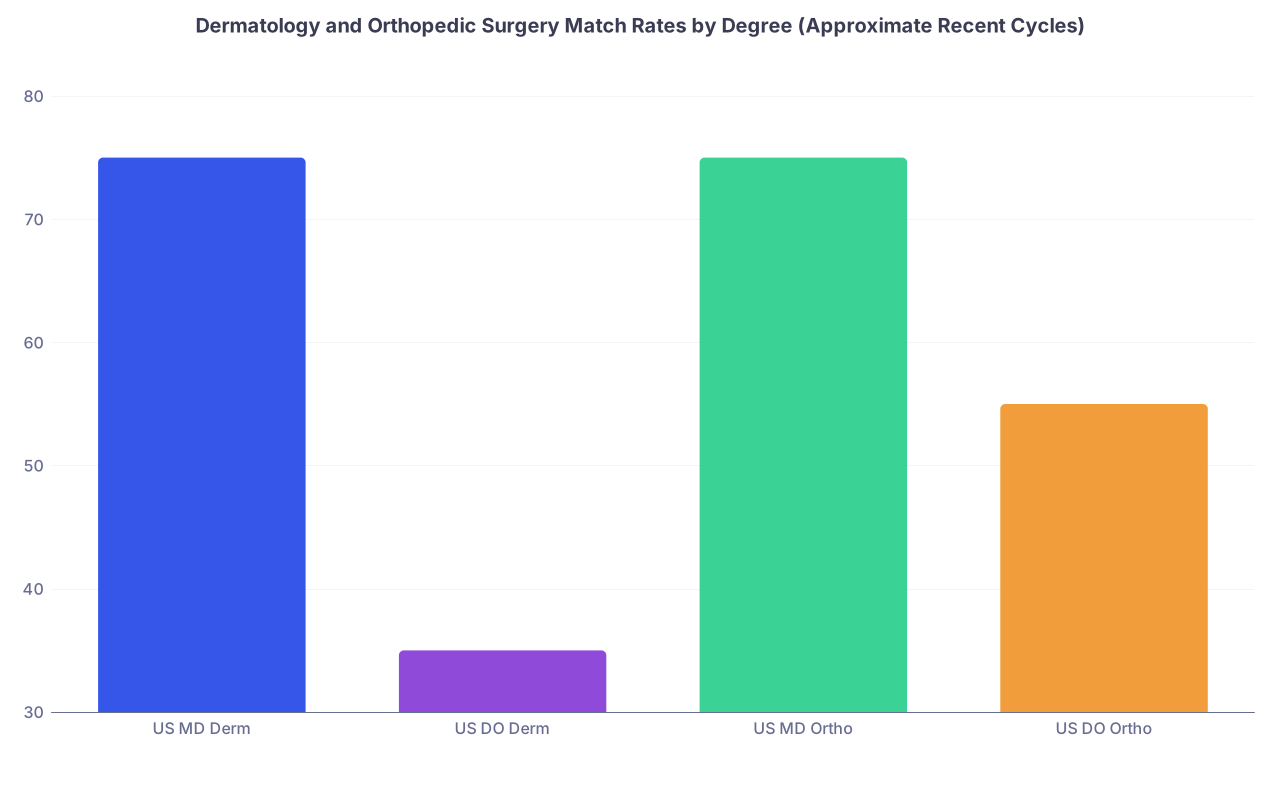
- Orthopedics, ENT, Derm, Neurosurgery, Plastics, academic IM or surgery tracks: Step 2 CK is close to a necessity unless you have extraordinary institutional support and connections.
As for targets, don't overcomplicate this. Use absolute score goals.
- Primary care range: 250-260 equivalent is a strong, practical target
- Competitive specialties: 270+ equivalent
- Academic or prestige-sensitive tracks: 280+ starts opening more doors
Those are not magic guarantees. But they are realistic thresholds that change how your file is received.
Timing matters too. The best testing window is usually right after core clerkships, when medicine, surgery, peds, OB/GYN, psych, and ambulatory management are all still alive in your head. I've seen students delay too long, drift into interview prep mode, and watch their score ceiling drop. Bad trade.
And yes, program directors know GPA inflation exists. They know some schools got softer while others hid distinctions entirely. That's exactly why many programs now use a composite screen:
- Board scores
- Letters of recommendation
- Interview performance
- Clinical comments
- Sometimes research or regional ties
So if rank disappeared, the answer isn't panic. It's to dominate the categories they still trust.
Build a Competitive Portfolio Without Rankings
No rank means you need proof from outside your home institution. External validation wins. Every time.
Start with away rotations. If you're targeting programs that historically under-interview DOs, especially MD programs, away rotations are not optional fluff. They're your chance to replace institutional bias with direct observation. A program may ignore your school name. It's much harder to ignore a faculty member saying, "This student functioned at the level of our sub-interns and I'd take them here."
The blueprint:
- Do 2-3 strategically chosen away rotations
- Prioritize programs where:
- DOs have matched before
- You meet score expectations
- Faculty actually write usable letters
- Geography or personal ties make your application more believable
Don't waste money on random "dream" aways where your score profile is far below the usual interview range. That's fantasy spending.
Research matters too, but a lot of students choose the slowest, messiest path possible. Chasing a basic science project with no active PI, no timeline, and no realistic publication plan is usually a mistake. You need output, not lab cosplay.
Better options:
- Clinical QI audits
- Case reports
- Retrospective chart reviews
- Outcomes analyses
- Systematic reviews tied to your clerkships or intended specialty
(See also: balancing do and md applications smartly for strategic advice.)
These projects move faster, cost less, and fit the residency reviewer's brain. They show you can identify a clinical question, work with data, and finish something. Finished beats fancy.
Your MSPE also becomes more important when rank disappears. You want narrative context that does real work. Not vague praise. Actual specifics. Meet early with student affairs or the dean's office and push for language that highlights:
- Longitudinal growth
- Clinical reliability
- Professionalism
- Team communication
- Initiative
- Improvement over time
If you had a rough preclinical semester, this is where context can save you. I've seen strong students get buried because they assumed the MSPE would "speak for itself." It won't. Most are bland unless you help shape them.
Here's the budget decision matrix students actually need:
Spend on away rotations first if:
- Your specialty values in-person performance heavily
- Your school has limited name recognition
- You need outside letters
- You're targeting MD programs with historical DO hesitation
Spend on conferences first if:
- You already have strong aways lined up
- You're presenting work that gets a national line on your CV
- The meeting gives direct networking in your specialty
- The cost is low and the exposure is real
If funds are tight, pick the thing that most directly changes your file. Usually that's an away rotation, not a poster where 14 people walk by and one grabs a mint.
Clinical Experiences & Letters That Speak for Themselves
Letters are your substitute ranking system. A great letter tells a program how you perform relative to real residents, not just classmates nobody knows.
The best letter writers:
- Program directors
- Division chiefs
- Clerkship directors with credibility
- Faculty from away rotations in your target specialty
- Attendings known to pick strong wording and submit on time
The worst letters come from famous people who barely know you. Prestige without content is useless. I'd take a sharp, detailed letter from a respected away-site faculty member over a generic note from a department chair who met you twice.
Schedule 2-3 aligned electives or aways if your specialty allows it. Not random. Aligned. If you want anesthesia, do anesthesia with people who can compare you to other applicants. If you want IM with academic lean, get seen on teaching-heavy services.
What helps a letter pass a screening review fast? Language like:
- "Performed at the level of an acting intern"
- "Among the strongest students I've worked with this year"
- "Would recruit this student to our residency"
- "Reliable, coachable, and trusted with increasing autonomy"
- "Communicated effectively with patients, residents, and nursing staff"
That wording matters because it reduces risk. Programs don't just want brilliance. They want someone who won't create chaos at 2 a.m.

If your transcript shows an early dip, don't apologize endlessly. Reframe it with evidence. Something like this works:
- Early adjustment period in preclinical curriculum
- Clear improvement afterward
- Strong shelf performance or board trajectory
- Excellent third-year clinical evaluations
- Letters confirming maturity and reliability
That is a real growth story. A flat excuse isn't.
Also, translate your evals into measurable snapshots on ERAS and in your personal narrative. For example:
- "Honors in 5 of 6 core rotations"
- "Consistently praised for efficient presentations and follow-through"
- "Recognized for strong patient ownership during sub-I"
- "Selected to present at department M&M/QI conference"
That kind of framing gives your application shape. Otherwise, all your good work gets buried in bland institutional language.
Navigating the Application Process & Interview Tactics
You need narrative control. If your school dropped rank, say it cleanly and move on. Don't act defensive, and don't act like something was taken from you. The right framing is adaptability.
Use this structure when someone asks, "How do your grades compare?" or "What's your class standing?"
State the system clearly "My school transitioned away from class ranking and GPA-based distinction."
Translate what replaced it "That put more weight on absolute performance measures, clinical evaluations, and board readiness."
Offer your strongest evidence "My Step 2/Level 2 performance, core rotation evaluations, and letters give the clearest picture of where I stand."
Close with readiness "What I'm most confident in is my consistency on clinical teams and ability to contribute early."
That's the whole answer. Short. Calm. No rambling.
Red flags to clean up before submission:
- Timeline gaps with no explanation
- Inconsistent specialty signaling
- Weakly explained leaves or course remediation
- Personal statement tone that doesn't match the rest of the file
- Missing letter strategy
- Late board date with delayed score release
I've seen applicants sabotage themselves by applying one story and interviewing another. Their CV says research-heavy academic medicine. Their personal statement says community mission. Their letters scream "good team player" but nothing about intellectual curiosity. Messy files get screened out.
Lock your score targets. Finalize your away rotation schedule. Get your letters early. Then submit without hesitation.
Your Execution Roadmap (Summary)
Here's the answer you're looking for: if your DO school drops rankings and GPAs, you compensate with objective performance and external validation. That's the entire playbook.
Priority order:
Boards
- Hit specialty-appropriate score thresholds
- Take Step 2 CK if your field is even moderately competitive
Away rotations
- Use them to bypass school-name bias
- Target programs where a strong performance can actually convert to interviews
Letters of recommendation
- Get detailed letters from faculty who observed you closely
- Prioritize attendings whose words carry screening value
Narrative and MSPE
- Make sure your school's grading system is explained clearly
- Emphasize growth, reliability, and clinical readiness
Static curves are gone. Good. They were overrated anyway. The current match environment rewards students who adapt fast, produce hard evidence, and act strategically instead of emotionally.
Your job now is simple: hit the score, secure the rotations, collect the letters, and submit a transparent application backed by proof. Systematic execution wins.