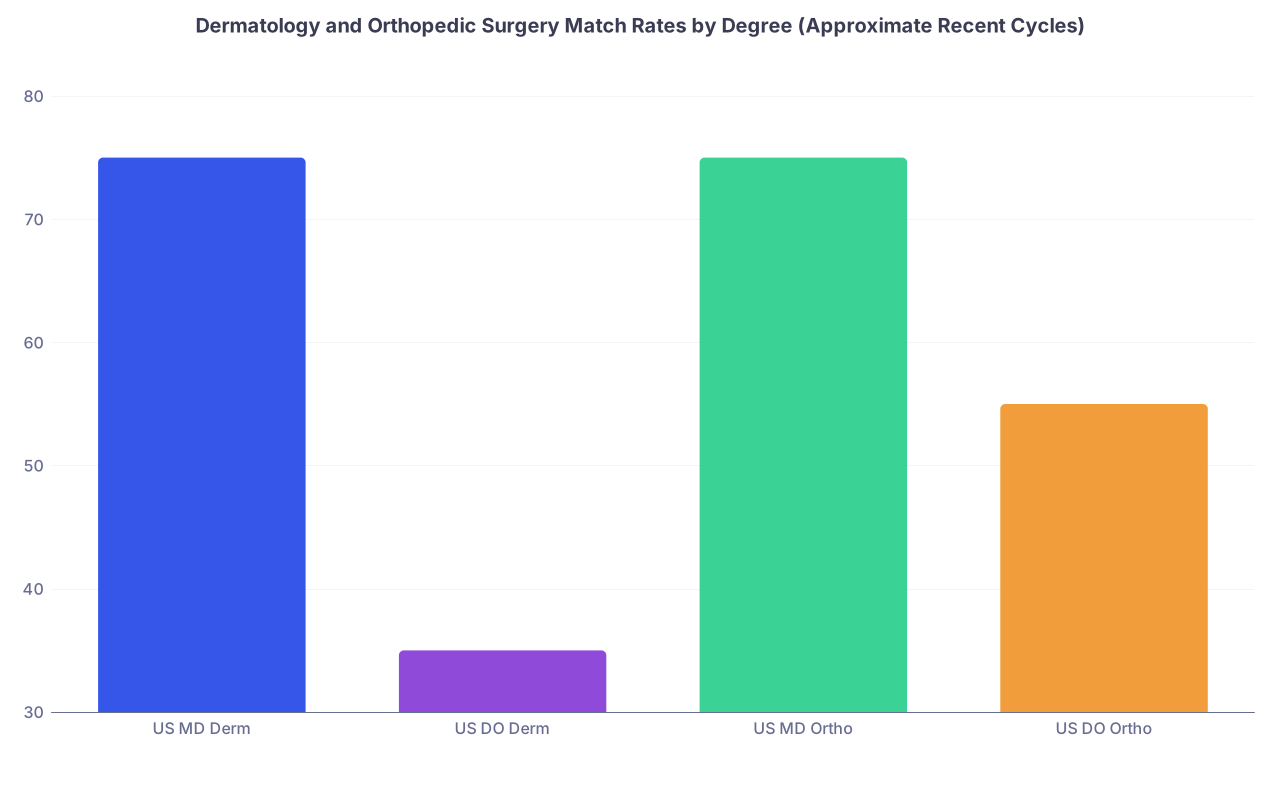
Nobody writes it down. Nobody puts it in an email. But after years of sitting in rank meetings and drinking terrible coffee with program directors, I can tell you the quiet arithmetic that runs through selection committee rooms all over this country: a DO application gets read with a different mental calculator than an MD application.
You've heard the rumor, DOs need ten, fifteen points higher on Step 2 to land the same interview. You've also heard the official line, "we review every application holistically." Both statements contain a piece of the truth. Neither is the whole story. Let me tell you what actually happens when your file hits the system.
Understanding how programs view these exams requires looking closely at how program directors interpret overapplication and filtering patterns.
Behind Closed Doors: What Program Directors Actually Whisper About DO Applicants and USMLE
First thing you need to understand: the overt discrimination is mostly gone. The 2020 single accreditation merger killed the old two-track system, and no program director with a functioning survival instinct says "we prefer MDs" out loud anymore. But spend enough time in faculty workrooms and you'll catch the residue. The half-second pause before a DO file gets opened. The question asked in a slightly lower voice: "Is a 245 from a DO school really the same as a 245 from our state MD program?" The question itself is the bias. Nobody ever asks it in reverse.
Second thing: most of this doesn't happen human-to-human anymore. It happens in software. ERAS and the program-side portals let coordinators filter on degree type, school, exam taken, and score threshold. I once watched a coordinator at a midwestern university program build the entire year's filter in about ninety seconds, degree field, exam field, a Step 2 cutoff the PD rattled off from memory between bites of a sandwich. No committee debate. No philosophy. Just keystrokes. That's the part nobody tells premeds: your fate is often decided by a dropdown menu configured by someone who has never met you and never will.
Some programs go further and filter "MD only" right at the degree field. It's legal. It happens far more than the profession likes to admit, especially in the surgical subspecialties. Others keep the door technically open but require USMLE scores, which accomplishes nearly the same thing without ever saying it.
Then came the change that rewired everything: Step 1 going pass/fail. Let me be blunt about what that did to DO students specifically. Before, a strong numeric Step 1 was the osteopathic applicant's great equalizer, proof, in the dialect programs spoke, that you belonged. That proof is gone now, for everyone, and COMLEX Level 1 went pass/fail right alongside it. Which means a DO student who skips the USMLE presents essentially zero numeric standardized data that a traditional program can read at a glance. Zero.
So Step 2 CK became the last number standing. The ultimate gatekeeper. Every PD I know treats it as the screening metric now, and for osteopathic applicants the pressure riding on that single three-digit score doubled overnight. One exam. One number. That's the game, whether you like it or not.
Myth vs. Reality: The Truth Behind Higher USMLE Score Cutoffs for DOs
The myth goes like this: programs keep a written policy, MD cutoff 235, DO cutoff 245. The reality is subtler and, frankly, more frustrating. I have never once seen a policy document with two columns. What I've seen instead is a single filter number applied to everyone, followed by a very human second pass, where MD applicants above the line get the benefit of the doubt and DO applicants near the line get an extra layer of scrutiny. School name. Rotation sites. Whether anyone in the room has ever trained with a graduate of your program. The effective threshold ends up different even when the official one isn't.
Call it a pattern, not a policy. That framing matters, because patterns can be worked around in ways policies can't.
Nobody publishes this chart. But if you gather what advisers, deans, and candid PDs actually report behind closed doors, the pattern looks something like this, illustrative effective cutoffs, not official data:
Look at the shape, not the exact digits. The gap barely exists in family medicine. It widens into a moat by the time you reach ortho and derm. That slope is the whole story.
Now, where does this bias actually live? Not everywhere equally, and internalizing this will save you real money and heartbreak. The heavy skepticism concentrates in traditional academic medical centers: the university flagships with NIH funding, research expectations, and fellowship pipelines. Their rank meetings run on USMLE vocabulary, their faculty published on USMLE percentiles, their fellowship directors ask about USMLE scores. Community programs, especially the former AOA programs with osteopathic heritage, read COMLEX fluently, recruit DOs on purpose, and couldn't care less about a ten-point three-digit gap. The bias isn't a wall around the whole profession. It's a wall around specific zip codes of prestige.
Then there are the ghost filters, the folklore numbers that haunt advising offices. "You need a 250 as a DO for emergency medicine." Says who? Usually it traces back to one PD's comment at a conference in 2017, passed down through three classes of anxious students, hardened into law by repetition. Advising offices trade in historical match lists, and match lists carry brutal survivorship bias, you see the one DO who matched ortho with a 258, not the forty who applied with 240s and vanished. I've watched students talk themselves out of specialties they were genuinely competitive for because of a number nobody could source. Don't let folklore do the filter's job for it.
The COMLEX Penalty: Why Many Programs Secretly Demand Both Exams
Now for the part that makes DO students angriest. I get it. But anger doesn't change the math: many programs whose websites say "COMLEX accepted" functionally mean "COMLEX tolerated."
Here's the mechanic. A PD at a university internal medicine program is staring at fifteen hundred applications for maybe a hundred twenty interview slots. When she hits a COMLEX Level 2 score of 580, she has to stop and convert. Sure, NBOME publishes correlation tables. Sure, conversion calculators exist. She doesn't trust them, she's told me so herself, more than once, in exactly those words. Different exam design. Different emphasis. OMM content she's never seen in her life. And uncertainty, in a famously risk-averse profession, gets priced. The price is a bigger cushion: either the COMLEX percentile has to be spectacular, or there needs to be a USMLE score she can read in her native language.
Do the funnel math and you'll see why. Fifteen hundred files. Committee time to holistically review maybe three hundred. Interview a hundred twenty. Manual review at scale simply doesn't happen, so "we accept COMLEX" quietly becomes "we accept COMLEX from applicants who are otherwise undeniable." That's not malice. It's triage. But the effect on your application is identical either way.
Here's the decision tree as it actually runs, stripped of brochure language:
So when is taking both exams non-negotiable? Here's the list I give my own advisees. If you're targeting ortho, ENT, neurosurgery, plastics, derm, rad onc, diagnostic radiology at university programs, or emergency medicine at academic centers, take the USMLE. Full stop. If you want academic internal medicine with a cards or GI fellowship in your future, take it. And if a program's website lists USMLE score ranges in its FAQ, that's them telling you which exam they dream in. Believe them.
When is COMLEX-only survivable? Former AOA community programs. Family medicine, psychiatry, peds, and community IM at sites with DOs on faculty and DOs in every residency class. How do you find them? Don't read the website boilerplate, every website claims to welcome everyone. Pull up the current resident roster and count the DOs. Programs matching DOs every single year are telling you the truth about their filters. A program with one token DO from 2019 is telling you something else entirely.
Beating the Filter: Insider Strategies to Override the Numbers Game
Here's the secret the anxious Reddit threads never quite grasp: filters sort files, but interviews go to people. Every lever I'm about to give you works because it converts you from a row in a spreadsheet into a name a human being will advocate for.

The single biggest lever for DO applicants is the audition rotation. A four-week sub-internship where attendings watch you work is worth more than fifteen points of Step 2. I've personally seen a program interview a rotator with a 228 over strangers holding 250s, because the 228 was a known quantity and the 250s were lottery tickets. Programs don't rank scores. They rank residents they trust. If your school allows away rotations, treat every single one as a month-long interview, because that is precisely what it is.
Second lever: advocacy. A phone call from your dean, your chair, or a faculty member who trained at the target program can physically move your file from the auto-reject pile to the interview list in a single afternoon. I've watched it happen, one call, coordinator pulls the file, filter overridden by a human with authority. This is what the osteopathic network is for. Your school's DO alumni are scattered through programs everywhere, and most of them remember exactly what the gauntlet felt like. Use them. That's not cheating. That's how medicine has always worked, the MDs have been doing it for a century.
Third: narrative and signals. When a score is borderline, something else has to make the coordinator pause the scroll. Geographic ties do it, programs filter on regional preference because they fear applicants who'll never rank them. A coherent story does it. And program signaling in the supplemental ERAS application does it most of all: a gold or silver signal answers the question every program silently asks, "will this person actually come here?" A genuine signal can absolutely override a borderline number, because programs are terrified of burning interview slots on ghosts.
Finally, the targeted email. Done right, it works. Done wrong, it confirms the filter's judgment. Timing: after submission, late September through October. Audience: the program coordinator, plus one faculty champion if you have a genuine connection. Length: four sentences. Who you are. One specific reason that program, and specific means naming something real, not "your strong clinical training." One line of proof. A soft close asking for nothing but consideration. Don't cold-email the PD unless you have an actual relationship, and don't follow up more than once. You're trying to make a human curious, not annoyed.
Remember this as you build your application: the filter is a wall with doors in it. Scores get you to the wall. Rotations, advocates, and signals are the doors. A borderline number with a champion beats a strong number with a stranger reviewing it, every cycle, in every specialty, I watch it happen. Don't just study for the exam. Build the humans on the other side of the screen.
Key Takeaways
- Program filters rarely have an explicit "DO penalty" written into policy, but risk-averse PDs often use higher USMLE thresholds as a proxy for board predictability.
- Taking both USMLE Step 2 CK and COMLEX Level 2 removes the guesswork for traditional academic programs that struggle to interpret osteopathic scoring.
- A strong clinical rotation performance, geographic preference signals, and faculty advocacy can completely neutralize a borderline USMLE score during holistic review.