
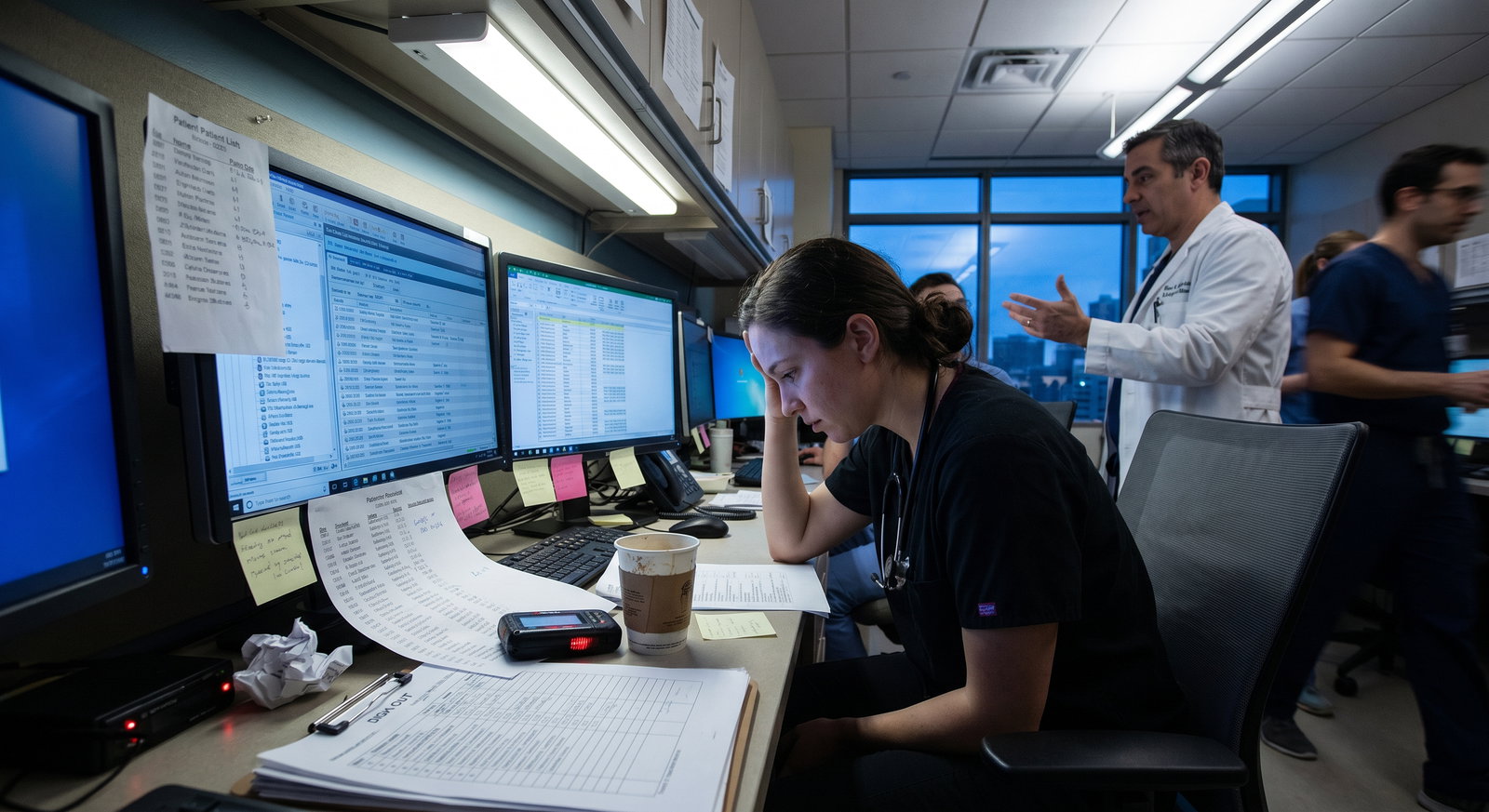
You know this moment. The list is finally shorter. The senior wants the floor clean. The night team has signed out. One patient is "probably going in the morning anyway," and you think, fine, I'll just get the discharge done now and be efficient.
I've seen interns make this mistake in the dead zone between fatigue and false confidence. The patient looks okay. The discharge order is half-written. The med list is "basically" done. Nobody wants to be the slow one. So the patient leaves. Then they bounce back 14 hours later with hypokalemia, oversedation, AKI, missed insulin instructions, or no clue who they're supposed to call. And suddenly that "efficient" discharge becomes a preventable readmission, a miserable sign-out, and sometimes a real patient harm event.
Here's the blunt truth: post-sign-out discharges are high-risk discharges. Not because night interns are careless. Because human beings get sloppy when ownership feels diluted. You stop thinking like the patient's doctor and start acting like the person clearing a task queue. Dangerous shift. Don't make it.
The Midnight Trap: Why "Sign-Out" Doesn't Mean "Done"
Sign-out creates a mental illusion. Responsibility has been transferred, so your brain quietly tries to downgrade the patient from "active clinical problem" to "administrative closure." That's sign-out fatigue. It's not laziness. It's a psychological gear shift. And it gets people hurt.
During the day, you're still in advocate mode. You're arguing with pharmacy, tracking urine output, calling family, rechecking sodium, wondering if the patient is actually ready. At night, especially after handoff, the temptation is different. The patient becomes an almost-discharged person. A box to click. A note to finish. A bed to free up. That's where bad medicine dresses itself up as efficiency.
Then there's handoff blindness. Information does not transfer perfectly between human beings. Ever. A detail that felt obvious to the day team may never land with the night team. A nurse may have mentioned mild confusion at 7 PM, but it never made it into the sign-out script. A patient's blood pressure "looked fine" until you notice the trend was 146 to 118 to 96 after evening diuresis. Small losses in information. Big consequences.
And yes, this matters. Patients discharged around handoffs and overnight transitions are more vulnerable to preventable bounce-backs, especially from:
- electrolyte derangements
- med reconciliation errors
- unresolved pain or sedation issues
- incomplete follow-up plans
- failure to recognize subtle deterioration
The intern mistake is calling speed a virtue here. It isn't. Rushing a discharge after sign-out is not streamlined care. It is often negligence disguised as productivity. Sharp wording, yes. Deserved wording too.
If you didn't watch the patient through the last several hours, you do not get to assume stability. Verify it.
For more on protecting your workflow when unexpected events occur, see handling a late-day admission without blowing up sign-out.
Watch for these danger thoughts:
- "They were going anyway."
- "The checklist is done."
- "The labs were fine earlier."
- "The nurse would tell me if something was wrong."
- "I just need to move this along."
That internal language is how bounce-backs start.
A safe post-sign-out discharge requires one mindset: act like you just admitted the patient and know nothing. Start there. Rebuild the case. Confirm the plan. If that sounds slower, good. Slow enough to prevent dumb mistakes.
Mistake #1: The "Checklist Complacency" Error
The electronic discharge checklist is useful. It is also seductive. It gives tired interns the feeling that completion equals safety. It does not.
If you find yourself struggling with the sheer volume of tasks, check out what faculty talk about after a bad night with an intern for perspective on performance reviews.
This is the classic error: you see green checks next to meds, follow-up, discharge summary, transportation. So you assume the patient is ready. But checklists are static. Patients are not. A heart failure patient can look "set for discharge" at 4 PM and drift into trouble by 8 PM after another round of diuresis, less oral intake, and a few doses of pain medication. The form doesn't tell you that. The bedside does.
I've watched interns discharge based on morning data while night nurses were quietly charting worsening edema, less urine output, or new dizziness with ambulation. That's not a paperwork problem. That's a failure to re-evaluate.
Red flag example:
- Morning weight improved
- Daytime creatinine stable
- Discharge planned
- But by evening: subtle JVD, marginal urine output, more fatigue, and the patient says, "I feel a little more short of breath walking back from the bathroom"
If you discharge that patient because the checklist was complete, you own the bounce-back.
Your protection strategy is simple:
- Recheck the latest vitals yourself.
- Review trending labs, not just the last normal value.
- Ask about symptoms in plain language.
- Confirm the patient can actually function: stand, walk, eat, void, think clearly.
- If the diagnosis is volume-sensitive, sedation-sensitive, or med-sensitive, do a bedside exam.
Treat every post-sign-out discharge as if you're meeting the patient for the first time. Because functionally, you are.
Mistake #2: Ignoring the Night Staff's "Whispered Warnings"
Night nurses and cross-cover residents often say the most important thing in the softest voice.
"He seemed a little off." "She got more confused after the pain meds." "He finally settled, but it took a lot." "I don't know. Something just feels different tonight."
New interns love to dismiss this because it sounds subjective. Bad move. Qualitative data is still data. Sometimes it's the earliest and best data you have.
A patient's labs can be unchanged while their trajectory is clearly wrong. Numbers lag. Human observation doesn't always. The nurse who has been in that room three times overnight knows if the patient is less steady, less sharp, less comfortable, less safe. Ignore that and you'll send unstable people home because the spreadsheet looked clean.
I remember a patient after abdominal surgery who was set to leave with opioid pain meds. Vitals acceptable. Labs acceptable. The box-checking version of medicine said discharge. But the night nurse hesitated and said, "He's been very sleepy after each dose. I had to wake him up twice to answer questions." That sentence should stop you cold. Instead, too many people hear it and think, okay, but technically stable.
Then the patient gets home, takes another opioid on top of residual sedation, lies down, and now the family is calling EMS for slow breathing. Entirely predictable. Entirely preventable.
Here's the rule: if night staff hesitates during sign-out, do not rush.
Ask directly:
- "What exactly worried you?"
- "When did you notice it?"
- "Did it improve, or did you just stop checking because shift changed?"
- "Was this different from baseline?"
- "Did the family notice it too?"
- "Would you be comfortable sending your own parent home like this?"
That last question cuts through nonsense fast.
And write the concern down. Don't trust your tired brain to remember the vague unease attached to Bed 12.
Do not let the false hierarchy of data fool you:
- Numbers matter.
- Trends matter more.
- Bedside observations matter most when they contradict your plan.
That whispered warning is often the last guardrail before a bounce-back. Don't step over it.
Mistake #3: Medication Reconciliation at Light Speed
This is the bounce-back factory. Bad med rec under time pressure.
The worst version is copy-forward medicine: admission med list becomes discharge med list with a few hurried edits, and nobody verifies what the patient actually took at home, what was intentionally held in the hospital, what needs restarting, and what now became dangerous because the physiology changed.
The "admission vs home" trap burns interns constantly. The chart says home metoprolol. Fine. But had the patient actually stopped it two weeks ago because of dizziness? The chart says prednisone 10 mg daily. Fine. But was that an active med or an old one autopopulated from a previous visit? The chart says lisinopril and NSAID are both home meds. Fine. But now the creatinine bumped after diuresis and you're about to send them home on a kidney insult combo.
Common dangerous mistakes:
- abrupt stopping of beta-blockers
- abrupt stopping of chronic steroids
- duplicate anticoagulation instructions
- continuing nephrotoxins despite new renal injury
- wrong insulin dosing after appetite changed
- PRN opioids without bowel regimen or sedation warning
My rule is brutal and simple: if you cannot explain why every single medication is on the discharge list, you are not done.
Use the Brown Bag Method mentally, even if the patient didn't bring the actual bottles:
- What did you take at home?
- What did we stop here?
- What must restart now?
- What should wait?
- What changed dose?
- What side effect means "do not take another pill and call us"?
If the history is fuzzy, call family. Call the pharmacy. Wake up enough to verify. A five-minute med clarification beats a 36-hour readmission every time.
Mistake #4: Vague Follow-Up Instructions for the Next Day
"Follow up with PCP." Worthless.
That line gets patients bounced right back because it shifts responsibility onto a confused person who just left the hospital with new meds, residual fatigue, and half-understood instructions. You know what happens next. They go home, don't know whether to call tomorrow or next week, don't know who owns the potassium recheck, and don't know when to restart the diuretic. Then symptoms return, nobody intervenes early, and the ED becomes the follow-up clinic.
Vague discharge instructions are lazy medicine. Full stop.
The red flag is any summary that says:
- follow up as outpatient
- see primary doctor soon
- repeat labs if needed
- resume home meds as directed
Directed by whom? Soon meaning when? Needed according to what threshold? This is how patients fall through the crack you created.
Build a bridge plan instead:
- Name the next clinician.
- Name the exact time frame.
- Name the required action.
- Name the contingency if that doesn't happen.
Example:
- "Please follow up with Dr. Patel in cardiology on Tuesday."
- "If you do not hear from the clinic by noon Monday, call this number."
- "Hold lisinopril until repeat BMP tomorrow."
- "Return to the ED tonight for worsening shortness of breath, confusion, no urine output, chest pain, or fainting."
That is a discharge. A real one. Not a shrug in document form.

What to Do Instead: A Safe Post-Sign-Out Discharge Routine
If you remember nothing else, use this five-step routine:
Pause the urgency
- The clock is not your attending.
- "Need to discharge" is not a clinical indication.
Re-evaluate the patient
- Vitals, symptoms, mental status, exam, function.
- Trend the last several hours, not just the morning.
Interrogate the sign-out
- Ask what changed after the day team left.
- Ask nurses what worried them.
Rebuild the med list from scratch
- Don't copy forward blindly.
- Verify high-risk meds one by one.
Create a 24-hour bridge plan
- Who is next?
- When?
- What must happen before then?
- What should trigger return immediately?
The Takeaway You Need to Carry Into Residency
Never trade clinical vigilance for chronological convenience. If the clock says you want to go home, but the patient is not clearly ready, you stay with the problem. That's the job.
Night staff observations are not background noise. They are often the only warning you get before a preventable complication declares itself.
Medication reconciliation is not clerical work. It is frontline patient safety.
And discharge is not an administrative ending. It is a care transition with a 24-hour blast radius. If the next step is unclear, the discharge is incomplete. Period.
So the next time you inherit a "probably going home" patient after sign-out, don't chase the feeling of being fast. Chase the standard of being safe. Be the annoying intern who double-checks. Good. Let them roll their eyes. Your patient gets one body. They can survive your extra ten minutes far better than they can survive your rushed mistake.