
Understanding the Role of Letters of Recommendation in a Dermatology Application
Letters of recommendation are one of the highest‑impact parts of a dermatology residency application—especially for a DO graduate. In a competitive specialty with relatively few spots and a high proportion of MD applicants, your letters can help:
- Demonstrate that you can thrive in a rigorous dermatology residency
- Validate your clinical skills and professionalism from trusted experts
- Counter any bias about being a DO graduate by providing objective, convincing endorsements
- Differentiate you when programs are deciding whom to interview and how to rank applicants
For the osteopathic residency match (and especially when applying broadly to ACGME programs), programs are looking closely at whether your dermatology residency letters prove that you can perform at the same level as any other applicant. Strong, specific letters from respected dermatologists and academic physicians are one of the best ways to show that.
Why Letters Matter Even More for a DO Graduate
As a DO graduate applying in dermatology, your letters of recommendation can:
- Confirm that you’ve excelled in ACGME or university-affiliated environments
- Provide evidence that you can handle complex medical dermatology, procedures, and academic expectations
- Show that dermatologists are willing to stake their reputation on you
- Help bridge gaps if you had limited derm electives, fewer publications, or late exposure to the field
Think of your letters as your advocates in the room when selection committees are debating interview offers and rank lists. Your ERAS application speaks for you—but your letter writers argue for you.
How Many Letters You Need and What Types Programs Prefer
Most dermatology residency programs require 3 letters of recommendation, and some allow or prefer 4, especially if one is a Department or Chair letter.
Always verify each program’s requirements in ERAS and on program websites, but the following is a strong general strategy for a DO graduate aiming for a derm match:
Ideal Letter Mix for Dermatology
Aim for letters that show both specialty-specific and broad clinical strength:
Dermatology Faculty Letter #1 (Core Letter)
- From a dermatologist who closely supervised you on a dermatology rotation (home program, away rotation, or community derm preceptor who knows you well).
- Should address your clinical reasoning, procedural skills, patient communication, and interest in dermatology.
Dermatology Faculty Letter #2
- From another dermatologist—ideally at an academic or large training institution.
- Particularly valuable if this person is known in the field, involved in resident education, or part of a residency program.
Chair or Program Director Letter (if available)
- Some dermatology programs strongly prefer or even require a letter from the Department Chair or Program Director.
- This letter often summarizes feedback from faculty and may carry significant weight in the derm match process.
Additional Non-Derm Letter (Optional or 3rd/4th Letter)
- A strong internal medicine, pediatrics, or surgery attending, or a research mentor (clinical or basic science) who knows you well.
- Particularly helpful if they can highlight your work ethic, clinical judgment, and teamwork in another demanding setting.
For most applicants:
- 3 letters is standard
- 4 letters is reasonable if all are strong and allowed by programs
- At least 2 dermatology letters are strongly recommended for a dermatology residency
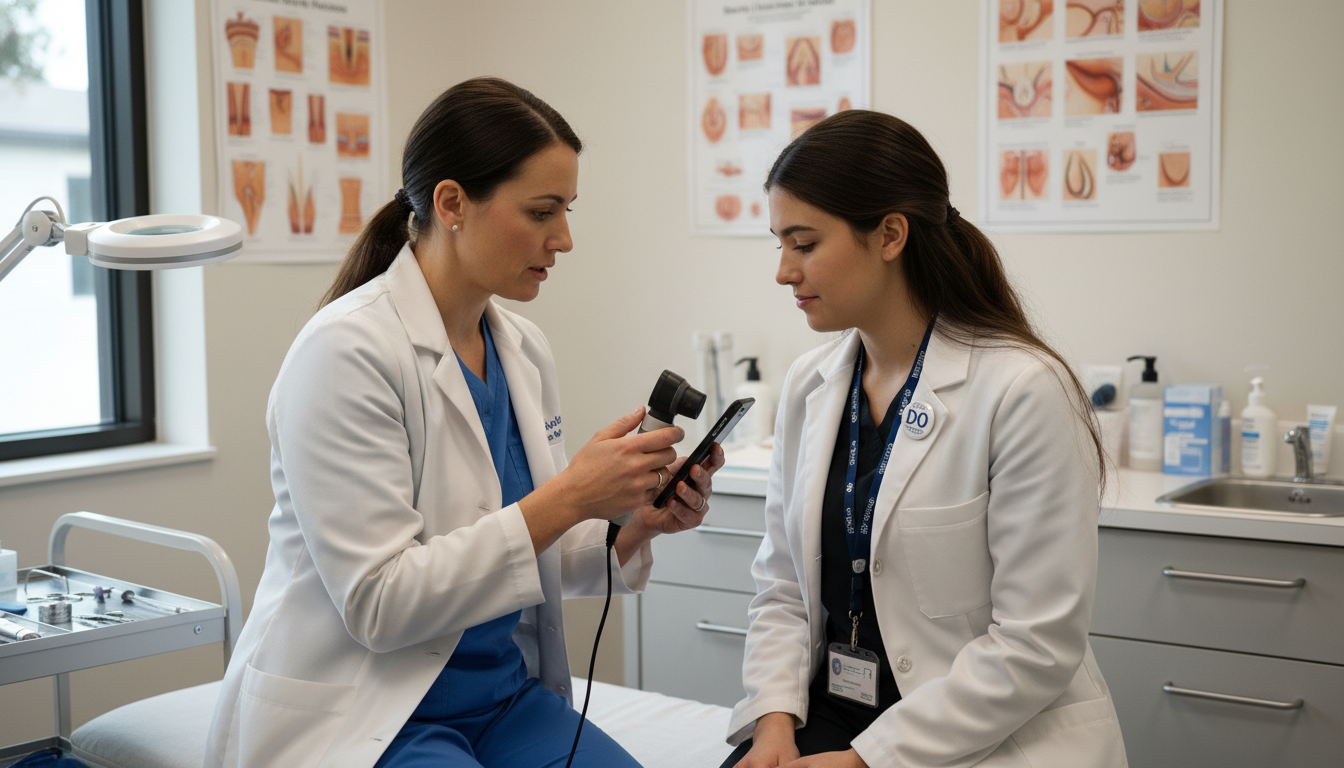
Who to Ask for Letters: Choosing the Right Authors as a DO Graduate
A strong letter is less about title alone and more about depth of knowledge of you. However, in dermatology, both name recognition and content matter.
Priority 1: Dermatology Faculty Who Worked Closely With You
These are your most important letter writers. Ideal characteristics:
- Supervised you for at least 2–4 weeks on a rotation
- Observed you in clinic, procedures, teaching sessions, and team interactions
- Can describe specific patient encounters, cases, or projects you worked on
- Is willing to be an advocate for you
Examples:
- Your home institution dermatology clerkship director
- An attending from your away rotation at a program you’re applying to
- A community dermatologist who consistently works with students and can compare you to others
Even if they are not a famous researcher, a specific, enthusiastic letter from a dermatologist who truly knows you is often stronger than a vague letter from a big name who barely interacted with you.
Priority 2: Department Chair or Program Director Letters
If your institution has a dermatology residency or academic department:
- A Chair or PD letter can carry substantial weight in the dermatology residency selection process, especially at academic centers.
- These letters often:
- Summarize multiple faculty impressions
- Speak to your fit for dermatology overall
- Comment on professionalism, reliability, and collegiality
Even if the Chair/PD didn’t directly supervise you clinically, they may solicit input from other attendings and residents—your job is to make sure you’ve built strong relationships and left a positive impression on the department.
Priority 3: Non-Dermatology Clinical Attendings
These letters are especially useful if they can speak strongly to your clinical excellence, work ethic, and ability to handle complex medical or procedural work. Ideal non-derm writers:
- Internal medicine, pediatrics, or surgery attendings from demanding sub-internships (acting internships) or core clerkships
- Preceptors who can say: “This DO graduate performed at or above the level of an intern”
- Faculty who can compare you favorably to residents or prior applicants to dermatology and other competitive specialties
These letters support the idea that you’ll be a safe, reliable PGY-1 and PGY-2, not just someone passionate about skin.
Priority 4: Research Mentors (Derm or Non-Derm)
Research letters are particularly valuable if:
- You have dermatology research and the mentor is a dermatologist or well-known academic physician
- The mentor can speak in detail about your:
- Scientific rigor
- Persistence
- Writing skills
- Independence and initiative
A strong research letter can help offset fewer publications or late entry into derm, and it reinforces that you will contribute academically during residency.
Who NOT to Prioritize
Be cautious about relying on:
- Letters from non-physicians (psychologists, PAs, NPs, etc.) – often not accepted or less impactful.
- Personal family physicians or dermatologists you shadowed briefly without real responsibility or evaluation.
- Big names who barely know you – a generic letter from a famous dermatologist is less helpful than a detailed, enthusiastic letter from a mid‑career attending who supervised you closely.
When thinking about who to ask for letters, ask yourself:
“Who can tell the most detailed, compelling story about me as a future dermatology resident?”
That’s your ideal letter writer.
How to Get Strong LORs: Strategies Before, During, and After Rotations
Knowing who to ask for letters is only half the battle. The other half is learning how to get strong LOR content by deliberately planning your interactions, performance, and follow‑up.
Before the Rotation: Set Yourself Up for a Strong Letter
Clarify Expectations Early
- Ask the resident or attending on Day 1:
- “What makes a student stand out on this rotation?”
- “Are there specific skills or goals you’d like me to focus on?”
- Ask the resident or attending on Day 1:
Signal Your Interest in Dermatology Clearly
- Share that you are a DO graduate planning to apply to dermatology residency.
- Briefly describe your background, research, and why derm matters to you.
Plan to Ask for a Letter (Mentally)
- Identify potential letter writers early: those supervising you most often, giving you feedback, or complimenting your work.
- Make sure they see you multiple times and in different contexts—clinic, procedures, inpatient consults, teaching sessions.
During the Rotation: Behaviors That Lead to Strong Letters
Focus on the qualities faculty repeatedly mention in strong residency letters of recommendation for dermatology:
Clinical Excellence and Curiosity
- Read up on the patients you see and common derm conditions.
- Ask thoughtful, concise questions.
- Present concisely and accurately; be ready with differentials and next steps.
Work Ethic and Initiative
- Arrive early, stay reasonably late when needed, and help with tasks without being asked.
- Offer to draft notes, call patients with results, or prep biopsy trays under supervision.
- Follow through on every assignment—charts, consults, reading.
Professionalism and Teamwork
- Be respectful to all staff—including MAs, nurses, and admin personnel.
- Handle feedback with maturity.
- Demonstrate reliability: if you say you’ll do something, do it.
Patient-Centered Communication
- Show empathy, especially in cases involving chronic disease, cosmetics, or stigmatizing conditions.
- Practice explaining diagnoses and treatment plans clearly.
- Ask permission when examining sensitive areas and maintain proper draping.
Dermatology-Specific Engagement
- Learn to use the dermatoscope and biopsy tools; seek hands-on learning when appropriate.
- Read derm path reports and correlate with clinical findings.
- If you’re on an away rotation, learn the local system quickly and ask how you can best contribute.
These behaviors translate directly into the “evidence” your letter writers include. The more examples they have, the stronger your letter.
When and How to Ask for the Letter
Timing and phrasing matter:
Ask Near the End of the Rotation (or Immediately Thereafter)
- This is when your performance is fresh in their mind.
- Ideally, after you’ve received positive feedback or a strong evaluation.
Ask for a Strong, Supportive Letter Explicitly
- In person or via email, you might say:
- “I’m applying to dermatology residency this cycle. Would you feel comfortable writing me a strong letter of recommendation?”
- This phrasing gives them an honest out; if they hesitate, it’s better to ask someone else.
- In person or via email, you might say:
Provide Supporting Materials to Make Their Job Easier
- Updated CV
- Personal statement draft (even if not final)
- ERAS experiences list or bullet points of key things you did with them
- A brief paragraph reminding them of specific cases, projects, or contributions
Clarify Logistics
- Confirm whether letters will be uploaded via ERAS
- Provide the ERAS Letter Request Form with their name, title, and email
- Confirm deadlines (ideally a date earlier than your real internal deadline)

What Makes a Dermatology LOR Truly Strong (and What Should Be in It)
You can’t write your own letter—but you can influence its strength by how you perform, what you share with your writers, and how you frame your request.
Hallmarks of a Strong Dermatology Letter
Strong residency letters of recommendation in dermatology tend to:
Be Enthusiastic in Tone
- Phrases like:
- “I give my highest recommendation…”
- “This applicant is among the best students I have worked with in X years”
- “I would be thrilled to have them as a resident in our program”
- Phrases like:
Offer Specific, Concrete Examples
- Detailed patient encounters (dealing with complex psoriasis, managing isotretinoin, counseling about cosmetic procedures)
- Procedure performance (shave/punch biopsies, cryotherapy, excisions, assisting with dermatologic surgery or Mohs)
- Evidence of independent thinking and synthesis of derm pathology and clinical findings
Compare You Favorably to Peers
- Statements like:
- “She is in the top 5% of students I’ve supervised.”
- “He functions at the level of a dermatology intern.”
- “They are one of the strongest DO graduates I have worked with, easily comparable to our top MD applicants.”
- Statements like:
Highlight Traits Critical for Dermatology
- Attention to detail (essential for derm)
- Visual diagnostic skills and pattern recognition
- Manual dexterity and procedural aptitude
- Compassion and sensitivity when addressing visible skin disease, scarring, and cosmetic concerns
- Reliability, organization, and academic potential
Address the DO Context (When Appropriate)
- Without making it the focus, some writers may:
- Emphasize that you performed exceptionally in an ACGME or academic environment
- Explicitly note that you are indistinguishable from, or superior to, MD peers in clinical performance and knowledge
- This can be especially reassuring to programs reviewing a DO graduate residency application in a historically MD‑heavy field.
- Without making it the focus, some writers may:
Red Flags or Weaknesses in a Letter
Be cautious if you suspect a letter might be:
- Overly brief or generic
- Lacking specific examples (“hardworking,” “pleasant” only)
- Lukewarm in support (“would do well,” without stronger endorsement language)
- Focused on unrelated or peripheral information instead of clinical competence
If, during your request, the faculty member seems unsure or not enthusiastic, consider asking someone else. A mediocre letter can quietly hurt your osteopathic residency match chances in dermatology.
DO-Specific Considerations: Overcoming Barriers and Maximizing Your Letters
As a DO graduate, your letters can be a powerful tool to:
- Show that you are fully prepared for ACGME-accredited dermatology training
- Counter any misconceptions about osteopathic education
- Highlight unique strengths you bring from your DO training
Strategically Using Your Letters to Support Your Application Story
Emphasize High-Level Clinical Performance
- Ask writers to highlight how you:
- Performed on away rotations at academic centers
- Managed complex medical derm cases
- Integrated OMM thinking where appropriate or showed a holistic, patient-centered approach
- Ask writers to highlight how you:
Target Programs Wise to DO Strengths
- Research programs with a history of interviewing/matching DO applicants.
- For those programs, strong letters from dermatologists who know DO training can be especially impactful.
Use Non-Derm Letters to Reinforce Core Intern Skills
- An internal medicine letter stating you can manage complex inpatients safely and efficiently reassures derm programs that you’ll be a strong PGY-1, not just a niche specialist.
Leverage Research Mentors to Demonstrate Academic Potential
- Particularly if your DO school had limited derm exposure, research letters can show that you proactively built a strong dermatology portfolio.
Practical Logistics and Timing for DO Applicants
- Start Early: Plan your dermatology rotations and away rotations so that your letters can be completed by late summer or early fall of your application year.
- Ask at the End of the Rotation: Then send gentle reminders 2–4 weeks later if needed.
- Track Letters in ERAS: Monitor the upload status. Aim to have all letters in before programs download applications or begin holistic review.
- Limit Total Letters but Maximize Impact: Use your ERAS slots wisely. Usually:
- 2–3 dermatology letters
- 0–1 Chair or PD letter
- 0–1 strong non-derm or research letter
You do not need to send all letters to every program—customize which letters each program receives, prioritizing dermatology and Chair letters where they are most valued.
Frequently Asked Questions (FAQ)
1. How many dermatology letters do I really need as a DO graduate?
Aim for at least two dermatology letters. For a competitive derm match, most DO and MD applicants will have 2–3 letters from dermatology faculty, plus an optional non-derm or research letter. If you can secure:
- 2 strong clinical derm letters
- 1 Chair/PD letter (derm if possible)
- 1 additional strong letter (medicine, surgery, or research)
you will be very well positioned from a letters standpoint.
2. What if my school doesn’t have a dermatology department or residency program?
You can still build a strong residency letters of recommendation portfolio by:
- Doing away rotations at institutions with dermatology residencies
- Working with community dermatologists who regularly teach students
- Pursuing dermatology research (even remotely) with academic mentors
- Supplementing with strong internal medicine, pediatrics, or surgery letters
Programs understand that not every DO school has robust derm departments. What matters is how well you’ve used the opportunities you had—and letters are a key way to show that.
3. Is it better to have a famous dermatologist write my letter, even if they don’t know me well?
Almost always no. A well-known name can help, but not if the letter is generic. Selection committees can tell when a letter writer barely knows the applicant. A detailed, enthusiastic letter from a mid‑career dermatologist who supervised you closely will carry more weight than a vague paragraph from a prominent but distant figure.
If you’ve worked closely with a recognized derm faculty member—fantastic. But choose based on depth of relationship and quality of content, not fame alone.
4. Can I see or edit my letters of recommendation?
In ERAS, you typically waive your right to see letters. Programs expect that letters are confidential; such letters are generally considered more honest and credible. You should not edit or write your own letters—this is professionally inappropriate and can be viewed as a serious ethical concern.
You can help your writers by:
- Providing your CV and personal statement
- Sending a short summary of your contributions with them
- Politely reminding them of deadlines
Beyond that, trust them to advocate authentically on your behalf.
Strong letters of recommendation are one of the most powerful tools you have as a DO graduate applying to dermatology. By carefully choosing who to ask for letters, intentionally demonstrating the qualities programs seek, and understanding how to get strong LOR content through your clinical performance and professionalism, you give selection committees compelling evidence that you are ready to excel in a dermatology residency—and that you fully belong in this highly competitive field.