Why Letters of Recommendation Matter So Much for IMGs in Neurology
For an international medical graduate (IMG), letters of recommendation (LoRs) can make or break a neurology residency application. Programs know that grading systems, clinical environments, and even expectations of trainees vary widely across countries. Strong, credible, and U.S.-relevant letters help program directors understand:
- How you function in a U.S. clinical environment
- Whether you’ve seen and managed patients with common neurological conditions
- If you can communicate clearly with patients, families, and teams
- Whether you will be a reliable, teachable, and collegial resident
In neurology specifically, LoRs are often used to differentiate between many applicants with similar USMLE scores and CVs. A well-written neurology-specific letter from a respected neurologist can significantly strengthen your “neuro match” profile.
For IMGs, LoRs serve three crucial purposes:
- Translation of your abilities into a U.S. context
- Validation by known U.S. faculty or institutions
- Differentiation in a crowded, competitive neurology residency pool
This IMG residency guide will walk you through how to get strong LOR, who to ask for letters, how to set your letter writers up for success, and how to avoid common pitfalls that hurt otherwise good applications.
Understanding What Makes a Strong Neurology LOR
Before you start asking for letters, you need a clear mental model of what programs are actually looking for.
Core Elements of a Strong Neurology Letter
Residency letters of recommendation that impress neurology program directors usually include:
Clear context of how the writer knows you
- Setting (inpatient neurology, stroke service, epilepsy, outpatient clinic, EMU, neuro ICU, research)
- Duration (4-week elective vs multiple rotations vs longitudinal mentorship)
- Role of the writer (attending, clerkship director, program director, research PI)
Concrete clinical examples
- Managing a stroke code, evaluating a first seizure, neuromuscular exam, localizing a lesion
- Examples of your reasoning: “He systematically considered vascular vs demyelinating vs neoplastic causes …”
- How you handled uncertainty, complex patients, or diagnostic challenges
Assessment of key neurology-relevant skills
Programs want to see commentary on:- Neurologic examination skills
- Clinical reasoning and localization
- Ability to synthesize imaging and lab data
- Communication with patients (especially those with cognitive or speech issues)
- Teamwork in multidisciplinary settings (e.g., working with neurosurgery, rehab, ICU)
Comparison to peers
Strong letters often include comparative phrases:- “Among the top 5% of medical students I have worked with in the past 10 years.”
- “Performs at the level of our categorical neurology interns.”
Without comparisons, letters can read as generic, even if positive.
Enthusiastic, unambiguous endorsement
Programs look for:- “I give my strongest recommendation…”
- “I have no hesitation recommending her for neurology residency.”
Weak phrases—“I recommend him for further training”—raise concerns.
Evidence of professionalism and reliability
Neurology involves long-term patient relationships, complex workups, and interprofessional communication. Letter writers should highlight:- Punctuality, follow-through, response to feedback
- Empathy, ethical behavior, respect for team members
- Resilience in demanding on-call situations
What Weak Letters Look Like (and Why They Hurt)
Even well-meaning faculty can write letters that harm your chances. Common signs of weak LoRs:
- Overly generic: “He was nice, polite, and hard-working” without examples or comparisons
- No neurology content: A generic internal medicine letter that barely mentions neuro
- Faint praise: “She will do best in a supportive environment,” “He is improving in his clinical skills”
- Too short: One paragraph, clearly formulaic, or obviously rushed
- Backhanded comments: Mention of language barriers, poor documentation, or punctuality issues
Recognizing these patterns helps you understand why you must be deliberate about who to ask for letters and how to support them with strong materials.

Who to Ask for Letters: Prioritizing the Right Neurology Recommenders
One of the most important questions in any IMG residency guide is who to ask for letters. Neurology is no exception. The right mix of letter writers is critical.
Hierarchy of Letter Value for Neurology IMGs
While there is no universal rule, most neurology program directors tend to value letters in roughly this order:
U.S. Neurology Faculty Who Have Directly Supervised You Clinically
- Attending neurologists from U.S. inpatient neurology, stroke, epilepsy, or general neuro rotations
- Neurology subspecialty attendings who saw you present and manage patients
These are often the “gold standard” for a neuro match.
U.S. Neurology Program Directors/Clerkship Directors
- Especially powerful if they can compare you to U.S. grads and speak to your readiness
U.S. Internal Medicine or ICU Attendings (with Strong Neuro Exposure)
- Particularly valuable if neurology experiences were limited but you took care of many neuro patients on medicine or ICU teams
Research Mentors in Neurology or Neuroscience
- Strong when combined with clinical letters, especially if they can speak to your analytical thinking, work ethic, and academic potential
- Most effective when the mentor is clinically active or closely associated with a neurology department
Non-U.S. Neurology Faculty
- Still valuable, especially if from a well-known center, and if they can describe your neurology-specific skills
- Often best as a supplement to at least 2 U.S. letters
Non-U.S. Non-Neurology Faculty
- Lowest priority; generally useful only if they know you extremely well or your U.S. exposure is minimal
Ideal Letter Mix for an IMG Applying to Neurology
For most IMGs, a strong neurology residency application might include:
- 3–4 total letters (depending on ERAS limits and program requirements)
- At least 2 letters from neurology faculty, ideally U.S.-based
- At least 1 letter from a U.S. clinical supervisor who knows you well (neurology or internal medicine with heavy neuro exposure)
- Optional: 1 research letter in neurology/neuroscience, especially if you have substantial research involvement
Example combinations:
IMG with U.S. neurology electives
- U.S. inpatient neurology attending
- U.S. neurology outpatient or subspecialty attending
- U.S. internal medicine attending (with neuro exposure) or neurology program/clerkship director
- Optional: neurology research mentor
IMG with limited U.S. experience
- Home-country neurology department chair or senior neurologist
- Home-country neurology attending with extensive direct supervision
- U.S. observer or research mentor (emphasizing professionalism, engagement, and communication skills)
How to Earn Strong Letters: Strategy Before You Ask
You cannot fix a weak four-week rotation with a last-minute email request. Strong letters are built on months of deliberate behavior.
1. Choose Rotations Strategically
For neurology IMGs, select rotations that:
- Include direct patient care, not only shadowing
- Have faculty who are actively involved in teaching and known to write detailed letters
- Offer chances to:
- Present on rounds
- Write notes (if allowed)
- Interact with multidisciplinary teams
- See bread-and-butter neurology (stroke, seizures, headache, neuropathy, movement disorders)
Avoid doing four short, superficial observerships; instead, prioritize fewer but deeper experiences (4–8 weeks in one place is ideal when possible).
2. Perform Like a Future Neurology Resident
During your neurology and medicine rotations, consistently:
- Arrive early, leave late, and volunteer for responsibility
- Perform detailed neuro exams and practice localization out loud with your residents/attending
- Read about your patients’ conditions and present short evidence-based updates (e.g., new stroke guidelines, epilepsy management)
- Ask for feedback midway through the rotation and then visibly act on it
- Document your cases, presentations, and procedures so you can later remind your letter writer of specifics
Specific neurology-focused behaviors that impress attendings:
- Drawing simple localization diagrams in your notes
- Explaining imaging findings at the computer with the team
- Following up test results without being prompted
- Showing empathy with patients who have cognitive deficits, aphasia, or degenerative disease
3. Make Your Interest in Neurology Explicit
Many IMGs never get strong neurology letters simply because the attendings did not realize how focused they were on the specialty. State your goals clearly:
At the start of the rotation:
- “I am an international medical graduate planning to apply specifically to neurology residency. I’d really appreciate feedback on how I can improve to be a strong neurology applicant.”
During the rotation:
- Ask for recommended neurology readings
- Request to participate in neuro-specific cases or procedures when appropriate
- Attend neurology conferences, morning reports, and grand rounds
When attendings know you are targeting neurology, they naturally observe and assess you through that lens—and write letters that speak to your neurology potential.
How to Ask for Letters (and Get the Best Possible Version)
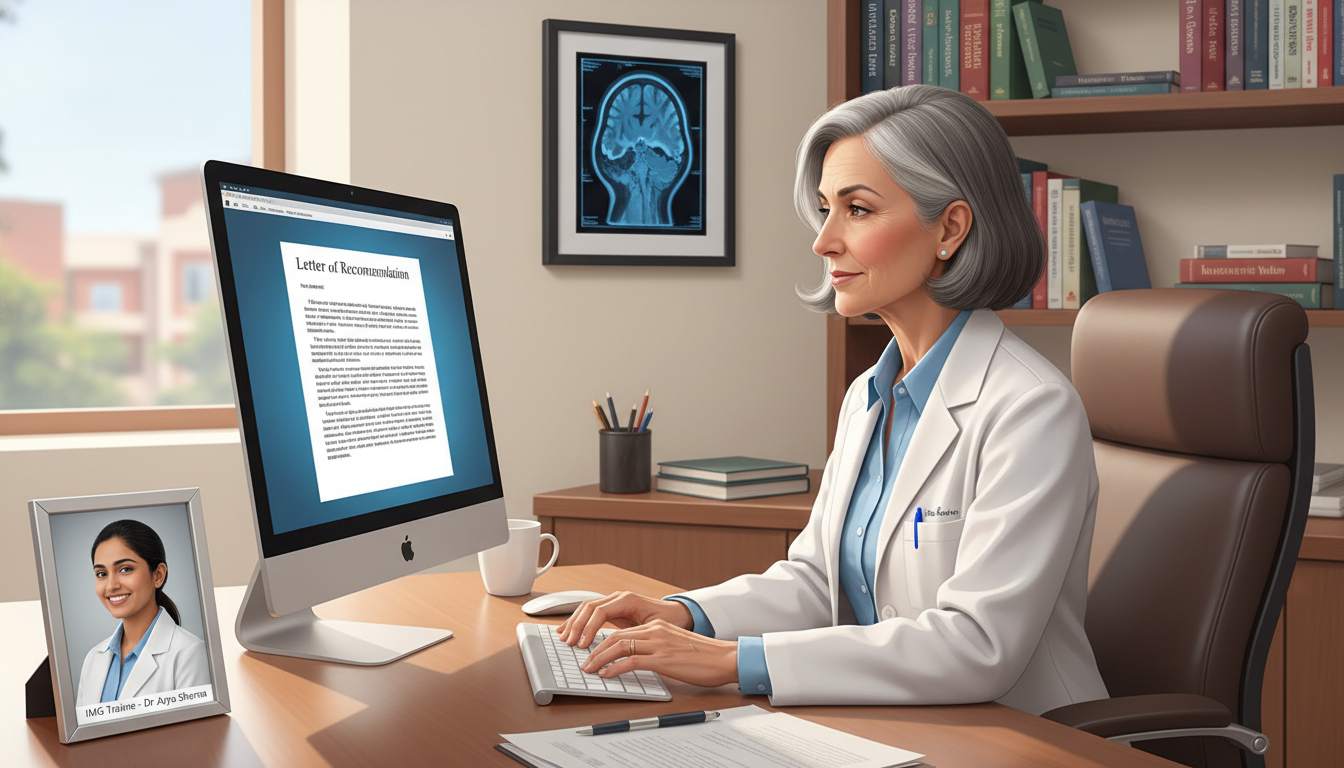
Knowing how to get strong LOR is as important as who you ask. Even excellent clinicians may write generic letters if you do not guide and prepare them properly.
Timing: When to Ask
- Ask near the end of your rotation, ideally in the final week, when your performance is fresh in their mind.
- If you feel unsure about how they view your performance, preface with:
- “I’ve really appreciated working with you. Do you feel you know my work well enough to write a strong letter of recommendation for neurology residency?”
This question allows them to decline politely if they cannot write a strong letter, saving you from a lukewarm LoR.
How to Ask (In Person and by Email)
In person (ideal):
Express specific appreciation:
- “I’ve learned a lot from the way you approach stroke localization and acute management.”
Make a direct, professional request:
- “Would you feel comfortable writing a strong letter of recommendation for my neurology residency applications?”
Explain logistics briefly:
- “The letters will be uploaded through ERAS in the coming months. I can send you my CV, personal statement draft, and a summary of our work together.”
Follow-up email template:
Subject: Neurology Residency Letter of Recommendation – [Your Name]
Dear Dr. [Last Name],
Thank you again for the opportunity to work with you on the [service name] rotation in [month/year]. I especially appreciated learning from your approach to [specific case/teaching point].
As we discussed, I am applying to neurology residency this cycle and would be very grateful if you could provide a strong letter of recommendation on my behalf. I have attached my current CV, a draft of my personal statement, and a brief summary of my clinical activities and cases from our rotation to help with letter writing.
The letter can be uploaded directly to ERAS, and I will list you as a recommender as soon as the application portal opens. Please let me know if you need any additional information.
Thank you again for your time and mentorship.
Sincerely,
[Your Full Name]
[IMG status, e.g., Medical Graduate, [School], Year]
[Contact information]
What to Provide to Your Letter Writers
To help them write detailed, neurology-focused letters:
- Your CV (updated, with neurology experiences clearly highlighted)
- Personal statement draft (even if not final, so they understand your narrative)
- ERAS AAMC ID (for easy identification)
- List of neurology programs or types of programs you are targeting (e.g., academic vs community, geographic preferences)
- Bullet summary of your work with them, including:
- Dates and type of rotation
- Specific patients or cases you managed
- Topics you presented
- Any feedback or areas of improvement you acted on
- Research, QI, or teaching activities you participated in
Providing these materials is not “telling them what to write”; it is giving them the tools to be specific and convincing.
Handling Non-U.S. or Non-Neurology Writers
If one of your strongest mentors is outside neurology or outside the U.S.:
- Clearly explain your neurology goal and why their perspective matters (e.g., they supervised your core clinical performance, professionalism, or long-term growth).
- Provide a short paragraph describing your neurology focus, including specific rotations, research, or exams.
- Politely suggest that they mention how your skills and attributes would translate into neurology training (e.g., clinical reasoning, communication, work ethic).
Practical FAQs for IMGs Seeking Neurology LoRs
How many letters of recommendation should an IMG applying to neurology have?
Most neurology programs accept up to 3 or 4 letters through ERAS. A strong approach for most IMGs:
- 3 letters minimum, with:
- At least 2 neurology letters (preferably U.S.-based)
- 1 additional clinical or research letter (U.S. or home country)
Some programs specify that at least one letter should be from a neurologist, or from a department chair. Always check individual program requirements and tailor your selection in ERAS accordingly.
Do my letters need to be “waived” (confidential) in ERAS?
Yes—whenever possible, you should waive your right to view the letters. Program directors tend to place greater trust in letters that are confidential, as they believe writers are more candid. If a writer offers to show you the letter, you can politely decline and say you prefer that they submit it directly through ERAS.
Is a research letter in neurology helpful for an IMG?
A neurology or neuroscience research letter is very helpful when:
- The mentor supervised you closely
- You had substantial, long-term involvement
- The letter can describe specific analytical skills, initiative, and academic potential
However, a research letter does not replace clinical letters. For a neurology residency application, at least 2 letters should address your clinical performance, patient care, and team interactions.
What if my only U.S. experiences are observerships?
Observership letters are more challenging because:
- You usually do not have direct patient responsibility
- Faculty see many short-term observers
To maximize their value:
- Be consistently present, engaged, and prepared
- Ask for small, appropriate tasks (preparing brief presentations, summarizing articles, observing specific procedures)
- Ask for feedback and incorporate it visibly
- Request a letter only from those who have actually interacted with you repeatedly and can comment on your knowledge, communication, and professionalism
You should combine such letters with strong home-country neurology letters that describe your direct patient care roles and responsibilities.
Final Thoughts: Turning LoRs into a Strength for Your Neuro Match
For an international medical graduate, letters of recommendation are not just a checkbox; they are a central part of your neurology residency story. By:
- Choosing rotations strategically
- Performing as a future neurology resident from day one
- Being explicit about your specialty goals
- Selecting the right letter writers
- Providing them with focused, detailed background material
…you can transform your LoRs from generic endorsements into powerful, neurology-specific evidence of your readiness.
Used wisely, your letters will do more than say you are “hard-working.” They will show program directors that you can localize a lesion, communicate complex conditions with empathy, work effectively on busy teams, and contribute meaningfully to their neurology residency program from day one.