Understanding the Power of Letters of Recommendation in Radiology for IMGs
For an international medical graduate (IMG) applying to a U.S. diagnostic radiology residency, letters of recommendation (LORs) are not a formality—they are one of the most powerful components of your application.
Radiology program directors consistently rank residency letters of recommendation among the top factors in interview and rank-list decisions. For IMGs, strong letters can:
- Validate that your international training prepared you for U.S. residency
- Offset unfamiliar medical schools or grading systems
- Demonstrate your readiness for a highly competitive specialty like radiology
- Provide context for non-traditional paths, gaps, or visa needs
This IMG residency guide focuses on exactly what you need to do—step by step—to build excellent LORs for the diagnostic radiology match, and how to get strong LOR that truly differentiates you.
What Makes a Strong Radiology Letter of Recommendation?
Before deciding who to ask for letters, you need to understand what a “strong” diagnostic radiology letter actually looks like.
1. Specialty-Specific, Not Generic
For radiology, program directors want to see:
- Direct comments on your visual reasoning, pattern recognition, and attention to detail
- Observations about how you handle image interpretation, diagnostic uncertainty, and clinical correlation
- Evidence of your interest and commitment to a radiology career
Example of strong specialty-specific content:
“During his four-week diagnostic radiology elective, Dr. Ahmed systematically approached each chest CT with an organized search pattern, consistently identifying subtle findings such as small pulmonary emboli and early ground-glass opacities that several of his peers missed.”
Versus a weak, generic line:
“Dr. Ahmed is a hardworking, pleasant physician who will do well in any field he chooses.”
2. Specific, Behavioral Examples
The best LORs show, not tell. Look for attendings who can describe:
- Specific cases you worked on
- How you handled high-volume reading room workflow
- Times you demonstrated extra initiative or curiosity
- Concrete examples of teamwork or communication with clinicians
Program directors are less impressed by broad adjectives (“excellent,” “hardworking”) and more by clear narratives:
“On a busy overnight call with over 80 imaging studies, Dr. Nguyen helped triage STAT cases appropriately, identified an acute aortic dissection on CTA, and clearly communicated the findings to the ED team, directly impacting emergent management.”
3. Clear Comparative Statements
Radiology program directors like letters that place you in context:
- “Top 5% of students I have supervised in the last 10 years”
- “Among the three best IMG rotators I have worked with”
- “Significantly above the typical level of a sub-intern in diagnostic reasoning”
These comparative statements help reviewers interpret your performance across different schools and systems.
4. Credible, Recognizable Authors
For an IMG in radiology, strong writers may include:
- U.S.-based diagnostic radiology attendings (gold standard)
- Radiology program directors, associate program directors, or department chairs
- Radiology clerkship directors
- Non-radiology U.S. attendings who worked with you closely (e.g., internal medicine, surgery, ICU) and can comment on your clinical ability and professionalism
International radiologists can still write useful letters, but most programs give more weight to recent U.S. clinical experience (USCE) letters, particularly from radiology.

Who to Ask for Letters: Building the Optimal LOR Mix as an IMG
A key part of this IMG residency guide is clarifying who to ask for letters. Many IMGs worry they need “famous names” or only radiologists. In reality, the best set of letters is balanced, recent, and specific.
Ideal LOR Composition for an IMG Applying to Diagnostic Radiology
Aim for 3–4 letters total (ERAS allows up to 4 per program):
Best-case combination:
U.S. Radiology Letter #1
- From an attending who directly supervised you in a U.S. diagnostic radiology elective, sub-internship, or observership with meaningful engagement
- Should highlight your image interpretation skills, work ethic, and specialty choice
U.S. Radiology Letter #2
- From a different radiologist or a radiology program director
- Can complement the first letter by emphasizing other strengths (research, teaching, call readiness, etc.)
U.S. Clinical Letter (Non-radiology)
- From an internal medicine, surgery, or ICU attending who saw you in a direct patient care role
- Confirms that you are clinically sound, reliable, and professional—important for radiologists who must communicate effectively with clinical teams
Optional: Research or International Radiology Letter
- From a radiology researcher, PhD, or international radiologist who supervised your research or substantial clinical work
- This can be particularly valuable if you are applying to academically focused or research-heavy radiology programs
Priorities If You Have Limited U.S. Exposure
If you are constrained by visa issues, finances, or opportunities:
- Prioritize at least one strong U.S. radiology letter
- Next priority: a U.S. clinical letter in any specialty where you had close supervision
- Then add strong international radiology letters that document sustained, meaningful radiology experience
Programs understand not every international medical graduate will have multiple U.S. radiology rotations, but they are reassured if they see at least one strong U.S.-based letter plus evidence of durable performance in your home country.
Who Not to Ask (Common Pitfalls)
Avoid or be cautious with:
- Letters from people who barely know you (“shadowed me for 3 days”)
- Letters written by non-physicians (unless in a research context and clearly framed as a research reference)
- Overly generic “template” letters that could apply to any student
- Letters from relatives or personal friends, even if they are physicians
If you must include a letter from someone with limited direct observation, it should be supplemental, not your primary clinical or radiology LOR.
How to Get Strong LOR: Step-by-Step Strategy for IMGs in Radiology
Knowing who to ask is only half the task; the other half is how to get strong LOR that stand out in the diagnostic radiology match.
Step 1: Plan Early—Before Your Rotations
As an IMG, you often have fewer opportunities and less time in each U.S. setting. Start planning before you ever set foot in a U.S. radiology department.
- Identify potential radiology electives, observerships, or externships at least 6–12 months in advance
- Research which institutions have a track record of hosting IMGs and supporting their residency applications
- If possible, select rotations with programs that have diagnostic radiology residencies—attendings there are familiar with the match process
Go into each rotation with a clear goal: “I want to earn a strong letter from this experience.” That mindset will shape your daily behavior.
Step 2: Excel Daily and Signal Your Interest
During your radiology rotation or observership:
- Arrive early, stay engaged, and volunteer for cases and tasks
- Ask focused, thoughtful questions about image interpretation, protocols, and differential diagnoses
- Read about cases you see and follow up the next day with literature or learning points
- Express your specific interest in diagnostic radiology and your career goals as an international medical graduate
Subtle but important: make sure at least one attending knows clearly that you plan to apply for diagnostic radiology and will likely request a letter. This helps them pay closer attention to your performance.
Step 3: Choose Your Letter Writers Strategically
By the mid to late part of your rotation, you can usually identify who knows your work best. Strong candidates for letters:
- Have observed you frequently (daily or several times per week)
- Have seen you interpret or discuss imaging, not only observe passively
- Have praised your work or given positive formative feedback
- Seem engaged in teaching and willing to mentor(small but important clue: they give specific feedback, invite questions, etc.)
If your best mentor is a mid-career attending rather than the department chair, that is perfectly fine. A detailed, enthusiastic letter from someone who truly knows you is usually better than a two-line letter from a famous name.
Step 4: Ask Clearly and Professionally
When asking, do it in person if possible (during your rotation), then follow up by email. Your key question:
“Would you feel comfortable writing a strong letter of recommendation in support of my application to diagnostic radiology residency in the U.S.?”
Adding the word “strong” is important; it gives the faculty member permission to say no if they do not feel able to support you enthusiastically.
If they hesitate, or say they can write a “standard” letter, consider that a red flag and ask someone else. A lukewarm letter can harm more than help.
Step 5: Provide Supporting Materials (Without Writing It Yourself)
Once they agree, help them write a focused letter by providing:
- Your CV
- Your personal statement draft (especially your reasons for radiology and your IMG background)
- Your USMLE scores and graduation year
- A brief summary of cases, projects, or tasks you did with them
- A short paragraph reminding them of specific instances that showcased your teamwork, reasoning, or initiative
You are not writing the letter for them—you are giving them raw material so they can write a detailed, authentic letter efficiently.
Example email segment:
“To help you, I’ve attached my CV and personal statement draft. I also summarized a few specific cases we worked on together (e.g., the acute stroke CT/CTA case and the testicular torsion ultrasound) that might be relevant if you choose to mention them.”
Step 6: Mind the Timeline
For the diagnostic radiology match:
- Ideally, request letters 2–3 months before ERAS submission
- Aim to have all letters uploaded at least 1–2 weeks before you submit ERAS, so programs see complete applications early
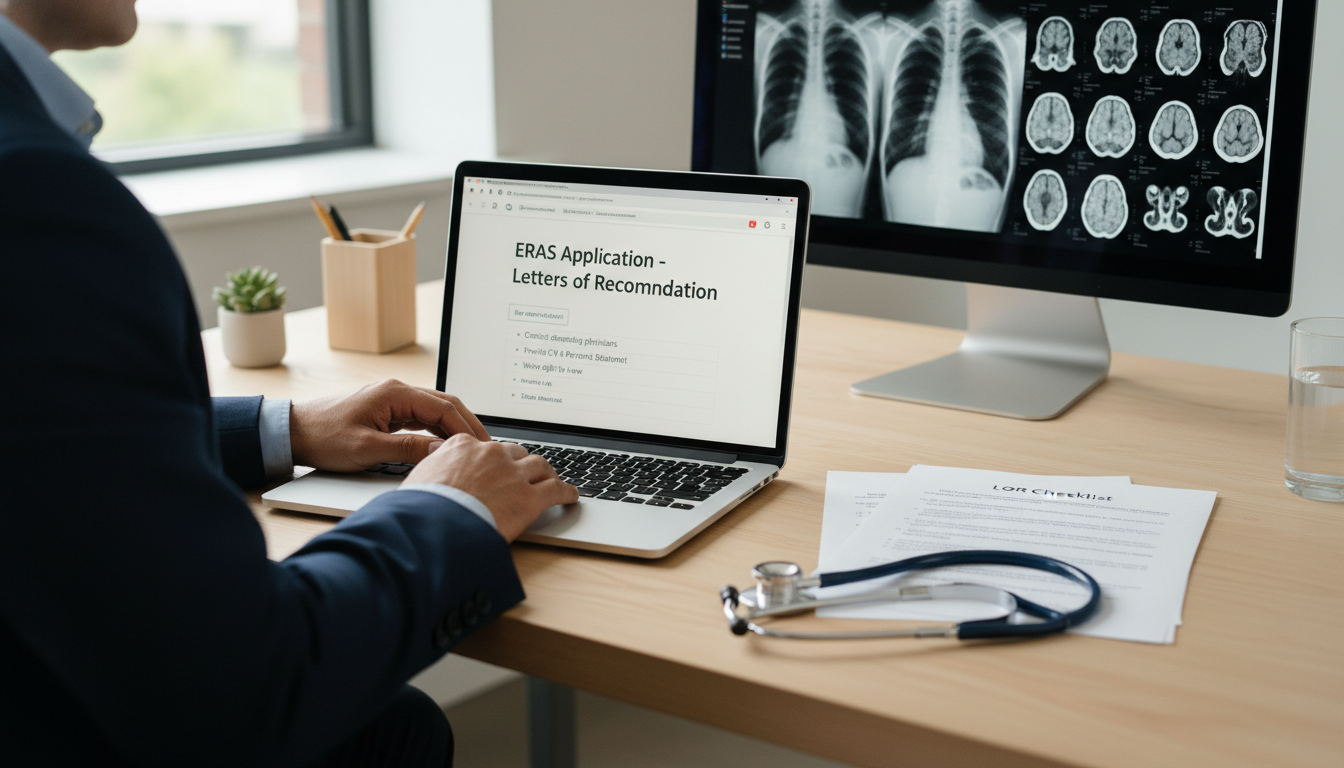
- Use ERAS’s LOR portal and track letter status; send polite reminders if letters are pending two or more weeks before your target date
If you will leave the institution before ERAS opens, ask your writer if they prefer:
- To upload the letter immediately into ERAS (if the portal is open), or
- To write it now and upload it later when you email them the ERAS letter request
Special Considerations for IMGs in the Diagnostic Radiology Match
1. Balancing International and U.S. Letters
A common question: “Can I use letters from my home country?”
Yes—but use them strategically.
For an international medical graduate, a balanced set might be:
- 2 letters from U.S. physicians (at least one radiologist)
- 1 letter from an international radiologist who supervised you extensively, especially if you have years of experience
- 1 optional research letter (if heavily involved in radiology research)
International letters are particularly valuable if they:
- Document long-term relationships (e.g., two years as a radiology trainee or junior staff)
- Show you have already functioned at a higher level of independence
- Describe significant responsibilities (teleradiology reporting, emergency imaging, night call, etc.)
2. Radiology Research Letters
If you have done radiology research, especially in the U.S.:
- A research letter can strongly support your academic potential, critical thinking, and persistence
- Ensure the letter writer emphasizes not just your technical skills, but also professionalism, communication, reliability, and teamwork—traits important in residency
Programs will not accept research letters as a substitute for all clinical letters, but they can significantly strengthen an already solid set.
3. Addressing Gaps, Delays, or Non-Linear Paths
Many IMG applications have:
- Gaps between graduation and application
- Extended research periods
- Work as a radiology resident or radiologist abroad
A good letter of recommendation can help contextualize these:
- A supervisor from your work or training site can explain that you were practicing clinically, not idle
- They can emphasize that your prior radiology experience has made you more mature and prepared for U.S. training
- For visa issues or delayed exams, a letter can describe your persistence and resilience
If you have any significant concerns (e.g., extended time off, career transition), consider directly asking one letter writer to briefly and positively address them.
4. ERAS Logistics for LORs
As you prepare your ERAS application for the diagnostic radiology match:
- Each letter must be uploaded to ERAS and assigned to programs
- You can upload more letters than you assign, and select different combinations for different programs if needed (e.g., more research-focused letters to academic programs)
- Radiology programs do not usually require a “Dean’s letter” as one of the 3–4 LORs; the MSPE is separate
Label your letters clearly in ERAS (e.g., “Radiology – Dr. Smith, Academic Center, U.S.”) so you can track and assign them correctly.
Practical Examples: What a Strong Radiology LOR Might Highlight
To help you visualize what reviewers want to see, here are some types of content commonly found in effective radiology letters for IMGs:
Clinical and Diagnostic Skills
- “Dr. Patel consistently correlated radiologic findings with the clinical scenario, often suggesting additional imaging or alternative diagnoses that refined patient management.”
- “He demonstrated a sophisticated understanding of CT protocols and radiation exposure, asking appropriate questions about contrast timing and dose reduction.”
Work Ethic and Adaptability
- “As an IMG unfamiliar with our system at first, she quickly adapted to our PACS, voice recognition, and workflow, and by the end of the rotation was functioning at the level of a senior U.S. medical student.”
Communication and Teamwork
- “He proactively clarified clinical questions from the ED team and communicated critical findings directly and clearly, demonstrating professionalism and maturity.”
Commitment to Radiology
- “Dr. Lopez attended every resident noon conference, often lingering afterward to ask follow-up questions and discuss cases. He also completed a self-directed mini-project on incidental pulmonary nodules, which he later presented to the group.”
These types of details reassure program directors that—despite the additional risk they may feel in ranking an international medical graduate—you are fully prepared for the demands of a U.S. diagnostic radiology residency.
Actionable Checklist for IMGs: From Today to Match Day
Use this as a practical roadmap:
6–18 Months Before ERAS Submission
- Identify target programs and locations for radiology electives/observerships
- Secure at least one or two U.S. radiology rotations if possible
- Start building relationships with faculty and research mentors (even remotely)
During Each Rotation
- Show up early; be present and engaged in the reading room
- Verbally express your interest in diagnostic radiology
- Ask for feedback mid-rotation; adjust and improve based on it
- Identify attendings who know your work well
4–6 Months Before ERAS
- Decide who to ask for letters (aim for 3–4 total)
- Ask in person or via video when possible, using the phrase “strong letter of recommendation”
- Provide CV, personal statement, and a bullet list of your contributions
2–3 Months Before ERAS Submission
- Send ERAS letter requests to your writers
- Monitor ERAS for letter upload status
- Send polite, brief reminder emails if letters are pending
Before ERAS Submission
- Confirm all letters are uploaded and properly labeled
- Assign 3–4 letters to each diagnostic radiology program according to your strategy (e.g., research-heavy vs community programs)
By following this structured approach, you transform LORs from a source of anxiety into a carefully planned strength of your application.
FAQs About Letters of Recommendation for IMGs in Diagnostic Radiology
1. How many radiology-specific letters do I need as an IMG?
Most diagnostic radiology programs are happy with 2 radiology-specific letters plus 1–2 additional clinical or research letters. At minimum, aim for one strong U.S. radiology letter. If you cannot secure two U.S. radiology letters, consider:
- 1 U.S. radiology letter
- 1 international radiology letter
- 1 U.S. clinical letter (non-radiology)
This still shows both specialty interest and adaptability to U.S. practice.
2. Are letters from my home country useful for the diagnostic radiology match?
Yes, especially if they:
- Reflect long-term, substantial radiology experience (years, not weeks)
- Come from a senior radiologist, residency director, or department chair
- Include concrete examples of your skills, responsibilities, and work ethic
However, they usually cannot replace all U.S. letters. Programs value at least one letter from a U.S.-based physician who can confirm you understand the U.S. clinical environment.
3. Is it better to have a brief letter from a famous professor or a detailed letter from a lesser-known attending?
For residency letters of recommendation, especially in radiology, content is more important than fame. A detailed, specific, and enthusiastic letter from an attending who knows you well almost always outweighs a short, generic letter from a famous name who barely interacted with you.
If you can have a famous professor who also knows you well and writes a detailed letter, that’s ideal—but do not sacrifice substance for prestige.
4. Can I reuse the same LORs if I have to reapply next year?
Yes. Strong letters, especially if they are recent, can be reused in a future cycle. However:
- If more than 2 years have passed, try to obtain at least one new or updated letter, especially if you have done new rotations, research, or clinical work
- You can ask a previous writer if they are willing to update the letter to reflect your recent progress
For a reapplicant IMG, showing growth and continued commitment to diagnostic radiology through new experiences and at least one fresh letter can be very helpful.
Thoughtful, well-planned letters of recommendation can significantly strengthen your profile as an international medical graduate applying for diagnostic radiology. By choosing the right writers, preparing them effectively, and timing everything well, you give programs exactly what they need to feel confident ranking you highly.