
Why Letters of Recommendation Matter So Much for Caribbean IMGs in Family Medicine
For a Caribbean international medical graduate (IMG), letters of recommendation (LORs) are one of the most powerful parts of your family medicine residency application. Program directors know your USMLE scores and transcript only tell part of the story—especially for Caribbean medical school residency applicants, where they may be less familiar with your school and clinical grading system.
Strong LORs can:
- Validate your clinical skills in the U.S. system
- Reassure programs about your professionalism and work ethic
- Highlight your specific fit for family medicine residency
- Offset concerns about being a Caribbean IMG by providing trusted endorsements
Whether you are aiming for community programs in the Midwest or an SGU residency match in a large academic center, programs will look closely at who wrote your letters, what they say, and how clearly they support your readiness for an FM match.
This article breaks down exactly how to get strong LORs as a Caribbean IMG targeting family medicine—who to ask, when to ask, what to provide, and how to avoid common pitfalls.
Understanding What Makes a Strong Family Medicine LOR
Before you think about who to ask for letters, you need to understand what “strong” actually means in the context of residency letters of recommendation.
Key Elements of a Strong LOR
A powerful LOR for family medicine should contain:
Clear clinical context
- Where you worked with the writer (outpatient clinic, inpatient service, sub‑I, elective)
- How long and how closely they supervised you
- What level of responsibility you carried
Specific behavioral examples
- How you managed a complex diabetic patient
- An instance where you handled a difficult family discussion
- A moment when you took extra initiative for patient care
Direct comparison to peers
- “Among the top 10% of medical students I have supervised”
- “One of the strongest Caribbean IMG students I’ve worked with in the last 5 years”
Alignment with family medicine values Program directors want to see evidence of:
- Patient-centered communication
- Teamwork and collaboration with nursing, social work, and allied health
- Breadth of knowledge across age groups and conditions
- Longitudinal thinking and continuity of care mindset
- Cultural humility and serving diverse or underserved populations
Clear endorsement for residency
- “I recommend her without reservation for a family medicine residency position.”
- “I would be thrilled to have him as a resident in our program.”
LORs that are generic, vague, or lukewarm are often more harmful than helpful—especially for Caribbean medical school residency candidates who already face additional scrutiny.
Who to Ask for Letters (and How Many You Need)
Many Caribbean IMGs struggle most with this question: who to ask for letters that will actually help you in the FM match.
How Many Letters for Family Medicine?
Most family medicine programs require:
- 3 letters of recommendation, and
- Accept up to 4 letters in ERAS
A strong strategy for a Caribbean IMG applying to family medicine would be:
- 2 letters from family medicine physicians (ideally from U.S.-based clinical experience)
- 1 additional letter from:
- Internal medicine, pediatrics, or OB/GYN (especially if FM‑relevant), or
- A department chair or clerkship director (if supportive and knows you reasonably well)
If you apply to a few other primary care specialties, such as internal medicine, you can often reuse family medicine letters, as long as they are not overly FM-specific. But for a focused family medicine residency application, at least 1–2 letters should explicitly state your fit for family medicine.
Ideal Letter Writers for Caribbean IMGs Targeting FM
As a Caribbean IMG, you need to be especially strategic about your letter writers. Aim for:
U.S.-based faculty who directly supervised you
- Family medicine attendings in core or elective rotations
- Preceptors at community clinics or FQHCs
- Inpatient FM hospitalist attendings
People who know you well enough to be specific
- Avoid letters from “big names” who barely remember you
- A detailed letter from a community preceptor is usually stronger than a generic note from a department chair who doesn’t know your work
Writers familiar with residency expectations
- Faculty who routinely work with students and residents
- Clerkship directors, site directors, or core clinical faculty
Letter writers who are comfortable supporting a Caribbean IMG
- Someone who has previously written for Caribbean graduates who successfully matched
- A faculty member who explicitly states they are happy to support your application despite the stigma sometimes associated with Caribbean schools
Example: Smart LOR Mix for a Caribbean IMG
A strong LOR set for a Caribbean IMG targeting FM might look like this:
Family Medicine #1 (Anchor Letter)
- Outpatient FM preceptor from a busy community clinic
- Worked with you for 4–6 weeks
- Emphasizes continuity of care, communication, and clinical reasoning
Family Medicine #2
- Inpatient FM attending or sub‑I preceptor
- Highlights your ability to handle volume, cross-cover, and work in teams
Third Letter
- Internal medicine or pediatrics attending from a U.S. rotation
- Shows versatility, strong baseline knowledge, and professionalism
- Optional: a research mentor if the work is directly related to primary care or community health and they know you clinically
If you are an SGU student aiming for an SGU residency match at an affiliate hospital, prioritize at least one strong letter from a site where SGU has a strong track record, as these faculty understand the pathway and can comment confidently on SGU Caribbean medical school residency applicants.

When and How to Ask for Letters (Without It Being Awkward)
Knowing how to get strong LOR letters is as much about timing and communication as it is about your performance.
Ideal Timing for Requesting Letters
For most Caribbean IMGs:
- Ask at the end of the rotation while you’re still fresh in the writer’s mind
- For rotations done early in third year, send a reminder 2–3 months before ERAS opens
- If possible, align at least one FM rotation within 6–9 months of your application season to obtain a recent, high-impact letter
If you finished a great FM rotation but didn’t ask for a letter at the time, it’s still worth contacting them later, as long as:
- You spent meaningful time with them (at least 3–4 weeks), and
- You can jog their memory with your evaluations, notes, or a brief recap of cases you worked on
How to Ask: The “Strong Letter” Question
One of the most important skills you can develop is learning how to ask specifically for a strong LOR.
In person or via email, use wording like:
“I really enjoyed working with you during my family medicine rotation, and I learned a lot from your teaching. I’m applying to family medicine residency this cycle and was wondering if you would feel comfortable writing me a strong letter of recommendation to support my application.”
If they hesitate or say anything less than an enthusiastic yes (e.g., “I can write a letter” but without “strong” or “positive”), that’s a red flag. You may want to ask someone else.
What to Provide to Your Letter Writers
Make it easy for them to write a detailed, supportive, and FM‑aligned letter. Provide:
- Your CV (highlighting clinical experience, volunteer work, leadership, and research)
- Personal statement draft (especially if it clearly explains why family medicine)
- ERAS letter request form with correct details
- A brief summary of your work with them, including:
- Dates and location of rotation
- Specific patients or cases you managed under their supervision
- Any feedback they gave you during the rotation
- Your career goals (family medicine focus, geographic preferences, interest in underserved care, etc.)
You might also include a short bullet list of qualities you hope they can comment on, such as:
- Clinical reasoning and independence
- Communication with patients and families
- Teamwork and professionalism
- Reliability and punctuality
- Fit for family medicine and primary care
This isn’t “telling them what to write”—it’s helping them remember your strengths and giving them structure.
Professional Follow-Up
After they agree to write:
- Send a thank-you email immediately with all documents attached
- Gently follow up if the letter is not uploaded within 2–3 weeks of your target date
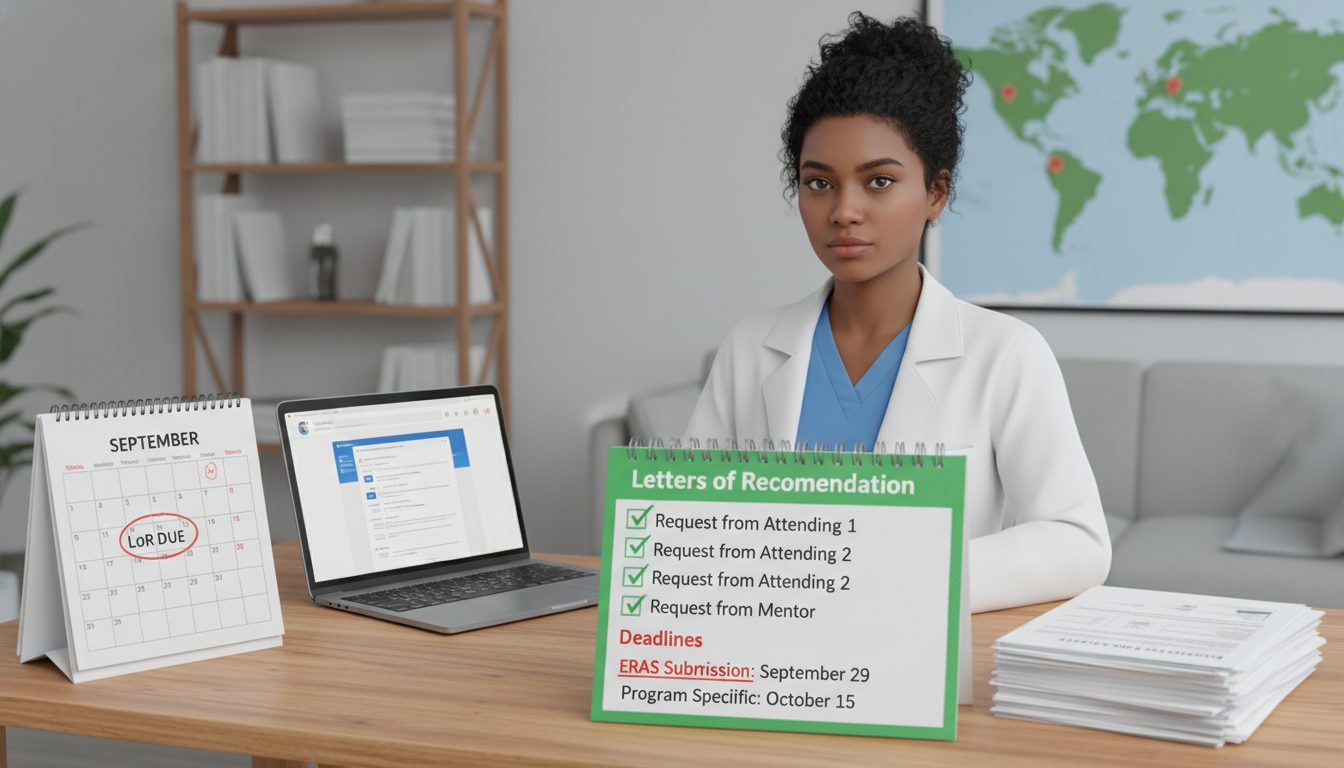
- In ERAS season, try to have all letters uploaded at least 1–2 weeks before September 15, so your application is complete on day one
And always send a thank-you update after you match—faculty appreciate seeing where their students end up, especially Caribbean IMGs who often had to overcome extra barriers.
Crafting LORs That Speak Directly to Family Medicine Programs
Family medicine program directors want to know: Are you genuinely committed to FM, and do you understand what the specialty involves?
Your letters are one of the best ways to demonstrate this.
Traits FM Programs Look for (That Letters Should Highlight)
Ask—or structure your supporting materials—so your letter writers naturally highlight these traits:
Communication and counseling skills
- Explaining chronic disease management in understandable language
- Motivational interviewing examples (smoking cessation, lifestyle changes)
- Building rapport quickly in a busy clinic
Breadth of clinical exposure
- Working with pediatric, adult, and geriatric patients
- Managing both acute and chronic problems in the same session
Continuity and follow-through
- Calling patients with results
- Following up on referrals or test abnormalities
- Remembering details about patients across visits
Teamwork and interprofessional collaboration
- Working well with nurses, MAs, social workers, pharmacists, case managers
- Learning from and respecting each role on the care team
Cultural humility and service to diverse/underserved communities
- Many Caribbean IMGs excel here due to personal background and training
- Experiences at community clinics, FQHCs, or rural sites are particularly valuable
Resilience and maturity
- Adapting to new health systems
- Handling stress and feedback professionally
- Navigating the transition from Caribbean medical school to U.S. clinical environments
Example: What a Strong Family Medicine Paragraph Might Look Like
“During his four-week family medicine sub-internship on our inpatient service, Dr. R. consistently demonstrated strong clinical reasoning, independent follow-through, and excellent communication with both patients and the multidisciplinary team. I was particularly impressed when he took the initiative to coordinate a complex discharge plan for an uninsured patient with newly diagnosed heart failure, mobilizing social work, pharmacy, and outpatient follow-up resources. His ability to consider the patient’s social context, financial constraints, and health literacy reflects the holistic, patient-centered approach that is central to our specialty.”
If your letter writers are busy, your case summaries and bullet points can prompt this level of detail.
Special Considerations for Caribbean IMGs in the FM Match
As a Caribbean IMG, you face specific challenges—and your letters can help address them head-on.
Addressing the “Caribbean School” Factor
Program directors may worry about:
- Variability in clinical training quality
- Less direct observation early in training
- USMLE performance and exam readiness
Strong LORs can counter these concerns by:
- Emphasizing your clinical competence relative to U.S. students
- Explicitly stating when you performed at the level of, or above, U.S. MD/DO students
- Highlighting your work ethic, adaptability, and growth during U.S. rotations
For example:
“Despite coming from a Caribbean medical school, Ms. L.’s performance was on par with, and in some instances exceeded, that of U.S. medical students rotating on our service. She integrated seamlessly into the team and demonstrated a level of maturity and professionalism consistent with an incoming intern.”
Statements like these carry significant weight in the Caribbean medical school residency context.
Aligning Rotations and Letters With FM Goals
If you’re aiming specifically for a family medicine residency:
- Prioritize core FM rotations and FM electives in the U.S.
- Seek out sub-internships in FM or hospitalist services affiliated with FM departments
- Consider rotations at programs where Caribbean IMGs, including those from SGU, have previously matched
If you’re an SGU student or from another major Caribbean school, check:
- Which programs commonly match Caribbean IMGs or SGU residency match graduates
- Try to rotate at those sites and secure letters there; faculty are familiar with your background and can vouch for your performance in a way that aligns with their program’s needs
Using LORs to Complement Your Application Profile
Think of your letters as part of a strategic narrative:
- If your Step 1 or Step 2 CK scores are modest, letters should highlight:
- Clinical judgment that exceeds what test scores alone might suggest
- Rapid improvement and self-directed learning
- If you had a leave of absence or delay, letters should:
- Emphasize your maturity, resilience, and current readiness for residency
- If you changed your target specialty to FM:
- At least one letter should make a clear, convincing case for your genuine interest in and fit for family medicine
The more your letter writers understand your story, the better they can advocate for you.
Practical Step-by-Step Plan: From Rotations to Strong LORs
To put everything together, here’s a concrete approach tailored for Caribbean IMGs targeting FM:
Step 1: Before the Rotation
- Clarify your goal: “I’m aiming for a family medicine residency in the U.S.”
- Let your attending know early that you’re interested in FM
- Ask how they like to work with students—expectations, case write-ups, presentations
Step 2: During the Rotation
- Show up early, stay engaged, volunteer for tasks
- Ask for mid-rotation feedback:
- “What am I doing well?”
- “What can I improve before the end of the rotation?”
- Demonstrate consistent growth based on feedback
This mid-rotation conversation often strengthens the eventual letter, because the attending can comment on your responsiveness and development.
Step 3: End-of-Rotation Conversation
In the last week:
Ask for verbal feedback.
If positive, ask for a strong letter:
- “Based on your experience working with me, do you feel you could write a strong letter of recommendation for my family medicine residency applications?”
If they agree:
- Confirm their preferred email and process
- Ask if there are any specific things they’d like you to send (CV, personal statement, etc.)
Step 4: Follow-Up Email Template (Simplified)
You can adapt something like:
Dear Dr. [Name],
Thank you again for the opportunity to work with you during my family medicine rotation at [Site] from [dates]. I truly appreciated your teaching and the chance to see a broad range of patients in the clinic.
As we discussed, I am applying to family medicine residency this upcoming ERAS cycle and would be very grateful for a strong letter of recommendation from you. I have attached my CV and personal statement draft, as well as a brief summary of some of the patients we saw together that I found especially meaningful.
Please let me know if there is any additional information I can provide. Thank you again for your support.
Sincerely,
[Your Name], [Caribbean Medical School], Class of [Year]
Step 5: Track and Confirm
- Maintain a simple spreadsheet:
- Writer’s name, specialty, rotation site, date requested, date ERAS request sent, date uploaded
- Check ERAS regularly to verify each letter’s status
- Gently remind writers 2–3 weeks before your internal deadline
FAQs: Letters of Recommendation for Caribbean IMGs in Family Medicine
1. Do I need all my letters to be from family medicine for an FM match?
No. For a strong family medicine residency application, aim for at least two letters from FM physicians who supervised you clinically in the U.S. The third can be from internal medicine, pediatrics, OB/GYN, or another rotation that shows your primary care strengths. What matters most is that your letters clearly support your fit for FM and speak to your clinical abilities and professionalism.
2. Is it better to have a letter from a famous academic or from a community preceptor who knows me well?
For a Caribbean IMG, a detailed letter from someone who knows you well is almost always more valuable than a generic note from a “big name” who barely worked with you. Program directors read between the lines; they want specific examples, strong language of support, and direct comparison to peers. Prestige matters far less than authenticity and depth.
3. Can I use the same letters for both family medicine and internal medicine applications?
Often yes, but with caution. A strong clinical letter that describes your performance on an inpatient or outpatient rotation can usually be used for both. However, if the letter is heavily tailored to family medicine (or to internal medicine), it may feel mismatched. Ideally, have at least one letter specifically supporting your family medicine application if FM is your primary target.
4. What should I do if a rotation went well but I never asked for a letter at the time?
You can still reach out, especially if the rotation was within the last 1–2 years. Email the attending:
- Remind them of who you are and when you rotated with them
- Share your CV and personal statement
- Provide a brief recap of memorable patients or cases you worked on together
- Ask if they feel comfortable writing you a strong LOR for family medicine residency
Many attendings are willing to help, particularly if your performance was solid and you make it easy for them to remember you.
By being intentional about who to ask for letters, how to get strong LOR support, and how to align your letters with the values of family medicine, you can significantly strengthen your chances of a successful FM match as a Caribbean IMG. Your letters are not just formal requirements—they are personal endorsements that can make your application stand out.