
Understanding Pathology Residency Letters of Recommendation as a DO Graduate
Letters of recommendation are one of the most important components of your pathology residency application, especially as a DO graduate. While your COMLEX/USMLE scores, transcripts, and personal statement matter, program directors consistently emphasize that residency letters of recommendation (LORs) often make the difference between a routine application and one that stands out.
For a DO graduate seeking a pathology residency, LORs serve several critical functions:
- They validate that you understand what pathology actually is and still want it.
- They demonstrate that people who practice or teach in the field would be comfortable training you.
- They help mitigate any perceived bias some allopathic programs may still have toward DO applicants by providing strong, detailed advocacy from credible recommenders.
This article will walk you through exactly how to get strong LORs, who to ask for letters, what makes a letter effective in the pathology match, and how to strategically use your recommendation letters to strengthen your osteopathic residency match prospects.
How Many Letters You Need—and What Types
Most pathology residency programs in the US ask for 3 letters of recommendation, plus the MSPE (Dean’s Letter). Always verify each program’s requirements in ERAS, but as a DO graduate targeting the pathology match, this is a strong baseline strategy:
Ideal LOR mix for a DO graduate in pathology:
1–2 letters from pathologists
- At least one from an academic pathologist (ideally at a teaching hospital with a pathology residency).
- If possible, one from a pathologist who knows you from elective, sub-internship, research, or significant project work.
1 letter from a clinical faculty member
- Someone who can speak to your work ethic, professionalism, communication, and clinical reasoning.
- Internal medicine, surgery, family medicine, or another core rotation is fine.
Optional: 1 research or specialty-specific letter
- If you have substantial research experience (especially in pathology, lab medicine, or basic science), a research mentor’s letter can be very powerful.
- This can be your 3rd or 4th letter if the program accepts more than three.
For DO graduates, having at least one strong letter from a pathologist is almost essential. It addresses the program’s key question: “Has this applicant had meaningful exposure to pathology, and does a pathologist think they are a fit for the field?”

Who to Ask for Letters: Pathology-Focused Strategy for DO Graduates
A major part of how to get strong LORs is being deliberate in who you ask. The right person who knows you well is more valuable than a big-name person who barely remembers you.
1. Pathologists You Have Worked Closely With
For the osteopathic residency match in pathology, your top priority is at least one strong letter from a pathologist. Ideal situations include:
Pathology elective or sub-internship
- You consistently showed up, were engaged at the microscope, asked good questions, and learned rapidly.
- You helped with grossing, previewing cases, tumor board prep, slide conferences, or quality improvement tasks.
Longitudinal or repeated exposure
- Multiple weeks on pathology services (surgical path, cytology, hematopathology, autopsy).
- Working with the same attending or small group of attendings who can compare your growth over time.
What makes these pathologist letters powerful:
- The writer can confirm you understand the day-to-day reality of pathology.
- They can describe your microscopic reasoning, work habits, and attention to detail.
- They help reassure programs that you’re making an informed and committed choice, especially important for DO graduates pivoting from more “traditional” clinical exposure.
2. Clinical Faculty Who Know Your Work Ethic and Professionalism
Pathology is still a clinical specialty with indirect but vital patient impact. Programs value letters from core clinical faculty who can speak to your:
- Accountability and reliability
- Teamwork and communication
- Ability to handle responsibility
- Empathy and professionalism with patients and staff
Good choices:
Internal medicine or surgery attending from a rotation where you:
- Took call or handled cross-coverage.
- Managed complex patients.
- Demonstrated careful documentation and follow-up.
Family medicine or primary care attending:
- Particularly good if you showed strong communication skills and a patient-centered approach, which translate to good interdepartmental collaboration in pathology.
These letters help residency programs see you as someone who will be easy to work with and safe to trust with important diagnostic decisions, even if you’re not at the bedside.
3. Research Mentors (Especially in Pathology or Lab Medicine)
If you’ve done meaningful scholarly work, especially in:
- Anatomic pathology
- Clinical pathology / laboratory medicine
- Hematopathology, microbiology, molecular diagnostics
- Or basic/translational science with tissue-based or lab-based methods
then a research PI or mentor can write a powerful letter that highlights:
- Intellectual curiosity and critical thinking
- Persistence and ability to handle complex problems
- Comfort with data, statistics, and analytical reasoning
- Scientific writing and presentation skills
This is particularly valuable for applicants who are:
- Interested in academic pathology
- Compensating for a slightly lower board score with strong scholarly engagement
- DO graduates applying predominantly to academic programs that value research
4. DO vs MD Letter Writers: Does It Matter?
For a DO graduate, programs do not require that your writers be MDs. DO pathologists and DO clinicians are absolutely acceptable and often excellent advocates. However, balance can help:
- Having a mix of DO and MD letter writers can reassure programs that you’ve been successful in diverse training environments.
- If you’re aiming at highly academic or historically MD-heavy departments, at least one MD pathologist or academic MD clinician letter can be beneficial—but not mandatory.
Focus more on strength and specificity than the degree behind the name.
How to Get Strong LORs (Not Just Generic Ones)
A letter’s real value isn’t just in the title of the writer; it’s in the content. Program directors are very good at recognizing “faint praise” versus genuine enthusiasm. Here’s how to get letters that truly help you in the pathology match.
1. Start Early and Build Relationships
During rotations: Identify attendings who:
- Teach regularly and thoughtfully.
- Give you feedback and seem invested in students.
- Have seen you handle complex or challenging situations.
Show longitudinal interest in pathology:
- Join your school’s pathology interest group.
- Attend tumor boards, autopsy conferences, or CPCs.
- Follow up with attendings about interesting cases or questions you had.
The better they know your personality, work habits, and growth, the richer their letter will be.
2. Ask the “Strong Letter” Question, Directly but Professionally
When it’s time to ask, do it in person or via a professional email:
- Use wording like:
- “Would you feel comfortable writing a strong letter of recommendation in support of my application to pathology residency?”
- This gives the faculty member a chance to decline if they can’t write a strong letter, which protects you from mediocre or lukewarm support.
If they hesitate, or suggest someone else, thank them and choose another recommender. A bland letter can hurt more than no letter.
3. Provide a Helpful Letter Packet
Make it easy for your letter writer to advocate for you. Include:
Updated CV
Personal statement (even a near-final draft)
Brief summary of your work together, such as:
- Rotations and dates
- Specific cases, presentations, or research projects you worked on
- Any positive feedback or milestones they mentioned during the rotation
A short bullet-point list of things you hope they might comment on:
- Your commitment to pathology
- Your analytical skills at the microscope
- Professionalism and teamwork
- Adaptability and learning curve
This isn’t telling them what to say; it’s refreshing their memory so they can write a concrete, detailed letter.
4. Know the Logistics and Deadlines
Clarify whether your school uses:
- A centralized LOR system
- A department letter packet
- Or direct uploads via ERAS
Give your writers:
- Clear instructions on where and how to upload
- A deadline 2–3 weeks before you really need the letter
Politely follow up:
- A gentle reminder one week before your deadline
- A thank-you email once it’s submitted
Attention to logistics shows professionalism and reduces the chance that a strong letter arrives late or never appears at all.
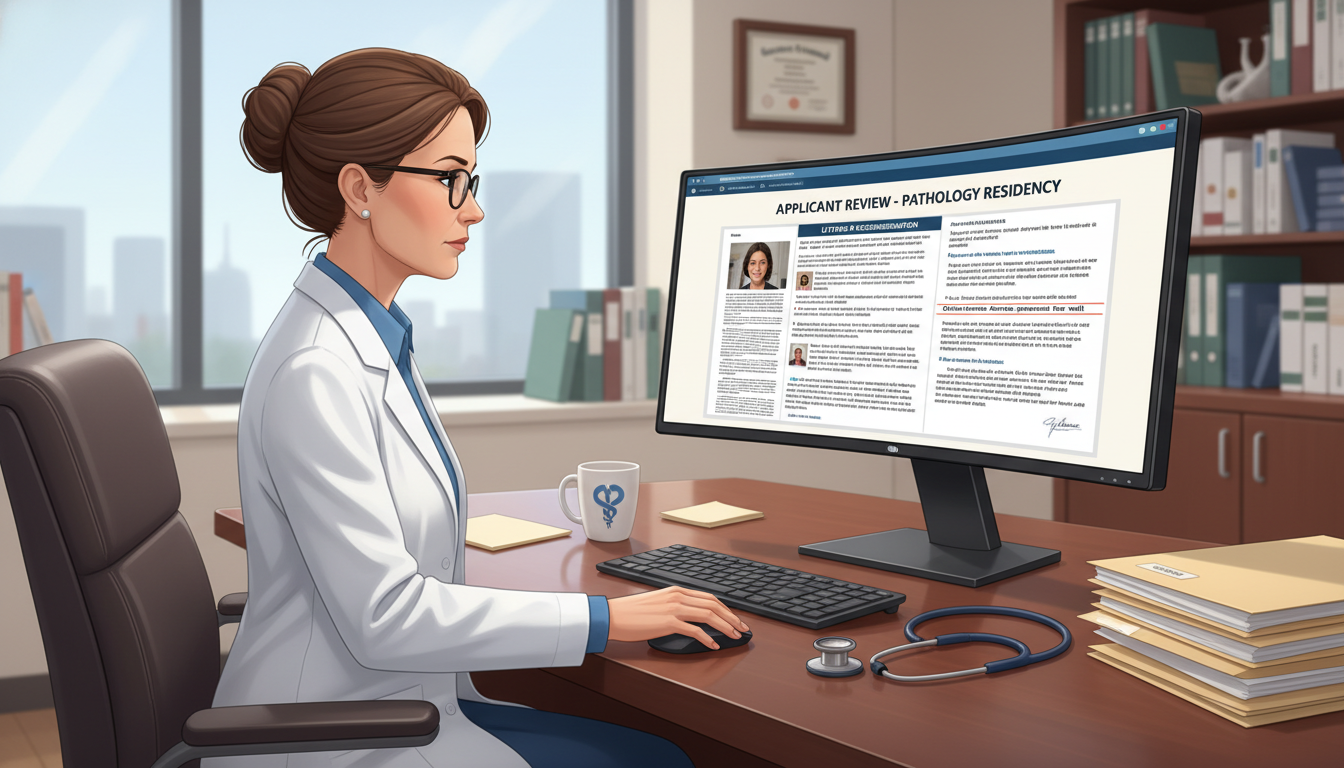
What Makes a Pathology LOR Effective for a DO Graduate?
Understanding what program directors look for helps you shape who you ask for letters and how you present yourself to those faculty.
1. Specific Evidence Over Generic Praise
Compare these two styles:
- Weak: “The student was always on time and showed interest in pathology. I believe they will make a good resident.”
- Strong: “On our surgical pathology service, the student independently reviewed 15–20 breast and GI biopsy cases each day, formulated preliminary diagnoses, and then revised their interpretations based on our sign-out discussions. Their ability to integrate histologic pattern recognition with clinical context improved steadily over the month.”
Pathology program directors prefer the second type: concrete examples, not vague adjectives.
2. Clear Endorsement of Specialty Fit
Because you’re a DO graduate—often with more early exposure to primary care—programs want reassurance that you’ve made an informed, intentional choice in pursuing pathology.
Strong letters will:
- Explicitly state that you are well suited for pathology.
- Describe features such as:
- Meticulous attention to detail
- Comfort with complex problem-solving
- Persistence in tracking down diagnostic answers
- Enthusiasm for microscopic and lab-based work
Phrases like “I would be delighted to have this student as a pathology resident in our program” or “I recommend this applicant to you without reservation” are particularly powerful.
3. Addressing DO-Specific Context (When Appropriate)
A strong LOR for a DO graduate in pathology can subtly reinforce your competencies and equivalence:
- Mentioning:
- Strong performance on COMLEX (and USMLE, if taken)
- Your ability to transition seamlessly into an academic environment
- Excellent performance on rotations with predominantly MD staff
Without making your degree the central issue, letters can help dismantle any lingering biases by highlighting your clinical performance, adaptability, and professionalism in diverse settings.
4. Commentary on Professionalism and Teamwork
Pathology is increasingly team-based—interfacing with:
- Surgeons and oncologists at tumor boards
- Clinicians in consultative roles
- Lab staff and technologists on the CP side
Letters that highlight your:
- Respectful interactions with non-physician staff
- Ability to communicate clearly and calmly
- Reliability under pressure
- Ethical behavior and integrity
are strongly valued—and can distinguish you from applicants with similar academic metrics.
Strategy: Aligning Your LORs With Your Pathology Career Goals
Beyond simply fulfilling requirements, think strategically: What story do your letters tell together? As a DO graduate, your letters can collectively emphasize themes that support your osteopathic residency match goals.
1. Demonstrating Genuine Commitment to Pathology
You want programs to feel confident you’ll stay in the field and not transfer out to a different specialty later. LORs can reinforce this by:
Describing:
- Your active participation in pathology-related activities.
- Your excitement about pathology cases.
- Your consistent expression of interest in academic or community practice paths.
Showing:
- Longitudinal engagement (multiple rotations or extended research).
- Independent reading or self-directed study in pathology.
You can encourage this by sharing your pathology-focused CV and personal statement with letter writers so they can see your narrative arc.
2. Balancing Academic and Clinical Strengths
Your ideal letter package might work like this:
- Pathologist letter #1: Emphasizes your performance on a pathology elective or sub-I—demonstrating diagnostic reasoning, microscopic skills, and enthusiasm.
- Clinical faculty letter: Highlights professionalism, reliability, and communication, showing you will be a solid colleague and responsible resident.
- Research mentor or second pathologist letter: Underscores intellectual curiosity, analytic ability, and academic potential, especially if your goal is an academic pathology career.
Think about the gaps in your application:
Slightly lower board scores? Encourage your writers to comment on your:
- Clinical reasoning
- Steep learning curve
- Ability to master complex material
Sparse research? Your clinical letters can focus on:
- Work ethic
- Interpersonal skills
- Maturity and resilience
3. Tailoring LOR Use Across Programs
While you can’t send totally different letters to each program via ERAS, you can:
Designate which letters are assigned to which programs:
- For more academic, research-heavy programs: assign your research mentor’s letter plus your strongest pathologist letter.
- For community or clinically-focused programs: prioritize letters emphasizing reliability, teamwork, and clinical maturity.
If programs accept 4 letters, you can mix:
- 2 pathologists
- 1 clinical attending
- 1 research mentor
This level of attention signals to programs that you’re deliberate and thoughtful—qualities prized in pathology.
Frequently Asked Questions (FAQ)
1. As a DO graduate, do I need letters specifically from pathologists for the pathology match?
While some programs do not technically require a pathology letter, you should absolutely have at least one strong LOR from a pathologist when applying to pathology residency. It shows:
- You’ve had meaningful exposure to the specialty
- A practicing pathologist believes you’re well-suited for the field
- You understand the nature of pathology practice
For a DO graduate, this can also help mitigate any subconscious biases by offering a clear specialty-specific endorsement.
2. Who should I prioritize if I can only get one pathology letter—local DO pathologist or big-name MD at an away rotation?
Choose the writer who can provide the strongest, most specific letter, not necessarily the one with the bigger title.
- If the local DO pathologist:
- Worked with you for several weeks
- Can give detailed examples of your performance
- Knows your story and commitment to pathology
then that letter is likely more valuable than a shorter, generic letter from a big-name academic MD who barely remembers you. Titles matter less than depth of knowledge about you as a candidate.
3. How many total letters should I send for pathology residency applications?
Most pathology residency programs expect 3 letters of recommendation (plus the MSPE). If a program allows 4 letters, it’s reasonable to send four if all are strong and add different dimensions:
- 1–2 pathology attendings
- 1 clinical faculty member
- 1 research mentor or additional pathologist
Do not send a weak 4th letter just because you can. Quality and clarity > quantity.
4. Should my letters address that I’m a DO, or could that hurt my application?
Your letters do not need to explicitly discuss your DO degree unless there’s a specific reason (e.g., highlighting your osteopathic principles in patient care, or your adaptability in MD-dominant environments). Many strong letters for DO graduates simply:
- Focus on your performance, professionalism, and potential
- Highlight your achievements and strengths in the same way as any MD applicant
- Emphasize how well you functioned in multidisciplinary teams
Program directors evaluate DO graduates in pathology primarily on competence, fit, and potential, not on degree label. Strong, detailed letters that showcase these attributes are the best way to strengthen your osteopathic residency match chances.
Thoughtfully chosen and well-supported letters of recommendation can significantly elevate your pathology residency application as a DO graduate. By investing early in relationships, seeking targeted experiences in pathology, and guiding your letter writers with the right context, you can create an LOR portfolio that tells a clear, compelling story: you understand pathology, you’re ready to train, and you will be an asset to any residency program that matches with you.