Why Letters of Recommendation Matter So Much in Diagnostic Radiology
Letters of recommendation (LORs) carry particular weight in the radiology residency application process. In a specialty where programs value analytical thinking, reliability, and collegiality—but may have limited direct clinical interaction with you during sub-internships—your letters often become the clearest window into who you are as a future radiologist.
For diagnostic radiology, program directors consistently rank residency letters of recommendation among the most important factors in interview selection and ranking decisions. While board scores and clerkship grades open the door, strong, specific letters often decide who gets an interview and who moves up the rank list.
Well-written LORs can:
- Validate your genuine interest in diagnostic radiology
- Provide evidence of your work ethic, professionalism, and teachability
- Differentiate you from other highly qualified applicants
- Reassure programs that you’ll work well in a reading room environment and in multidisciplinary teams
By contrast, generic, lukewarm, or poorly chosen letters—especially in a competitive field like radiology—can quietly weaken an otherwise solid application.
This guide focuses on how to get strong LORs for the diagnostic radiology match: who to ask, when to ask, how to set your letter writers up for success, and how to avoid common pitfalls.
How Many Letters Do You Need—and From Whom?
Basic Numbers: How Many Letters?
Always check the current ERAS and individual program requirements, but as a general rule:
- Most programs accept 3–4 letters of recommendation
- A common pattern is:
- 1–2 letters from diagnostic radiology faculty
- 1 letter from a non-radiology clinical faculty member
- Optional: 1 “wild card” (research mentor, additional radiologist, or department chair)
If you are also applying to interventional radiology (IR) residencies, you may want at least one letter that comments on your procedural skills or your potential as an IR physician, even if the primary focus is diagnostic radiology.
Programs often care more about the substance and credibility of each letter than the exact mix, but there are strong conventions about who to ask for letters in radiology.
Ideal Types of Letter Writers for Radiology
Aim for a core set of radiology-focused LORs plus one or two broader clinical voices:
Radiology Attendings Who Know You Well (Top Priority)
- From your home institution or a strong away rotation
- Have directly supervised your work (readouts, conferences, call shifts, or scholarly projects)
- Can comment on:
- Your image interpretation skills
- Your ability to learn anatomy and pathology
- Your communication and teamwork in the reading room
Department Leadership (If They Truly Know You)
- Program director, associate PD, vice chair, or chair of radiology
- Particularly strong if:
- They have supervised your work, or
- They have substantial indirect exposure to your performance (evaluations, conferences, research)
- A “chair’s letter” can be powerful, but only if it’s personalized and genuinely supportive, not just a boilerplate departmental summary.
Non-Radiology Clinical Faculty
- Internal medicine, surgery, emergency medicine, neurology, or other core clerkship fields
- Especially valuable if:
- They’ve seen you on busy inpatient or consult services
- They can speak to your reliability, clinical reasoning, and bedside manner
- Radiology is a consult-based specialty; programs want to know you can work effectively with clinicians and patients.
Research Mentors (Radiology or Non-Radiology)
- Particularly important if you have:
- Radiology or imaging-related research
- Multiple publications or conference presentations
- They should speak about your:
- Scientific curiosity
- Follow-through
- Independence and initiative
- Contribution to manuscripts and projects
- Particularly important if you have:
Who NOT to Prioritize
Avoid choosing writers primarily for their title or prestige if:
- They barely know you
- Your interaction was limited to a few passive shadowing sessions
- They cannot comment on concrete examples of your work
A detailed, enthusiastic letter from a junior attending who knows you well is generally stronger than a vague, generic letter from a famous chair who barely remembers you.

What Makes a Strong Radiology Letter of Recommendation?
Understanding what programs are looking for helps you understand how to get strong LOR support. Strong letters tend to share several characteristics.
1. Specific, Concrete Examples
The most valuable letters contain specific anecdotes, such as:
- A case you worked through at the workstation where you:
- Recognized a subtle finding
- Formulated a strong differential
- Communicated effectively with the clinical team
- A time you stayed late to help finalize reports or follow up findings
- Your role in preparing a radiology case conference or teaching session
- Your initiative in starting or significantly contributing to a research or QI project
These give program directors a vivid mental picture of how you behave in real clinical and academic environments.
2. Clear Endorsement and Comparative Language
Radiology tends to be competitive, and PDs are reading between the lines. Strong letters typically:
- Place you in context:
- “Among the top 10–15% of students I’ve worked with in the past five years”
- “One of the strongest radiology-bound students our department has seen in recent cycles”
- Explicitly endorse your candidacy:
- “I give my strongest possible recommendation for her application to radiology residency”
- “I would be delighted to have him as a resident in our program”
You can’t directly control what they write, but you can choose letter writers likely to speak this strongly on your behalf.
3. Alignment With Radiology-Specific Attributes
Program directors are looking for a skill set particularly relevant to diagnostic radiology, such as:
- Strong analytical and visual-spatial skills
- Attention to detail and pattern recognition
- Comfort with uncertainty and probabilistic thinking
- Intellectual curiosity and self-directed learning
- Communication skills (both written and spoken)
- Reliability, humility, and collegiality in team settings
- Emotional steadiness under time pressure and overnight call
An ideal radiology LOR doesn’t just say “good student, works hard.” It provides examples of how you’ve shown radiology-relevant strengths in real situations.
4. Evidence of Genuine Interest in Radiology
Programs want to avoid residents who will be disengaged or later switch specialties. Effective letters might mention:
- Consistent attendance at radiology conferences or noon lectures
- Active participation in case discussions or journal club
- Ongoing involvement with radiology interest groups
- Longitudinal radiology or imaging research
- Your thoughtful questions about imaging, technology, or subspecialties
The more your letters collectively paint a picture of a person who is truly radiology-minded, the more confident programs feel in ranking you highly.
Strategically Planning Your Radiology Letters: Timeline and Approach
Strong letters rarely result from a last-minute scramble. Think of collecting LORs as a multi-step, year-long process.
M3 (Core Clinical Year): Laying the Foundation
During M3:
- Identify potential radiology letter writers early:
- If your school has a required or elective radiology rotation, treat it seriously—this is often your best chance.
- Attend radiology interest group events and meet faculty.
- On non-radiology rotations:
- Work with at least one attending longitudinally so they can get to know you.
- Tell them you are considering radiology but value clinical excellence broadly.
Near the end of rotations where you’ve excelled, ask:
“I’ve really appreciated working with you. I’m planning to apply into diagnostic radiology. Based on what you’ve seen of my work, do you feel you could write a strong letter of recommendation for my residency application?”
Using the word “strong” gives them an opening to decline if they can’t be enthusiastic.
M4 (Application Year): Getting Radiology-Focused
Key steps for M4:
Schedule Radiology Rotations Strategically
- Early M4 (or late M3 if possible) at your home institution
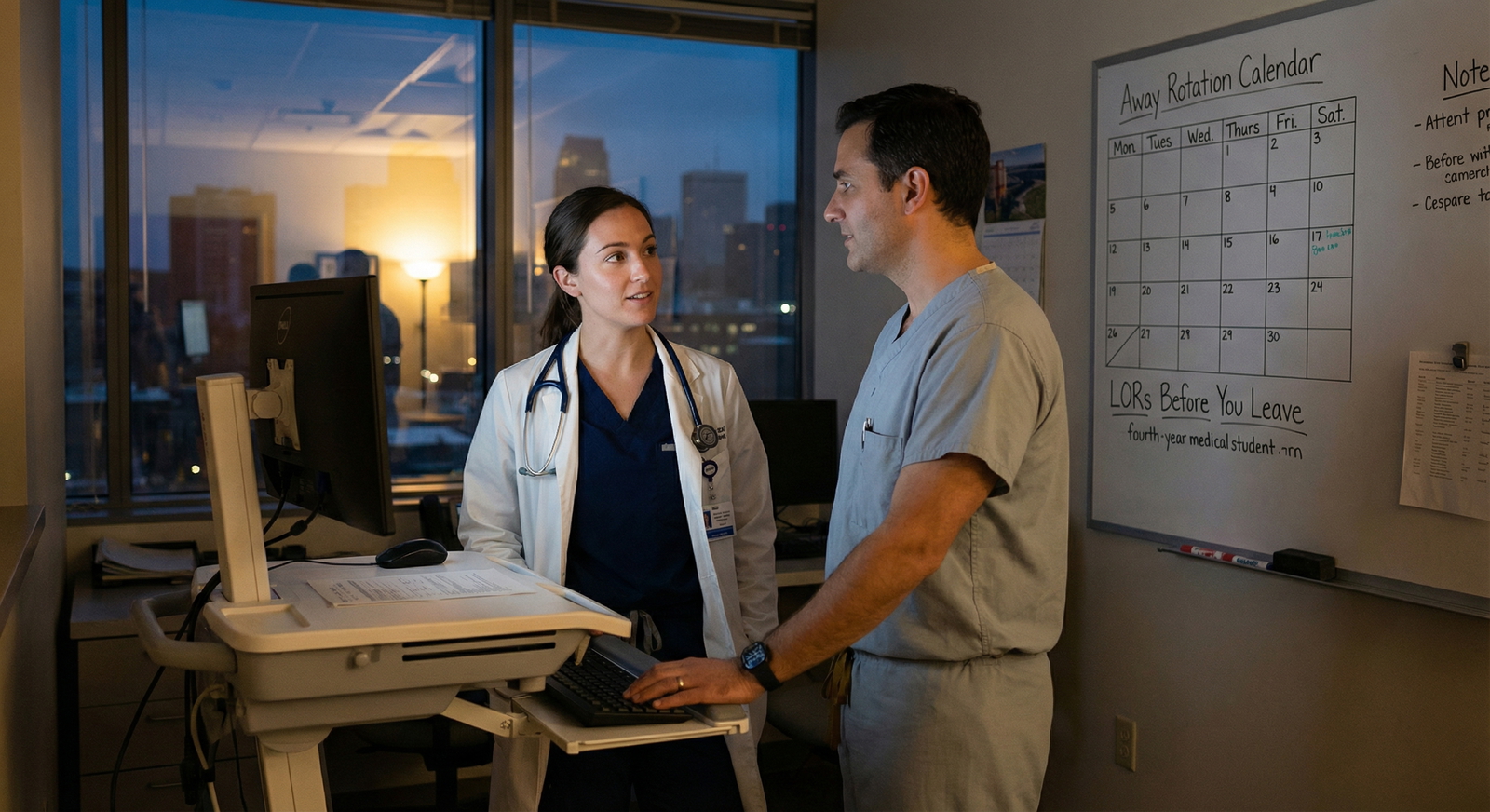
- If appropriate, 1–2 away rotations at programs where you might want to match
- Treat every radiology day like a job interview—arrive early, stay engaged, and be a positive presence in the reading room.
Decide Who to Ask for Letters
- From your home radiology department, try to secure:
- 1 letter from an attending who knows your day-to-day work
- 1 letter from a program director, vice chair, or chair (but only if they know you reasonably well or can synthesize strong feedback)
- From away rotations:
- Ask 1 attending per rotation who supervised you closely
- Make sure they understand your goals (e.g., “I’d like to signal your program as one of my top choices”).
- From your home radiology department, try to secure:
Ask at the Right Moment
- Ideally near the end of the rotation, right after you’ve:
- Completed a strong presentation
- Successfully handled a complex call shift
- Demonstrated growth across the rotation
- In-person is best; if that isn’t possible, ask via a thoughtful email (see example below).
- Ideally near the end of the rotation, right after you’ve:
Give Plenty of Lead Time
- Aim to ask at least 4–6 weeks before ERAS submission.
- Provide a gentle reminder 2–3 weeks before deadlines if needed.

Helping Your Letter Writers Help You
Once you know who to ask for letters, your next job is to make it easy for them to write something specific and compelling.
Provide a Brief “Brag Sheet” or Letter Packet
When they agree to write, send a concise packet that typically includes:
- Updated CV
- Draft of your personal statement (even if not final)
- A short summary of your interactions with them:
- Which rotation and dates
- Memorable cases or projects
- Any specific strengths you hope they might address (e.g., work ethic, team skills, research, teaching)
- Your radiology career interests:
- Diagnostic vs IR vs undecided
- Any subspecialty inclinations (e.g., neuroradiology, MSK, body imaging)
- Academic vs community interests (if known)
- A clear deadline for letter upload and the ERAS instructions
Keep this 1–2 pages maximum, ideally with bullet points. You’re not writing the letter for them, but you are refreshing their memory and focusing their attention.
Example Email to a Radiology Attending
You might write:
Dear Dr. Smith,
I wanted to thank you again for the opportunity to work with you on the abdominal imaging rotation in May. I learned a tremendous amount from your teaching on CT interpretation and enjoyed rounding with you in the reading room.
I am applying to diagnostic radiology residency this cycle and was wondering if you would feel comfortable writing a strong letter of recommendation on my behalf. I particularly appreciated your feedback on my case presentation about acute mesenteric ischemia and my growth in formulating differentials over the month.
I’ve attached my CV and a brief summary of my experiences and goals in radiology in case they are helpful. ERAS suggests submitting letters by [date], but earlier is always appreciated. If you are able to write a letter, I will enter your name and email into ERAS so you receive the upload link directly.
Thank you for considering this, and regardless, I truly appreciate the time and mentorship you’ve provided.
Best regards,
[Your Name]
This structure is professional, appreciative, and makes it easy for them to recall specific interactions.
Customize What You Highlight for Each Writer
For each letter writer, emphasize the strengths they are best positioned to comment on:
- Radiology attendings:
- Your reading room interactions, diagnostic thinking, conference participation
- Surgeons/internal medicine attendings:
- Clinical reasoning, patient care, teamwork, consult communication
- Research mentors:
- Intellectual curiosity, perseverance, independence, academic potential
By doing this thoughtfully, you help your letters collectively paint a coherent, multi-dimensional picture of you as a future radiologist.
Should You Waive Your Right to View Letters?
In ERAS, you can choose whether to waive your right to see each letter.
- In most cases, you should waive:
- Program directors tend to assume waived letters are more candid and thus more trustworthy.
- Only consider not waiving if:
- Your school has a specific advising policy around this (increasingly rare), or
- You are in a unique situation and have discussed it carefully with your dean’s office.
Common Pitfalls and How to Avoid Them
Even strong applicants can weaken their diagnostic radiology match chances with preventable mistakes related to LORs. Here are frequent issues and how to sidestep them.
Pitfall 1: Waiting Too Long to Ask
- Risk: Faculty get overwhelmed close to ERAS deadlines; your letter may be rushed, delayed, or generic.
- Solution:
- Ask early (4–6+ weeks ahead).
- Confirm deadlines and send polite reminders well before you start to panic.
Pitfall 2: Overemphasis on Prestige over Substance
- Risk: A short, lukewarm letter from a famous chair who barely knows you may be less helpful than a detailed letter from an engaged attending.
- Solution:
- Prioritize depth of interaction and strength of support over title.
- Department leadership letters are great when they’re truly substantive.
Pitfall 3: Letters That Don’t “Fit” Your Narrative
- Risk: Mismatched or confusing messaging, such as:
- A letter implying you are primarily interested in surgery or internal medicine
- No mention of radiology interest at all
- Solution:
- Clearly tell each writer you are applying to diagnostic radiology and share your reasoning.
- Provide your personal statement draft to help align the narrative.
Pitfall 4: Generic, Vague, or Short Letters
- Risk: Program directors interpret short or generic LORs as either:
- Lack of familiarity, or
- Lukewarm support
- Solution:
- Choose letter writers who have seen you in multiple contexts or for a substantial period.
- Work closely and proactively on rotations to give them real material to write about.
Pitfall 5: Not Matching Letters to Programs
You typically don’t need custom letters for every program, but you may want:
- At least one letter from your home radiology department
- At least one letter from a well-regarded academic program
- If you complete an away rotation at a “reach” program:
- Make sure that attending understands you are very interested in that institution.
- Many programs value a strong away-rotation letter as a serious signal.
Use ERAS to assign your most radiology-focused, strongest letters to radiology programs and adjust your mix if you’re also applying to a preliminary or transitional year.
FAQs: Letters of Recommendation for Diagnostic Radiology Residency
1. How many radiology-specific letters do I really need?
Most applicants should aim for at least two radiology-specific letters:
- One from a home institution radiology attending
- One from either:
- A radiology program director/vice chair/chair who knows you reasonably well, or
- An attending from an away radiology rotation where you had a strong performance
Your third or fourth letter can be from a non-radiology attending or a research mentor who knows you well. The key is that your set of letters collectively shows strong performance and clear commitment to radiology.
2. What if my school doesn’t have a radiology department or residency?
If you lack a home department:
- Seek elective radiology rotations at nearby academic centers or larger community hospitals.
- Strong letters from:
- Away rotations
- Radiology research mentors at other institutions
- Non-radiology clinicians who can speak to your excellence and professionalism
- Clearly explain, in your personal statement and interviews, how you sought out radiology exposure despite limited local resources. Programs generally respect initiative and resilience.
3. Should I get a letter from an interventional radiologist if I’m mostly applying to diagnostic radiology?
Yes, an interventional radiologist can still be an excellent letter writer. IR attendings can speak to your:
- Clinical skills and bedside manner during procedures
- Work ethic and resilience during long or complex cases
- Ability to work in a team and communicate with referring services
If you are applying only to diagnostic radiology, ask them to frame the letter in a way that emphasizes your potential as a radiologist overall, not just procedurally. If you’re applying to both DR and IR, their letter can naturally address both aspects.
4. What if I think one of my letters might not be very strong?
You usually won’t see your letters if you’ve waived rights, so this is more about preventing weak letters:
- Ask explicitly if they can write a “strong” letter.
- If they hesitate, thank them and consider asking someone else.
- Diversify: Don’t rely on just one letter to “carry” your application. Aim for multiple writers who know you well.
- If you’re concerned afterward (e.g., a writer misses multiple deadlines or shows limited engagement), talk with your dean’s office or an advising faculty member. They may suggest adjusting which letters you assign to which programs.
Thoughtful planning, proactive communication, and strategic choice of writers can transform your radiology residency application. By understanding who to ask for letters, how to support your letter writers, and how to avoid common missteps, you can secure residency letters of recommendation that convincingly portray you as a capable, committed, and collegial future diagnostic radiologist.