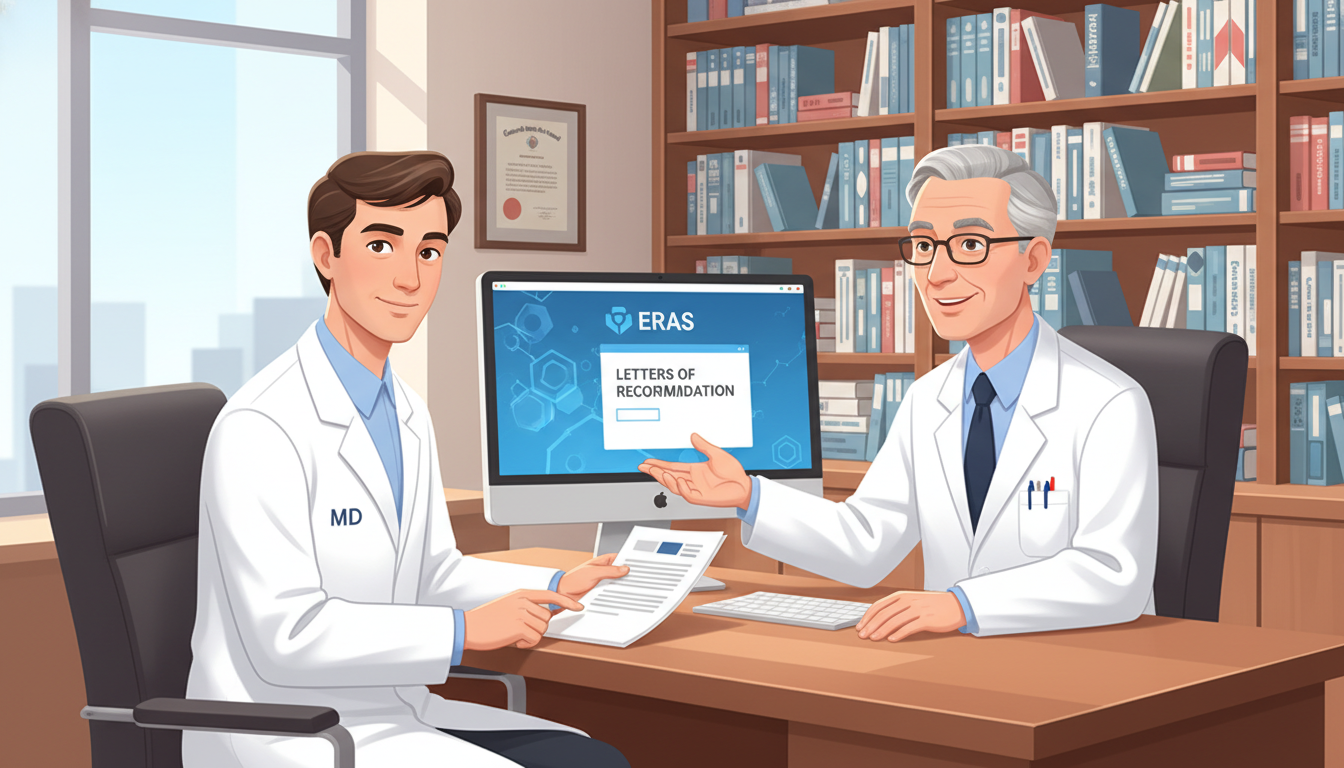
Understanding the Role of Letters of Recommendation in the Urology Match
For an MD graduate targeting urology, letters of recommendation are one of the most scrutinized parts of your application. In a competitive field with a relatively small number of positions, program directors often use residency letters of recommendation as a key differentiator among applicants who otherwise look very similar on paper.
Unlike some larger specialties, urology residency programs often know each other’s faculty personally, attend the same conferences, and sit on the same committees. That means a strong, detailed letter from a well-known urologist can significantly elevate your application in the urology match, especially if you are coming from an allopathic medical school that may not be widely recognized or if you’re an MD graduate taking a research or gap year.
In most urology residency programs, LORs are used to:
- Validate your clinical skills and professionalism
- Confirm your interest and commitment to urology
- Differentiate your performance from your peers
- Add context to your board scores, grades, and CV
- Assess “fit” with a surgical and often tight-knit specialty
You typically need 3–4 letters of recommendation for urology residency. Most programs prefer:
- 2–3 letters from urologists (ideally including at least one from your home institution, if available)
- 1 letter from a non-urology physician (e.g., general surgery, internal medicine, or a research mentor, depending on your profile)
Because urology participates in the early match, your entire timeline for securing letters is shifted earlier than many other specialties. Planning ahead is crucial.
Who to Ask for Letters: Strategy for Urology Applicants
Choosing who to ask for letters is one of the most important strategic decisions you’ll make for your urology application. Strong, specific letters from the right people can matter more than one additional publication or a slight bump in Step scores.
Priorities for Urology Letters
For an MD graduate from an allopathic medical school targeting urology, aim for:
Home Institution Urology Faculty (Core Letter)
- Ideally, a urology residency program director, associate program director, or well-known faculty member at your home institution.
- If your school has an affiliated urology department, this letter often serves as a “summary” opinion of your readiness for the specialty.
- If you did a sub-I (sub-internship) in urology at your home program, the attending(s) you worked with closely are top candidates.
Away/External Rotation Urology Faculty
- If you performed one or more away rotations in urology, try to secure at least one letter from an away rotation.
- Programs know that faculties at away sites see you in a “try-out” context and can compare you with their own residents and visiting students.
- A strong letter from an away site where you performed well can:
- Open doors for an interview there
- Function as a powerful external endorsement when other programs review your file
Research Mentor in Urology (If Applicable)
- Particularly helpful if:
- You have a research year or substantial projects in urology
- You’re applying to academically heavy programs
- This letter should emphasize:
- Your scholarly abilities
- Work ethic
- Academic potential and contribution to the field of urology
- Particularly helpful if:
Non-Urology Clinical Letter
- This can be from:
- General surgery (often the strongest non-urology choice)
- Internal medicine, ICU, or another surgical subspecialty
- Value: Shows you are an excellent physician broadly, not just within urology.
- This can be from:
How to Prioritize When You Have Several Options
If you have more willing writers than LOR “slots,” prioritize:
- Urologist who knows you best and can comment on your clinical performance over time
- Program leadership (PD/APD or known academic urologist) with at least moderate direct observation
- Away rotation urologist who saw you at your best clinically and procedurally
- Urology research mentor with detailed knowledge of your work
- Strong non-urology clinical letter (especially from surgery)
- Less direct contact or generic letters, even from famous names
Name recognition helps only if the letter is strong and specific. A generic letter from a nationally known urologist is less valuable than a detailed, enthusiastic letter from a mid-career faculty member who worked closely with you.

How to Get Strong LOR: Building Relationships and Performance
If you’re wondering how to get strong LOR rather than just acceptably positive ones, the answer starts months before you ever ask anyone to write.
Excel Where It Counts: Urology and Surgical Rotations
Urology attendings write their best letters when they’ve seen you:
- Take ownership of patient care
- Function as a sub-intern or junior resident
- Handle stress and time pressure in the OR and on the wards
- Collaborate effectively with residents, nurses, and staff
On your core and sub-I rotations in urology:
- Be present and prepared
- Show up early, stay appropriately late
- Know your patients in detail
- Pre-round thoroughly and anticipate questions
- Demonstrate genuine interest
- Read about every case or diagnosis you encounter
- Ask informed, concise questions at appropriate times
- Act like a team member, not an observer
- Volunteer for tasks (notes, orders as allowed, discharge summaries)
- Help residents with scut work without complaining
- Be reliable and professional
- Communicate clearly
- Own your mistakes and correct them quickly
Strong letters often explicitly compare you to prior students and even interns—your job is to stand out enough that such a comparison is natural and honest.
Build Longitudinal Relationships with Faculty
The best residency letters of recommendation for urology are written by faculty who:
- Have known you for at least several weeks to months
- Have seen you in more than one context (e.g., clinic + OR + research conference)
- Understand your motivation for urology and your career goals
To build these relationships:
Identify 2–3 potential mentors early
- A home institution urologist whose practice interests you
- A PD/APD or a faculty member known to be supportive of students
- Possibly a research-oriented urologist if you’re academically inclined
Stay in touch
- Schedule brief check-ins during and after your rotation
- Update them on your progress, exams, and research
- Ask for guidance on program selection and career planning
Engage outside the rotation
- Attend urology grand rounds, journal clubs, and M&M conferences
- Present research or case reports if possible
- Offer to help with ongoing projects
When it comes time to ask for a letter, this kind of relationship means your writer can speak deeply and credibly about who you are, not just what you did over two weeks.
Signal That You Want a STRONG Letter
One of the most practical pieces of advice about how to get strong LOR is to ask explicitly for a strong letter, not just any letter. This gives the writer a way to decline if they can’t honestly be enthusiastic.
Use language like:
“Dr. Smith, I’m applying to urology and I was hoping you might be able to write a strong letter of recommendation on my behalf. You’ve seen me in clinic and in the OR, and I really value your perspective. Do you feel you know me well enough to write a strong letter for my application?”
If they hesitate, seem noncommittal, or say something like “I can write you a letter that describes your work with us,” that’s a subtle signal they may not be able to write the kind of advocacy letter you want. In that case, politely thank them and consider asking someone else.
Timing, Logistics, and Strategy for the Urology Match
Because the allopathic medical school match for urology operates on an earlier timeline than the NRMP Main Match, your planning for letters has to be aggressive and organized.
General Timeline for MD Graduate Urology Applicants
While exact dates vary by year, a typical flow looks like:
Winter–Early Spring (MS3 or early MS4; or pre-application year for MD graduate)
- Identify potential letter writers
- Start urology rotations and meet key faculty
- Begin or continue urology-related research projects
Late Spring–Summer
- Complete home urology sub-I
- Complete 1–2 away rotations (where possible)
- Ask for letters at the end of each rotation while you’re still fresh in their mind
- Provide your writers with your updated CV and draft personal statement
Early–Mid Fall (ahead of the urology application deadline)
- Confirm all letters are uploaded to ERAS or the appropriate application platform
- Double-check that programs requiring a certain number of urology letters are satisfied
For MD graduates taking research or gap years, align key clinical experiences (sub-Is and observerships) so that your letters are recent (within 12–18 months of application).
How Many Letters Should You Upload?
Most urology programs accept 3–4 letters. A typical, strong mix for an MD graduate:
- Letter 1: Home institution urology faculty (preferably PD/APD or senior mentor)
- Letter 2: Away rotation urology faculty
- Letter 3: Urology research mentor or another strong clinical urologist
- Letter 4 (optional): Non-urology clinical (general surgery, ICU, etc.) if excellent
Upload all of them if permitted; you can decide which letters to assign to which programs if the system allows selective assignment.
ERAS and Early Match Logistics
- Waive your right to see the letters. Programs expect confidential letters; it strengthens credibility.
- Give your writers plenty of time. Ideally 3–4 weeks minimum.
- Provide:
- Your CV
- Personal statement draft (even if still evolving)
- Transcript and exam scores, if you’re comfortable sharing
- A short summary of your work with them (clinical tasks, cases, or projects) to jog their memory
You may also share a “programs list” and highlight any programs where their name or connections might carry particular weight.

What Makes a Letter Strong in Urology: Content and Qualities
Understanding what program directors look for can help you choose writers wisely and provide them with the right context.
Characteristics of a High-Impact Urology LOR
The most persuasive letters for urology residency share several traits:
Specificity
- Concrete examples:
- “On call, she independently evaluated a patient with obstructing stone and sepsis, formulated the plan, and presented clearly to the chief resident.”
- “In clinic, he consistently followed up on test results and communicated them to patients with clarity and empathy.”
- Avoids generic statements like “hardworking” without examples.
- Concrete examples:
Comparative Statements
- Programs value context:
- “Among the more than 100 students I have supervised, she ranks in the top 5%.”
- “He performs at the level of an intern in terms of autonomy and clinical reasoning.”
- This is particularly important in a competitive specialty like urology.
- Programs value context:
Insight into Surgical Potential
- Fine motor skills, spatial reasoning, comfort in the OR:
- “He demonstrated excellent hand–eye coordination during cystoscopy and was able to anticipate steps in the procedure.”
- Willingness to wake early, stay late, and handle physically demanding schedules.
- Fine motor skills, spatial reasoning, comfort in the OR:
Professionalism and Teamwork
- How you interact with nurses, residents, ancillary staff:
- “Her interactions with nursing staff were consistently respectful and collaborative.”
- Reliability: shows up on time, follows through, responds to pages promptly.
- How you interact with nurses, residents, ancillary staff:
Clear Endorsement for Urology
- Strong closing statements:
- “I recommend her for urology residency without reservation.”
- “He will be an outstanding urology resident and future leader in our field.”
- Strong closing statements:
Alignment with Program Culture
- Community-focused, research-oriented, or high-volume surgical programs may look for different nuances.
- Faculty who know your goals can speak to your fit with specific types of programs (academic vs. community, research-heavy vs. clinically focused).
Providing Helpful Material to Your Letter Writers
While you should never write your own letter, you can facilitate a stronger one by providing:
- A brief one-page summary including:
- Why you chose urology
- Key clinical strengths
- Any challenges you have overcome
- Your career goals (e.g., academic urology, oncology, female pelvic medicine)
- A list of specific encounters or cases you had with them that you remember as positive moments:
- “First call weekend with Dr. X (obstructing stone patient)”
- “Assisted in radical prostatectomy case on [date]”
- “Presented at urology grand rounds on [topic]”
This gives your writer a reference point to build detailed, personalized comments rather than generic praise.
Common Scenarios and How to Handle Them (For MD Graduates)
Not every MD graduate follows a traditional path. Here’s how to navigate letters in some frequent situations.
Scenario 1: Limited Exposure to Urology at Home Institution
If your allopathic medical school has a small or nonexistent urology department:
- Maximize away rotations
- Aim for 2 aways at solid urology programs (academic if you’re research-inclined, or community-based if more clinically focused).
- Get 2 letters from away rotations and 1 from surgery or another related specialty.
- Seek out research or observerships in urology during breaks or a dedicated year:
- Even short-term observerships can help generate at least one informed letter.
Explain the lack of home urology exposure briefly in your personal statement or, if appropriate, in program-specific supplemental questions.
Scenario 2: MD Graduate with a Research Year (or Gap Year)
If you are an MD graduate who took time for research:
- Ensure at least one letter is recent and clinical (ideally urology), not only research-based.
- Ask your research mentor in urology for a letter focusing on:
- Research productivity and independence
- Intellectual curiosity and potential for academic contribution
- Balance the application with 2 clinical urology letters if at all possible.
- Emphasize in your materials how you’ve maintained clinical skills (e.g., PRN work, clinical volunteering, observerships).
Scenario 3: Borderline Exam Scores or “Red Flags”
If your board scores or transcript are not as strong as you’d like:
- Letters become even more critical in the urology match.
- Focus on getting extremely detailed, supportive letters that:
- Highlight clinical performance above standardized metrics
- Emphasize improvement, maturity, and resilience
- Explicitly endorse you as ready for the demands of a surgical residency
Discuss any concerns frankly with your mentors before asking for letters; they may address context appropriately and reassuringly.
Scenario 4: Late Decision to Pursue Urology
If you decided on urology late in training:
- Front-load intensive exposure:
- Rapidly schedule urology electives, sub-Is, and possibly an away rotation if timeline allows.
- Ask for letters from rotations where you had the most direct contact, even if the time was short:
- Honest, highly positive comments can still carry weight.
- You may initially lean more on:
- General surgery or other surgical subspecialty letters
- Clarify your trajectory and reasons for a later decision in your personal statement.
Frequently Asked Questions (FAQ)
1. How many urology-specific letters do I need for a competitive application?
Most successful urology applicants have at least two strong letters from urologists, and many have three. A typical pattern is:
- 2–3 urology letters (home + away + research or another clinical urologist)
- 0–1 non-urology clinical letter (often from general surgery)
Programs vary, but aiming for three total letters, with at least two from urologists, will position you well for the urology residency match.
2. Is it better to get a letter from a famous urologist who barely knows me, or a less-known faculty member who worked closely with me?
Always prioritize substance over name recognition. The allopathic medical school match process in urology values:
- Detailed descriptions of your performance
- Specific comparisons to peers
- Evidence of your potential as a resident
A generic, vague letter from a famous urologist is far less helpful than a rich, enthusiastic letter from a mid-career or junior faculty member who supervised you closely. Ideally, you want letters that are both connected and specific—but if you must choose, choose specificity.
3. When should I ask for letters during an away rotation?
Ask for a letter during the final week of the away rotation, ideally after you’ve received informal feedback that your performance has been strong. Approach your main supervising attending (and possibly the PD, if appropriate) in person:
“I’ve really appreciated working with you this month. I’m applying in urology and was wondering if you’d be able to write a strong letter of recommendation based on my rotation here.”
Follow up with an email thanking them and attaching your CV, personal statement draft, and any additional helpful information.
4. Can I reuse letters for both urology and a backup specialty?
Technically yes, but it’s rarely ideal. Urology programs want letters that specifically endorse you for urology, not generic statements like “for residency.” If you are seriously considering a backup specialty:
- Ask some writers to write urology-specific letters.
- Ask others for letters tailored to the backup specialty.
- In some cases, a more general letter can be used for both, but it may dilute the strength of your application in each direction.
Discuss this openly with trusted mentors; they can help you develop a safe and coherent dual-application strategy if needed.
Thoughtful planning, early relationship-building, and strategic choices about who to ask for letters can substantially strengthen your urology residency application. As an MD graduate, you control more of this process than you might think. Aim for letters that don’t just say you will “do fine” but that clearly advocate for you as an outstanding future urologist.