Letters of recommendation (LORs) can make or break a diagnostic radiology application—especially for a non-US citizen IMG or foreign national medical graduate. When programs receive hundreds of applications with similar scores, strong, credible letters often determine who gets invited to interview and who does not.
This guide focuses specifically on how non-US citizen IMGs can secure strong, strategic residency letters of recommendation for diagnostic radiology residency in the US. We’ll cover who to ask, what program directors actually want to see, how to manage limited US experience, and how to avoid common pitfalls that hurt otherwise solid applications.
Why Letters Matter So Much for Non-US Citizen IMGs in Radiology
Radiology is a detail-oriented, high-competition specialty. Programs are trying to assess not only your knowledge but also your:
- Clinical judgement
- Work ethic and reliability
- Communication skills
- Professionalism and integrity
- Potential to function in a US academic environment
For a foreign national medical graduate, LORs serve several crucial purposes:
Validate your performance in a US clinical context
Program directors want reassurance you can function in a US hospital system—understand workflows, communicate effectively in English, and handle clinical responsibility.Bridge unknown schools and systems
If your medical school or hospital is unfamiliar to the committee, strong letters from known US faculty (especially in radiology) help normalize and contextualize your performance.Differentiate you in a competitive pool
Diagnostic radiology programs routinely receive many high-score applications. A letter that says, “This IMG functioned at the level of our top US students” carries enormous weight.Address visa and “risk” concerns indirectly
Programs know that sponsoring visas requires extra institutional steps. When respected faculty advocate strongly for a non-US citizen IMG and describe you as a “must interview” candidate, it helps overcome subconscious hesitations.
How Many Letters and What Type Do Radiology Programs Prefer?
Most ACGME diagnostic radiology residency programs require 3 letters of recommendation, and many allow 4. A strong setup for a non-US citizen IMG typically looks like:
- 2–3 letters from US-based physicians
- At least 2 letters from radiologists
- 1 letter can be from a non-radiology specialty (internal medicine, surgery, neurology, etc.), especially if it highlights clinical judgement, communication, and teamwork
Ideal Letter Mix for Radiology
For a diagnostic radiology match as an IMG, a powerful combination might be:
- Letter 1: US academic radiologist who directly supervised you in a rotation, elective, or observership
- Letter 2: Another radiologist (US preferred, can be home country if letter is strong and specific)
- Letter 3: Clinical supervisor from another specialty (US if possible) attesting to work ethic, communication, and multidisciplinary teamwork
- Optional Letter 4: Research mentor, especially if radiology-focused and can speak to your analytical skills, reliability, and academic potential
If you must include non-US letters due to limited US exposure, prioritize substance and specificity over geography—but understand that US-based letters still hold more impact for most program directors.

Who to Ask for Letters (and Who to Avoid)
Many IMGs struggle with who to ask for letters and default to the most senior person they can find—or someone who says “Sure” first. That approach often leads to generic, unhelpful letters.
Priorities When Choosing Letter Writers
When deciding who to ask for letters, for a non-US citizen IMG you should prioritize:
Direct supervision over name recognition
A detailed letter from an assistant professor who worked with you daily is usually stronger than a generic one from a famous department chair who barely knows you.Radiologists over non-radiologists
Programs value the opinion of people who understand radiology training demands. A radiologist can comment on your:- Imaging interpretation skills
- Attention to detail
- Pattern recognition and analytic thinking
- Interest and commitment to the field
US faculty over international faculty (when possible)
While excellent international letters still help, US letters:- Are more familiar in style and content
- Come from systems residency programs know and trust
- Demonstrate functioning in a US clinical environment
Faculty who genuinely like and respect you
The single most important criterion is that the writer feels comfortable advocating strongly for you. If you sense hesitation, do not ask that person, no matter how senior.
Best-Case Letter Writers for a Radiology-Bound IMG
- Radiology attending from a US rotation or observership where you:
- Presented cases
- Participated in readouts
- Attended conferences and engaged actively
- Radiology fellowship director or program director who has seen you consistently over weeks
- Radiology research mentor (particularly in the US) who can speak to your:
- Analytical ability
- Discipline and reliability
- Academic potential
- Non-radiology attending in the US who can honestly say:
- You were among the top students they’ve worked with
- You communicate clearly and professionally
- You work well with diverse health care teams and patients
Who You Should Avoid Asking
- Supervisors who worked with you for only 1–2 days
- Very senior faculty or chairs who barely know you and will likely write a generic, template-style letter
- Non-physicians (unless a program explicitly allows it, which is rare)
- Anyone who seems lukewarm when you mention applications to radiology or who says something like, “I can write you a letter, but it may not be very strong”
If you ever hear, “I can write you a standard letter,” that is often a polite warning that the letter may be vague and unhelpful.
How to Get Strong LOR: Building Relationships and Performance
Understanding how to get strong LOR starts months before you actually ask for the letter. Especially as a non-US citizen IMG, you have fewer chances to impress within limited US-based time, so every day counts.
1. Maximize Your Radiology Elective or Observership
Even if you are officially listed as an observer, you can still make a strong impression:
Before the rotation:
- Email your supervising faculty or coordinator:
- Introduce yourself briefly
- Express specific interest in diagnostic radiology
- Share a focused CV and ERAS-style personal statement (if available)
- Clarify expectations:
- What time to arrive and leave
- Dress code (usually professional attire and white coat)
- Whether you can attend readouts, tumor boards, or conferences
During the rotation:
- Arrive early, leave late—at least on most days
- Take notes on cases you see and read about them later
- Ask focused, thoughtful questions (e.g., “How would this finding change management?” instead of “What is this?” repeatedly)
- Volunteer for small tasks:
- Preparing short case presentations
- Doing brief literature searches
- Helping with teaching files or case logs (if allowed)
Radiology-specific behaviors that impress:
- Looking at the images yourself before the attending’s readout
- Trying to formulate a preliminary differential, even if imperfect
- Demonstrating improvement in pattern recognition and terminology over the rotation
- Attending all conferences and writing down learning points
2. Show Traits Radiology Programs Value
Your letter writers will naturally comment on traits they notice. For diagnostic radiology, cultivate and demonstrate:
- Attention to detail: Noticing subtle findings, double-checking information, carefully preparing presentations
- Analytical reasoning: Explaining why you think one diagnosis is more likely than another
- Professionalism: Respecting confidentiality, being punctual, courteous, and reliable
- Communication: Presenting cases clearly and concisely; being understandable and composed when speaking
- Teamwork: Interacting politely with technologists, nurses, other students, and residents
3. Communicate Your Goals Openly
Many foreign national medical graduates worry about disclosing that they are IMGs or need visa sponsorship. But for letters, you need transparency:
At some point early in the rotation, say something like:
“I’m a non-US citizen IMG planning to apply to diagnostic radiology residency in the US. I know it’s competitive, and I’m very motivated to do my best here. I would really appreciate any feedback on how I can improve.”
This signals:
- Seriousness about the field
- Self-awareness and maturity
- Openness to feedback (which faculty value greatly)

Asking for the Letter: Timing, Wording, and Supporting Materials
Once you’ve worked closely with a faculty member for at least 2–4 weeks (or completed a substantial research project), you’re ready to ask.
When to Ask
- End of the rotation is most common—ideally during the final week
- If you had an outstanding interaction earlier (e.g., major project or impressive case presentation), you may hint earlier and formally ask later
- Don’t wait many months after the experience; memories fade and letters become generic
How to Ask (Sample Script)
In person (best when possible):
“Dr. Smith, I wanted to thank you for the opportunity to work with you this month. I learned a lot about diagnostic radiology and feel even more committed to the specialty. I’m planning to apply to diagnostic radiology residency this cycle as a non-US citizen IMG.
I was wondering if you would feel comfortable writing me a strong letter of recommendation for my applications?”
Key points:
- You clearly state your specialty (diagnostic radiology)
- You identify yourself as a non-US citizen IMG (context matters)
- You explicitly ask for a “strong” letter, giving them permission to decline if they cannot
If they hesitate or say something like, “I can write a letter,” but avoid the word “strong,” you might respond:
“I really appreciate your honesty. Since strong letters are so important, would you recommend someone else in the department who might be able to comment in more detail on my performance?”
By giving them an easy way out, you protect yourself from weak letters.
Email Follow-Up Template
Even if they agree in person, follow up with an email:
- Thank them again
- Provide logistical details
- Attach supporting materials
Example:
Subject: Letter of Recommendation for Diagnostic Radiology Residency
Dear Dr. Smith,
Thank you again for agreeing to write a strong letter of recommendation for my diagnostic radiology residency applications. I am very grateful for your support.
As discussed, I’m a non-US citizen IMG applying in this upcoming ERAS cycle. I’ve attached my current CV and a draft of my personal statement, and I’ve also included a brief bullet-point summary of the work we did together on the CT chest rotation.
ERAS will send you an email with instructions for uploading the letter directly. If there is any additional information that would be helpful, I would be happy to provide it.
Thank you again for your time and mentorship.
Sincerely,
[Your Full Name]
AAMC ID: [xxxxxxx]
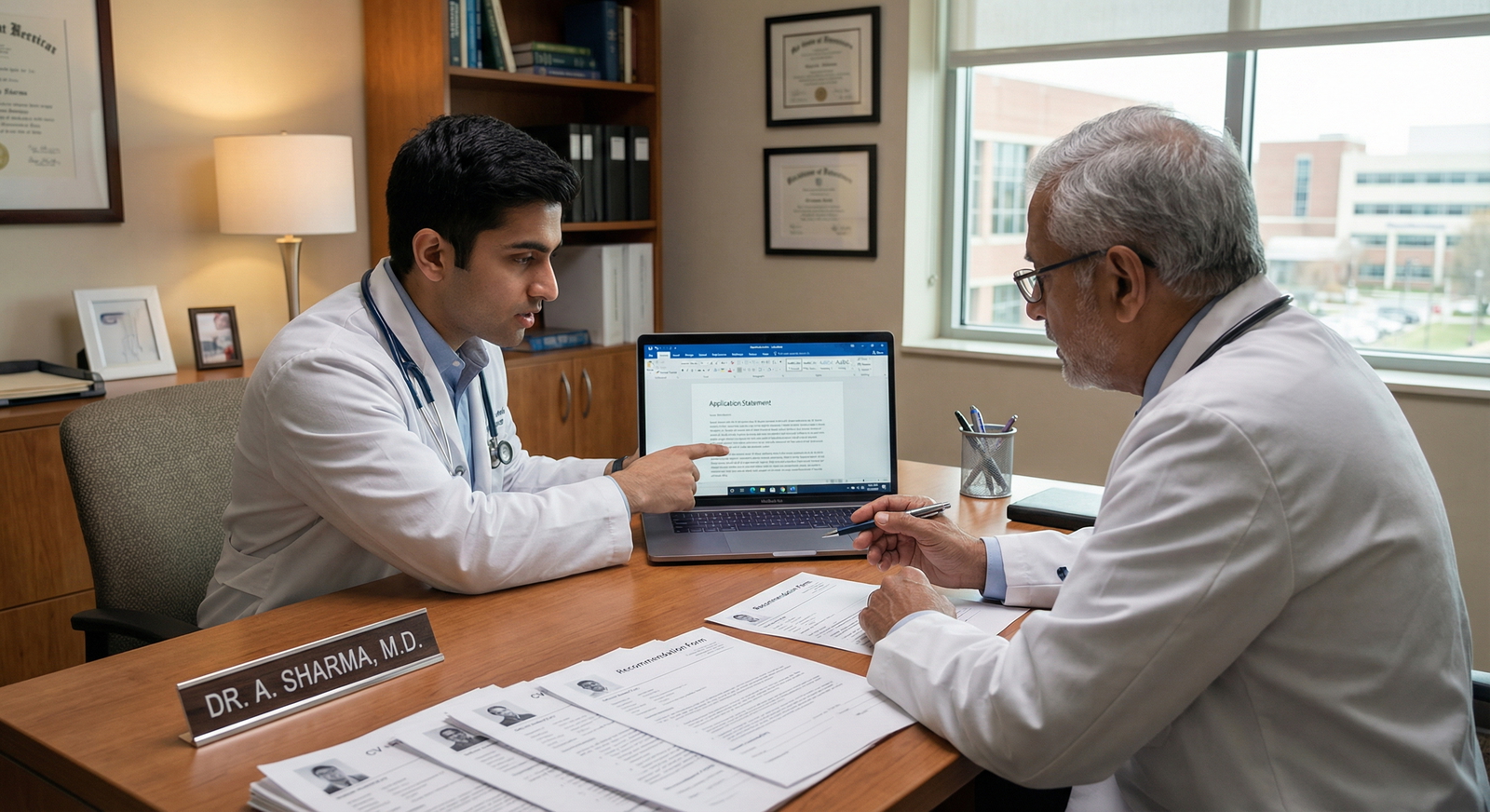
Provide a Helpful “Letter Packet”
To make it easier for your writer—and encourage a more detailed, tailored letter—include:
- Updated CV (ERAS-style)
- Personal statement (radiology-focused)
- Transcript and exam scores (if appropriate)
- Brief bullet list (1–2 pages max):
- Dates of rotation/research
- Specific cases or projects you worked on
- Any presentations or teaching you did
- Traits you hope they can highlight (e.g., attention to detail, work ethic)
You are not writing your own letter—but you are giving them structure and reminders of your contributions.
Special Challenges and Strategies for Non-US Citizen IMGs
As a non-US citizen IMG or foreign national medical graduate, you face specific obstacles in securing competitive letters. Fortunately, there are targeted strategies to address them.
Challenge 1: Limited or No US Clinical Experience
Problem: Programs prefer at least some US-based clinical or radiology exposure, but not all IMGs can secure formal clerkships.
Strategies:
- Pursue observerships or shadowing in radiology at academic or community hospitals:
- Many IMG-friendly institutions have structured observership programs
- Maximize every day:
- Attend all educational conferences
- Ask for small but meaningful tasks (case logs, literature searches)
- Take careful notes on cases and discuss them with your supervisors
- Aim for continuity:
- Longer observership (4–8 weeks at the same site) is better than many short, scattered experiences
- Complement with tele-radiology or remote research:
- Collaborate with US faculty on retrospective imaging studies or case reports
- Even remote work can build enough relationship for a meaningful research-based letter
Challenge 2: Non-Radiology Background Before Radiology Application
Many IMGs have:
- Internal medicine experience
- General practice experience
- Non-radiology residencies at home
How to leverage this for radiology LORs:
- Ask former supervisors to highlight:
- Your diagnostic acumen
- Your habit of reviewing imaging and valuing radiology input
- Instances where you coordinated care based on imaging results
- Show a coherent narrative:
- “I developed a strong interest in radiology while working closely with imaging for patient management in internal medicine…”
Challenge 3: Visa Issues and Hidden Bias
Programs may quietly worry about:
- Visa sponsorship logistics
- Long-term retention
- Adaptation to US culture and teamwork
LORs can counter these worries by emphasizing:
- Your excellent English communication (both spoken and written)
- Effectiveness in multidisciplinary US teams
- Reliability and professionalism (“always on time, stayed late when necessary, highly dependable”)
- Comparative strength (“performed at the level of, or above, our US medical students and residents”)
When mentors know your visa situation, they can choose language that reassures program directors without directly discussing immigration.
Challenge 4: Over-Reliance on Home Country Letters
Some foreign national medical graduates submit 3–4 letters all from their home institution. While better than no letters, this is less competitive.
If US letters are limited:
- Ensure your home country letters are:
- Exceptionally detailed, not generic
- From faculty who know you over a long period
- Explicit about your ranking (“among the top 5% of students I have supervised in 10 years”)
- Ask writers to comment on:
- Your adaptability
- English communication skills (if true)
- Interest in and exposure to radiology, even if limited
- Pair these with at least one US-based letter, even from a brief observership, if at all possible
Practical Tips to Avoid Common LOR Mistakes
To optimize your letters for the diagnostic radiology match, keep these practical points in mind:
Do not waive confidentiality lightly
In ERAS, you must choose whether to waive your right to see the letter. Programs often take waived letters more seriously, believing they are more candid. Most residency advisors recommend waiving your right.Do not submit more than 3–4 letters per program
Overloading a program with 6–7 letters can backfire; they may only scan the first few. Choose your 3–4 strongest letters strategically.Label letters thoughtfully
In ERAS, you can assign specific letters to specific programs. For more research-heavy programs, prioritize your research mentor’s letter; for community programs, choose the strongest clinically-focused letters.Send gentle reminders—politely
If a letter is not uploaded 2–3 weeks after your request (and especially as ERAS deadlines approach), send a respectful reminder:- Acknowledge their busy schedule
- Confirm the deadline
- Offer any additional information they might need
Avoid obvious template letters from the same institution
If all your letters from one hospital are short, identical templates, they lose impact. Seek at least one letter from a setting where faculty write more personalized evaluations.
Frequently Asked Questions (FAQ)
1. As a non-US citizen IMG, are US letters absolutely required for diagnostic radiology?
They are not absolutely required, but they are strongly preferred and often make a noticeable difference. For a competitive diagnostic radiology match, at least one US letter, ideally from a radiologist, is extremely helpful. Without any US letters, your application becomes harder to evaluate, and you may be at a disadvantage compared to applicants with clear US-based performance data.
If you cannot secure a full clerkship, pursue observerships, shadowing, or radiology research with US mentors to generate at least one credible US-based LOR.
2. Is it better to have a strong non-radiology US letter or a weak radiology letter?
A strong non-radiology US letter is usually more helpful than a weak, generic radiology letter. Ideally you want both: at least one strong radiology letter and one strong non-radiology letter. If you sense a radiology mentor will write only a lukewarm letter, it is better to avoid that letter and rely on other faculty who can genuinely advocate for you. Programs read tone very carefully; a half-hearted radiology letter can hurt more than it helps.
3. Can research mentors write primary letters of recommendation, or must all letters be clinical?
Research mentors can absolutely write primary LORs, especially in radiology where academic output and analytical thinking are valued. A research letter is particularly useful if:
- The project was substantial or long-term
- The mentor can comment on your reliability, initiative, and communication
- The research is imaging-related
However, you should not rely only on research letters. Programs still want to see evidence of clinical professionalism and teamwork. Aim to balance research and clinical perspectives across your 3–4 letters.
4. How recent should my letters be for a diagnostic radiology application?
Most programs prefer letters from the last 1–2 years. For IMGs who graduated longer ago, older letters can be supplemented with fresh US clinical or research experience producing newer letters. If your best letter is older, it can still be used, but pair it with at least one recent letter that reflects your current skills and readiness for residency.
Well-chosen, thoughtfully obtained letters of recommendation can significantly elevate your application as a non-US citizen IMG aiming for diagnostic radiology residency. Focus on building real relationships, demonstrating radiology-relevant skills, and strategically choosing who to ask for letters. With planning and intentional effort, your LORs can transform you from “another IMG applicant” into a must-interview candidate.