
What if you drain your savings applying to 60+ programs… and your Step scores quietly filter you out before anyone even reads your personal statement?
That’s the nightmare, right? Not just not matching. But lighting money on fire while not matching.
You’re staring at your Step scores, your specialty list, and that ERAS cart that keeps climbing into the thousands and thinking: “Am I being smart… or just desperate?”
Let’s talk about that. Honestly. No fake reassurance.
First: Are Your Scores Actually “Low” for Your Target Specialty?
This is where a lot of us mess up. We don’t define “low.” We just compare ourselves to the loudest people on Reddit flexing 260s.
You have to anchor your anxiety in some kind of reality.
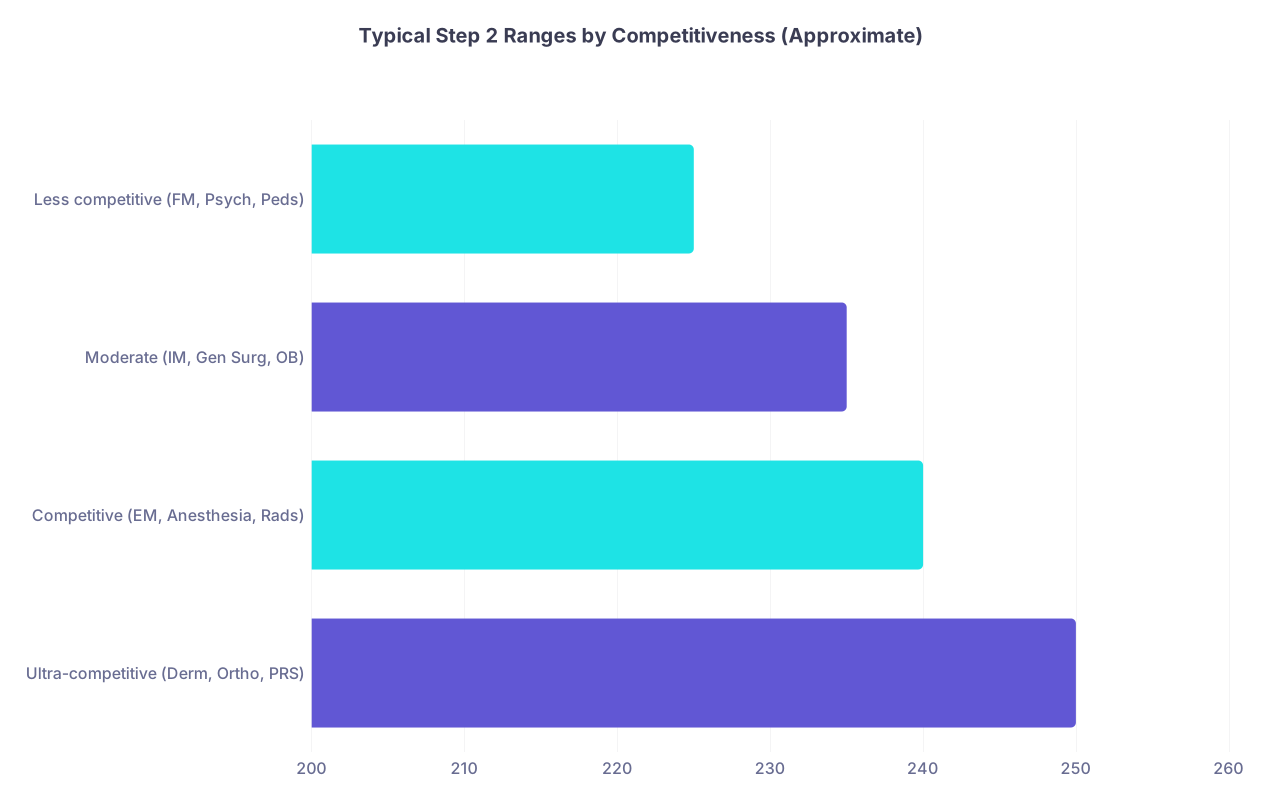
| Category | Value |
|---|---|
| Ultra-competitive (Derm, Ortho, PRS) | 250 |
| Competitive (EM, Anesthesia, Rads) | 240 |
| Moderate (IM, Gen Surg, OB) | 235 |
| Less competitive (FM, Psych, Peds) | 225 |
Those aren’t cutoffs. They’re vibes. General ranges where lots of matched applicants cluster.
Here’s the uncomfortable truth: “low” is relative to three things:
- Your specialty
- Your school/type of degree (MD vs DO vs IMG)
- Your other application strengths
A 228 Step 2:
- For Derm at a top academic program? Basically a hard wall.
- For Internal Medicine at community programs? Not ideal, but absolutely workable if the rest of your app is solid.
- For Family Medicine? Not low. Just normal.
So before you even think about “broad vs targeted,” you need a harsh, clear-eyed category for yourself.
| Category | Step 2 vs Specialty Norm | How PDs Often React |
|---|---|---|
| Strong | Clearly above average | Screened in quickly |
| Average | Around typical matched | Neutral, other factors matter |
| Weak | Below typical matched | Needs clear compensating strengths |
| Very weak | Far below typical | Many auto-screens, some doors closed |
If you’re in the “weak” or “very weak” group for your target specialty… that’s where the “am I wasting money?” panic starts to feel very real.
How Programs Actually Use Your Scores (The Brutal Filter Phase)
You know how PDs love to say, “We look at the application holistically”?
Yeah. After the filters.
Most programs do some version of:
- Set basic filters in ERAS (Step 2 min, attempt limits, maybe graduation year).
- Kill a chunk of apps instantly.
- Then look holistically at whoever survives.

| Step | Description |
|---|---|
| Step 1 | You Submit ERAS |
| Step 2 | Auto Screen Out |
| Step 3 | Human Review |
| Step 4 | Consider Research, Letters, Fit |
| Step 5 | Score Above Cutoff |
| Step 6 | Attempts Limit Met |
This is why Step feels so unfair. Your entire identity reduced to one number that decides whether a human ever sees your story.
So if your Step 2 is below common cutoffs for your specialty, “applying broadly” doesn’t fix that. It just means:
- You get auto-rejected by 80 identical programs instead of 30.
That’s the financial trap nobody warns you about.
When “Applying Broadly” Is Smart… And When It’s Just Expensive Denial
I’m going to say the thing that makes everyone flinch:
Sometimes “I’m applying broadly” is just code for “I don’t want to admit I’m not competitive for this specialty tier.”
Let’s split this out.
Case 1: Low-ish Scores, Still Competitive Somewhere
Example:
- Step 2: 226
- Specialty: Internal Medicine
- US MD, solid clinical evals, no major red flags
Here, applying broadly makes sense — if by “broadly,” you mean:
- Tons of community IM programs
- A mix of mid-tier university and safety-ish university-affiliated programs
- Maybe 1–2 reaches if you have something special (big research, strong home letter)
This is “broad but targeted.” You’re accepting your lane and saturating it.
Case 2: Scores Really Low for the Specialty, But You’re Still Only Targeting That Specialty
Example:
- Step 2: 216
- Specialty: Ortho / Derm / ENT / PRS
- No insane research portfolio, no extra degrees, no “I did 3 years of postdoc in this lab” story
Here, applying to 60–80 programs isn’t “broad and safe.” It’s you buying lottery tickets in bulk.
A few programs may not have hard cutoffs. Some PD somewhere might have a soft spot. But proportionally, a huge part of whatever money you spend is functionally wasted.
Not because you’re a bad applicant. Because you’re invisible to their filters.
The Hidden Cost Curve: When Extra Programs Stop Helping
You probably feel that little gnawing thought: “What if the next 10 programs has the one that would’ve interviewed me?”
So you keep adding.
The reality looks more like this:
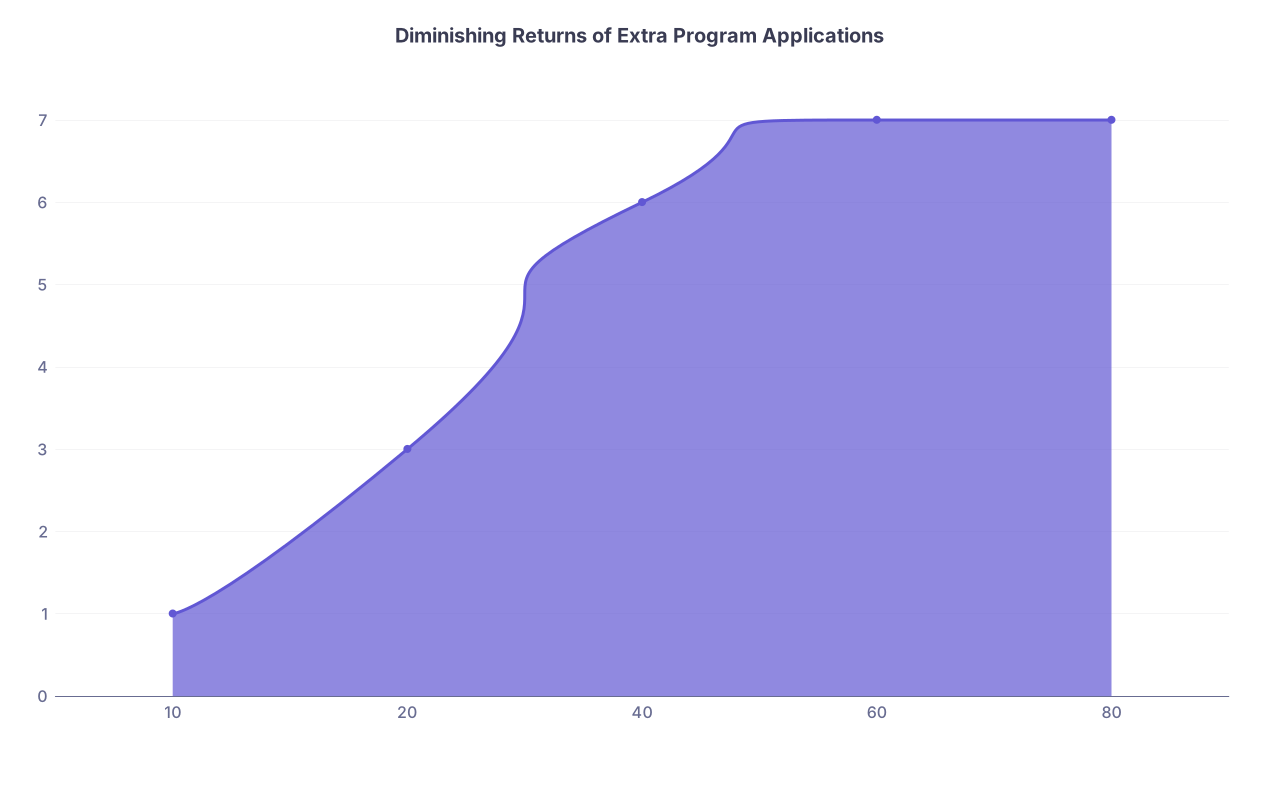
| Category | Value |
|---|---|
| 10 | 1 |
| 20 | 3 |
| 40 | 6 |
| 60 | 7 |
| 80 | 7 |
Very rough idea, but the pattern holds:
- From 10 → 40 programs, you dramatically increase your chances of getting some interviews.
- From 40 → 60, you maybe add a few more.
- From 60 → 80, often nothing changes, especially if your scores are below many cutoffs.
And meanwhile, your wallet is bleeding. Travel, interviews, ERAS fees, NRMP, hotels, flights. Easily $3–5k+ all in.
When your Step scores are lower for your specialty, you need to think in terms of:
- “Which 40–50 programs actually might consider me?”
Not: - “How many can I afford if I eat instant ramen all year?”
So… How Do You Know If You’re Wasting Money?
This is the part where you want a clean formula. You won’t get one. But you can get something close enough for rational decisions.
Ask yourself, brutally:
- Is my Step 2 above, near, or below the bottom end of the usual matched range for this specialty?
- Do I have any compensating factor that PDs actually care about?
- Home program in the specialty that likes its own
- Strong research specifically in that specialty
- Stellar letters from well-known people in that field
- A compelling backstory plus evidence of performance (honors, strong sub-I evals)
- Have I looked up at least 15–20 specific programs and:
- Checked if they publish cutoff ranges
- Asked current residents there (or on SDN/Reddit) about realistic ranges
- Talked to advisors who know match data (not just “you’re great, go for it” fluff)
If your honest answers are:
- My score is clearly below most matched ranges for my target specialty,
- I don’t have big compensating strengths, and
- I’m thinking of applying “broadly” without a clear program list rationale
Then yes — a chunk of that money is likely being wasted. Not all. But a lot.
Targeted Broadness: The Less-Terrifying Middle Ground
You don’t have to choose between:
- “Apply to 20 programs and give up” vs
- “Apply to 90 and go broke”
There’s a saner path: targeted broadness.
That means:
- Accept you might need to shift tiers or even specialties.
- Go broad within realistic lanes, not across fantasy ones.
| Specialty | Step 2 Competitiveness | Application Strategy |
|---|---|---|
| Internal Medicine | Borderline | 40–60 mostly community + some low-tier university |
| Family Med backup | Comfortable | 15–20 targeted programs as safety net |
| Dream specialty (e.g., Cards later) | N/A now | Aim for IM, then fellowship, not direct entry |
Notice the logic:
- You’re not throwing away your dreams.
- You’re just acknowledging that sometimes you reach them in two steps (IM → Cards) instead of through a fantasy match into a top residency with a weak score.
Talking Numbers: How Many Programs Is “Enough” With Lower Scores?
Rough ballpark. Not magic.
Assuming weaker Step 2 for specialty, BUT no massive red flags like multiple fails:
Less competitive specialties (FM, Psych, Peds)
Low Step 2 (say low 220s or below)
Applying to ~25–40 programs can be reasonable if you avoid super-elite academic powerhouses and actually target community / mid-tier places.Moderately competitive (IM, OB, Gen Surg, Neuro)
Low Step 2 (220ish)
You might be looking at something like 40–70 programs, heavily community-focused, and perhaps adding a safety specialty if things feel very borderline.Competitive / very competitive (EM, Anesthesia, Rads, Ortho, Derm, ENT, PRS)
Low Step 2 (low 220s for these? That’s low.)
Applying to 60–80 of these with no other insane strengths is largely a money sink. For many people in this boat, the rational move is:- Either improve your profile (dedicated research year, stronger letters, Step 3, etc.), then apply
- Or redirect into a less competitive specialty where your score is not an anchor around your neck
This is where your anxiety and your bank account are at war. Your anxiety screams: “More programs = more safety.” Reality: “More programs = more copies of the same problem.”
The Emotional Part Nobody Talks About: Buying Hope vs Buying Chances
There’s this awful truth: paying for another 10 programs feels like doing something. Like you bought more hope.
But you’re not buying guaranteed interviews. You’re buying more entries into the same filter.
So ask yourself bluntly:
- Am I paying for more realistic chances?
- Or am I paying because I’m terrified of feeling like I “didn’t do everything”?
Because here’s the thing:
You can “do everything” and still be strategic.
Sometimes “doing everything” looks like:
- Switching to a more realistic specialty before ERAS opens
- Or applying to a mix of dream + realistic + backup
- Or saving money this year, doing a research year or extra rotations, and applying stronger next year
It doesn’t always mean “max out the credit card on a 100-program list this season.”
Concrete Steps So You’re Not Just Spiraling
If you’re spiraling right now, do this. Today. Not in a week.

Write down your exact scores and attempts.
No more “around 220.” Put the number. Own it.Pick your primary specialty and one realistic backup.
Backup doesn’t mean you’ve failed. It means you’re not gambling your entire future on Reddit success stories.Make three program lists for your primary specialty:
- “Dream/Reach”: programs where you’re definitely below their usual range
- “Realistic”: your scores are within shouting distance of their norms
- “Safety”: programs in locations or tiers that usually take applicants with your stats
Talk to three real humans who know what they’re doing:
- A trusted faculty advisor in your specialty
- A recent grad who matched with similar stats
- Someone who applied last year and didn’t match, if you can (they’re brutally honest)
Set a hard cap on total spending.
Not “whatever it takes.” A real number based on your finances. Then make your program list fit that number, not the other way around.

| Step | Description |
|---|---|
| Step 1 | List Scores and Attempts |
| Step 2 | Choose Specialty and Backup |
| Step 3 | Sort Programs by Tier |
| Step 4 | Consult Advisors and Residents |
| Step 5 | Set Budget Cap |
| Step 6 | Finalize Program List |
This is how you shift from anxious flailing to anxious-but-strategic.
A Quick Reality Check on “Low Scores = No Match”
Are low scores a problem? Yes. You’re not imagining it.
Do they automatically equal “wasted money and no chance”? No.
I’ve seen:
- 214 Step 2 match FM solidly.
- 220-ish match community IM and later get Cards fellowships.
- A DO with multiple attempts still match Psych after a brutally broad but targeted application focusing on DO-friendly, community-heavy programs.
And I’ve also seen:
- 230s chasing Ortho, apply to 80 programs, zero interviews, $5k gone.
- People ignore backup specialties entirely because “it’ll work out, it always does,” and then they’re in SOAP in full panic mode.
Both can be true:
- Your situation is not hopeless.
- Your situation might require swallowing some pride and changing the plan.
Visualizing the Long Game (You’re Not Done Just Because of One Score)

Your Step scores feel like the entire world right now. They’re not.
Most attendings don’t sit around telling stories like: “She had a 262.” They say: “She’s good with patients,” or “He always shows up,” or “She’s solid in a crisis.”
But to get to that stage — where nobody cares about your Step anymore — you have to actually land in a residency. Any residency that you can imagine yourself in without hating your life.
That might mean:
- Letting go of the “I must do this one specialty or I’d rather not practice at all” fantasy.
- Accepting that a slightly less “sexy” specialty with a sure match beats a glamorous one with a 5% shot and $4k of sunk costs.
It’s not settling. It’s choosing medicine as a career over your ego as a short-term project.
FAQs
1. If my Step scores are low, is it better to skip this cycle and reapply stronger?
Maybe. If:
- You have a clear, realistic plan to significantly improve your application (research year, strong new letters, Step 3, extra rotations with great evals),
and - You’re willing to risk the “reapplicant” label (which some programs dislike, but many don’t automatically reject),
then waiting can be smarter than throwing thousands at a cycle where your chance of interviews is tiny.
If your plan is just “hope things feel different next year,” that’s not a plan.
2. Is there any point applying to top-tier academic programs with my low scores?
There can be a point — if you have something unusually strong that aligns with that program:
- Long-term research with one of their faculty
- You’re from that medical school or did a rotation there and got a killer letter
- You have some unique story or nontraditional background and solid clinical performance
But sending out 20 apps to big-name places just because “imagine if” is mostly just buying expensive daydreams. One or two true reaches? Fine. Twenty? That’s fantasy spending.

3. How do I find programs that are realistically in my range?
You do some actual detective work:
- Look at FREIDA and program websites for any mentioned cutoffs or “average Step 2” data
- Search old SDN/Reddit threads from people who matched or interviewed there with similar scores
- Ask current residents directly if you can (email, visiting rotations, alumni)
- Talk to your school’s advising office — they often track anonymous match stats by score and specialty
If nobody with your ballpark score has matched that specialty tier from your school in years, that tells you something. Believe the data, not the one token success story from 2014.
4. What’s one sign I’m just throwing money at my anxiety instead of making a solid plan?
If your program list was built like this:
- Step 1: Sort ERAS list by location desirability
- Step 2: Click “select all” for a specialty and then “unselect” like 5 programs you’ve heard are impossible
- Step 3: Tell yourself “the more the better” without checking any actual data or asking any advisors
That’s not strategy. That’s panic shopping.
Open your preliminary program list right now and ask, for each program: “What’s my actual reason for believing they might realistically consider me?”
If you can’t answer that in one sentence, that’s a program you shouldn’t be paying to apply to with low Step scores.