
You are not completely out of the running. But pretending your application is fine as‑is would be lying to you.
Both things can be true at once:
- You’re not doomed.
- You also don’t have the luxury of coasting or following generic advice.
Let’s talk about what people actually do when they’re sitting where you are—staring at a Step score that makes your chest hurt and an empty “Research” section on ERAS.
The brutal reality (and where you actually stand)
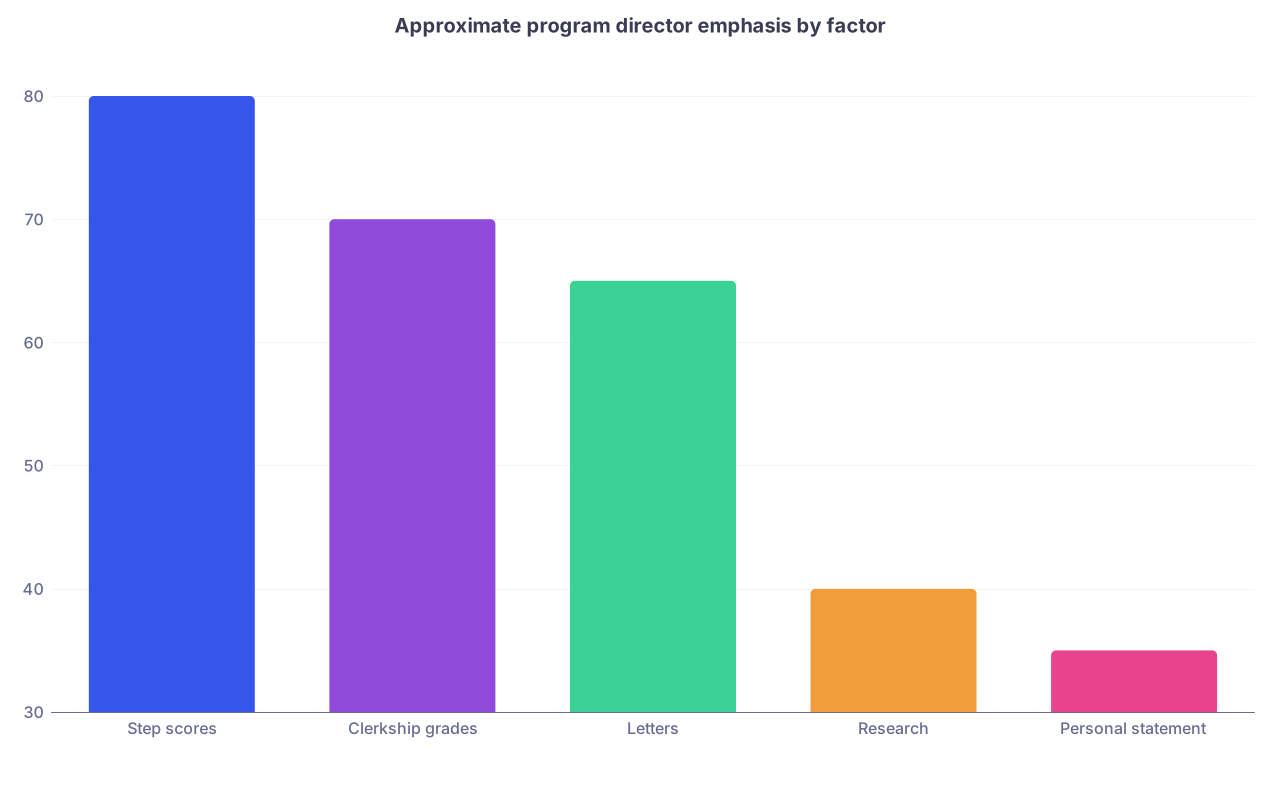
Here’s the part no one says out loud on those “you can do anything!!” forums: program directors filter. A lot.
| Category | Value |
|---|---|
| Step scores | 80 |
| Clerkship grades | 70 |
| Letters | 65 |
| Research | 40 |
| Personal statement | 35 |
Those numbers aren’t perfect, but they match what I keep hearing in hallways and PD panels:
- Scores and clinical performance get you seen
- Letters and narrative stuff get you chosen
- Research is a “strong plus” in some fields and “whatever” in others
So where does that leave you with a low Step score and no research?
Not in the trash pile automatically. But also not in “Apply to 20 Derm programs and manifest it” land.
I’m going to be very blunt about three things:
- The specialty you’re targeting matters more than anything right now. Low Step and no research in Dermatology vs in Family Medicine are two different universes.
- You do have levers left to pull this late. But they’re not glamorous and they’re not fast.
- If you do nothing and just “hope my story speaks for itself,” you’re gambling with your future. Hard.
Let’s make this less abstract.

How bad is “low”? And how bad is “no research”?
“Low” feels like failure when you’re scrolling Reddit and everyone has 255+.
But program directors aren’t obsessing over the same cutoffs you are. They think in buckets:
| Bucket | Step 2 CK Range | Typical Reaction |
|---|---|---|
| Strong | 245+ | Competitive almost everywhere (with other strengths) |
| Solid | 230–244 | Fine for many core specialties |
| Borderline | 220–229 | Needs context and strengths elsewhere |
| Concerning | <220 | Needs very strong story, backup plan, and strategy |
If you’re in the “Borderline” or “Concerning” group, that doesn’t mean “no match,” but it does mean:
- You’re probably not in the running for the hyper‑competitive specialties unless there’s something extraordinary about you.
- You can absolutely still match into many IM, FM, psych, peds, neuro, etc., if the rest of your file pulls its weight.
Now the “no research” part.
Here’s the ugly truth:
- For Derm, Rad Onc, Plastic Surgery, Ortho at big academic centers: No research is a near‑fatal flaw.
- For IM at big‑name academic places (Mayo, MGH, Hopkins): You’re at a disadvantage without it.
- For community programs, FM, psych, peds, smaller IM programs: Lack of research is often a shrug, not a death sentence.
So the combo of “low score + no research” is not one thing. It’s:
- Catastrophic for some paths
- Annoying but survivable for others
- Almost irrelevant in some community programs if your clinical record and letters are strong
The question isn’t “Am I out?” It’s “Out of what exactly?” Because odds are, you’re not out of residency—just out of some specific fantasy version of it.
What you can still fix (and what you probably can’t)
Let’s be realistic.
Things that are basically fixed right now:
- Your Step score. It’s on your transcript. It is what it is.
- Your lack of a three‑year research CV. That ship sailed.
Things that are still surprisingly fixable:
- How programs interpret that score (via letters, narrative, context)
- Your specialty list and school list (targeting programs where you’re actually viable)
- How many programs you apply to (and how diverse that list is)
- The quality of your letters and how intentionally you pick writers
- Any “late” things you add to your CV (small projects, QI, case reports)
A lot of people in your situation make the same catastrophic mistake: they assume the score already decided everything. So they half‑ass the rest of their application out of shame and burnout.
That’s how you actually tank your chances.
Strategy #1: Get unbelievably intentional about specialty and program choice
If you have a low Step score and no research, you do not get to ignore data. You just don’t.
Here’s what I’d be doing in your shoes:
Be brutally honest about your target specialty.
- If it’s something like Derm, Ortho, Plastics, ENT, Rad Onc, Neurosurg, integrated IR, Optho: with low scores and no research, you need either a true miracle story (gold medal Olympics, PhD, 10 pubs but not on ERAS yet—unlikely) or a serious Plan B.
- If it’s IM, FM, psych, peds, neuro, pathology, anesthesia: you have viable paths, but not at every program.
Tilt heavily toward community and mid‑tier academic programs.
- The flashy “Top 10” names are seductive, but they screen aggressively.
- Community programs care more about: Can I trust you on nights? Will you show up? Will patients like you?
Over‑apply. This is not the cycle to “only apply where I’d be super happy.”
- I’ve watched too many borderline applicants send 40 apps to competitive programs and then sit with 1–2 interviews in December, trying not to cry.
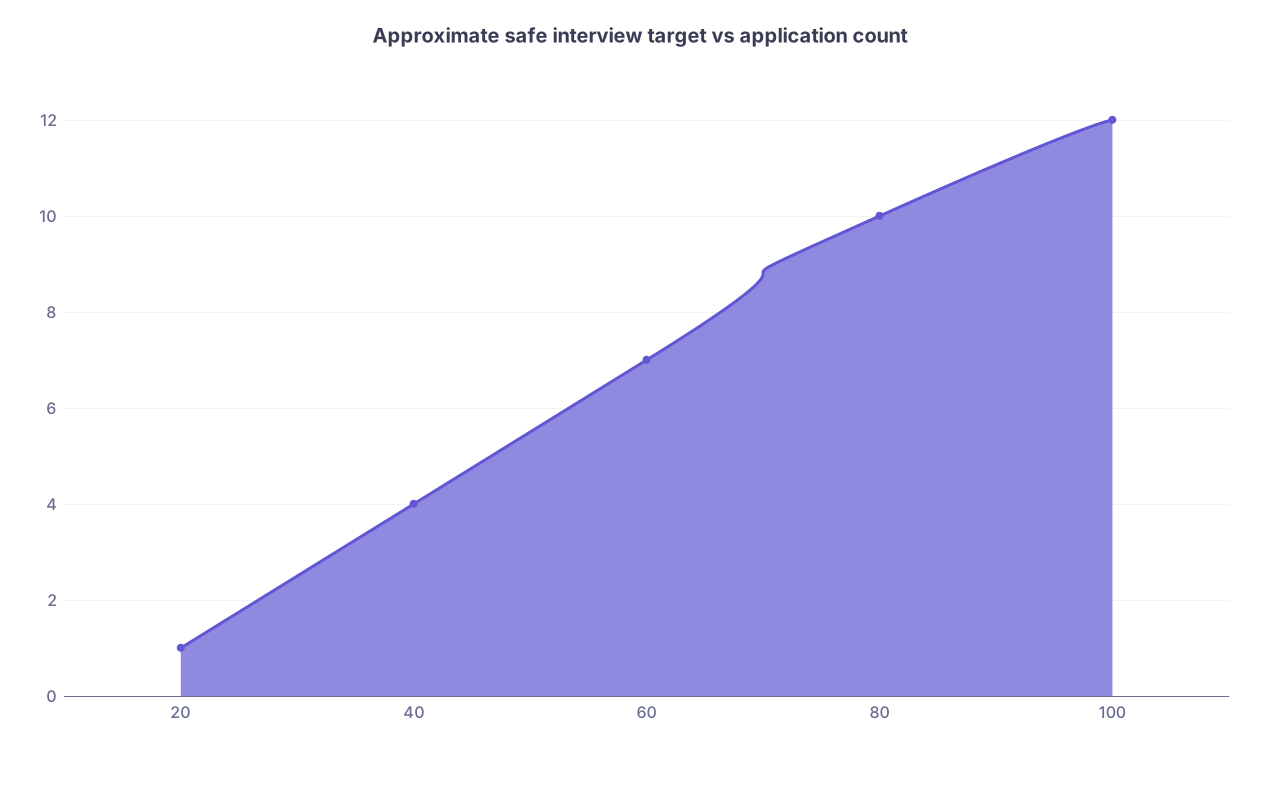
- Think more like 70–100+ total in many core specialties if you’re on the weak‑score side. Yes, it’s expensive. Yes, it sucks. It’s still cheaper than a forced gap year.
| Category | Value |
|---|---|
| 20 | 1 |
| 40 | 4 |
| 60 | 7 |
| 80 | 10 |
| 100 | 12 |
Those numbers aren’t exact, but they reflect the basic idea: low‑stat applicants need a wider net to hit the same safe number of interviews (around 10–12 for many core specialties).
Strategy #2: Use letters of recommendation to “talk back” to your score
If your score says, “Borderline,” your letters need to scream, “Clinically excellent, safe, hardworking, and normal to work with.”
Weak, generic letters kill borderline applicants. I’ve heard this exact sentence from an attending reading files:
“Low Step, no research, and letters that basically say ‘fine resident’… I don’t have a reason to fight for them.”
You need letters that sound more like:
“One of the top students I’ve worked with in the last few years…” “Takes feedback well and improved noticeably over the rotation…” “I would be very happy to have this student in our program…”
If you don’t have those people yet, you need to:
- Prioritize rotations with attendings who actually see your work for a sustained period.
- Be weirdly explicit when you ask for the letter:
“I’m applying with a lower Step score and limited research. I’m hoping my clinical performance can speak for me. If you feel you can write a strong letter commenting on my work ethic and clinical skills, I’d be very grateful.”
If they hesitate? Back away. A “meh” letter is worse than no letter.
Strategy #3: Fix what you can on your CV—fast and focused
You’re not going to suddenly have a first‑author NEJM paper in three months. That doesn’t mean you do nothing.
Things that can realistically happen late:
- Case reports (yes, even one or two, especially if tied to your specialty)
- QA/QI projects (chart review on something basic, like discharge instructions or vaccination rates)
- Teaching roles (near‑peer tutoring, USMLE review sessions, interest group leadership)
- Local presentations (department or regional conferences)
Is this going to magically make Hopkins IM forget your score? No.
But it changes how you look to normal programs: not “low score and empty,” but “low score, improving, engaged, and clearly trying.”
And if you’re thinking, “But it’s so late; does it even matter?”—program directors notice direction. Effort matters. Someone hustling to add small but real academic activity looks different than someone who just gave up after their score posted.
Strategy #4: Stop hiding from the elephant in the room
Everyone with a low score fantasizes about the same thing: that somehow, no one will notice, or that if they just don’t mention it, the PD will magically focus on the personal statement about their grandma.
That’s not how this works.
You don’t need a teary “I bombed Step because my life fell apart” confession paragraph. But some situations do require context:
- Significant, documented health issues or crisis during the exam period
- Family emergency you had to handle
- Pattern where your clinical performance is dramatically stronger than your test history
The key is: context, not excuses. Something like:
“My Step 2 CK score does not reflect my usual performance or current capabilities. During the exam period, I was managing [brief situation], which affected my preparation. Since then, I have [highlight honors in rotations, strong shelf exams, additional coursework, etc.]. I’m confident in my ability to meet the demands of residency.”
You’re not begging. You’re framing the data.
Strategy #5: Build a realistic backup on purpose, not in shame
You know what terrifies me more than a low Step score? Watching people pretend everything’s fine, not match, and then scramble through SOAP like it’s The Hunger Games.
Backup plans aren’t weakness. They’re basic self‑preservation.

| Step | Description |
|---|---|
| Step 1 | Low Step score and no research |
| Step 2 | Develop serious backup specialty |
| Step 3 | Apply broadly within core specialty |
| Step 4 | Apply to both primary and backup |
| Step 5 | Overapply and target community programs |
| Step 6 | Monitor interview count and adjust |
| Step 7 | Competitive specialty target |
Two reasonable backup approaches:
- Backup within medicine: Your dream is Cards, but you pivot to making sure you at least match into IM somewhere solid and then fight for fellowship later.
- Backup across specialties: Apply both to your first‑choice specialty and a less competitive one you could see yourself doing without being miserable.
The key is doing this now, not after you have three interviews and it’s too late.
The emotional side no one addresses directly
You’re probably cycling through:
- Shame (“Everyone else did fine; I’m the weak link.”)
- Catastrophizing (“I’ll never be a doctor; I ruined my life.”)
- Avoidance (not opening ERAS, putting off emailing mentors)
This headspace is exactly how people sabotage the parts that are still under their control—like letters, personal statement, and application list.
You do not have to be endlessly positive. But you do have to stay functional.
If your brain is stuck on “I’m doomed,” borrow my more accurate version:
“I am behind in some areas, but I still have meaningful control over my outcome if I’m strategic, humble, and aggressive about fixing what I can.”

You’re allowed to grieve the idea of the career you thought you’d have. But don’t let that grief cost you the career you can still have.
FAQ: Low Step Score, No Research, and the Match
1. Is it even worth applying this cycle, or should I wait a year to “fix” things?
If your only plan for a gap year is “do research and hope my score is forgotten,” I’m skeptical. A low Step doesn’t disappear because you spent 12 months in a lab. A gap year makes sense if:
- You’re re‑taking an exam you failed
- You have a concrete research opportunity that will definitely result in multiple pubs in your target specialty
- You can transform some other major part of your application (e.g., going from no clinical experience in the US to strong US clinical experience if you’re IMG)
If you’re in a core specialty, often it’s smarter to apply now—broadly and strategically—than delay your entire life on the bet that one year of research fixes everything.
2. Should I mention my low Step score in my personal statement?
If there was a genuine, meaningful reason your performance didn’t reflect your usual, yes, briefly. If not, don’t turn your personal statement into “The Step Apology Essay.” Use it to show who you are as a clinician and human. Let your letters and performance on rotations quietly argue against the idea that your score defines you.
3. Can strong clinical grades and honors really offset a low Step score?
Not perfectly. But yes, they absolutely help. I’ve seen applicants with 220‑ish scores match into decent IM and psych programs because:
- They had multiple Honors in core rotations
- Their attendings wrote things like “top 10% of students I’ve worked with”
- They interviewed like normal, grounded, hardworking people
Programs don’t want robots. They want residents who can carry the pager and not implode.
4. If I have no research at all, is it worth scrambling to put random things on my CV now?
If “random” means fake, padded, or exaggerated, no. That will bite you in interviews when someone asks about a “project” you barely remember.
If “random” means small but real (a case report, a poster, a simple QI project), yes. Even one or two projects show initiative and curiosity. They won’t erase your score, but they’ll make you look more like a whole person and less like “low score and empty CV.”
5. How many interviews do I actually need to feel somewhat safe?
For most US MD and DO seniors in core specialties, around 10–12 interviews is where match probability starts looking reasonably safe. With a low Step and no research, your job is not to impress every program. It’s to cast a wide enough net, with a coherent application, that 10–12 programs say, “Yeah, we’d talk to this person.”

Here’s the bottom line:
- You’re not completely out, but you are in a statistically tougher group. Pretending otherwise is naive.
- You can still move the needle—through specialty choice, program targeting, letters, and small but real academic/clinical wins.
- The biggest threat now isn’t your score; it’s paralysis. Do something. Strategically and soon.