The number of rejections you can expect with a low Step score is probably more than you want to hear—and less than your 3 a.m. brain is telling you.
Let me be blunt: if your Step score is below typical program averages, you should expect a lot of silence and a lot of “no.” For some people, that means 80–90% of programs will never email them back. For others, it’s more like 50–70%. It feels brutal. It is brutal. But it’s not the same thing as “you’re done; you’ll never match.”
Let’s actually put numbers and strategy to this, instead of just catastrophizing in the dark like most of us do.
What “Low Step Score” Really Means for Rejections
The phrase “low Step score” is vague and terrifying. Programs don’t use that phrase. They use filters.
So you’ve got something like:
- Step 1 (if you took it scored) in the low 210s or below
- Step 2 CK under ~230 for competitive places, under ~220 for a lot of mid-tier community programs
- Or a fail on first attempt, even if you later passed with an okay score
You see that and your brain immediately jumps to: “No one will interview me. I will go unmatched. I ruined everything.”
The reality is uglier and more nuanced.
| Step 2 CK Range | Interview Outlook (US Grad, Non-competitive Specialty) |
|---|---|
| 250+ | Strong; rejections mostly from top-tier only |
| 240–249 | Good; rejections from reach programs |
| 230–239 | Decent; need balanced list, some silent rejections |
| 220–229 | Noticeable drop; many filters, more rejections |
| <220 or Fail | Heavy filtering; expect majority rejections |
No, these aren’t “official” numbers. They’re the pattern I’ve seen over and over from people in your situation.
If you’re under ~220 or have a fail, you should be emotionally budgeting for this kind of reality:
- You may apply to 80–120 programs.
- You might get 5–15 interviews in a best-case scenario (less for competitive specialties, more for primary care / community-heavy fields).
- You may get zero responses from entire regions.
- You might open ERAS daily and see…nothing.
Does that mean you won’t match? No. It means the price of being in the game is swallowing more rejection than your classmates with 250s ever have to even think about.
How Many Rejections Should You Actually Expect?
Your brain wants a precise number: “Will I get 30 rejections? 60? 100?” The bad news: you often won’t even get rejections. You’ll just get silence. Which is somehow worse.
Think about it this way instead: what percentage of programs are likely to say yes to an interview?
I’m going to oversimplify to make this usable.
Let’s assume:
- You’re a US MD or DO
- You’re aiming for Internal Medicine, FM, Peds, Psych, Neuro, or similar (not derm, ortho, plastics, ENT, etc.)
- You have a Step 2 CK in the low 220s or one fail but later pass
Rough, pattern-based expectations:
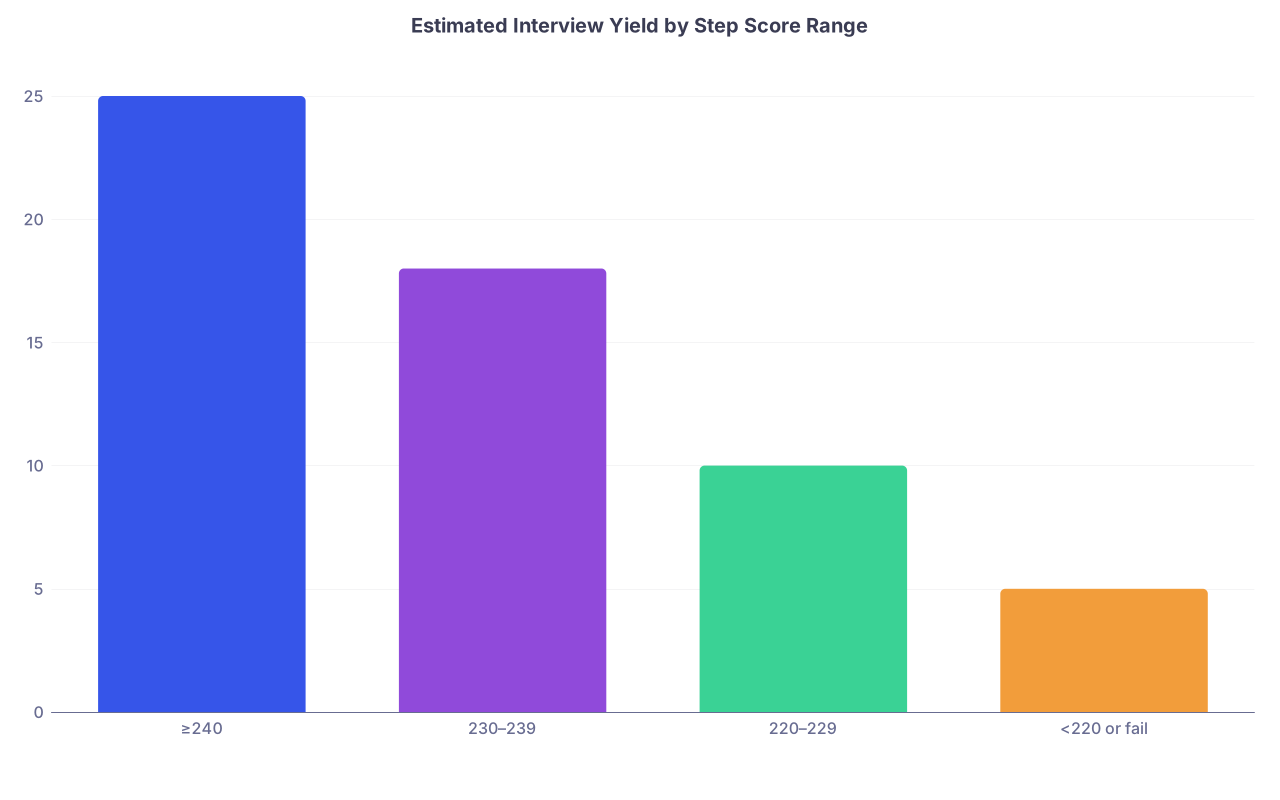
| Category | Value |
|---|---|
| ≥240 | 25 |
| 230–239 | 18 |
| 220–229 | 10 |
| <220 or fail | 5 |
These bars represent approximate percentages of programs that might invite you, assuming a sane, well-chosen list (not just Harvard, UCSF, and Mayo x80).
So if you:
- Apply to 80 programs with ~10% yield → maybe ~8 interviews
- Apply to 100 programs with ~5% yield → maybe ~5 interviews
Which also means:
- 72–95 programs never invite you
- Many won’t even send a rejection email
- A handful will send the “we were impressed by your accomplishments, but…” boilerplate
And yes, staring at a list of 90 programs and realizing only 7 of them want to talk to you feels like failure. Even though it isn’t.
How Filters Turn Your Score Into Silence
The part that messes with your head is the feeling that every rejection is personal.
It often isn’t.
Programs use filters like:
- Minimum Step 2 cutoff (e.g., 225, 230, 235)
- Automatic screen out if any Step fail
- IMG vs AMG filters
- DO vs MD biases in some places
- Time since graduation
If you’re below their threshold, they might never even see your personal statement, your LORs, your unique backstory about working nights as an EMT, or the fact you turned around from a Step 1 fail to pass Step 2.
You feel like they looked at your entire soul and said “no.”
Reality: a spreadsheet said you didn’t meet the minimum. Cold and stupid, but true.
This is why two people with the same low Step score can have very different rejection experiences:
- Person A applies to 40 mostly academic, big-name programs with high cutoffs → gets 1–3 interviews and panics
- Person B applies to 120 mostly community programs, off-the-radar places, and their home region → gets 10–15 interviews and still panics, but for different reasons
Strategy: How to Turn “100 Rejections” into “Enough Interviews”
I know your real question isn’t “how many rejections?” It’s “is there any way around this?” and “what should I actually do now?”
There is a strategy. It’s not pretty. But it’s real.
1. Apply Broadly… But Not Stupidly Broad
The reflex: “My score is low → I’ll apply to 200 programs in one specialty and hope someone bites.”
The problem: if 120 of those have cutoffs above your score, you’re basically lighting money on fire.
You want a list that’s:
- Heavy on community programs
- Heavy on lower-cost-of-living cities, non-major metros
- Mixed across regions, but especially where you have ties (even weak ones)
And you want to do actual homework, not just scroll on Reddit. Look at:
- Program websites for stated minimum Step 2 or language like “strong applicants typically score…”
- Past residents’ med schools (if they take lots of DOs, IMGs, or lower-ranked schools, that’s a good sign if you’re not coming from a top-tier place)
- Whether they mention holistic review, second chances, non-traditional applicants
You’re trying to find programs where your score is not an auto-kill.
2. Understand Specialty Reality (And Maybe Swallow a Pride Pill)
There are specialties where a low Step score means almost no realistic chance as a first-time applicant unless you have insane other strengths. I’m not going to sugarcoat that.
If your Step is low and you’re aiming for:
- Derm
- Ortho
- Neurosurgery
- ENT
- Plastics
- Integrated IR, Integrated Vascular, etc.
You’re signing up for a brutal rejection rate. Like, 98–100% rejection rate.
Could you still match? Rarely, yes. But that road usually includes research years, connections at a powerhouse home institution, and a willingness to reapply.
If your goal is simply “I want to be a physician, I want to match this cycle,” then pivoting to:
- Internal Medicine
- Family Medicine
- Psychiatry
- Pediatrics
- Neurology
- PM&R (variable, but still more feasible than the ultra-competitive fields)
…will dramatically change the number of rejections vs interviews.
This is the part people hate hearing. It sounds like “give up on your dream.” It isn’t. It’s “don’t blow your one shot at matching on a fantasy built on ignoring hard numbers.”
3. Use Every Non-Score Thing You Have
Programs that will even look at a file with a low Step score are the ones that need more reasons to see you as a full person, not fewer.
This is where you lean shamelessly into:
- Strong clinical comments: “hardest working student on the service,” “excellent with patients,” “great team member.”
- Letters that actually say something: not just “performed at expected level,” but “I would be thrilled to have them as a resident.”
- Real life story: maybe you worked through school, are a non-traditional student, took care of a sick family member, immigrated, learned medicine in your second language.
And no, this doesn’t magically erase a 215. But it gives a program that’s willing to look below 230 a reason to say, “okay, let’s give them a shot.”
4. Cold Emails and “Showing Interest” Without Being Weird
I used to think reaching out to programs was useless. Then I watched a couple of low-score applicants pull interviews out of the void with well-targeted emails.
It’s not a numbers game like secondaries in med school. Sending 200 cold “Dear Program Director, I’m very interested” emails is spam.
But sending 5–15 very intentional emails where you:
- Have a real tie (grew up in the area, did an away rotation there, know a faculty member, are from a nearby med school)
- Acknowledge your score without wallowing in it
- Highlight concrete strengths (clinical comments, research with their faculty, language skills, underserved passion)
…can sometimes nudge someone to actually open your file instead of letting the filter trash it.
Don’t expect miracles. Maybe 1–2 interviews from this if you’re lucky. But when you need 10 interviews to feel semi-safe, 1–2 is not nothing.

| Step | Description |
|---|---|
| Step 1 | Low Step Score |
| Step 2 | Very high rejection rate |
| Step 3 | Manageable rejection rate |
| Step 4 | Apply broadly but targeted |
| Step 5 | 5 to 15 interviews |
| Step 6 | Rank list |
| Step 7 | Reasonable match chance |
| Step 8 | Research year or reapply |
| Step 9 | Specialty choice |
Acceptance vs Rejection: What Your Brain is Doing to You
The worst part of this isn’t even the numbers. It’s the waiting.
You will:
- Watch classmates with 250s casually drop “oh, I already have like 10 interview invites” in September.
- Refresh your email obsessively and get nothing.
- Start calculating insane things like “1 invite for every 20 apps” and extrapolating your own doom.
- See people on forums with stats “worse” than yours get more interviews and wonder what’s wrong with you.
And your brain will quietly morph “I have a low score” into “I am a bad future doctor” and then into “I don’t deserve to match.”
That’s the part that causes the 3 a.m. spiral.
Here’s the ugly truth: the rejection rate simply isn’t a good reflection of your worth. It’s a reflection of:
- Your score
- The filters
- Your specialty choice
- Your strategy (good or bad)
- Some randomness
I’ve seen brilliant, empathetic, hard-working low-score applicants match at solid community programs and become phenomenal residents. I’ve also seen high-score people match “prestige” and still flounder because they hate the grind.
The process does not know how good a doctor you’ll be. It only knows how good your numbers and PDFs look.
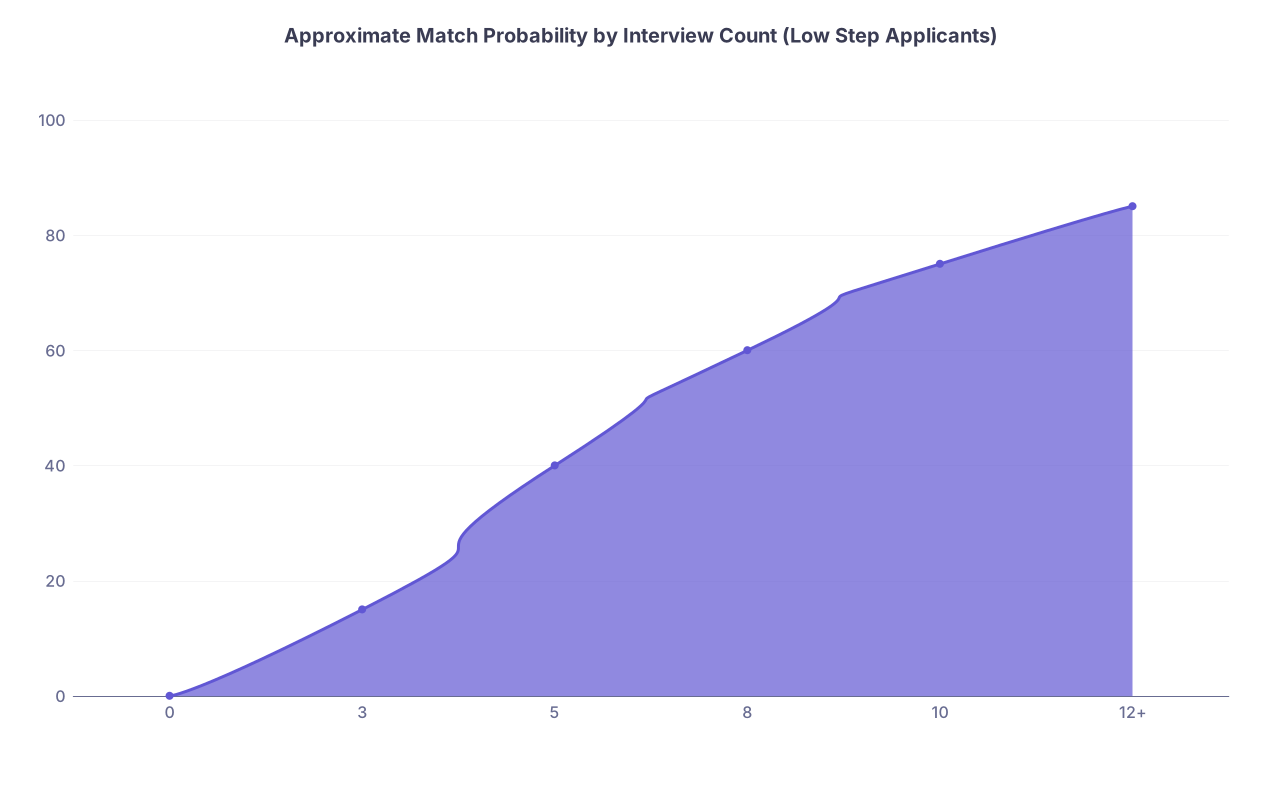
| Category | Value |
|---|---|
| 0 | 0 |
| 3 | 15 |
| 5 | 40 |
| 8 | 60 |
| 10 | 75 |
| 12+ | 85 |
For low-score applicants (especially in less competitive specialties), your fate is less about how many rejections you get and more about how many interviews you salvage from the mess.
The working target people rarely say out loud:
If you can claw together 8–12 interviews, your match chances as a US grad in a reasonable specialty are still very real, even with a low score or a fail.
So yeah, maybe that means 50–100 rejections. Maybe more. But the number of “no’s” doesn’t matter nearly as much as whether you fought your way to those 8–12 “yes, come talk to us.”
What You Should Do Today (Not Someday)
Let’s not leave this in vague “keep your chin up” territory. Your anxiety is chewing you alive, and vague pep talks don’t help.
Do these two things today:
Open your program list. Ruthlessly classify it.
Make three columns:- “Probably filtered out” (high cutoffs, super academic, big-name only)
- “Realistic” (community, stated holistic review, DO/IMG friendly if that’s you)
- “Stretch but possible”
If more than ~30–40% of your list is in the “probably filtered out” bucket, you’re not facing “too many rejections,” you’re facing a strategy problem. Fix that.
Draft one honest, targeted email to a single program where you have any tie.
Not a sob story. Not begging.
Two short paragraphs: who you are, why you’re interested in them specifically, and one sentence of context about your low score + what’s strong in your app. Save it. Edit it. Then send it to just one program tomorrow.
Not 20. Just one. Build from there.
You can’t control how many programs ignore you. You can control how intelligently you choose them, how you present yourself, and whether you keep showing up even when it feels pointless.
So: open your program list right now and highlight every program that’s clearly out of your realistic range with your current Step score. Be brutal. How many are you counting? If that number is high, your rejection problem isn’t destiny—it’s fixable.