
Last week, someone I know opened their Step 2 score report in the hospital stairwell between cases. They’d honored most of their rotations, had solid evals, but this number… lower than practice, lower than classmates, lower than what the Reddit spreadsheets say you “need.” They just sat there, frozen, thinking: “This is it. I’m done. Every program director is going to see this and move on.”
If you’re reading this, I’m guessing you’ve got your own version of that story. One exam. One score. And now your brain is screaming: Will program directors judge me more harshly for this one bad exam?
Let me answer that directly:
Yes, some will. No, most will not only use it against you. And no, a single bad exam almost never destroys an application by itself. But how you handle it can absolutely make things better or worse.
Let’s break it down like someone who’s up at 2 a.m. compulsively refreshing Charting Outcomes would want it broken down.
How Program Directors Actually Look at Exam Scores (Not the Fantasy Version in Your Head)
There’s this nightmare image in my mind of program directors sitting in a dark room, giant projector, your ERAS pulled up, someone pointing at your score yelling, “NEXT.”
Real life’s not that dramatic.
Most programs use scores in three main ways:
- Initial screen – They sort apps by score ranges or have rough cutoffs. Not always hard cutoffs, but tiers.
- Risk assessment – “Will this person pass the boards on the first try?” Programs care because their board pass rate is public and tied to accreditation.
- Context signal – “Does this score match the rest of the story?” They look at scores with grades, class rank, letters, etc.
Here’s the part that matters for your question: they look for patterns, not isolated explosions.
One bad exam? Annoying. Concerning maybe. But they’re going to ask:
- Is this a random blip?
- Or is this part of a downward trend?
- Or does it fit a story that you actually explain?
If it’s one ugly outlier in an otherwise solid file, most program directors will not automatically punish you for it. They’ll notice it, sure. But they’ll move on and see what else they can anchor their opinion to.
| Pattern | Typical Reaction |
|---|---|
| Single low Step 1, better Step 2 | “Improving. Less worried.” |
| Good Step 1, single low Step 2 | “What happened? Do they recover?” |
| Both low but passed | “Risky but maybe strong elsewhere.” |
| One failure, strong later score | “Risk, but shows resilience.” |
| Big jump upward | “Nice. They can improve with work.” |
They’re not robots. They look for explanations, consistency, and evidence that you’ll pass their boards and not crash under pressure.
Yes, Some Will Judge You More Harshly — But Not All, and Not Equally
Let me be brutally honest because your brain’s already going there.
There are program directors who will:
- Filter hard by score and never see the rest of your app
- Use a single low number as confirmation bias to label you as “weak”
- Quietly rank you lower because they’re nervous about board pass rates
This happens more in:
- Hyper-competitive specialties (derm, ortho, plastics, ENT, neurosurg)
- Top-name academic programs that get 1000+ apps
- Programs with recent board pass issues or small resident classes
But here’s the part your anxiety usually erases:
There are also a lot of programs where:
- A single low score is just… one data point
- They’ve seen rockstar residents with mediocre scores and disasters with 260s
- They personally failed or underperformed on an exam at some point and remember what that felt like
And they care more about:
- Your work ethic on wards
- How attendings describe you
- Whether you’re teachable and not miserable to work with
- If you’ll show up at 4:45 am without whining and still be kind to nurses at 6 pm
So yes, a few will judge you more harshly. Some won’t even see your name because of filters.
But “some” is not “all,” and for most specialties, you don’t need “all.” You need enough.
How Bad Is “Bad”? (Your Brain vs Reality)
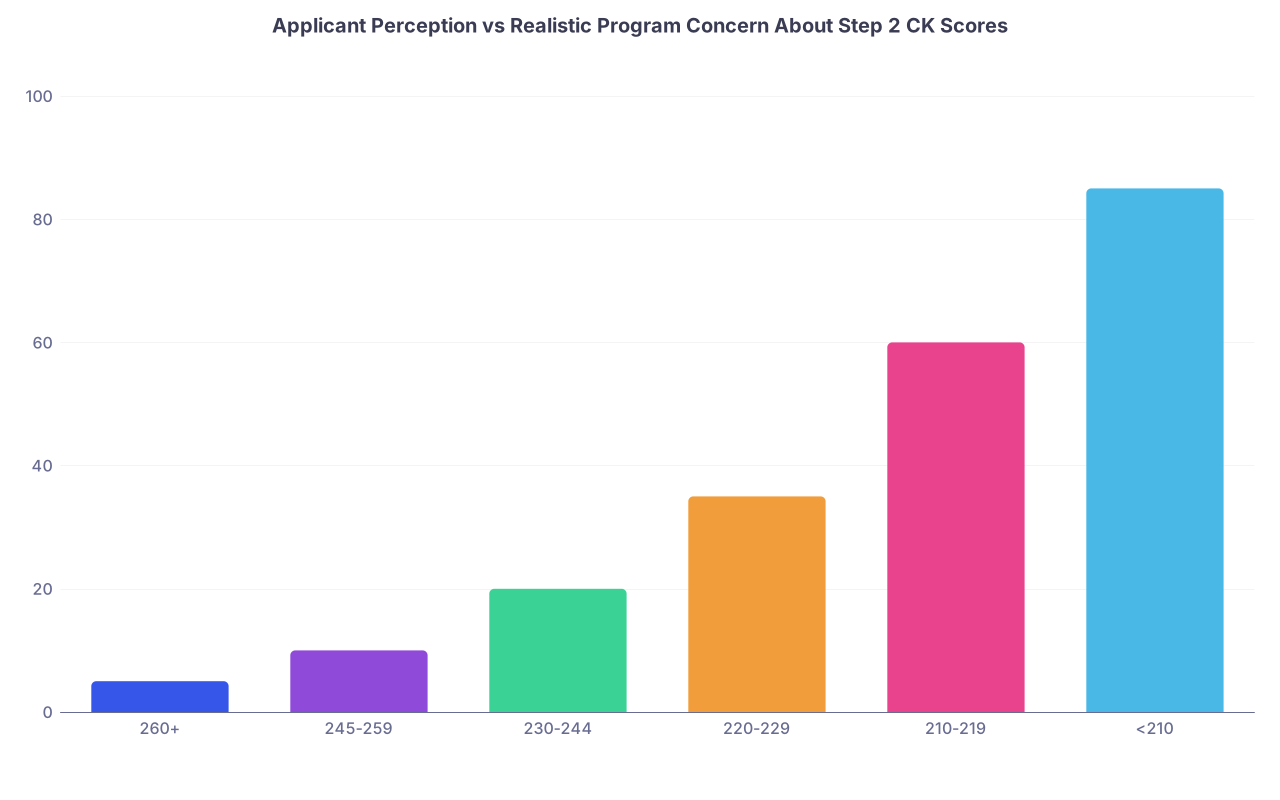
Your brain probably classifies anything below “average on Reddit” as catastrophic. That’s not how programs see it.
Let’s get concrete.
| Category | Value |
|---|---|
| 260+ | 5 |
| 245-259 | 10 |
| 230-244 | 20 |
| 220-229 | 35 |
| 210-219 | 60 |
| <210 | 85 |
Those “concern levels” are rough, but this is the pattern I keep seeing:
- 260+ – You’re fine. Your worries are about other things.
- 245–259 – Solid. If you’re anxious here, that’s perfectionism talking.
- 230–244 – Very common, not a death sentence for most fields.
- 220–229 – Programs start to pay more attention; still very workable for many specialties.
- 210–219 – Now they’ll look harder at everything else.
- <210 or a fail – This is where true “risk” flags go up, but not every door slams shut.
A “single bad exam” could be:
- One low but passing score
- One fail then pass
- One big drop compared to the other exam
Each of these is fixable in different ways. Where it really hurts is when everything else also looks average or weak. Then the exam becomes one more negative instead of the only negative.
If your file is:
- Strong clinical evaluations
- Honors/HPs in core rotations
- Solid letters with specific praise
- Some research or meaningful extracurriculars
Then that one exam? Annoying. Not fatal.
How To Keep One Bad Exam from Defining You
This is the part that matters most: not the score, but the way you build around it.
1. Strengthen the rest of your application like your life depends on it
Because in your head, it kinda does.
Focus on things that directly counter the story a bad exam wants to tell about you:
- Clerkship grades: Push hard to honor or at least high pass in rotations related to your specialty.
- Narrative evaluations: Ask for feedback early, fix things, show improvement. Directors actually read these.
- Letters of recommendation: You want phrases like “top 10% of students I’ve worked with” and “would be thrilled to have them in our program.” That language matters more than one number.
Programs will notice if:
- Your score is mediocre
- But your attendings are raving about your work ethic, fund of knowledge, and clinical reasoning
That usually carries more weight in the final ranking discussions than your exact 3-digit score.
2. Decide if you need to address it head-on
Sometimes ignoring the elephant makes it bigger.
You might consider addressing the score if:
- You failed an exam (Step or shelf)
- You had a major life event (family emergency, illness, etc.) around the time
- There’s a massive discrepancy (e.g., 255 Step 1, 220 Step 2) with context
Where to do it:
- ERAS Personal Statement? Sometimes, but not ideal for 90% of people. PS should not be a damage-control essay.
- Additional Info section / secondary questions if they ask about academic challenges.
- MSPE – Sometimes your dean’s office can mention the context in the school’s letter.
- Interviews – If they bring it up, have a clean, short explanation ready.
Key rule: brief, factual, growth-focused.
Something like:
“I underperformed on Step 2 compared to my practice exams after dealing with a family health issue during my dedicated period. Since then, I’ve worked closely with faculty to strengthen my clinical reasoning and test-taking, which is reflected in my improved shelf scores and strong clinical evaluations.”
Not a sob story. Not ten paragraphs. Just: this happened, I learned, here’s evidence I’m fine now.
3. Show an upward trend anywhere you can
Programs love trajectories. They feel safer betting on someone who’s clearly moving in the right direction.
Ways to show that:
- Improved shelf scores later in third year
- Progress from Pass → HP → Honors across rotations
- Any later standardized test (in-training exams, subject exams) you can talk about, if relevant
Even if your Step 2 is the bad one, you can still show:
- Prior solid performance (Step 1, class rank, preclinical exams)
- Subsequent clinical excellence
If the “bad exam” is early (like Step 1 when it was still scored), and then Step 2 is better? Honestly, most PDs will interpret that as you figuring things out.
Specialty Reality Check: Who Cares the Most?
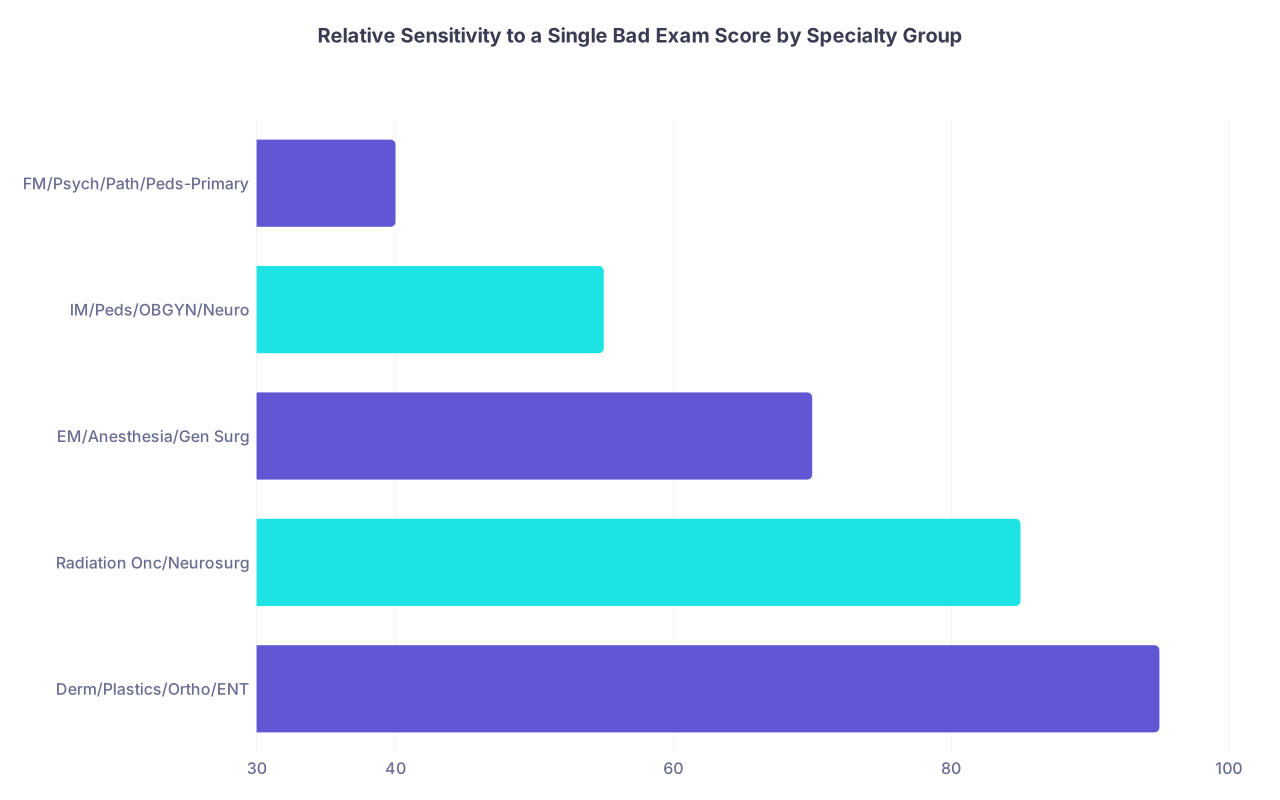
Let’s not pretend all specialties see this the same way.
| Category | Value |
|---|---|
| Derm/Plastics/Ortho/ENT | 95 |
| Radiation Onc/Neurosurg | 85 |
| EM/Anesthesia/Gen Surg | 70 |
| IM/Peds/OBGYN/Neuro | 55 |
| FM/Psych/Path/Peds-Primary | 40 |
Rough translation of that anxiety-level chart:
- Derm, plastics, ortho, ENT, integrated surg – One bad score can hurt a lot because there are too many 250+ applicants. You’ll need stronger everything else and tons of strategic applications.
- Neurosurg, rad onc – Similar story. Hyper-competitive. They may still read past it if your research and letters are insane.
- EM, anesthesia, gen surg – They care, but they will look at the rest of your app. Some programs are very score-heavy, others not as much.
- IM, peds, OB/GYN, neuro – Wide range. University programs and big names are more selective; community or mid-tier academic programs are much more flexible.
- FM, psych, path, peds-primary – A single bad exam is rarely a dealbreaker if everything else is decent. They care much more about fit, professionalism, and clinical work.
If you’re going into a highly competitive field with a glaringly low exam, you might need a realistic Plan B or dual apply strategy. That’s not failure. That’s survival.
The Part Nobody Tells You: How Much Interviews Can Rewrite First Impressions
By the time you reach interview season, that “single bad exam” is still in your file—but it’s not what people are actively thinking about.
What they are thinking during interviews:
- Are you awkward or easy to talk to?
- Do you seem like someone they could call at 3 am without regretting hiring you?
- Do your stories sound real or rehearsed?
- Do you blame others or take responsibility when describing challenges?
I’ve seen:
- Applicants with average scores jump to the top of rank lists because everyone loved working with them on away rotations and they absolutely killed the interview.
- Applicants with huge scores get ranked lower because “seemed arrogant,” “not a team player,” or “talked down to residents.”
So even if your score is the weak point, the most dangerous thing you can do is assume it’s all anyone sees. If you walk into interviews acting like you’re already disqualified, they’ll pick up on that energy.
You need to be the person whose entire file says:
- “I had a bump.”
- “I adjusted.”
- “Here’s how I perform now.”
- “And here’s why I’ll be a safe, hardworking, teachable resident in your program.”
That’s what gets remembered in the room when they’re building the rank list.
What To Do Tonight If You’re Still Spiraling
Because I know the post-score doom scroll is real.
Look at your entire app, not just your score.
Make a brutally honest list: strengths, weaknesses, what’s fixable in the next 6–12 months.Talk to someone who’s actually on the inside.
Not just Reddit. A PD, APD, trusted attending, or dean. Show them your real numbers. Ask, “Where do I realistically stand, and what should I target?”Adjust your strategy, not your entire identity.
That might mean:- Applying to more programs than you planned
- Leaning harder into home and regional programs
- Adding a slightly less competitive backup specialty
- Doubling down on letters and away rotations
Stop catastrophizing the worst-case scenario as if it’s guaranteed.
The actual worst-case (not matching anywhere) is statistically unlikely if you apply broadly and strategically—even with a bad exam. You have control over more than your brain is letting you believe.