
Two days after scores dropped, a classmate of mine sat in his car in the hospital parking lot for an hour before he could make himself walk into rounds. He’d scored below the median for his dream specialty. All he could think was: “Everyone else just became competitive. I just became… disposable.”
If that’s where your brain is right now—stuck on one number, feeling like your entire future just narrowed to a hallway closet—I’m right there with you. Let’s walk through this mess honestly.
First: Is Your Dream Specialty Actually “Over”?
Let me be blunt: a low Step score makes life harder. It does not make your dream impossible. Those are very different things.
Programs don’t sit in some secret bunker and sort people into “over 240 = human” and “under 240 = trash.” They think like this:
- “Can this person handle our boards pass rate expectations?”
- “Will adding this applicant hurt our program’s stats?”
- “Do they bring something else that makes the risk worth it?”
The score is a filter. A huge one, sometimes a lazy one, but still just one filter.
And you’re sitting there thinking: “Cool, but I wanted derm / ortho / plastics / ENT / ophtho / urology / gas / EM / anesthesia / rad onc / rad, and I’m below the median. That seems… fatal.”
So let’s get specific.
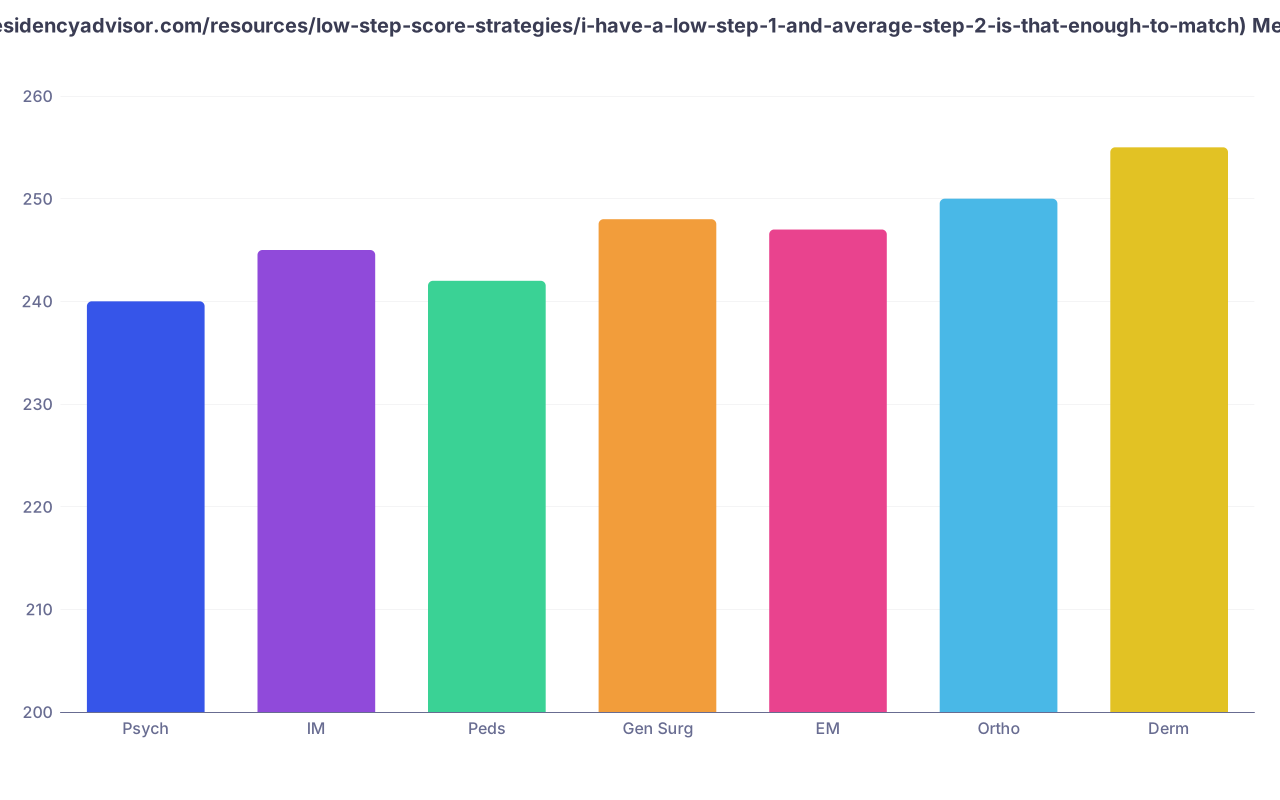
| Category | Value |
|---|---|
| Psych | 240 |
| IM | 245 |
| Peds | 242 |
| Gen Surg | 248 |
| EM | 247 |
| Ortho | 250 |
| Derm | 255 |
Those medians are not “hard cutoffs.” They’re just what matched folks on average happened to have. Plenty of people match below them every single year. You just don’t hear their stories because no one runs around proudly announcing, “I matched with a 228 and three red flags!”
Here’s the actual question you need to answer:
Is my score “below median but within range” or “so low it looks like a hard stop for this field without a story”?
Roughly how bad is “bad”?
This is not exact, but I’ve seen this pattern enough times it’s basically real life:
- ~5–10 points below median: Annoying but workable with other strengths.
- ~10–15 below: You’re swimming upstream. Need significant compensating factors.
15 below: Now you need a very sharp, coherent story and strong mentorship. Or to be flexible on program type and location. Or both.
And then there are the truly brutal combos: very competitive specialty + very low score + no research + no mentors. That’s when “is my dream specialty over?” becomes a real conversation, not just anxiety.
But you do not decide that in one evening with your score report and a meltdown. You decide it with data, mentors, and a Plan B/C that doesn’t feel like exile.
Understanding What Programs Actually See When They Look at Your Score
Programs don’t just see “below median.” They see:
- How far below
- Trend (Step 1 vs Step 2, or NBME shelf scores if they hear about them)
- Context (school, transcript, remediation, delays)
- Does everything else scream “this person will still crush residency”?
Think like a PD for 30 seconds. You’re running, say, a mid-tier gen surg or EM program. You see two applications:
- Applicant A: Step 2 = 254, generic LORs, okay MSPE, no research, average interview
- Applicant B: Step 2 = 235, outstanding surgery/EM chair letter, strong narrative of growth, honors on demanding rotations, research with real ownership, fantastic interview
You don’t automatically pick the 254. You pick the one you can imagine at 3 a.m. in the ED not imploding. Programs have plenty of “good test takers who were disasters on the team.”
You’re worried because your Step score is the one number you can’t move anymore. That’s exactly why your brain is obsessing over it. But it’s also the one thing you can now stop trying to fix and start trying to contextualize.
Let’s take a hard look at strategy.
Strategy 1: Decide If You’re Pushing Forward or Pivoting
You need a brutally honest assessment, not from your inner catastrophizing gremlin, but from people who’ve actually placed applicants with scores like yours.
Step 1: Get real data on your score vs specialty
Use FREIDA, NRMP Charting Outcomes, and your school’s match data. Then map yourself:
| Specialty Type | My Score vs Recent Match Data | Reality Check Level |
|---|---|---|
| Ultra-competitive | 15+ below median | High risk |
| Competitive | 8–15 below median | Risk, but possible |
| Moderately competitive | 5–10 below median | Doable with strengths |
| Less competitive | Near or slightly below median | Very possible |
Now you know if you’re trying to jump a curb or scale a wall.
Step 2: Talk to the right people
You need at least:
- One advisor at your med school who actually knows your class’s match data
- One faculty member in your dream specialty (ideally PD/APD if you can swing it)
- One recent grad who matched in your target field with a not-stellar score
Ask them bluntly: “With a Step 2 of X and the rest of my application [briefly summarize], what would you do?”
If two or three independent people say the same thing—“Stay in, but you need X, Y, Z” or “You can try, but I’d dual apply”—believe them more than your self-doubt or your denial.
You’re not weak for pivoting. You’re not dumb for aiming high. You are dumb if you make a huge life decision based only on your current anxiety and zero outside data.
Strategy 2: Build a “Score-Compensating” Application
If your Step score is your weak link, everything else has to pull like hell.
1. Letters that actually say something
You can’t afford generic lines like “performed at expected level for training.” That’s code for “meh.”
You need:
- At least one letter from a big name or highly respected clinician in your specialty (or related field)
- Someone who has seen you on your best days—complex patients, call, consults, procedures
- Language that sounds like: “top 10% of students I’ve worked with in 20 years,” “I’d be thrilled to have this student in our program,” “mature, resilient, reliable under pressure”
This is where you lean into your strengths: work ethic, team behavior, growth, ownership. Make sure your letter writers actually know your Step performance, your response to it, and the kind of resident you’re trying to be.
2. Rotations and aways that prove the Step score is not you
If your Step is low, your clinical performance needs to scream the opposite.
- Honor/High Pass in your specialty rotation if your school allows that
- Strong narrative comments that say “outperformed peers,” “functioned at intern level,” “exceptional”
For competitive fields: away rotations matter… a lot. Yes, it’s terrifying to walk into an away with a weak score. But this is your shot to convert a file weakness into an in-person strength.
You need to show up to aways like your life depends on it. Early, prepared, pleasant, sponge-like, tireless. Not fake. Just locked in.
3. A personal statement that doesn’t hide but also doesn’t whine
You don’t need a 2-page Step apology letter. But you also don’t pretend it didn’t happen if it clearly contradicts the rest of your record.
The sweet spot looks like this:
- One brief line or short paragraph explaining context if there is legit context (illness, family crisis, language barrier, documented anxiety that you addressed)
- Clear emphasis on how you responded: remediation, improved clinical performance, more structured studying, seeking help, not repeating the same mistakes
- Then move on. Spend most of your statement showing why you belong in this specialty, not relitigating your worst exam.
Programs want to see: did this person fall, learn, and get better—or just fall and submit ERAS anyway?
Strategy 3: Use Time Before ERAS and Interviews Ruthlessly
You’re not going to magically boost your Step score. But you can absolutely make other metrics stronger before things go out.
Improve what’s still improvable
- Shelf exams and rotation grades now matter more; they prove you can handle content even if standardized tests betrayed you
- Get involved in a small, doable research or QI project related to your target specialty (case report, retrospective chart review, something finishable)
- If Step 3 timing makes sense for you (and isn’t risky), a solid Step 3 can help quiet some anxiety for certain fields and PDs
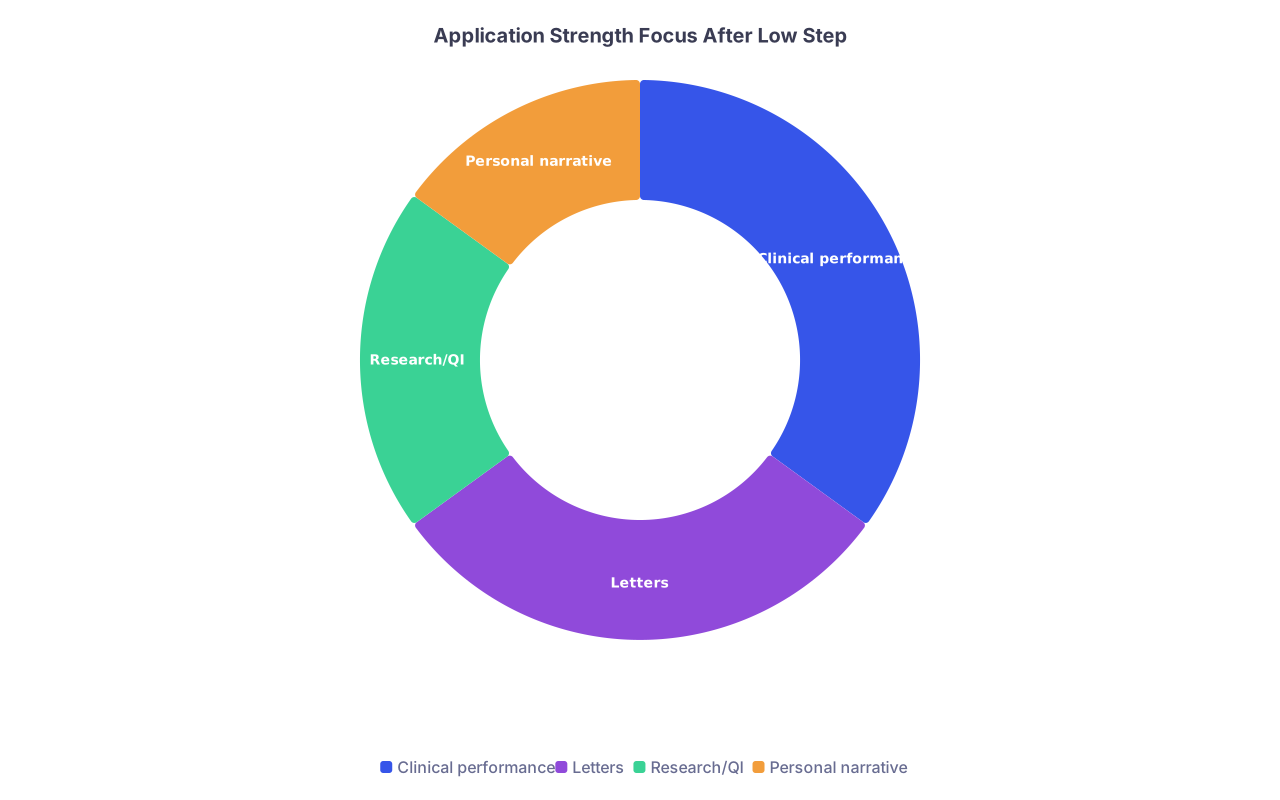
| Category | Value |
|---|---|
| Clinical performance | 35 |
| Letters | 30 |
| Research/QI | 20 |
| Personal narrative | 15 |
Time spent spiraling on Reddit is time not spent fixing the few things that are still in your control.
Strategy 4: Be Strategic About Programs and Dual Applying
People hate this part because it forces you to interact with reality. But reality is kinder when you face it early.
Applying broadly is not “desperate”—it’s smart
If your score is below median, you do not have the luxury of only applying to dream coastal academic powerhouses in your specialty. That’s not grit. That’s denial.
You target:
- A spread of program types: academic, community, hybrid
- A spread of geographic areas, especially regions less flooded with applicants (Midwest, South, smaller cities)
- Programs known to have taken applicants with lower scores if you can figure that out from prior grads or advisors
If your advisors are saying “you need to dual apply” and you hate that… yeah. Me too. But dual applying doesn’t mean you’ve cheated on your dream. It means you want to match more than you want to perform loyalty theater to a field.
Strategy 5: Mindset: Not Toxic Positivity, Just Survival
The hardest part of all of this isn’t the spreadsheets or the away rotations. It’s getting out of bed and doing it while your inner voice is telling you you’re already doomed.
You will see classmates post their 260s in group chats. You will sit in lectures where someone says, “Of course Step matters,” and your stomach will drop. You will mentally rehearse telling your family you “failed” even if you passed.
Here’s what I’ve watched actually help people in this situation:
- One or two trusted people who know your score and don’t flinch when you talk about it
- A firm rule about Step comparisons (no asking everyone their scores, no doomscrolling match stats at 2 a.m.)
- Therapy if you can access it, especially if your anxiety tanked your studying the first time and you’re scared it’ll tank the whole application now
- Accepting that you’re going to feel behind, ashamed, jealous—and still move forward anyway
You don’t need to convince yourself this score doesn’t matter. It does. You just need to remember it is not the only thing that matters, and it is not a moral judgment on your ability to be a good doctor.

| Step | Description |
|---|---|
| Step 1 | Get Step Score |
| Step 2 | Apply as planned |
| Step 3 | Meet mentors and advisors |
| Step 4 | Target specialty with broad list |
| Step 5 | Strengthen letters and rotations |
| Step 6 | Consider dual apply or pivot |
| Step 7 | Identify realistic backup |
| Step 8 | Submit strong ERAS |
| Step 9 | Below median for dream specialty |
| Step 10 | Advisors support pursuing specialty |

The Ugly Truth and the Real Hope
Here’s the part I’m not going to sugarcoat: for some people, with some scores, in some specialties, yes—your dream as originally imagined might be over. Not because you’re incapable, but because the system is rigid and numbers-obsessed and deeply imperfect.
But the story you’re writing from here isn’t “I was doomed by a single test.” It’s:
- Did I get real advice and use it, instead of hiding from it?
- Did I give my first-choice specialty a fair shot if it was still realistic?
- Did I build a smart Plan B that honors who I am instead of punishing myself?
- Did I keep showing up for patients and for my own life, even while ashamed of a number?
I’ve seen people with “bad” Step scores match into their dream fields after a transitional year, an MPH, a research year, or a relentless grind boosted by unreal mentorship. I’ve also seen people gently pivot into a different specialty they swore they didn’t want… and later admit, quietly, “I love this. I didn’t know I was allowed to.”
Your score is a plot twist. Not the final chapter.

Quick Recap
- A below-median Step score makes matching harder, not impossible. You need strategy, not despair.
- Get honest, specific advice from mentors and PD-level people about whether to push forward, dual apply, or pivot.
- If you push forward, your letters, rotations, narrative, and program list must all be intentionally crafted to compensate for the score.
FAQ (Exactly 6 Questions)
1. I’m 15+ points below the median for my dream specialty. Is it delusional to still try?
Not automatically, but it’s high risk. If you have strong clinical evaluations, real research in the field, and powerful letters, some PDs will still look. Most people in that range should at least consider dual applying, especially if they can’t stomach the idea of going unmatched. Get 2–3 independent advisors to weigh in before deciding.
2. Should I explain my low Step score in my personal statement?
Only if there’s clear, genuine context and a story of growth. “I was stressed and didn’t sleep” is not enough. A short, direct acknowledgment plus evidence of improvement is fine. A long justification section screams defensiveness and keeps the reader focused on your worst moment instead of your strengths.
3. Can a strong Step 3 score “fix” a low Step 2 for residency applications?
It can help, but it doesn’t erase Step 2. Some programs care a lot about Step 3 as a reassurance you’ll pass boards; others barely glance at it. Also, there’s risk: if you bomb Step 3, you’ve just added another problem. Only take it early if you’re sure you can do meaningfully better and your mentors think it’ll help for your specialty.
4. Is taking a research year worth it after a low Step score?
Sometimes. If you’re aiming for a very competitive specialty and can get a legit, productive year with strong mentors (posters, papers, real networking), it can move the needle. If the “research year” is basically you floundering with no output and no advocacy, you’ve just delayed graduation for nothing. The quality of the year matters more than the title.
5. How many programs should I apply to with a low Step score?
More than you want to. For competitive specialties, people with below-median scores often apply to 60–80+ programs, sometimes more. For less competitive fields, 30–50 may be enough. Your advisors should tailor this to your situation, but the theme is: you lose the right to be picky about locations and prestige if your score is a major weakness.
6. I feel so ashamed I don’t even want to talk to mentors about my score. What do I do?
You talk to them anyway. Sitting in silence with shame is how people end up under-applied, poorly strategized, and unmatched. Most attendings either had their own academic smackdown at some point or have seen dozens of students recover from one. You don’t need to show up fearless. Just show up honest: “My Step is X, I’m scared, and I need help making a realistic plan.” That’s how grown physicians handle problems—and you’re closer to being one of them than you think.