
“What If Every Program Screens Me Out for Low Step Scores?”
It’s 1:47 a.m. Your phone is on the pillow next to you, ERAS emails turned on even though you keep telling yourself to turn them off. You open FREIDA again—for the hundredth time—to stare at the same line: “May use Step 1/2 minimum cutoffs for interviews.”
Your Step is lower than you ever imagined it would be. Not a disaster in the global sense, but bad enough that you know those red-flag numbers by heart. 205. 208. 215. Whatever your number is, it’s the one you keep doing mental gymnastics around.
And the thought that’s lodged in your brain like a splinter is brutal:
What if every single program screens me out?
Every. Single. One.
Let me say the thing you’re afraid of first: yes, some places will auto-trash your file without ever reading your name. That’s real. I’ve watched PDs scroll a list, sort by score, and say, “We set the cutoff at 220 this year; everything below that gets filtered.” No drama. Just a click.
But “some” isn’t “all.” It only feels like “all” at 1:47 a.m.
Let’s talk like adults about how bad this can get—and then what you can actually do besides refresh your email until your soul leaves your body.
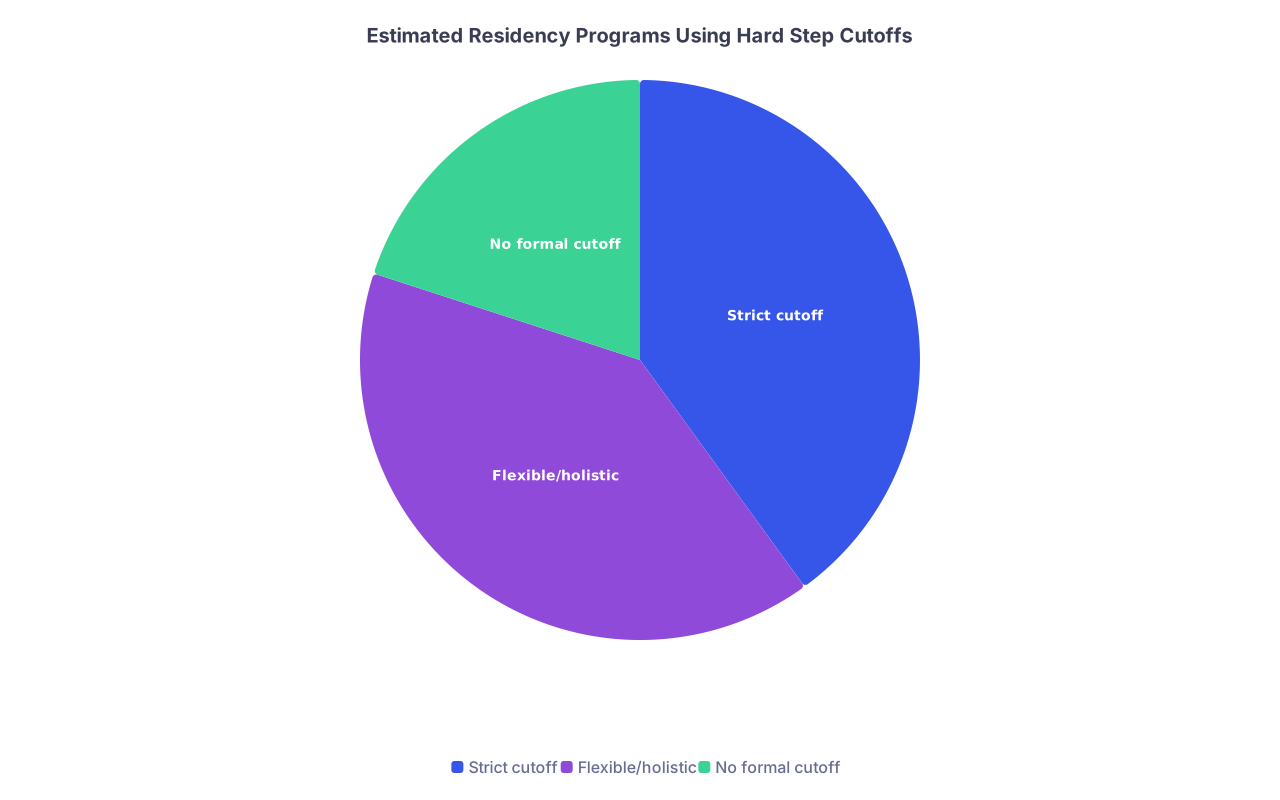
| Category | Value |
|---|---|
| Strict cutoff | 40 |
| Flexible/holistic | 40 |
| No formal cutoff | 20 |
Reality Check: Could Every Program Screen You Out?
You want the worst-case scenario. Fine.
Could literally every program screen you out solely based on Step?
If you’re applying to a hyper-competitive specialty (Derm, Ortho, Plastics, ENT, competitive Rad Onc) with a score far below their usual range and you only apply to a small group of “dream” programs? Yes. You absolutely can get zero interviews. I’ve seen it. More than once.
But even in ugly situations, it’s usually not “every program” in the universe. It’s “every program you chose, given your stats and strategy.”
That sounds harsh, but that’s actually the good news. Because strategy is the part you can still change.
Programs fall into rough buckets regarding Step screens:
| Program Type | Step Screen Attitude |
|---|---|
| Big-name academic | Often strict cutoffs |
| Mid-tier academic | Cutoffs but some exceptions |
| Community with university affiliation | More flexible |
| Pure community | Often most forgiving |
| Newer/unfilled programs | Desperate for applicants |
The fantasy is “if I just explain my story, they’ll look past it.” Some will. Many won’t. But your job is not to convert Mass General into a holistic-review paradise. Your job is to find the ones who are already at least somewhat open to you and then make it almost painful for them to say no.
Step 1: Stop Guessing—Figure Out How Bad It Actually Is
Your brain is probably operating on vibes: “Everyone else is 250+ and I’m doomed.” That’s not a plan; that’s spiraling.
You need three pieces of clarity:
How low is your score relative to your specialty norms?
Not Reddit norms. Real ones.How does the rest of your app look?
Because a low Step score on a strong app is a very different beast than a low Step on a weak app.How much time you have before or during application season to move levers (Step 2, aways, research, extra year, etc.).
If you haven’t already, sit with someone who actually knows your field: your home PD, clerkship director, or that attending who everyone knows is plugged into the match. Not your class group chat.
Ask very direct questions:
- “With a Step 1/2 of X, what range of programs realistically might still look at me?”
- “Am I delusional to aim for [specialty] without a backup?”
- “What have people with my score from our school actually matched into in the last 3–5 years?”
If they wince, that’s data. If they say, “You’ll be fine,” and you don’t believe them, push: “Fine like ‘match somewhere if I apply broadly,’ or fine like ‘still a shot at mid-tier academic’?”
You’re not looking for comfort here. You’re looking for the map of landmines so you don’t step on all of them at once.

Step 2: Weaponize Step 2 (If You Still Can)
If Step 1 is your problem and you still have Step 2 ahead of you, this is your single biggest shot at changing the narrative. No drama, no magic. Just math.
Programs love an “upward trend.” Translation: they’ll forgive a bad Step 1 if Step 2 is clearly stronger.
If you:
- Bombed Step 1 but can get Step 2 up by 15–20+ points → a lot of doors reopen, especially in IM, FM, Peds, Psych, Neuro, Path, maybe even less competitive EM or Gas in some places.
If you:
- Also do poorly on Step 2 (or don’t take it early enough) → then you don’t have “I improved” to lean on, and the score story is much harder to spin.
So if Step 2 is still in the future and you’re thinking, “Maybe I’ll just coast, I already know I’m bad at these exams”—no. That’s catastrophic thinking masquerading as realism.
I’ve watched people go from:
- Step 1: 208 → Step 2: 244, and suddenly mid-tier university IM programs that would have insta-screened them are offering interviews.
The cost of treating Step 2 like a salvage mission instead of a formality is huge…but so is the payoff.
If you’ve already taken Step 2 and it’s also low? Then you stop wishing you had a retake button and start focusing on the parts of the application that aren’t locked in stone.
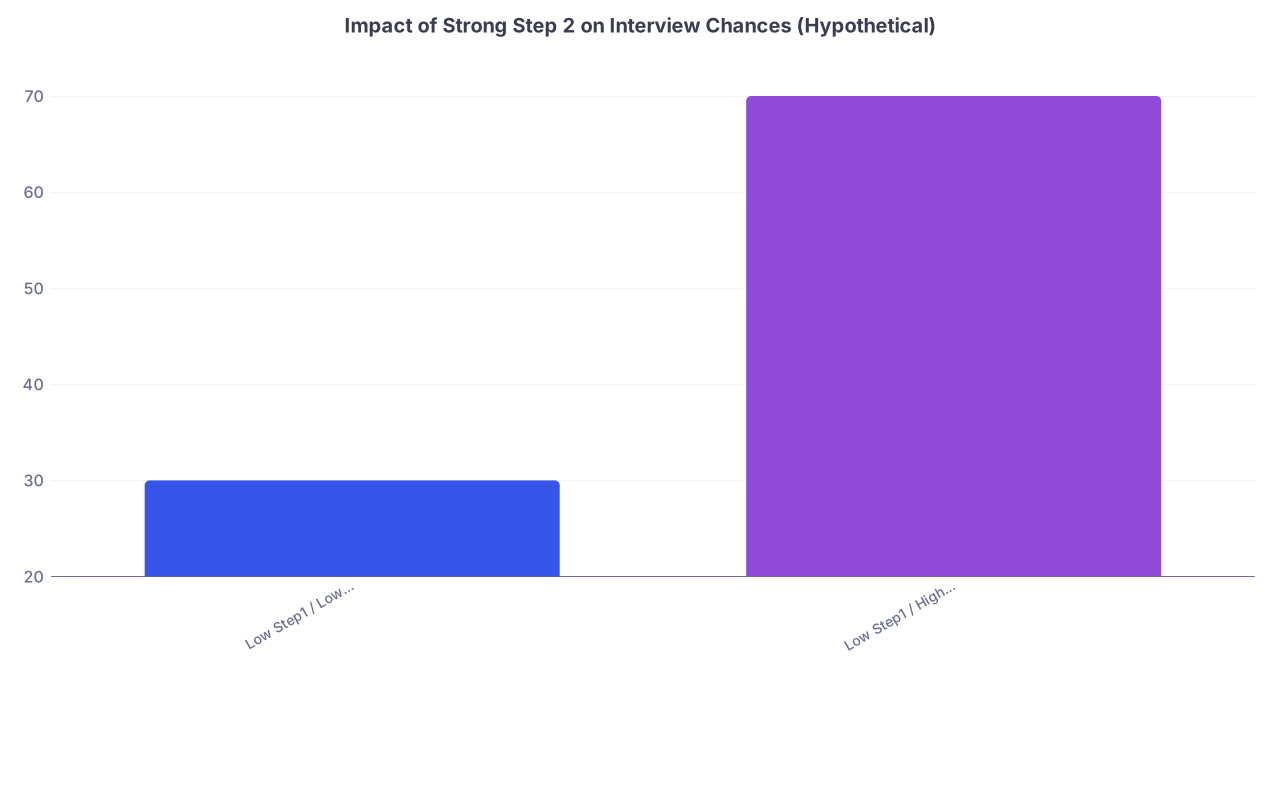
| Category | Value |
|---|---|
| Low Step1 / Low Step2 | 30 |
| Low Step1 / High Step2 | 70 |
Step 3: Build an Application That Forces Them to Think Twice
If your scores won’t clear many auto-filters, you have two levers:
- Change the kind of programs you target.
- Make the rest of your file so aligned, so specific, that the programs who do see it have trouble ignoring you.
This is where most people with low scores blow it—they keep the same “spray and pray” strategy as everyone else, but then are shocked that a numbers-based system doesn’t magically become holistic just for them.
You need to be uncomfortably deliberate.
Think about:
Bread-and-butter alignment:
If you’re applying to FM with low scores and your experiences are all ICU, neurosurg, and basic science bench research, your file screams, “I’m here because nothing else worked.” Compare that to someone with tons of community clinic time, Spanish, underserved work, continuity clinic research. Who gets the benefit of the doubt?Location fetish:
Programs love people who actually want to be where they are. If half your app is about rural Midwest health and you apply to a small community program in Iowa, you look serious. If your whole app screams big coastal city, they think “backup.”Letters that say something specific:
With low scores, a generic “hardworking and pleasant” letter is basically a “no.” You need at least 1–2 letters that actually go to bat for you: “Score doesn’t reflect their clinical performance; they were one of the strongest students on my service,” etc.Personal statement with a spine:
Not “I’ve always wanted to be a doctor.” Something that quietly acknowledges adversity (without sob story drama) and shows you’ve already functioned at a high level clinically. If there’s a reason for the low score (illness, family stuff, disaster) you can briefly and non-defensively acknowledge it. One sentence, maybe two. No excuses, just context.
Your goal: when you do manage to sneak past a filter—because not every place screens strictly—you want the faculty reader to think, “Why is this person’s score that low? They seem strong everywhere else.” That question buys you an interview.

Step 4: Fix the Program List Before It Kills You
Here’s the nightmare: you apply to 60 programs, you think, “That’s broad, right?” But 50 of them have unspoken or explicit cutoffs above your score, and the other 10 are ultra-competitive brand-name places.
End result: zero interviews. And you conclude, “Everyone screened me out.”
No. You chose a list where the odds were rigged.
You need a list that’s strategically biased toward places where low scores hurt less. That usually means:
- Heavy on community programs (especially those not in trendiest cities).
- Including newer programs and those that have recently gone unfilled.
- Being honest about your competitiveness for big-name academic places and drastically reducing those.
This doesn’t mean you can’t take big swings. But “sprinkling in” a few safety programs isn’t enough when numbers are your weakness. Realistically, your list might need to be 60–70% “safety-ish” for your profile.
If you have access, look at your school’s match list by score bands. Ask: “Where did people with scores around mine actually end up?” Those are your model programs.
If your school doesn’t track that, ask older residents you trust:
- “In your opinion, which programs in [specialty] were more forgiving of low scores when you applied?” Some of them will literally say, “X community program took a lot of 210–220 people who were strong clinically.”
That’s gold.

| Step | Description |
|---|---|
| Step 1 | Low Step Score |
| Step 2 | Focus on High Step 2 |
| Step 3 | Optimize Application |
| Step 4 | Take Step 2 Early |
| Step 5 | Update ERAS with New Score |
| Step 6 | Target Flexible Programs |
| Step 7 | Apply Broadly |
| Step 8 | Focus on Interview Skills |
| Step 9 | Reassess Strategy or Reapply |
| Step 10 | Step 2 Available? |
| Step 11 | Interviews? |
Step 5: Assume Interviews Will Be Scarce—and Prepare Like Hell
Low scores almost always means fewer interviews. Not necessarily zero. But “not many.”
That changes the math completely. If your friend with a 250 can afford to bungle an interview or two, you can’t. You might only get three or four shots.
So while your brain screams, “What if I don’t get any interviews?!”, you also need to quietly prepare for the possibility that you get a few and absolutely have to convert them.
That means:
- You practice the obvious questions until they’re boring: “Tell me about yourself,” “Why this specialty,” “Why our program,” “Tell me about your Step score.” You need clean, calm, unconvoluted answers.
- You decide in advance how you’ll talk about the score. Not a three-minute saga. Something like: “I underperformed on Step 1 for a mix of reasons, including poor test strategy and some personal circumstances, but that pushed me to revamp how I study. You can see that in my Step 2 improvement and my clinical evaluations.”
- You show up with actual knowledge of the program. Not just “I like your focus on research.” No one believes that. Something specific you can’t copy-paste across 20 places.
Interviewers are human. Some will look at your score and mentally downgrade you. Others genuinely care more about how you think, how you talk to patients, how you fit the culture. Your job is to give the second group as much ammo as possible.

Step 6: Plan for the Actual Worst Case: Zero Interviews
You want to know the real nightmare? It’s not “screened out everywhere” in the abstract. It’s October 31st. And you have no invites. At all.
I’ve watched that happen to good people. It’s excruciating. But it’s not the end of your career unless you decide it is.
What people do before they get to that point makes a huge difference.
If by late September / early October you haven’t heard anything significant, you don’t just sit there in radio silence. You:
- Talk to advisors immediately. Not in January when it’s clearly over. Now. Ask if expanding your list to more community or less competitive regions might still matter.
- Consider politely emailing a very small number of programs where you have a real connection (home institution, away rotation, strong letter writer there) to express specific interest. No mass cold-email campaign. That just annoys people.
- Start thinking about the reapplication plan, even as you still hope you don’t need it. Extra year of research? Prelim year? Switch specialties? Extend graduation?
The people who get absolutely wrecked psychologically are often the ones who tell themselves, “It’ll probably be fine,” all the way into January, then realize they never had a backup plan.
The backup plan doesn’t jinx you. It just means if the worst happens, you aren’t starting from zero in March.
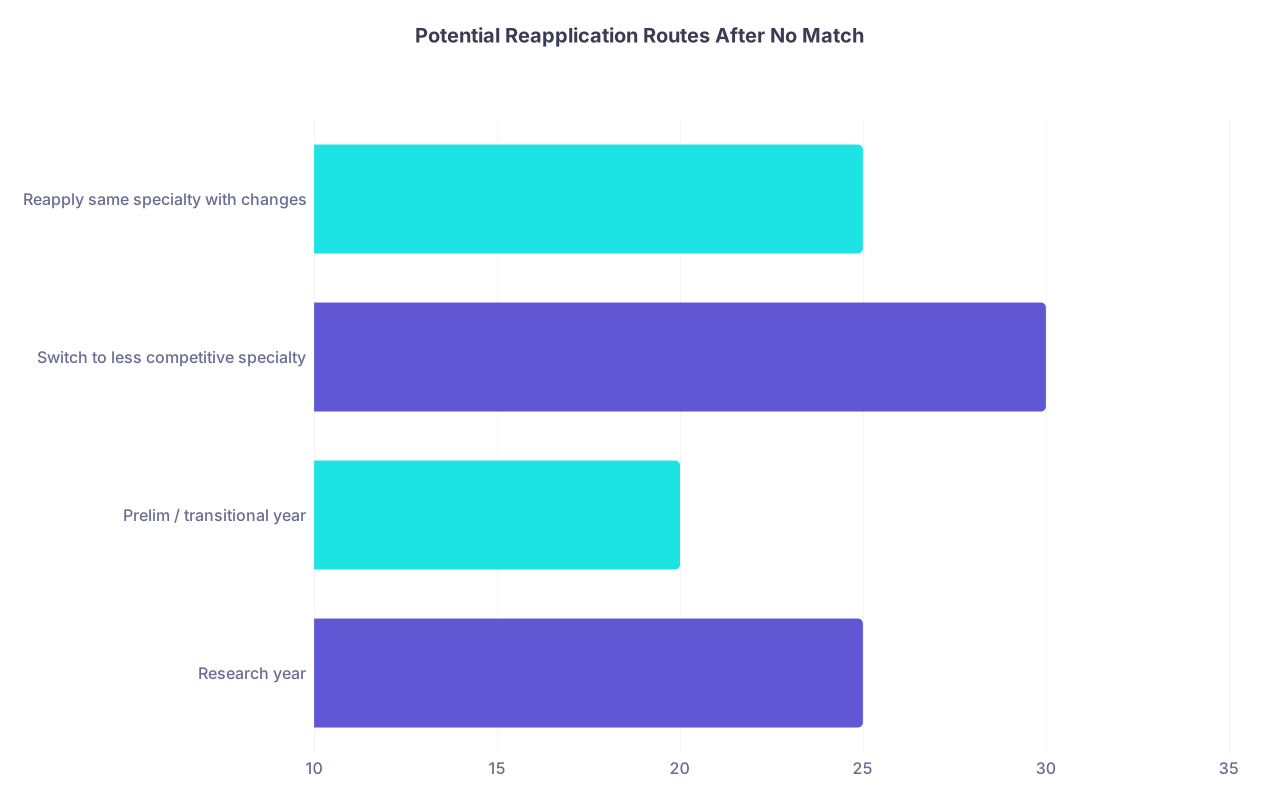
| Category | Value |
|---|---|
| Research year | 25 |
| Prelim / transitional year | 20 |
| Switch to less competitive specialty | 30 |
| Reapply same specialty with changes | 25 |
The Ugly Thought: “What If I Just Don’t Match Ever?”
This is the one you probably don’t even want to say out loud.
Here’s the uncomfortable truth: a low Step score makes life harder. It can absolutely lead to a no-match year. Sometimes more than one. Especially if people cling to unrealistic specialty choices or refuse to adjust their strategy.
But “ever” is doing more work than you think.
I’ve seen:
- Someone with low 200s, no interviews first cycle in a competitive specialty, take a research year + get better letters + switch specialties → match into a solid community program.
- An applicant use a prelim IM year to prove themselves, collect killer letters, then slide into categorical in the same place.
- People change specialties completely—like shooting for Ortho, then matching PM&R or IM—and end up actually happier.
Low score + no flexibility + no self-honesty? That’s where “ever” starts to become a real risk.
Low score + brutal honesty + strategic adjustment over 1–2 years? I’d put money on you eventually landing somewhere.
You might not love every version of “somewhere.” But from the other side, once you’re actually a resident seeing patients, those fine-grained prestige distinctions start to matter a lot less than your R-schedule and whether your seniors help you on call.
What You Actually Need to Remember
I’m not going to sugarcoat this into “Everything will be fine.” It might not be fine this year. But you’re not powerless, and you’re not uniquely broken.
Keep three things front and center:
- A low Step score does not mean every program will screen you out—but it does mean you must build a ruthlessly realistic, community-heavy, flexible program list and application strategy.
- Step 2 (if still pending) and the non-score parts of your application—letters, experiences, personal statement, true program targeting—are your best levers to counteract filters. Use them like your career depends on it, because yes, it does.
- The actual worst case is not “no one wants me”; it’s “I refused to adjust when the data was screaming at me.” If this cycle goes badly, you regroup, get help, and come back smarter—not just more anxious.
You’re allowed to be scared. You don’t get to stop being strategic.