
What if your low Step 1 and only-average Step 2 aren’t just “a bump in the road”… but the thing that quietly kills your chances of matching while everyone tells you “you’ll be fine”?
Reality Check: How Bad Is “Low” Step 1 + “Average” Step 2… Really?
Let me say out loud what you’re probably thinking:
“Programs say they’re holistic, but do they just filter me out in 0.5 seconds because of my scores?”
Sometimes? Yeah. Some do.
But here’s the part nobody tells you clearly: a low Step 1 and average Step 2 doesn’t automatically end your career. It just changes your strategy and your risk level.
Let’s put some rough numbers to it so this doesn’t stay in vague, anxiety-land.
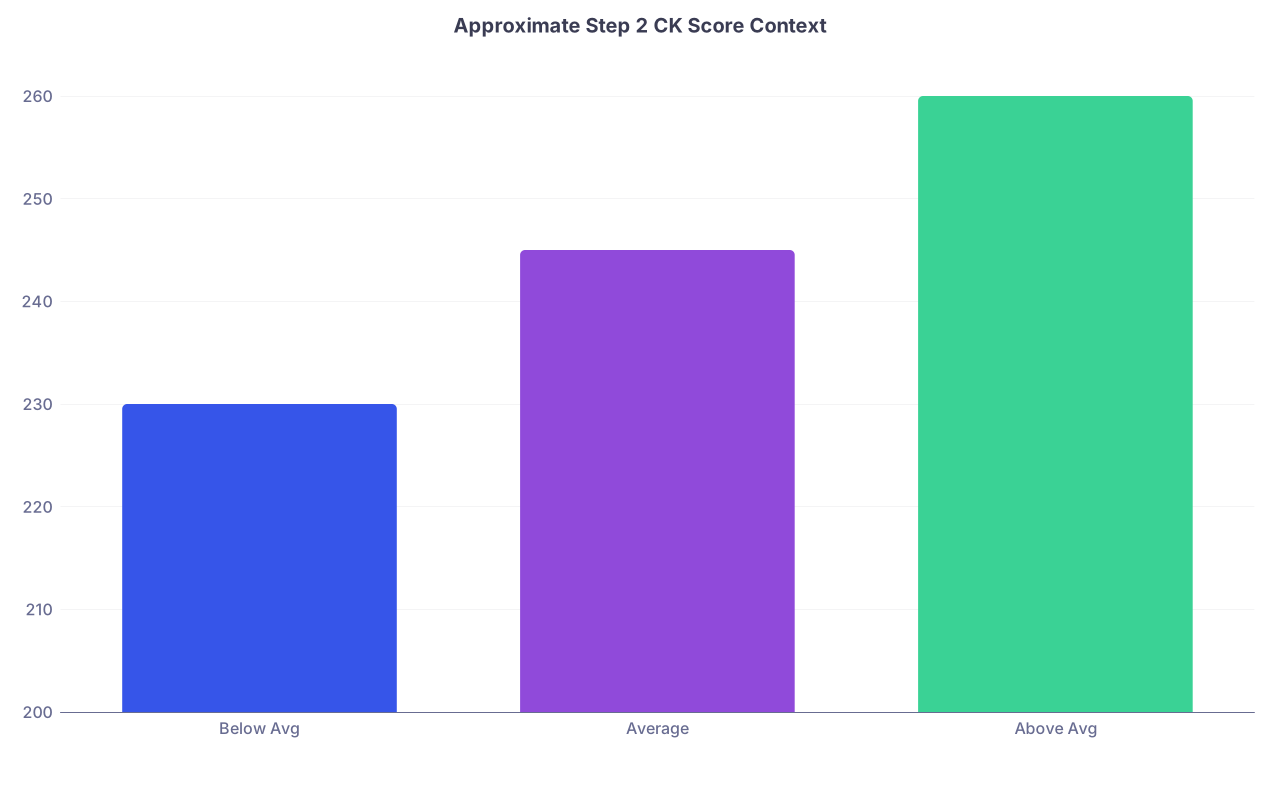
| Category | Value |
|---|---|
| Below Avg | 230 |
| Average | 245 |
| Above Avg | 260 |
Right now, for most specialties:
- “Average” Step 2 CK hovers around mid‑240s (varies a bit by year).
- Competitive specialties (derm, ortho, plastics, ENT, etc.) like higher 250s+.
- Less competitive fields (FM, psych, peds, IM in less hot locations) are more comfortable with low 230s and even below, especially with strong other parts of the app.
So if your Step 1 is low (old score in the 200–215 range or just “Pass” with a scary history) and your Step 2 CK is around 235–248, you’re not dead in the water. You’re just not coasting.
Where you land depends on:
- Specialty choice.
- Program tier (Harvard vs community).
- How many things besides scores you have working for you.
Here’s the harsh but honest version:
| Profile | Competitiveness for Match |
|---|---|
| Low Step 1, Avg Step 2, Strong CV | Realistic for mid/low-tier, many core specialties |
| Low Step 1, Avg Step 2, Weak CV | At risk, needs smart school list |
| Low Step 1, High Step 2 | Story of growth, much better odds |
| Low Step 1, Low Step 2 | Very high risk, may need backup specialty |
| Pass Step 1, Avg Step 2 | Reads as “fine but not a score star” |
You’re in that middle gray zone. Not an automatic “no.” Not an automatic “yes.” Which is exactly why your brain is spiraling.
Let’s talk about what actually moves the needle for someone in your position.
How Programs Actually Use Your Scores (Not the Sugarcoated Version)
Programs don’t sit there reading your personal statement first. They screen. Fast.
Here’s how I’ve seen this play out:
Initial filter.
Some places use hard cutoffs. Stuff like:- Step 2 ≥ 240
- Or Step 2 ≥ 220 for community/less competitive
- Some still ask about Step 1 history if it was numeric and low or had a fail
Relative to their usual pool.
A 240 looks “meh” for ortho at a big academic center.
That same 240 looks totally solid for community FM.Red flag vs non-issue.
True red flags:- Step failure (1 or 2)
- Massive drop-off from one exam to another
- Significant attempts You? With low Step 1 (now pass/fail or ugly old score) and average Step 2? That’s more like “not stellar” than “red flag.”
So no, your scores aren’t “great.” But they might be “good enough” depending on what you’re aiming for.
The problem is: most anxious applicants act like they’re applying with a 270 and then get blindsided.
You cannot do that.
Picking Your Fights: Specialty and Program List Strategy
This is where people with your score profile either save their chances… or quietly sabotage themselves.
1. Be brutally honest about specialty competitiveness
If you’re sitting on:
- Step 1: low / concerning
- Step 2: 230–245
Then:
- Dermatology, plastics, ENT, neurosurg, ortho: extremely high risk unless you have ridiculous research, connections, or are couples matching with a superstar.
- EM: variable, but post-merger and match chaos, it’s not the “easy backup” people thought.
- IM, peds, FM, psych, path, neurology: very realistic with solid strategy.
- OB/GYN, gen surg, anesthesia: doable, but you need to be smart about program tiers and locations.
If you’re dead-set on something competitive, fine. But you must:
- Over-apply.
- Honestly consider a backup specialty or a soap plan.
- Be okay with the emotional hit if it doesn’t work.
If you’re more flexible and your main goal is “just match somewhere decent and train,” then choosing a less competitive specialty boosts your odds dramatically.
2. Program list: this is where anxious people blow it
The worst thing you can do with your scores is apply like you’re average for a super competitive field.
I’ve watched it happen:
Person A: 238 Step 2, wants IM
- Applies to 60 programs
- Overweights “big name” places in NYC/Boston/California
- Gets 4 interviews, panics all season
Person B: Same score, wants IM
- Applies to 80+ programs
- Mix of:
- Home program
- Regional academic mid-tiers
- Lots of community programs
- Rust belt / midwest / south / not-hot cities
- Ends up with 10–15 interviews and matches fine
One isn’t “better.” One is more realistic.
If your scores are nothing special, your school list has to compensate. That’s it.

| Step | Description |
|---|---|
| Step 1 | Self assess scores |
| Step 2 | Apply broadly and consider backup |
| Step 3 | Focus on realistic programs |
| Step 4 | Include many community programs |
| Step 5 | Adjust based on interview count |
| Step 6 | Competitive specialty? |
What Absolutely Must Be Strong If Your Scores Aren’t
Here’s where you actually have control.
If your Step 1 is low and Step 2 is average, your application can’t afford more “just okay” sections. You need spikes.
The big levers:
1. Letters of recommendation
If your scores don’t sell you, other people have to.
Mediocre:
“X is a solid student who will be a good resident.”
Translation: we don’t really know this person; they did okay.
What you need:
“X is in the top 10% of students I’ve worked with in the last 5 years… I would be thrilled to have them in our program.”
You get letters like that by:
- Choosing attendings who actually know you, not just “famous names.”
- Working like a maniac on rotations where you want letters. Show up early. Volunteer for notes, follow-ups, scut. Be reliable and pleasant.
- Explicitly telling them your score context:
“My scores are not amazing; I’m hoping your letter can speak to my clinical ability and work ethic.”
Yes, that feels embarrassing. Do it anyway.
2. Clinical performance and narrative
Programs are increasingly sick of number robots who can’t function with patients.
Your job is to make them see you as the opposite of that.
That means:
- Strong comments on MSPE: “hardworking, reliable, excellent team member”
- No professionalism issues. None.
- If you had a rough pre-clinical phase but crushed clinicals, that’s your story: growth, maturity, real-world competence.
3. Personal statement and “story”
This does not mean trauma-dump your life.
It means:
- You clearly explain why this specialty.
- You subtly frame your test performance if needed without making excuses.
Example of what doesn’t work:
“I’ve always wanted to help people…”
Programs see this 200 times a day.
Example that actually helps when you have lower scores:
A statement that connects consistent themes:
- Longstanding interest (jobs, volunteering, research).
- Concrete experiences with patients.
- Reflection that shows actual insight, not just “this was inspiring.”
If you need to address scores:
- One short, direct sentence in your personal statement or a secondary essay:
“Standardized tests have historically been a challenge for me, though I’ve worked to improve my performance. On the wards, I’ve consistently performed at a high level, as reflected in my evaluations and letters of recommendation.”
Then stop. Don’t write a manifesto about test anxiety.
4. Research and extras (optional boosters)
If you’re going into a research-heavy specialty like academic IM or neuro:
- Any publications, posters, or ongoing projects help offset middling scores.
But: research is a bonus, not a band-aid. No amount of random case reports fully makes up for poor Step scores in ortho.
If you’re going into FM or psych, research is nice, not required. Clinical performance and fit matter much more.
Timing Nightmares: Step 2, Step 3, and When to Panic
You might also be stressing about when your Step 2 posted and whether it’s “too late” to help you.
Some realities:
- Many programs want Step 2 by interview season, especially now that Step 1 is pass/fail.
- If your Step 2 is already in and average, that’s not ideal for “fixing” your file, but it’s at least stable information.
- If you bombed Step 1 and haven’t taken Step 2 yet, your entire strategy should be to:
- Delay ERAS submission if needed.
- Crush Step 2.
- Get that score in before programs deep-dive apps.
Step 3? Most med students don’t need it before residency. Those who take it early sometimes do so to prove they can pass exams, especially with older Step 1 failures. It can help a little, but it’s rarely the magic key you think it’ll be. Don’t gamble your sanity on it unless advised by a mentor who knows your exact file.
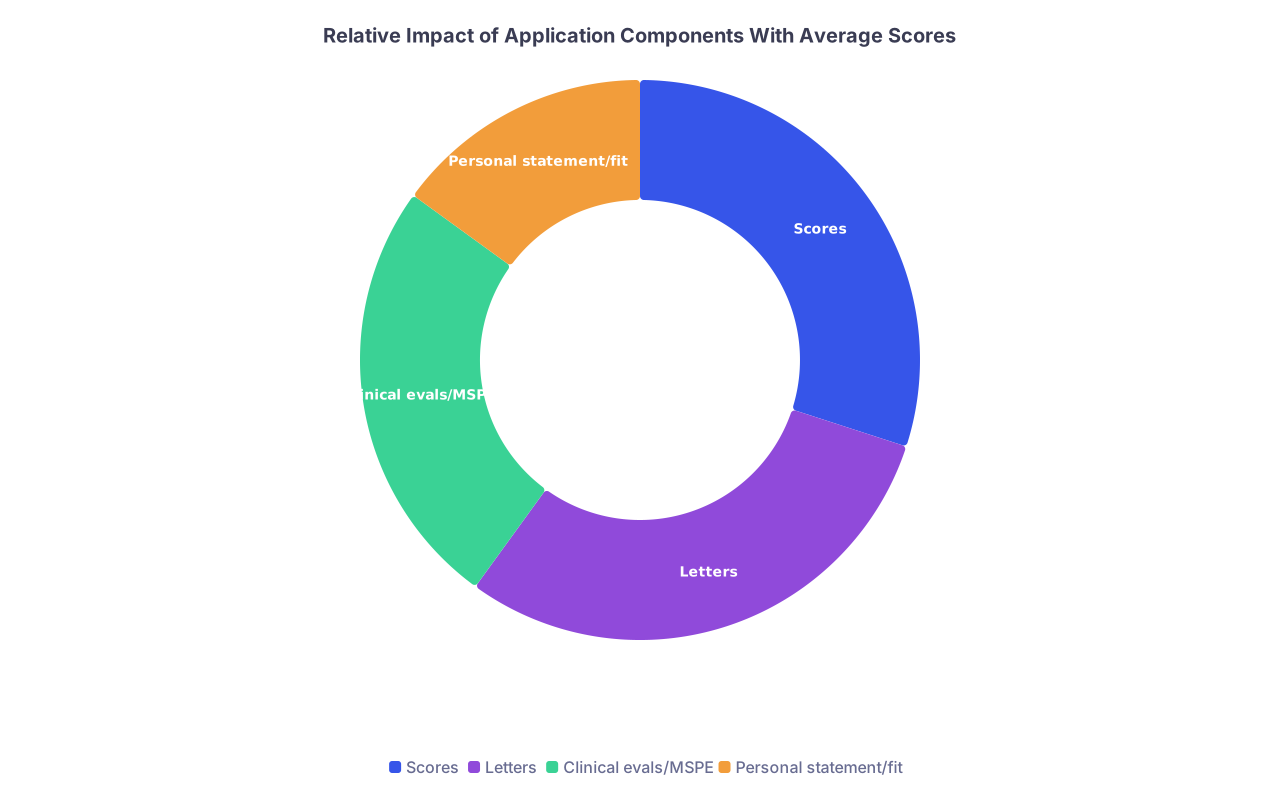
| Category | Value |
|---|---|
| Scores | 30 |
| Letters | 30 |
| Clinical evals/MSPE | 25 |
| Personal statement/fit | 15 |
Red Flag vs Just Imperfect: Where You Actually Stand
Your brain probably keeps looping:
“Programs will see my Step 1 and just throw my app away.”
Let’s separate fear from reality.
True program-stopping red flags:
- Step 1 or 2 failure (especially multiple attempts).
- Massive professionalism issues, leave of absence without explanation, dean’s letter disasters.
- Huge Step 2 drop after ok Step 1.
You:
- Low Step 1.
- Average Step 2.
That’s not a red flag. That’s a liability. There’s a difference.
Liabilities can be:
- Offset by strengths.
- Softened by a coherent narrative.
- Managed with a smart program list.
They don’t vanish, but they also don’t automatically kill you.
What You Should Actually Do Next (Concrete Steps)
Here’s the “no-BS, if I were you” plan:
- Get clear on your actual numbers and specialty competitiveness. Stop guessing.
- Talk to:
- Your school’s advising office (yes, even if they’re mediocre).
- A resident in your desired specialty who matched with similar scores.
- Build a program list that:
- Includes your home program (if applicable).
- Has a heavy chunk of community and mid-tier programs.
- Doesn’t fixate on coastal, big-name, “Instagram-famous” residencies.
- Fix every other part of your application:
- Rewrite your personal statement with a clear, specific story.
- Hunt down your strongest possible letter writers and tell them your goals.
- Ask for honest feedback on your CV and experiences.
- During interviews (if/when they come):
- Don’t lead with apology energy about your scores.
- Be ready with one calm, confident sentence if they come up.
- Spend your real energy showing you’re someone they’d want at 3 a.m. on call.
And yeah, also have a Plan B:
- SOAP awareness.
- Backup specialty if your mentors think you’re at real risk.
- Emotional backup (this process is brutal).
FAQ (Exactly 5 Questions)
1. My Step 1 was really low (or a borderline pass), but Step 2 is around average. Do programs actually care more about Step 2 now?
Yes. Step 2 has become the de facto score many programs lean on, especially after Step 1 went pass/fail. A low Step 1 plus average Step 2 won’t make you a star applicant, but Step 2 is usually the one they care about more for predicting board passage in residency. If Step 2 shows at least stability or improvement, that’s significantly better than both being low.
2. Is it even worth applying to a competitive specialty with these scores?
It might be, but only if you’re ruthless about reality. If by “competitive” you mean derm, ortho, plastics, ENT, neurosurg: your path is steep unless you have serious research, strong connections, and you’re ready to over-apply and probably SOAP. If we’re talking about things like gen surg, OB, anesthesia, EM, it’s not impossible, but you need an aggressive, well-planned program list and very strong letters. If your primary goal is “just match,” consider a less competitive specialty or at least a parallel plan.
3. Should I address my low Step 1 in my personal statement?
Briefly, if it’s clearly an issue. One to two sentences, tops. Something like: “Standardized tests have never fully reflected my clinical strengths; I’ve worked hard to improve and am proud of my performance in clinical rotations and Step 2 CK.” Then move on. Don’t write three paragraphs about test anxiety or your studying trauma. You want to acknowledge, not obsess. Anything longer looks defensive.
4. Will an average Step 2 hurt me at community programs too, or just at top academic ones?
Most community programs are more flexible with scores. An average Step 2 is often totally fine for them, especially if your letters, clinical evaluations, and professionalism are strong. Where you’ll feel the sting more is at high-profile academic centers, competitive urban locations, and in hot specialties. With community programs, they care a lot about: Are you normal? Are you going to work hard? Will you pass boards? If your file convincingly answers “yes” to those, your average Step 2 is usually not a dealbreaker.
5. I’m terrified I won’t get enough interviews. How many programs should I apply to with low Step 1 and average Step 2?
More than the “average” applicant. For a core specialty like IM, peds, or FM, people in your situation often apply to 60–100+ programs, depending on how risky their list is (geography, prestige, visa status, etc.). For more competitive specialties, 80–120+ isn’t insane, plus possibly a backup specialty. The key isn’t just raw number; it’s distribution: lots of community and mid-tier programs in less flashy locations. If you apply to 40 NYC/California academic programs with your scores, that’s gambling, not strategy.
Key points: your low Step 1 and average Step 2 don’t automatically end your chances, but they do mean you lose the luxury of a casual, prestige-chasing application. You have to be honest about your competitiveness, build a smart program list heavy on realistic options, and squeeze every other part of your application for strength—letters, clinical performance, and how you present your story.