
The match process does not care about your feelings, but individual programs absolutely care about your context. You just have to explain it the right way.
You had a personal crisis. Your Step score tanked. Now you are staring at ERAS wondering if you should say anything, say everything, or just pretend it never happened. If you get this wrong, you either look like you are making excuses, oversharing, or hiding the ball.
Let’s fix that.
First: Be Honest About What You’re Up Against
You are not just “a low Step score.” On a program director’s screen, you are a line on a spreadsheet with a red flag next to it. That flag might be:
- Step 1: Fail, or barely passing on second attempt
- Step 2 CK: <220 for competitive fields, <210 for many IM/FM programs
- Big drop from practice tests to real exam
- A noticeable dip compared to your class or to your preclinical/clinical grades
Programs will not automatically reject you for this. But they will ask two questions:
- Is this a pattern of underperformance?
- Does this reflect something ongoing (poor work ethic, poor stress management) or a contained event that is now resolved?
Your job in your application is to answer those two questions clearly, without drama, and with evidence.
And yes, you probably need to address it. Silence + low score = they fill in the story themselves. And the story they write is rarely flattering.
Decide Where (and Whether) to Explain
You’ve got a few tools in ERAS and beyond. Each has a different “risk level” and ideal use.
| Option | Best For |
|---|---|
| ERAS “Education/Personal” text | Brief, factual crisis explanation |
| Personal statement | Framing growth and resilience, not details |
| MSPE/Dean’s letter | Confirming context and performance trend |
| LORs | Third-party validation of recovery |
| Interview answers | Nuanced, human, short story + resolution |
If your Step score is only slightly low for your specialty and everything else is strong, you might barely touch it. One tight sentence in ERAS or your PS can be enough.
If you have:
- A fail
- Multiple attempts
- A very low score relative to your target specialty
- Or a massive, time-limited crisis (death, assault, severe illness, caregiving, etc.)
…you usually need a more deliberate explanation.
Here’s how to choose your approach:
- Minor concern (e.g., 222 for IM with strong clinicals): One sentence in personal statement or not at all, focus on strengths.
- Moderate concern (e.g., fail then strong pass, or big drop vs practice): Short explanation in ERAS + one short paragraph in PS.
- Major concern (fail + marginal second score, extended leave, major crisis): Clear ERAS explanation, confirmed in MSPE if possible, and a rehearsed, concise explanation for interviews.
Do not dump the entire story in your personal statement. That’s where most people blow it.
How to Talk About the Crisis Without Making It Your Personality
The instinct is to write a confessional essay. Do not. Directors are not your therapist.
You need three things, in this order:
- Context – What happened, in 1–3 sentences, without gore or melodrama.
- Impact – How it specifically affected your prep/performance.
- Resolution and Evidence – What changed, and how you’ve already proven recovery.
If any of these parts is missing, your explanation will feel off.
1. The Context: What Actually Happened
You do not need to disclose every detail. You do need to be specific enough that it sounds real, not vague fluff.
Bad:
“Due to personal reasons, I underperformed on Step 1.”
Better:
“During the dedicated study period for Step 1, my father was hospitalized with a critical illness, and I became the primary family member coordinating his care.”
Other clean ways to phrase context:
- “Shortly before my exam, I experienced a sudden bereavement in my immediate family.”
- “During my Step 2 preparation, I developed a new-onset medical condition that required surgery and recovery within the same time frame.”
- “In the months leading to Step 1, I was involved in an ongoing legal process related to a personal safety incident, which required repeated court appearances and meetings.”
You’re showing this was not just “I was stressed and sad.” It was a concrete, time-bounded crisis.
2. The Impact: Tie It Directly to the Score
You must connect the dots between the crisis and the test. Not in a whiny way. In a causal, concise way.
Examples:
- “The result was fragmented study time and frequent travel, which significantly disrupted my planned schedule and focus.”
- “I attempted to continue full-time rotations while managing daily physical symptoms and multiple medical appointments, and I underestimated the impact on my cognitive performance.”
- “I postponed the exam once, then took it while still in the acute phase of grief, which in hindsight was poor judgment.”
Notice what I’m not doing: “I was depressed, anxious, overwhelmed, couldn’t focus, couldn’t sleep” in a long paragraph. Those are real experiences, but in an application you translate that to functional impact and decisions.
3. Resolution & Evidence: This Is The Part Programs Care About Most
Here’s the main question: is the problem over, and can you handle residency?
Your answer must be: yes, and here is proof.
Types of proof that matter:
Later academic performance
- Strong Step 2 after weak Step 1
- Honors/high passes in core clerkships after the crisis
- Shelf scores improving over time
Functional recovery
- “The legal matter is fully resolved and no further proceedings are expected.”
- “I am now on a stable treatment regimen with my specialist and have had no missed clinical responsibilities.”
- “Family responsibilities have normalized; my father is now stable with home support in place.”
Behavioral change
- Tutoring others for Step
- Structured study systems you built and used successfully later
- Seeking academic support, mental health care, disability resources as needed
This is where most applicants stay vague. Do not.
Example of a strong, compact arc:
“During my Step 1 study period, my mother was diagnosed with advanced cancer, and I returned home frequently to assist with her care and medical appointments. My study schedule became inconsistent, and I chose to sit for the exam despite not being fully prepared, resulting in a score that does not reflect my usual performance. Since that time, my family responsibilities have become more predictable, and I have established a structured approach to studying. This is reflected in my Step 2 CK score of 244 and consistent honors in my core clinical rotations.”
That’s how you do it. Real crisis, real impact, real recovery.
Where To Put the Story: ERAS vs Personal Statement vs MSPE
ERAS / Application Comments: The “Facts Only” Version
Use this for a brief, clinical description. Think doctor writing a note, not poet writing a memoir.
Template:
“During [time frame], I experienced [brief description of crisis] which significantly disrupted my preparation for [Step exam]. I chose to proceed with the exam, and my score does not fully reflect my capabilities. Since then, [situation resolution], and my subsequent performance on [Step 2 CK / clerkships / etc.] is more representative of my abilities.”
You can drop in your actual Step 2 score or mention honors if they’re strong.
Keep it under 4–5 sentences.
Personal Statement: Only If It Serves The Bigger Story
Your personal statement is not “The Day My Life Fell Apart Before Step 1.” It’s your “why this specialty” and “what kind of resident I’ll be” story.
The crisis should be a paragraph or less, and it must feed into a professional point: resilience, empathy, understanding chronic illness, etc. If you cannot make that leap without it feeling forced, then keep the explanation mostly in ERAS and the MSPE.
Example paragraph inside a PS:
“In the middle of my Step 2 preparation, my younger brother experienced a psychiatric crisis that required acute intervention and ongoing family involvement. I made the decision to prioritize his safety and support my parents, and my exam performance suffered. That experience was one of the hardest in my life, but it also changed how I think about patients and families in crisis. It pushed me toward psychiatry and taught me to build systems around myself—regular supervision, clear boundaries, structured study routines—which I then used to earn honors in my psychiatry, neurology, and internal medicine rotations.”
Notice: the focus is on what you learned and how it ties to your specialty, not on getting pity.
MSPE / Dean’s Letter: Get Them On Record
If your school is supportive, they can mention:
- Timing of leave or crisis
- Pattern: “Since then, student has demonstrated strong academic performance”
- That the issue is resolved
You cannot write this yourself, but you can ask explicitly:
“I’m concerned about how my Step 1/2 score will be viewed because of [brief reason]. Would you be willing to include a short contextual note in my MSPE about the timing and my subsequent academic performance?”
Ask early. Deans are more likely to help if they are not blindsided late.
How To Handle This In Interviews Without Rambling or Crying
Assume you will be asked:
- “Can you tell me about your Step score?”
- “I see there was a difference between your Step 1 and Step 2. What happened?”
- “Were there any challenges during medical school that affected your performance?”
You need a 60–90 second, practiced answer. Aloud. Multiple times. Not in your head.
Structure it the same way: context → impact → resolution.
Example answer:
“During my Step 1 preparation, my grandfather, who helped raise me, was hospitalized with a sudden, life-threatening condition. I traveled frequently to be with my family and tried to continue full-time studying, but my preparation was fragmented, and I decided to sit for the exam anyway. The result was a score that was well below my practice tests and below what I know I’m capable of.
After that experience, my family situation stabilized, and I took a very different approach to Step 2 CK. I created a structured schedule, checked in weekly with a faculty mentor, and took dedicated time away from other responsibilities. That led to a Step 2 score of 242 and consistent honors in my core clerkships. The whole experience taught me a lot about my limits and about asking for help early, which I think will be crucial in residency.”
Then stop talking. Let them ask follow-ups if they care.
Key rules:
- Do not cry if you can help it. If you are still that raw, trim the details.
- Do not get defensive (“I know I’m smart, it was just…”).
- Do not trash anyone (family, school, healthcare system, ex-partner).
- Always land the plane on what you changed and how that shows up now.
Different Types of Crises: How Much Detail To Give
Some situations are more sensitive. You can still talk about them without blowing up your privacy.
Mental Health Crises
You do not have to name diagnoses if you do not want to. You do have to show stability.
Safer language:
- “I went through a period of significant anxiety and depression for which I sought professional help.”
- “I now have a stable treatment plan and have not missed clinical responsibilities or exams since.”
- “Working with a therapist helped me develop coping strategies I still use.”
Do not say: “I had a nervous breakdown and couldn’t function.” Too vague and alarming. Translate symptoms into impact and then into treatment and recovery.
Assault, Abuse, Legal Issues
You are allowed to protect yourself.
You can say:
- “I was involved in a personal safety incident that required legal and logistical attention over several months.”
- “I had ongoing court and legal appointments that disrupted my ability to prepare.”
- “That process has now concluded, and I’ve had stable performance since.”
You do not need to say “I was sexually assaulted” or “I was in a messy custody battle” if you are not comfortable—especially in writing. If pressed in person, you are allowed to say: “I’m comfortable saying it was a safety-related situation that is now resolved; I’ve processed it in therapy and it’s not impacting my functioning now.”
Chronic Illness or Disability
Here, you may want to be a bit more specific, because accommodations and long-term functioning are relevant.
- Brief diagnosis or category (“autoimmune condition”, “neurologic condition”, “chronic pain disorder”).
- Clear statement about control: “My condition is now well controlled with medication and accommodations.”
- Proof: no missed rotations, good Step 2, reliable work performance.
Common Mistakes That Sink Good Applicants
I’ve seen this enough times that I can almost predict who will get burned. Avoid these:
Writing a trauma dump in the personal statement.
If your story would make a therapist lean forward and say, “That’s a lot,” you’ve said too much for ERAS.Not mentioning the score at all when it’s obviously a problem.
They will assume the worst: ongoing chaos, poor insight, lack of accountability.Blaming everything except your own decisions.
Some honest self-critique actually helps: “I underestimated the impact and chose not to delay.”Over-promising.
“I’ll never let anything affect my work again” is naive and unbelievable. Better: “I’ve put systems in place so that when stress comes up, I don’t try to white-knuckle my way through it alone.”Inconsistency between documents.
Do not tell one version in your PS, another in an interview, and have your Dean’s letter hint at something else. Keep the core facts identical.
When Your Score Is Low and You Don’t Have a Crisis
Some of you are reading this hoping to retroactively invent a crisis. Don’t.
If you did not have a genuine, documentable crisis, do not fabricate one. You talk instead about:
- Poor early test-taking strategy
- Taking on too many commitments
- Learning to study more effectively
- Evidence of improvement and reliability over time
You can still use the same structure, just without the external event. But if you had a real crisis, own it honestly.
Pair Your Explanation With Smart Application Strategy
Context helps, but it does not magically turn a 200 into a 260. You still need a realistic list and some strategic choices.
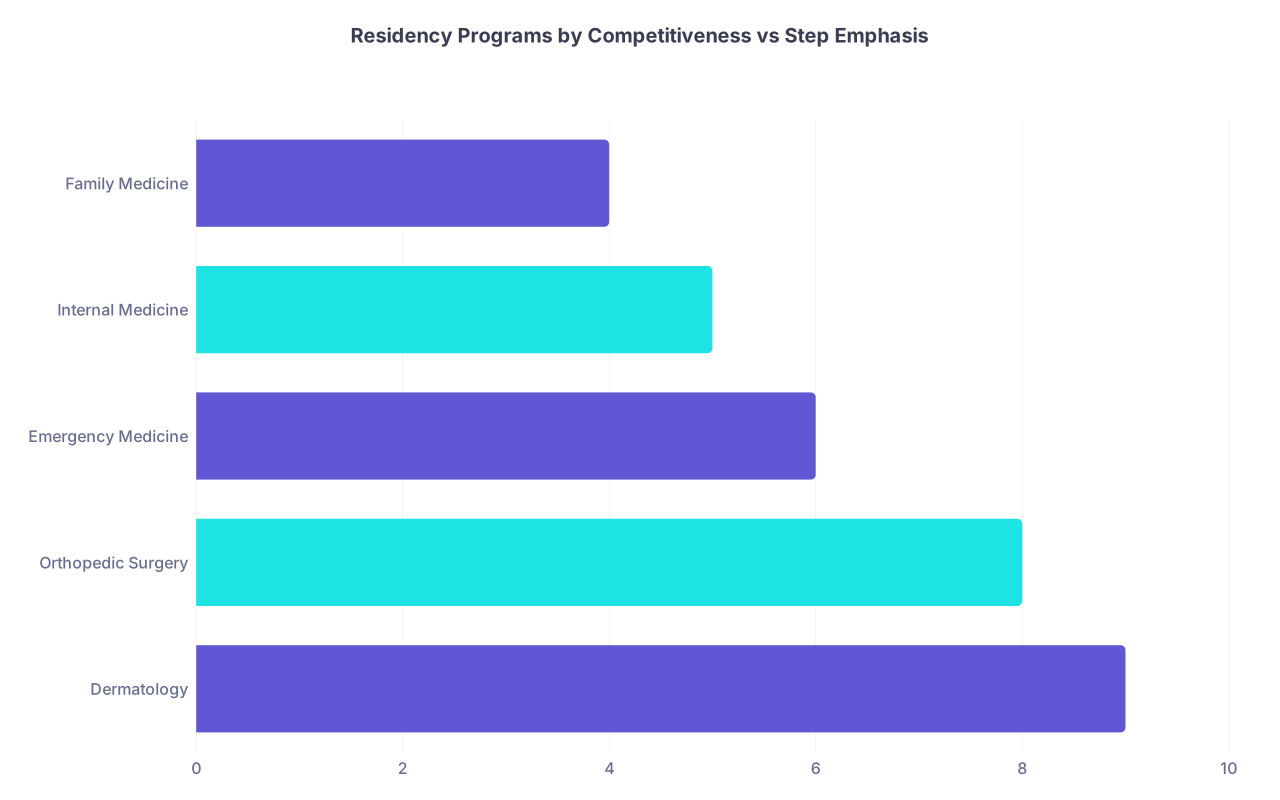
| Category | Value |
|---|---|
| Dermatology | 9 |
| Orthopedic Surgery | 8 |
| Emergency Medicine | 6 |
| Internal Medicine | 5 |
| Family Medicine | 4 |
(Think of 10 as “Step-obsessed” and 1 as “Step-agnostic.” Obviously simplified, but you get the point.)
Concrete moves:
- Lean into programs / specialties known to look beyond scores (many community IM/FM, some prelims, certain regions).
- Apply broadly. Broader than your classmates with normal scores.
- Use every “signal”/preference token strategically if your specialty uses them.
- Make Step 2 CK, if strong, the centerpiece of your academic story.
- Secure letters that explicitly call out your work ethic and reliability.
Your explanation is the “why.” Your strategy is the “so what now.”
A Quick Visual: How Your Story Should Flow

| Step | Description |
|---|---|
| Step 1 | Personal crisis occurs |
| Step 2 | Step exam underperformance |
| Step 3 | Brief explanation in ERAS |
| Step 4 | Evidence of recovery - Step 2 and rotations |
| Step 5 | Aligned personal statement |
| Step 6 | Consistent interview story |
| Step 7 | Programs see contained event not chronic issue |
What To Do Today
Open a blank document and write three short sections, no more than 3–4 sentences each:
- One paragraph that factually describes the crisis and when it happened.
- One paragraph that explains how it affected your Step prep and exam, in concrete terms.
- One paragraph listing specific evidence that things are now stable and you’ve performed well since (scores, honors, feedback).
Then, from those three paragraphs, carve out:
- A 3–4 sentence “ERAS version” (facts and recovery only).
- A 1-paragraph “PS version” if it genuinely supports your specialty story.
- A 60–90 second spoken version you can say out loud without your voice shaking.
Do that today. Don’t wait until your first interview to “wing” the hardest story you have to tell.