
The residency world will not cancel you for a failed Step + low pass. But it absolutely will judge you. Your job now is not damage control. It is a credibility rebuild.
You are not starting from zero. You are starting from a red flag. Very different problem, and it needs a different level of precision.
Let’s walk through what to do if you failed a Step exam (1 or 2) and then passed with a low score — and you’re heading into (or already in) the Match cycle.
1. Accept the Reality: How Programs Actually See You
First, stop guessing. Let me spell out how your file is getting read.
What your record looks like to PDs
Program directors do not see “I overcame adversity.” They see:
- Failed Step exam (automatic risk flag)
- Low passing score (doubles the concern)
- Question: “Is this person safe, reliable, and able to pass boards?”
In practical terms, they worry about three things:
Board pass risk
They have ACGME board pass requirements. Another failure (in training or boards) hurts their stats. They are not going to “take a chance” lightly.Performance consistency
A fail plus low score implies shaky test-taking, knowledge gaps, or poor work habits. They don’t know which. They just know there’s smoke.Behavioral risk
Fair or not, some will wonder: “Will this person struggle with deadlines, exams, and clinical responsibilities too?”
Here is what tends to happen:
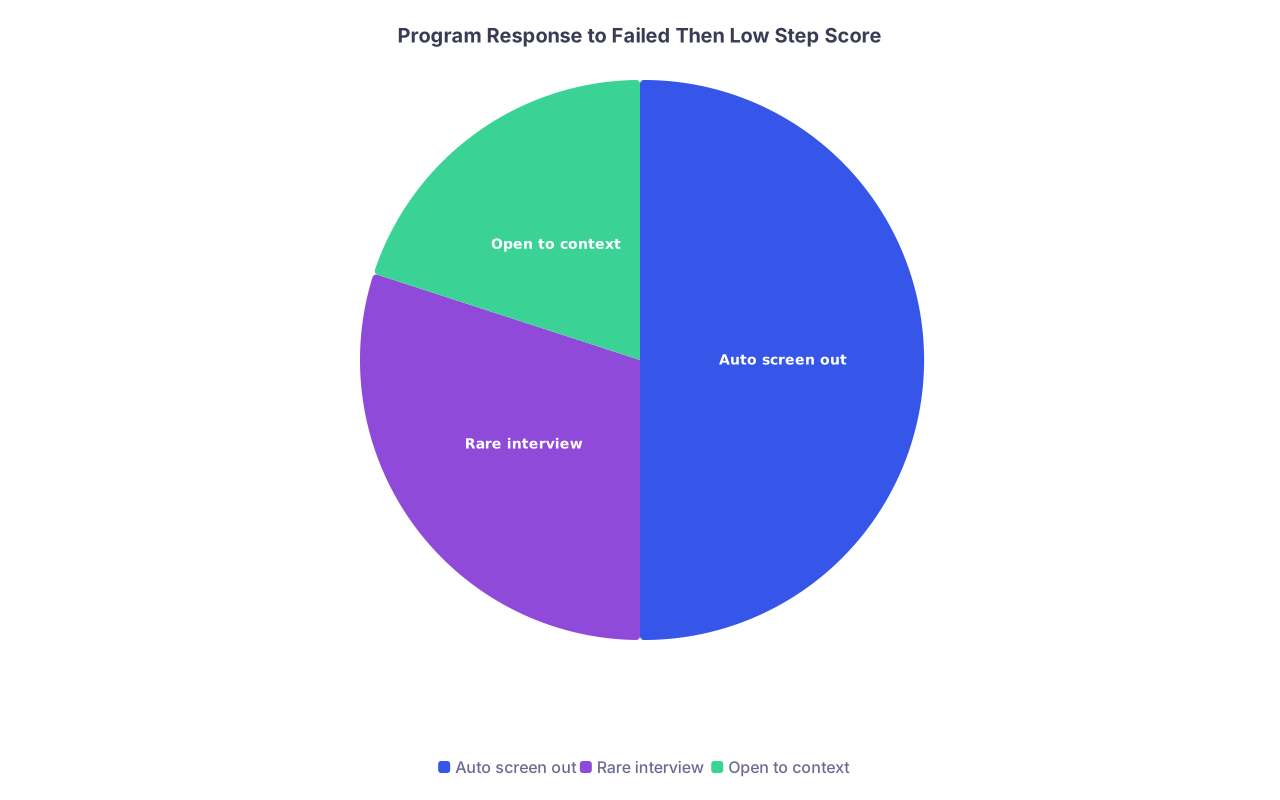
| Category | Value |
|---|---|
| Auto screen out | 50 |
| Rare interview | 30 |
| Open to context | 20 |
Half of programs will never read past the red flag. Gone before your personal statement even loads. Another group will still look, but you are now in the “maybe” pile instead of the “safe” pile.
That’s the bad news.
The good news: 20–30% of programs will at least consider context, patterns, and the rest of your application. Those are your target audience. You do not need 100 programs to like you. You need a subset that can say: “OK, there’s a risk, but this file is strong enough to justify it.”
Your strategy is to:
- Minimize the perceived risk
- Maximize every other signal of reliability, work ethic, and improvement
- Make it easy for them to explain to their colleagues why they’re ranking you
2. Stop the Bleeding: Stabilize Academically Now
If you’re still in medical school or early in your final year, your first job is: no more academic surprises. No new red flags. No “conditional passes” or professionalism write-ups. Nothing.
Here is the baseline you must hit:
- Consistent pass in all remaining rotations (honors are great, but stability is non-negotiable)
- No more exam failures — shelf, OSCE, anything
- Positive clinical comments that explicitly mention reliability, work ethic, improvement
If you’ve already graduated and are in a gap year, your equivalent is:
- Solid performance in any research job, observership, or clinical role
- At least one supervisor willing to write, “This person is reliable and teachable. I would trust them with patients.”
Your credibility rebuild starts now, not in some future application essay.
3. Understand Which Specialties and Programs Are Still Realistic
Some doors are harder to open now. That’s reality. You can still have a good career. You just need to aim intelligently.
| Specialty Type | Impact of Fail + Low Pass | Realistic? With What? |
|---|---|---|
| Highly competitive (Derm, Ortho, Plastics, ENT, Ortho, Urology) | Almost disqualifying at most places | Only with strong home support / unique hook |
| Mid-competitive (EM, Anesthesia, Radiology, OB/GYN) | Major barrier at many academic places | Community and lower-tier university with strong story |
| Less competitive (IM, FM, Peds, Psych, Neuro) | Significant but not fatal | Many programs still possible with strong overall app |
| Transitional/Prelim only | Variable | Sometimes easier entry point |
If you’re dead-set on a highly competitive field with this record, I won’t sugarcoat it: most of those doors are mostly closed, unless:
- You’re matching at your home program with champions
- You have a very unusual asset (PhD, national-level research, insane connections)
- You’re willing to do a prelim year and fight a long uphill battle
Everyone else: you should at least consider:
- Internal Medicine
- Family Medicine
- Pediatrics
- Psychiatry
- Some community EM / community OB / community Neuro programs
This is not “settling.” This is picking a battlefield where your record can still win.
4. Fix the Story: How to Explain the Failure and Low Score
You must have a clean, simple, credible explanation. Rambling is death. Blame is death. Over-sharing is also death.
Your explanation needs four parts:
- What happened (brief, factual)
- What changed (specific, behavioral)
- What the outcome was (improvement, stability)
- Why this will not happen again (evidence, not promises)
Weak explanation (what most people write)
“I struggled with anxiety and had trouble adjusting to the demands of medical school, which affected my performance on Step 1. However, I have learned from this and am confident it will not affect my residency performance.”
Translation in PD’s head: “So you struggled, then you say you’re better now… with no actual proof. Next.”
Stronger explanation structure
Use concrete behavior and evidence.
Example:
“I failed Step 1 on my first attempt. At that time, I was studying without structure, using only passive review, and trying to work part-time due to financial pressure. After the failure, I met with academic support, created a daily schedule with spaced questions, stopped working evenings, and joined a dedicated study group. On my retake, I passed comfortably, and since then I have passed all clerkships and shelf exams on the first attempt. My performance on in-house exams and clinical rotations has been stable. The failure was a wake-up call that forced me to overhaul how I prepare for high-stakes assessments.”
Notice:
- No melodrama
- No blaming illness, family, or vague “stress” (unless it was something major and well-documented)
- Clear before/after behavior change
- Evidence: shelf exams, rotations, later stability
You can do a version of this even if your retake score was low. You’re not trying to claim you became a superstar. You’re trying to show that you’re now consistent and self-aware.
5. Build a Counterweight: What You Need to Overcompensate
One bad test + one low score means: the rest of your application must be heavier.
You do not need everything. But you need several of these in your favor:
- Strong, specific letters of recommendation
- Solid clinical comments (no “quiet, reserved, unsure” nonsense)
- Continuity and commitment to your specialty
- Tangible academic or scholarly productivity
- Signs of professionalism and reliability
Let’s break those down.
A. Letters of recommendation: these can save you
Generic letters will not move the needle. You need at least 2–3 letters that say:
- You show up prepared and are reliable
- You are coachable and improve quickly
- You function at or above expected level for your stage
- You have no professionalism concerns
Gold-standard lines in your situation look like:
- “Despite a challenging standardized test history, on our service this student functioned at the level of a strong intern.”
- “I would have no hesitation having this resident care for my own family.”
- “They consistently followed through, responded well to feedback, and handled increasing responsibility safely.”
If you do not have those kinds of letters yet, your priority is: put yourself in positions where attendings see you work, ask for feedback early, and then explicitly request: “If you feel you can comment on my reliability and growth after my exam struggles, that would be very helpful for residency applications.”
Yes, you say it out loud. That level of directness signals maturity.
B. Clinical performance: no “invisible student” behavior
You cannot afford to be forgettable. You want attendings and residents to remember you when programs call.
On rotations:
- Be early, not just “on time”
- Volunteer for follow-up calls, notes, and extra tasks
- Ask focused, not random, questions
- Read about your patients that night and bring something useful the next day
You want comments like: “Hard worker,” “always followed through,” “grew a lot over the rotation.” These directly counter the “unreliable test-taker” narrative.
C. Show commitment to your specialty
Programs get nervous when the applicant’s career story is muddy. With your Step history, ambiguity is deadly. You want a tight arc.
Show:
- Electives/sub-Is in the specialty
- Longitudinal interest (research, volunteering, student groups)
- A personal statement that actually explains why this field — not just “I like helping people.”
If you failed and then scored low on Step 1 but are applying in IM with 2 IM sub-Is, an IM research project, and an IM mentor saying, “We’d take this person,” that’s much less scary.
D. Add real scholarly or project work (if you still have time)
You don’t need a Nature paper. But you need to show you can carry something from start to finish.
Examples that help:
- Case report → submission (even if not accepted yet)
- QI project → poster at a local/regional meeting
- Chart review → abstract
- Curriculum project → implemented on a rotation
The key is completion and follow-through. PDs love that.
6. Rewrite Your Application Components for Maximum Damage Control
Now we get into the practical building blocks: personal statement, ERAS experiences, MSPE use, and interviews.
Personal statement: where to briefly address the red flag
Short answer: Yes, you usually should mention the failure, but briefly and surgically.
Structure:
- 70–80%: Why this specialty, what kind of physician you’re becoming, specific clinical experiences.
- 10–15%: A short paragraph on the exam failure + low score, using the four-part explanation above.
- 10–15%: What you’re looking for in a program and what you bring.
You do NOT:
- Write a trauma essay about the exam
- Center your entire narrative around your failure
- Blame external factors without clear behavior change
Two test lines to see if your paragraph works:
- If someone only read that one paragraph, would they see accountability and growth?
- If that paragraph disappeared, would the rest of your statement still make sense?
If yes to both, you’re in good shape.
ERAS experiences: signal reliability and growth
You’re not listing random stuff. You’re choosing experiences that make a case:
- Long-term commitments (2+ years) beat 3-month sprints
- Leadership with real responsibility beats fancy titles
- Teaching, tutoring, mentoring can specifically help if your red flag is academic
Write your descriptions with outcomes and growth, not fluff.
Bad: “Participated in research on heart failure.”
Better: “Coordinated data collection for 120+ heart failure admissions, tracked protocol adherence, and presented preliminary findings to the cardiology division.”
One of your experiences can mention that you “restructured study strategies after Step 1 failure and subsequently passed all clerkships and in-house exams on first attempt.” That’s a quiet receipt that you did, in fact, adjust.
MSPE / Dean’s letter: use it if they offer
If your school allows you to provide input on the MSPE or has a specific “Academic Challenges” section, you want:
- A single, clear, factual statement about the failure and retake
- A line highlighting stable performance afterward
- If possible: a line about your professional behavior and reliability
Something like:
“Student failed Step 1 on first attempt. After working closely with our learning support services and adjusting study methods, the student passed on retake and subsequently completed all core clerkships on time with no additional academic concerns.”
That’s what you want written about you. Clean. Boring. Reassuring.
7. Application Strategy: Where, How Many, and Backup Plans
You cannot play the “apply to 25 programs” game. That’s fantasy with your record.
For most people in your position:
- IM / FM / Peds / Psych: 60–120 programs is reasonable, skewed toward community and lower-tier university programs, heavily including your geographic ties.
- Mid-competitive fields: You’ll likely need to apply both to your desired specialty and a backup (or dual-apply to IM/FM).
- Visa-needing IMG + failed Step + low score: You’re in the hardest tier. You may need:
- 120+ applications
- A gap year with research or US clinical experience
- Serious backup planning
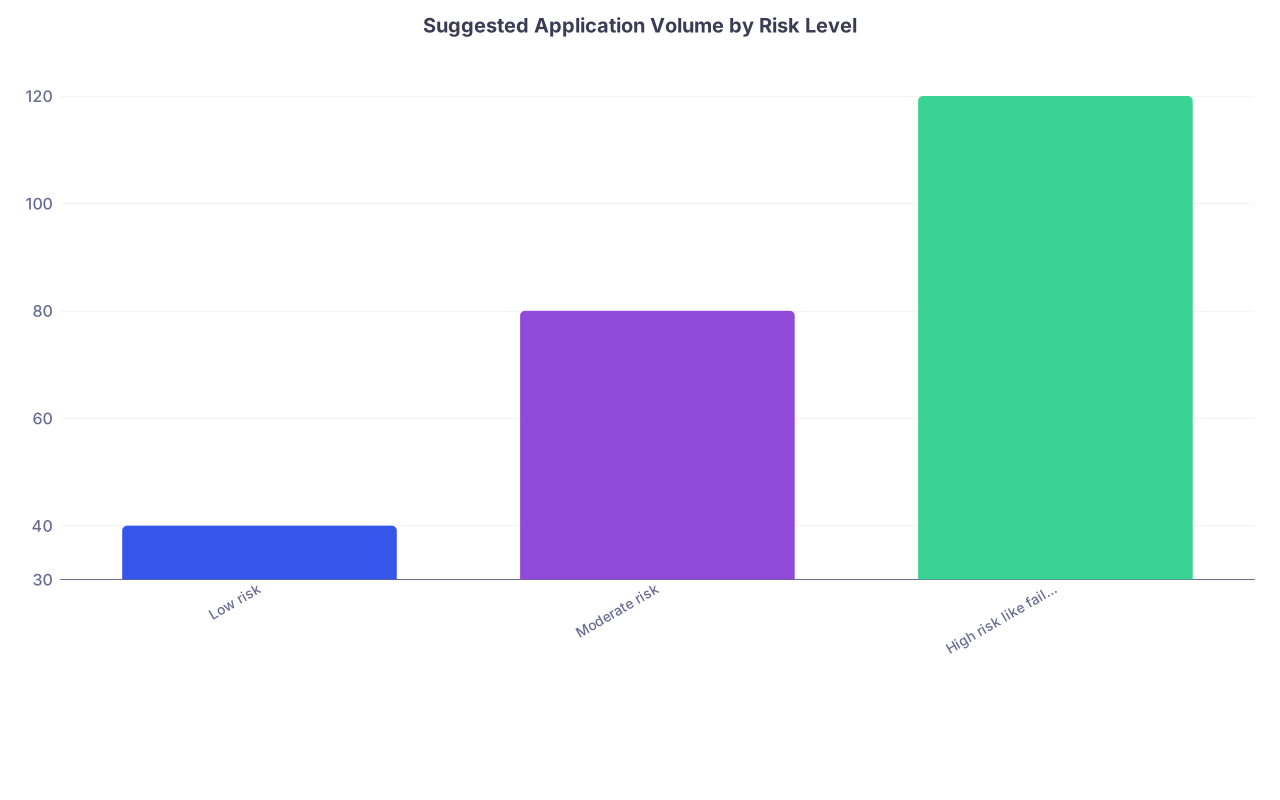
| Category | Value |
|---|---|
| Low risk | 40 |
| Moderate risk | 80 |
| High risk like fail+low | 120 |
You also need to:
- Prioritize programs known to be IMG-friendly or historically forgiving of Step issues.
- Email a subset of programs with a short, professional note if you have a real tie or interest.
- Use mentors to advocate for you at specific programs. Phone calls matter much more in your situation.
8. Interview Behavior: Prove You’re Not That Test Score
If you get interviews, you have one job: convince them the red flag is already in your past.
Expect questions like:
- “Can you tell me about your Step failure?”
- “I see your test scores were lower than average. What happened?”
- “How have you addressed test-taking going forward?”
Wrong answers:
- Long emotional stories
- Blaming test center issues, vague “stress,” or unfairness
- Overconfidence with no evidence (“I know I’ll ace the boards”)
Right answer structure:
- Brief fact: “I failed Step 1 the first time.”
- Ownership: “That was on me. I didn’t have a structured plan and tried to balance too many things.”
- Behavior change: “I met with academic support, changed to daily question blocks, cut out work, and treated it like a full-time job.”
- Evidence: “Since then I’ve passed Step 2, all clerkships, and internal exams on the first attempt using the same methods.”
- Safety line: “I now treat standardized exams like a clinical responsibility — prepare early, schedule in advance, and build in redundancy.”
You want the interviewer to walk away thinking: “Annoying red flag, but this person is self-aware, teachable, and probably fine now.”
Also: be high-energy, engaged, and prepared. You cannot come across as flat or ambivalent. That just confirms their fears.
9. If You Don’t Match: Realistic Next Moves
We have to talk about this. With a failed Step + low pass, your odds are lower. Planning for a reapplication year is not pessimism. It is smart.
If you go unmatched:

| Step | Description |
|---|---|
| Step 1 | Unmatched |
| Step 2 | Participate in SOAP |
| Step 3 | Plan Gap Year |
| Step 4 | Start Residency |
| Step 5 | Research Year |
| Step 6 | Prelim/TY Spot Next Cycle |
| Step 7 | Home Institution Role |
| Step 8 | Reassess Specialty Choice |
| Step 9 | SOAP? |
| Step 10 | SOAP Match? |
| Step 11 | Available Options |
Your gap year (or years) must not be “lost time.” It has to be:
- Research with real output
- Significant clinical exposure (USCE, observerships, assistant roles)
- Direct contact with people who can write strong letters
- More evidence of reliability and growth
If you haven’t taken Step 3 yet and you’re eligible, a solid Step 3 score can sometimes soften the earlier failures, especially for IM/FM and for visa-needing applicants. But only if you’re absolutely ready. Another poor showing will slam the door shut.
10. The Mental Side: Don’t Let Shame Drive the Wheel
I’ve watched strong people quietly sink after a Step failure + low score because they internalized it as: “I’m not smart enough.”
That mindset does three harmful things:
- Makes you avoid asking for help (you don’t want to “reveal” your weakness)
- Makes you aim too low or too high irrationally
- Makes your interviews sound defeated
You don’t have that luxury. You need to be:
- Honest about what went wrong academically
- Aggressive about fixing it
- Calm and matter-of-fact when discussing it
You’re not the only one with this record. Programs see it every year. Some people with your pattern match. Some don’t. The difference is rarely raw intellect. It’s execution, self-awareness, and how tightly they build the rest of their application around the story of growth.

11. Concrete 60-Day Action Plan
If you’re within 1–3 months of applications opening or interviews starting, here’s what I’d tell you to do right now:
Week 1–2
- Meet with an honest advisor (not just a cheerleader) to review your full record.
- Decide on primary specialty and any realistic backup.
- Identify 3–4 attendings who could potentially write strong letters.
Week 3–4
- Draft personal statement with a tight exam-failure paragraph.
- Build ERAS experiences with outcome-focused language.
- Ask for letters, explicitly explaining you’d value comments on reliability and growth.
Week 5–6
- Finalize program list heavily weighted toward realistic options.
- If still on rotations: double down on being visible, useful, and engaged.
- Start mock interviews with someone who will push you on the exam questions.
Week 7–8
- Polish everything. No typos. No contradictions.
- Prepare 3–4 clear stories that showcase resilience, responsibility, and teachability.
- Set realistic expectations but stay aggressive with applications and outreach.
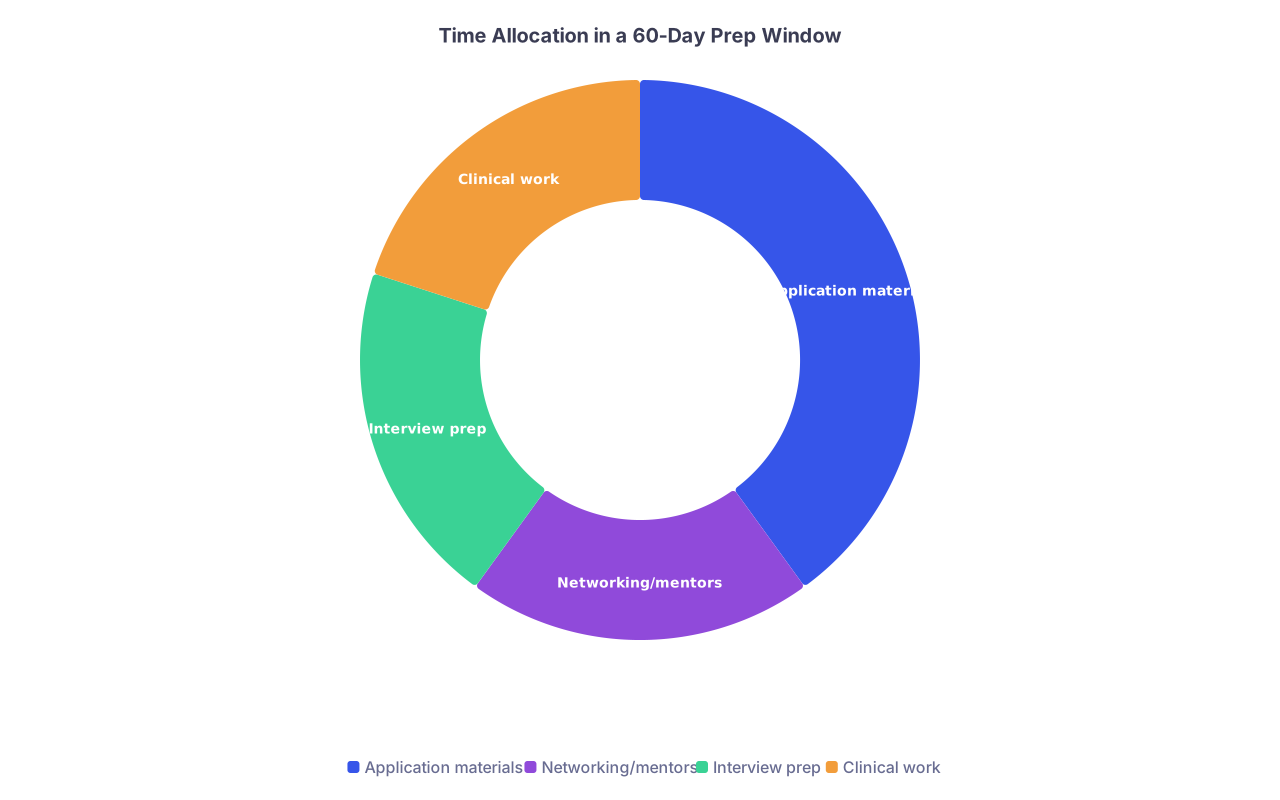
| Category | Value |
|---|---|
| Application materials | 40 |
| Networking/mentors | 20 |
| Interview prep | 20 |
| Clinical work | 20 |
This is not the time for half-effort. You’re not competing with people who have your same record. You’re competing with people who look “safe” on paper. Your differentiation is in intentionality and the story you build.

12. Big Picture: What “Credibility Rebuilt” Actually Looks Like
If you do this right, here’s how a reasonable PD might summarize you at rank meeting:
“Yes, they failed Step 1 and passed low on retake. But since then, they’ve had solid clinical performance, strong letters that explicitly say they function at intern level, and they’ve completed several projects to completion. They were thoughtful about their failure and had a clear plan for how they changed. I think the risk is acceptable for our program.”
That is success for you. Not erasing the red flag. Making it survivable.
You’re not trying to pretend the failure didn’t happen. You’re trying to prove that it was the worst day of an old version of you — and that the current version is the one they’ll get for three+ years.
With those foundations in place, you can move from defensive to offensive: building the kind of resident career that makes this Step story a footnote, not your headline. How you thrive once you land in a program—well, that’s the next chapter.

FAQ (Exactly 5 Questions)
1. Should I ever skip mentioning my Step failure in the personal statement?
Sometimes. If your MSPE already gives a clear, neutral explanation and your failure was years ago with strong subsequent performance (e.g., high Step 2, strong shelves), you can omit it from the statement and save your explanation for interviews. But if your retake score is still low and the concern is obvious, I usually advise a brief, direct paragraph to show you own it.
2. Does a strong Step 2 or Step 3 score really “erase” a failed Step 1?
No, it does not erase it. But it can dramatically soften it, especially in fields like IM/FM/Peds/Psych and especially for community programs. A solid Step 2 or 3 says, “Whatever happened before, I can now pass high-stakes exams.” Programs still see the risk, but they’re less anxious about board pass rates.
3. Is it worth doing a research year if I have a failed Step and low pass?
It can be, but only if the year produces real outputs and strong letters. A “research year” where you’re just a spreadsheet monkey with nothing to show hurts more than it helps. If you do one, aim for abstracts, posters, and a PI who is willing to pick up the phone for you. For less-competitive specialties, a strong clinical or teaching role may be just as valuable as research.
4. How many programs should I apply to if I’m an IMG with a failed Step and low score?
You’re in the highest-risk group. For IM/FM/Peds/Psych, 120+ applications is common, heavily targeting community and IMG-friendly programs in multiple regions. You’ll also need strong US clinical experience, good letters from US physicians, and ideally a passed Step 3. Even then, you must be prepared for the possibility of a multi-year journey or a need to reconsider specialty or country.
5. Will programs think I am making excuses if I mention mental health, illness, or family crises in my explanation?
They might, if you overfocus on it or fail to show concrete behavior change. If you had a real, documentable issue (e.g., hospitalization, major family death during exam period), you can mention it briefly, but you still need to own your preparation and response. The safest pattern: “There were external stressors, but I also made mistakes in how I prepared. Here is what I changed, and here is my stable performance since then.”