
The residency market is not just tight for you. It’s brutal. Low Step scores plus needing a visa is one of the harshest combinations you can bring into the Match. But it’s not a death sentence—if you stop pretending you’re a “typical” applicant and start playing a completely different game.
I’m going to talk to you like someone who’s watched this exact situation play out dozens of times: IMGs with 220s or a failed Step, needing J‑1 or H‑1B, wondering why they’re ghosted by programs despite 80+ applications. The advice for “average” applicants does not apply to you. If you follow it, you lose.
Here’s how you operate in this lane.
Step 1: Be Brutally Honest About Your Starting Point
You cannot fix what you refuse to quantify.
You’re not “kinda low.” You’re not “borderline competitive.” You’re in a risk category. Treat it that way.
Make a one-page reality sheet with:
- Step 1: pass/fail plus any failures (and date)
- Step 2 CK score and attempts
- Any USMLE failures at all
- Graduation year
- Visa need: J‑1 only, H‑1B possible, or “need either”
- US clinical experience: exact number of weeks, type (hands-on vs observership)
- Research: PubMed-indexed? Poster only? Nothing?
- English: strong, average, weak (be honest, think OSCE feedback, patient comfort)
- Red flags: gap >6 months, unexplained, prior discipline, failed medical school exam years
Then categorize yourself like a program would:
| Tier | Typical Profile | Reality Check |
|---|---|---|
| Tier 1 | Step 2 ≥ 245, no failures, grad ≤ 2 yrs | You are not here if you’re reading this |
| Tier 2 | Step 2 235–244 or one older red flag | Needs targeting but can cast wider net |
| Tier 3 | Step 2 220–234, ≥1 attempt, IMG, visa | Must be hyper‑strategic, narrow and deep |
| Tier 4 | Repeated failures, >7 yrs since grad | Likely requires backup or alternative path |
If you’re Tier 3 or 4, your plan must be different. Fewer “prestige” dreams. More surgical targeting (for IM, FM, psych—not actual surgery).
Step 2: Stop Wasting Applications on Dead Programs
The biggest mistake low‑score + visa applicants make: they spray 150+ applications at every program listed on FREIDA and pray.
Most of those programs were never going to touch your file. Not because they’re evil. Because they’re busy and they use hard filters.
You need to build a real target list.
How to build a reality-based program list
Do this with a spreadsheet open. No “I’ll remember” nonsense.
- Start with FREIDA / Residency Explorer for your specialty.
- For each program, you want 4 data points:
- Visa: J‑1 only? H‑1B? “Accepts visas” is too vague.
- IMG friendliness: % of IMGs in recent classes.
- Step filtering: any stated cutoffs (even unofficial, like 220+).
- YOG (year of graduation) preference.
Then dig deeper, because FREIDA is often incomplete or outdated.
- Check program website for phrases like:
- “We do not sponsor H‑1B visas”
- “Graduation within the last 5 years”
- “Minimum Step 2 CK of 230”
- Scroll resident bios:
- How many IMGs?
- Any graduates from your country or school?
- Older grads or all fresh grads?
If:
- They have 0 IMGs in the last 5 years
- Or they don’t list any visa info
- Or they say “no visa sponsorship”
You treat that program as “probably dead” unless a mentor has a personal connection there.
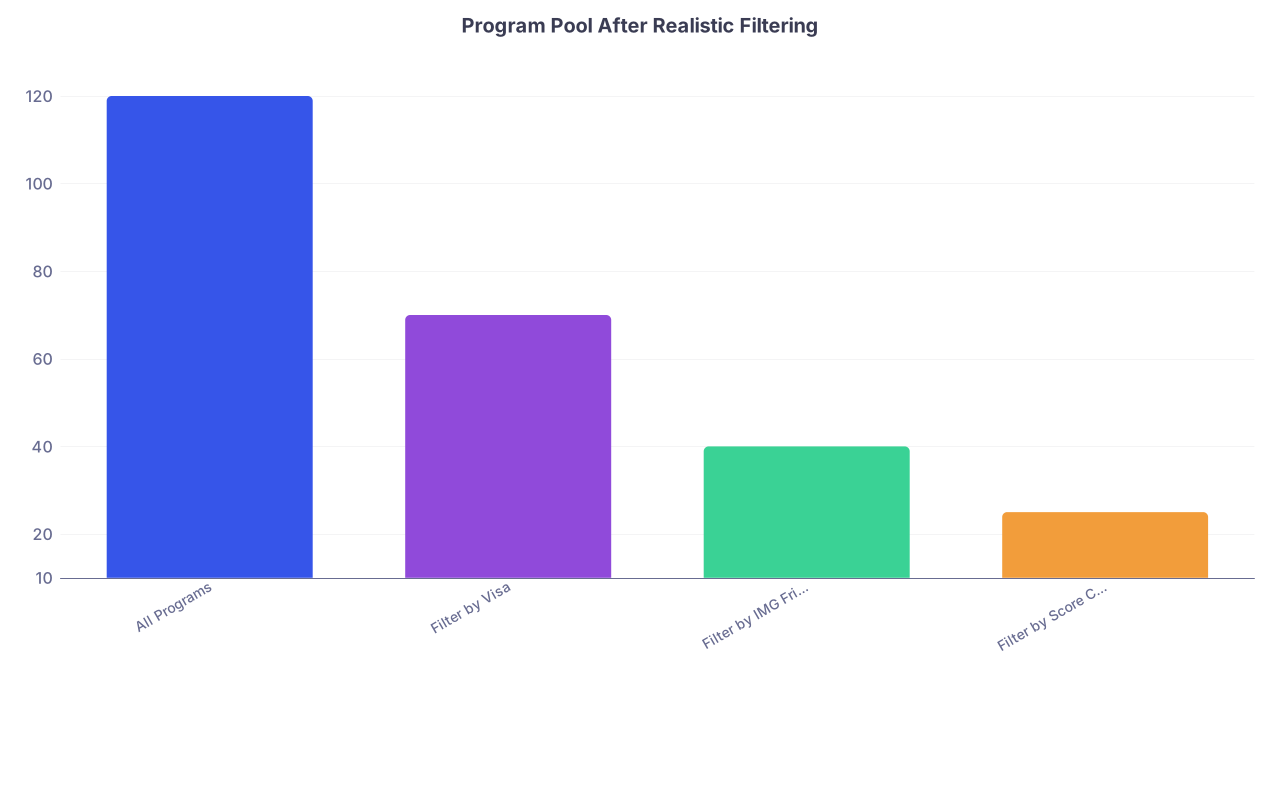
| Category | Value |
|---|---|
| All Programs | 120 |
| Filter by Visa | 70 |
| Filter by IMG Friendliness | 40 |
| Filter by Score Cutoffs | 25 |
So maybe you started with 120 programs in IM. After real filtering, you’re left with 20–30 realistic ones. That’s normal. That’s the pool you work hard.
And yes, that means you apply more heavily to those realistic programs instead of shotgunning into places that will never open your file.
Step 3: Choose Specialty and Track Like Your Life Depends on It
If you have low scores and need a visa, you cannot apply like a US MD with a 245. Those people can play in neurology, anesthesiology, EM, etc. You shouldn’t. Not now.
Safest lanes (for most IMGs with low scores + visa needs)
- Family Medicine
- Internal Medicine (community programs, non‑university)
- Psychiatry in some regions
- Pediatrics in some regions
You want a specialty where:
- There’s a workforce shortage
- Community programs exist (not just big-name academics)
- IMGs are already present
If your heart is set on something more competitive—fine. But then:
- You either:
- Take a bridge year or two to strengthen your application in that field, and
- Simultaneously build a backup in FM or IM
- Or you accept: you might never match into that specialty in the US
The number of applicants I’ve watched burn 3–4 years chasing US neurosurgery with weak scores and visa needs is… depressing. They end up with gaps, no match, more desperate each year.
Pick one main specialty that’s realistic. Decide before ERAS opens, not after your 0-interview season.
Step 4: Turn Your “Low Score” File into a Story Programs Can Trust
Programs hate uncertainty. Low scores = risk. Your job is to show that risk is controlled and past, not ongoing.
If you have a Step failure or very low Step 1
You must show:
- Clear upward trend: Step 2 CK significantly higher than Step 1, or at least not worse.
- Recency of success: recent strong performance (Step 2, CK, or shelf exams if you can mention them).
Your personal statement and MSPE / LORs need to hit three points clearly (without sounding like a confession letter):
- What went wrong
- What changed
- Evidence it worked
Bad version: “I was going through a difficult time and did not study well for Step 1.”
Better:
“I failed Step 1 on my first attempt because I treated it like another school exam—passive reading, not performance-based preparation. After that wake-up call, I rebuilt my approach: daily UWorld questions, weekly self-assessments, and scheduled review of my errors. The same system helped me achieve a passing score on my second attempt and improved my clinical exam performance, including honors in my internal medicine rotation.”
Do not spend 70% of your statement apologizing. Acknowledge, show concrete change, then move on to why you’re ready now.
Step 5: Fix the Visa Problem Strategically (Not Emotionally)
You need to separate what you want (often H‑1B) from what will actually get you into a US residency.
Here’s the hierarchy of difficulty for you:
| Visa Type | Relative Difficulty | Common in Which Programs |
|---|---|---|
| J‑1 | Easiest | Many community and academic programs |
| H‑1B | Harder | Some IM/FM/Neuro, selective |
| No Visa (only GC/USC) | Impossible for you | Ignore these entirely |
If your main goal is “live and train in the US,” J‑1 is usually the first realistic step. Then later: waiver jobs, change of status, etc.
Strategic choices:
- If you absolutely require H‑1B (due to home country rules or long-term plan), you:
- Need to limit yourself to programs that explicitly offer H‑1B
- Accept that your already small list will shrink further
- Might need a year of US research or a prelim year at a J‑1-friendly program to set up H‑1B later
I see too many applicants reject J‑1 outright… and stay unmatched 3–4 cycles. At some point, the gap becomes its own red flag.
Step 6: Build Weapon-Grade US Clinical Experience (Not Just “I Have Some”)
For a low-score, visa-needing IMG, US clinical experience is not optional decoration. It’s your lifeline.
Not all USCE is equal:
- Hands-on electives in US med schools during final year > pure observerships
- Long-term (3–6 months) with consistent involvement > random 2-week “rotations”
- Clinical research with patient contact and recommendations from US attendings > dry data-only research
If you’ve already graduated and can’t get electives easily, then:
- Aim for:
- 1–2 solid observerships or externships in your chosen specialty
- Minimum ~8–12 weeks total in the US system
And during those:
- Show up early. Stay a little late.
- Ask smart questions, not constant questions.
- Volunteer for presentations (journal club, brief talks).
- Make your interest in residency explicit, but not clingy:
“Dr. X, I’m applying to internal medicine and I really value your feedback on how I’m doing and what I can improve.”
You want LORs that sound like this:
“Despite low board scores, I would place Dr. ___ in the top 10% of IMGs I have worked with and would welcome them into our program without hesitation.”
You get that only if the attending has seen you work closely, not just watched you from a hallway.
Step 7: Your ERAS Application Needs to Be Surgical, Not Generic
Think of ERAS like an exam. You’re not going for “okay.” You’re going for “I minimized every possible reason to reject me on sight.”
Personal statement: one page, one clear message
Just one version per specialty. Not 8 versions that all say nothing.
Core structure that works well for your situation:
- One specific clinical moment that shows how you think or care.
- Brief path of your medical training (include context if you’re an older grad).
- Transparent but concise handling of major red flag (if needed).
- Why this specialty + what you’ve actually done to pursue it (USCE, research, mentorship).
- What you bring to a residency team (work ethic, communication, language skills, maturity).
Do not:
- List your entire CV in paragraph form.
- Spend half the statement re-explaining your Step failure.
Experiences: substance over fluff
For each experience:
- Use specific actions and outcomes:
- “Led a 4-student team that created 10 discharge education leaflets, improving patient understanding scores from 60% to 82% on follow-up surveys.”
- Prioritize:
- Clinical experience in your specialty
- US experience
- Leadership or longitudinal commitment
If you did a research year, do not just write “Research fellow.” Spell out your actual responsibilities. Did you manage databases? Recruit patients? Present at conferences? That matters.
Step 8: Letters of Recommendation That Actually Move the Needle
With low scores, your LORs can either reinforce the stereotype (“nice, tries hard”) or break it (“this person outperforms their test scores”).
You want at least:
- 2 letters from US physicians in your chosen specialty
- 1 letter from home institution or long-term mentor
How to set this up:
- During your USCE, ask for feedback early:
- “Is there anything I can improve on during my time here?”
- After some concrete wins (case write-up, good presentation, strong patient feedback), you ask:
- “Dr. X, would you feel comfortable writing me a strong letter of recommendation for internal medicine residency?”
- If they hesitate or say something vague, do not push. That means “no.”
And you can help them by sending:
- Your CV
- Personal statement draft
- Short bullet list: “Here are some things I felt were significant during my time with you…”
Not 10 paragraphs. A clean one-page summary.
Step 9: Use Direct Outreach Intelligently (Not Desperately)
Emailing every program director in the country with your PDF CV is useless. They delete those instantly.
Targeted outreach can help in specific situations:
- You have a real connection:
- You rotated there
- Your mentor knows the PD or APD
- You’re an alumnus of their affiliate school
Or:
- You noticed the program regularly matches IMGs from your country/school and you’ve done recent, relevant USCE.
In those cases, a short, respectful email after your ERAS is submitted can work:
- 4–6 sentences:
- Who you are
- Why their program (one real reason)
- 1–2 concrete strengths
- That your application is in ERAS and you’d be grateful for consideration
What it’s not:
- A 1000-word life story.
- An explanation of every exam failure.
Sometimes these emails do nothing. Sometimes they get you from “not reviewed” to “we’ll take a look.” That’s all you need.
Step 10: The Interview Game Is Different for You
If you get interviews with low Step scores + visa needs, that means your story and advocates did enough to override the numbers. Now you cannot blow it by being vague or defensive.
Common traps I see:
- Over-defending failures:
- “The exam was unfair.”
- “I was very stressed that day.”
Death sentences. Own it and move on.
- Being too passive:
- One-word answers, no initiative, no questions about the program.
- Sounding like you’ll leave after residency:
- If you need J‑1, you must sound serious about US training and working in underserved or shortage areas afterward.
When asked, “Can you explain your Step performance?”:
- A good answer:
- Brief problem → Change → Evidence → How that helps you now.
Example: “I underperformed on Step 1 because I relied heavily on passive reading and did not test myself under timed conditions. Since then, I’ve built a structured system around question banks, error logs, and weekly practice exams. It’s not only helped me pass Step 1 on my second attempt and improve my Step 2 performance, but it’s also the same method I use now on wards—checking my understanding with senior residents and asking for feedback regularly.”
Programs want to know: if they invest in you, are you going to pass the in‑training exams and boards? You answer that with systems, not emotions.
Step 11: Understand Your Match Odds and Have a Real Backup
You’re in a tighter market, especially in the last few years. More US grads, more competition, more automatic filters.
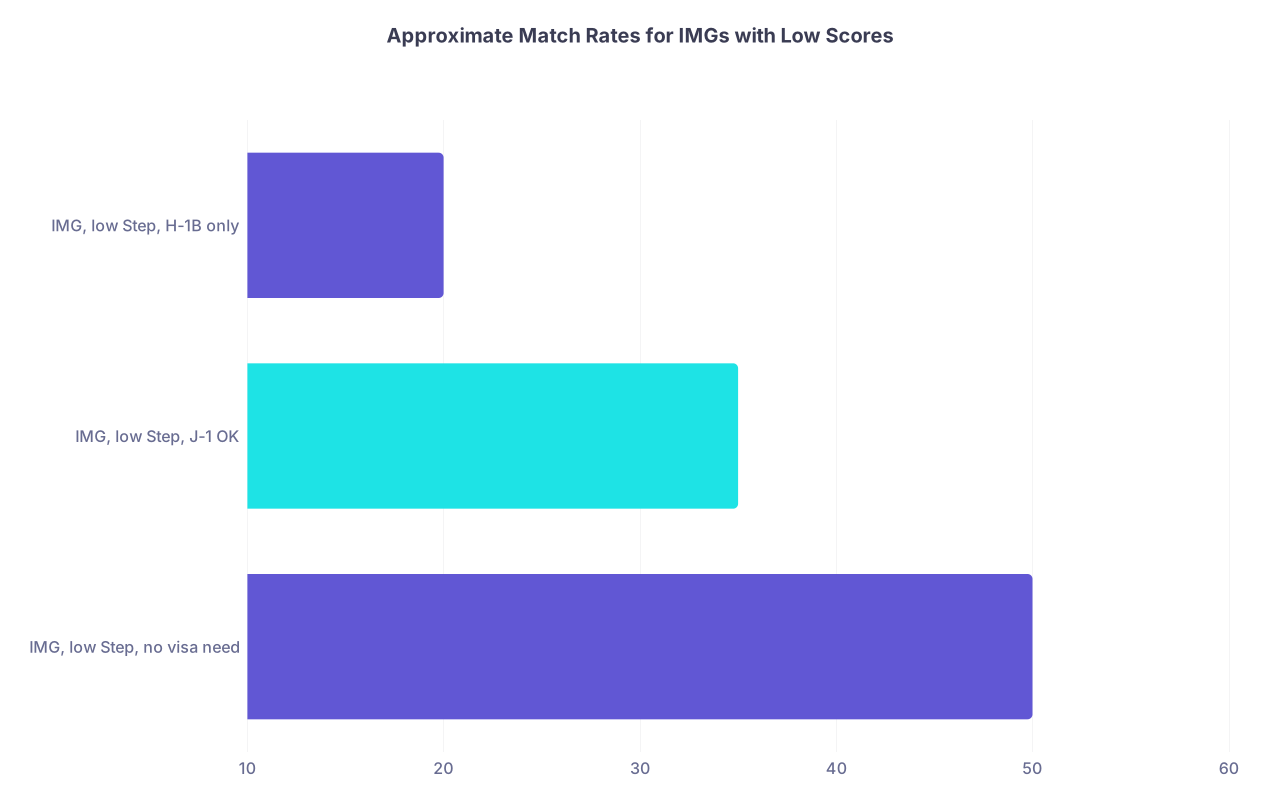
| Category | Value |
|---|---|
| IMG, low Step, no visa need | 50 |
| IMG, low Step, J-1 OK | 35 |
| IMG, low Step, H-1B only | 20 |
These are ballpark directional numbers, not official NRMP stats—but they reflect what I’ve actually seen in real cycles.
What this means for you:
- One unmatched cycle is not the end—if you use the next year well:
- US research with clinical exposure
- More USCE
- Stronger letters
- Tighter specialty focus
- Two or more unmatched cycles with no serious change in your file? You need to seriously consider:
- FM instead of IM (or vice versa)
- Different country for training (UK, Canada, Germany, Middle East)
- Non‑residency roles: hospitalist-equivalent jobs in other systems, public health, clinical research careers
Hope is fine. Delusion is not.
Step 12: Fix What You Can Still Fix This Year
If you’re already in an application season or just before it, here’s a priority list. Do not try to do everything. Do the highest-yield moves.

| Step | Description |
|---|---|
| Step 1 | Low Step + Visa Need |
| Step 2 | Add USCE or research |
| Step 3 | Optimize current file |
| Step 4 | Secure strong US LORs |
| Step 5 | Rewrite PS and experiences |
| Step 6 | Build realistic program list |
| Step 7 | Targeted program outreach |
| Step 8 | Interview prep with mock sessions |
| Step 9 | Before ERAS? |
If you have 6–12 months before applying:
- Get 8–12 weeks of USCE in your chosen specialty.
- Aim for at least two solid US letters.
- Fix English fluency if it’s an issue—take it seriously.
If you’re close to ERAS:
- Rewrite personal statement with a mentor who actually matches people.
- Clean up ERAS entries—no fluff.
- Finalize a realistic program list with someone experienced (not just friends).
Step 13: Mental Game – Don’t Let Shame Run the Show
People with low scores and visa needs often operate from shame. They hide their failures, they avoid asking for help, they compare themselves to US MDs with 250s and spiral.
That’s a fast way to sabotage yourself.
Here’s the truth:
- Programs don’t need you to be perfect. They need you to be reliable and coachable.
- Many PDs prefer a hardworking, humble IMG with a 222 and great bedside manner over a 260 who’s arrogant and disengaged.
- Your job is to make it very easy for them to imagine you as the resident who shows up, takes feedback, passes boards, and doesn’t make drama.
You do that with:
- A clear, honest story
- Real work to strengthen weaknesses
- Targeting programs that have historically taken people like you
Not by pretending your file is something it isn’t.
If You Remember Nothing Else
- You’re not in the “standard applicant” pool. Stop using standard advice. Your strategy has to be narrower, deeper, and more realistic: IMG‑friendly, visa‑friendly, score‑tolerant programs only.
- You can’t erase low scores, but you can surround them with evidence: stronger Step 2, serious US clinical experience, powerful letters, and a coherent, honest story that shows growth.
- Matching with low Step scores plus visa needs is possible—but only if you ruthlessly cut wishful thinking, pick specialties and programs that actually take people like you, and treat every piece of your application like it has to earn back trust.