
The worst mistake after not matching with low Step scores is drifting. You don’t have that luxury. You need a plan, not vibes.
You’re in a brutal but navigable situation: you did not match, your Step scores are weak, and you’re staring down a system that openly screens by numbers while claiming it “reviews holistically.” I’m going to walk you through exactly what to do in the next 2–12 months so you’re not in the exact same position next year.
Step 1: Get Brutally Clear About Your Actual Position
First thing: no fantasies. You need a clear-eyed assessment.
Here’s what matters most right now:
- Step 1 (P/F or numeric, and if numeric, what)
- Step 2 CK score
- Number of attempts on each exam
- Graduation year (or expected)
- Visa status
- Specialty you applied to
- What you did this year (research, gap, prelim year, nothing, etc.)
If you don’t write this down, you’ll keep dodging it mentally. I want you to literally make a small one-page snapshot.
| Category | Your Data |
|---|---|
| Step 1 | |
| Step 2 CK | |
| Exam Attempts | |
| Grad Year | |
| Visa Status | |
| Prior Specialty | |
| Red Flags | |
| Strengths |
Now, reality check by category.
Your scores
Here’s the rough translation for Step 2 CK in many programs’ minds:
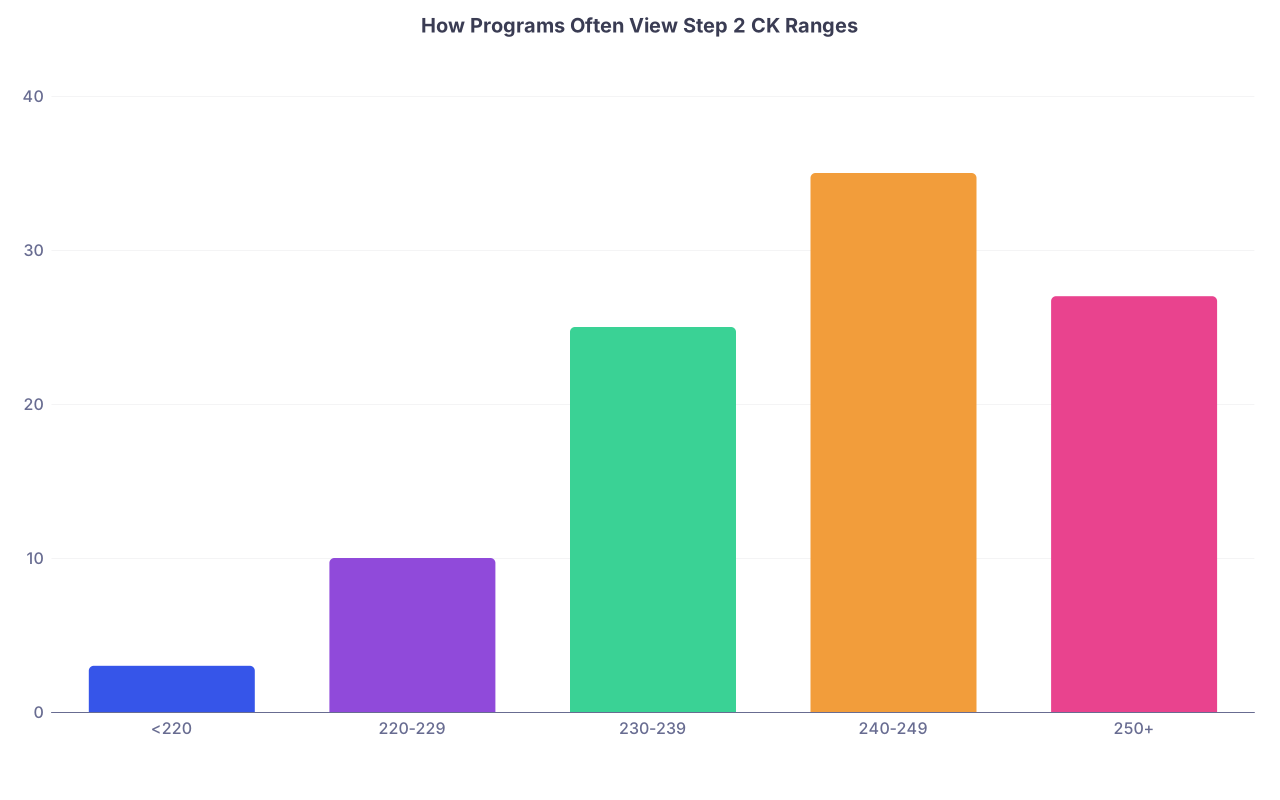
| Category | Value |
|---|---|
| <220 | 3 |
| 220-229 | 10 |
| 230-239 | 25 |
| 240-249 | 35 |
| 250+ | 27 |
Interpretation:
- Below 220: You are fighting an uphill battle almost everywhere. You must be extremely strategic.
- 220–229: Still a meaningful handicap at most academic programs, workable at some community programs and less competitive specialties.
- 230–239: Not great for competitive fields, workable for many IM/FM/psych/peds/community programs with strong application.
- 240+: Weak in some hyper-competitive fields but not “low.”
If you’re under ~230, especially with attempts or older grad year, you cannot just “try again” the same way. You need a pivot.
Your graduation year
Brutal but real:
- US grads: 1–2 years out is usually still okay; 3+ years, doors start closing unless you’re doing something clinically relevant.
- IMGs: even 2–3 years out with inactivity can be lethal for many programs. You must show continuous clinical engagement.
If your grad year is more than 3 years back and you’ve done little clinical work? That’s a bigger problem than the low score. You’ll address both.
Step 2: Decide Your Primary Goal Before You Do Anything
You can’t chase five things at once. Decide what your actual target is right now.
Typical viable goals:
- Reapply to a different (less competitive) specialty next cycle
- Reapply to the same specialty but in a more realistic tier (community, prelim, transitional, rural)
- Lock in any clinically oriented foothold (prelim year, non-ACGME position, research year with clinical exposure) to stay in the game
- Pivot out of US residency entirely (home country training, another country, non-clinical path)
You don’t have to like it. You just have to pick a primary path for the next 12–24 months. You can always shift later, but right now you need a working plan.
If your Step scores are low and:
- You applied to derm, plastics, ortho, ENT, ophtho, rad onc, or integrated surg → you almost certainly need a specialty pivot.
- You applied to EM, anesthesia, or categorical surgery with multiple attempts or very low scores → likely need to pivot to IM/FM/prelim surg/transition year, or accept a multi-year “prove yourself” plan.
- You applied to IM/FM/psych/peds and still didn’t match → your combination of scores + application strategy + letters + interview performance is not competitive. You need not just a pivot, but an upgrade in execution.
Step 3: Choose the Right Kind of Pivot (Not All Pivots Are Equal)
You have four main pivot levers: specialty, geography, level of program, and timeline.
1. Specialty pivot: where low Step scores have the best odds
If you’re willing to change fields, the math changes. Objectively easier (not easy, just easier) for low scorers:
- Family Medicine
- Internal Medicine (especially community, non-university)
- Psychiatry (getting tighter, but still more forgiving in some regions)
- Pediatrics (varies by region)
- Transitional or Prelim Medicine/Surgery (as a foothold)
Do not assume “FM is a backup so it’s easy.” I’ve seen people with 205–215 Step 2 score and a 2018 grad date get rejected from 80+ FM programs because:
- No US clinical experience
- Horrible personal statement
- Sloppy application with generic “I like primary care” nonsense
- Weak or irrelevant letters
2. Geography pivot: go where people don’t want to go
Urban academic coastal programs will screen you out for sport. You need to think like this:
- Rural Midwest
- Deep South
- Smaller community hospitals not attached to big-name universities
- Newer programs (but not disastrously malignant ones)
- Regions with chronically underserved populations
If you insist on staying in NYC, LA, Boston, or Chicago with low Step scores and no connections, you’re voluntarily choosing hard mode.
Step 4: Build a 12-Month Salvage Plan (Month-by-Month Mindset)
You probably have about a year until the next application cycle plays out. You cannot spend that year “studying and hoping.”
Here’s how to turn 12 months into something programs respect.
A. Fix what you can objectively improve
Step 2 CK (or Step 3 if CK already done and you’re eligible)
- If your Step 2 < 230 and you haven’t taken Step 3: a strong Step 3 can partially offset concerns. Not erase them. But shift the narrative from “this person can’t test” to “this person developed.”
- If you failed an exam before, you must show stability with a clean, solid pass next time.
Do not casually retake just to “try for higher.” Retakes and failures hurt. But if you have a fail or very low score, a later stronger performance helps more than it hurts, if done right.
Concrete study plan
- 3–4 months of focused prep with daily UWorld, NBME self-assessments, and a structured schedule.
- You should be tracking your practice score progression and be able to talk about it later: “I went from 52% to 68% UWorld accuracy over 10 weeks and scored X on NBME Y before my exam.”
B. Get US-relevant clinical or quasi-clinical work
If you’re out of school or an IMG, this part is often the difference between match and no match.
Options that actually help:
- Research positions with clinical exposure (chart review, clinics, tumor boards, case conferences)
- Full-time clinical research coordinator jobs
- US-based externships or hands-on observerships with strong letter potential
- Hospital-embedded roles: scribe in IM/FM/EM, quality improvement roles, etc.
Weak or low-yield:
- Short shadowing stints with no letters
- Random volunteer stuff unrelated to medicine
- Remote “tele-research” with no publication and no known faculty sponsor
Your goal: by the time you reapply, you want at least one strong letter from the US system that says: “I’ve seen this person show up every day, take responsibility, and function in our clinical environment.”
Step 5: If You’re Reapplying – Change Your Strategy, Not Just Your Luck
Most unmatched reapplicants basically re-send the same application and hope something shifts. Programs notice. They don’t love it.
Here’s how to actually pivot strategically.
A. Rewrite your story around growth, not excuses
Your personal statement should not be a Step obituary. It should:
- Acknowledge briefly (1–2 lines) that your early exam performance was not where you wanted it
- Show specific changes you made: new study methods, mentorship, simulation, clinical roles
- Focus heavily on the work you’ve done since: research, jobs, hands-on experience, patient impact
You’re telling a “resilience, insight, and upward trajectory” story, not “I am begging for a chance.”
B. Be painfully realistic about program list
If your Step 2 is under 230 and you’re:
- An IMG
- Or >2 years out
- Or have attempts/fails
You need a deep list, heavily weighted toward:
- Community programs
- Less desirable geographies
- Newer programs with established leadership
- Preliminary and transitional year spots if you’re willing to grind your way in
For many in this position, 100–150+ programs is not overkill. It is normal. But only if each application is polished; 150 garbage apps is worse than 60 targeted ones.
Step 6: Use SOAP and Off-Cycle Opportunities Intelligently
If you just didn’t match, your immediate question is: “Can I salvage something through SOAP?”
SOAP reality with low Step scores
SOAP is chaotic and cruel, but not random.
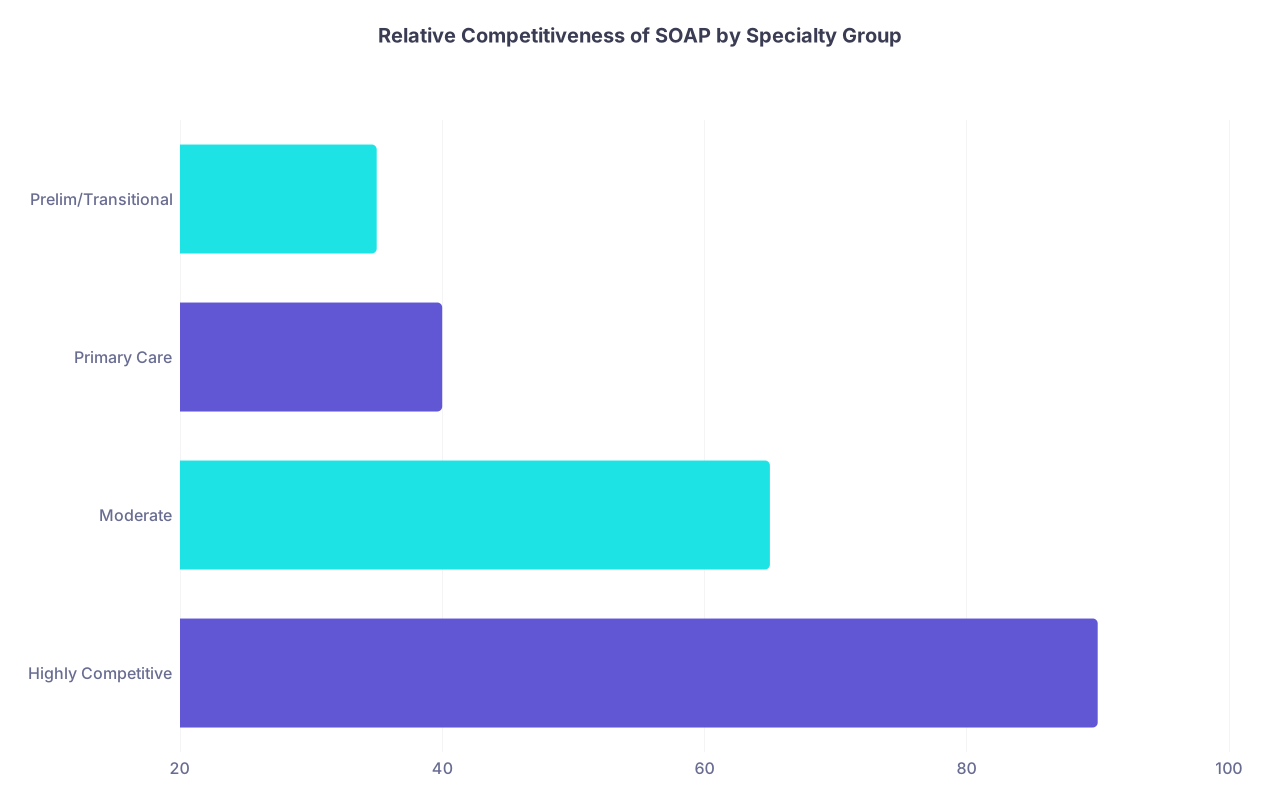
| Category | Value |
|---|---|
| Highly Competitive | 90 |
| Moderate | 65 |
| Primary Care | 40 |
| Prelim/Transitional | 35 |
Higher number = more competitive to get in during SOAP.
For low Step scorers, your best SOAP targets:
- Family Medicine
- Internal Medicine (community)
- Pediatrics (in some years)
- Psychiatry (but tightening)
- Prelim Medicine / Prelim Surgery
- Transitional Year (if available and not crazy competitive that year)
But here’s the key: if your application is exactly the same as it was on Monday of Match Week, SOAP won’t magically transform you. You’re basically re-competing with the same file.
Smart move: if SOAP fails, shift immediate focus to off-cycle prelim or non-ACGME positions:
- Research fellowships with heavy clinical content
- Chief resident–created “gap-year” clinical roles
- Non-ACGME fellowships (hospitalist, critical care support, etc.) at community hospitals
- Off-cycle prelim IM or surgery spots that open when residents leave
These roles are how a lot of low-score applicants sneak back into the system. They’re less flashy, more word-of-mouth, but they give you the one thing your score can’t: real-world proof.
Step 7: Have a Hard Backup Plan That’s Actually Livable
Some of you reading this shouldn’t be reapplying at all. No one will say that to your face because they don’t want to crush you, but I’ve seen people waste 5–7 years chasing something that was effectively closed.
Who’s in that risk category?
- Multiple exam failures with no sign of improved performance
5 years post-graduation, no sustained clinical work
- Serious professionalism issues on record
- Visa complications with no realistic sponsoring options
- Burnout or depression so deep you’re functioning at 30% just trying to breathe
You’re allowed to choose a different life and still be “a real doctor” in a different system or role.
Realistic alternative tracks:
- Train in your home country or another country with more flexible entry (and later consider fellowship in the US if that path exists)
- Public health (MPH + applied work, not just another degree to hide in)
- Clinical research career (CRC → project manager → higher-level research roles)
- Medical education, informatics, pharma, or consulting
Do not wait until year 4 of failed attempts to think about this. You can pursue a US reapplication effort for 1–2 cycles while simultaneously building a parallel path. That’s not “giving up.” That’s being an adult with contingency planning.
Step 8: What to Say in Emails, Networking, and Interviews About Low Scores
You will be asked about your scores. If you freeze or ramble, you kill interviews. You need a practiced, honest, concise answer.
Basic structure:
- Brief acknowledgment: “My Step 1/Step 2 score is lower than I had aimed for.”
- Clear, non-excuse context (if appropriate): “At that time, I was using an approach that focused too much on memorization and not enough on application.”
- Specific changes: “For Step 3 / subsequent coursework / my research role, I changed my strategy: daily active questions, spaced repetition, regular feedback from mentors.”
- Evidence of improvement: “Since then, I have [passed Step 3 with X], [performed at the top of my cohort in clinical evaluations], [handled a high-volume clinic as a research coordinator].”
- Tie back to residency: “Residency demands exactly the skills I grew through that process—consistency, learning from mistakes, and adapting under pressure.”
What you must avoid:
- Blaming the exam
- Long sob stories
- Vague “I studied harder”
- Overcompensation or defensiveness (“Actually, my score is fine”)
Quick Reality Checks I Give People in Your Situation
These are blunt, but they’re the questions that matter.
Ask yourself:
- Am I willing to move anywhere in the country if it means training as a physician? If not, you’ve just narrowed an already tight path to a sliver.
- Am I willing to pivot specialties if that’s the only way in? If the answer is no, accept that you may never practice clinically in the US.
- Can I afford 1–2 more years financially and emotionally of grinding without a guarantee? If not, you need a more stable Plan B starting now, not later.
- Do I have even one attending, faculty member, or program director willing to advocate for me? If the answer is zero, that’s a bigger priority than another certificate or random volunteer gig.
FAQs
1. Should I take Step 3 if my Step 2 score is low?
If you’re eligible and your Step 2 is clearly weak (<230) but you believe you can do meaningfully better, Step 3 can help. Programs often see a solid Step 3 as evidence you can handle board-style exams now, even if you struggled before. But you only take it if:
- You have at least 2–3 months to prepare seriously
- Your practice scores are trending solidly above the passing line
- You’re not already carrying multiple failures that suggest another one is likely
A mediocre Step 3 that’s only slightly better than your prior score does almost nothing for you. Another failure will hurt badly.
2. Is it worth doing a research year if I have low scores?
Yes, but only under certain conditions. It’s worth it if:
- The position is full-time, with real responsibility
- You’re working closely enough with faculty that you can earn strong letters
- There’s some clinical or patient-facing component (clinic, tumor board, rounding, etc.)
It’s not worth it if you’re just a remote data grunt with no visibility, no letters, and no end products. In that case, you’d be better off in a more clinical role (scribe, CRC with clinic time, externship) where someone can actually see you work.
3. Should I reapply to the same specialty or switch?
If your specialty is one of the classically competitive ones (derm, ortho, ENT, plastics, ophtho, radiology, neurosurgery, rad onc) and you have low Step scores, multiple attempts, or an older grad year, a straight reapplication to the same field is usually a dead end unless:
- You have extremely powerful backing (well-known mentors actively calling PDs)
- You already did a strong preliminary year in that field or a related one
- You’re willing to do multiple years of related training (e.g., surgery prelim → gen surg or another field)
For IM/FM/psych/peds and some mid-competitiveness specialties, reapplying can work if you change your program list, improve your profile, and fix weak parts of your application.
4. I’m an IMG with low scores and no US experience. Do I have any real shot?
You have a shot, but only if you’re willing to be extremely aggressive and realistic:
- You must get US clinical or research experience with direct supervision and letter-writing potential
- You should target less competitive specialties (IM, FM, some peds and psych) and less popular locations
- You probably need a large, heavily community-focused program list
If you’re also several years out from graduation with zero clinical work, you’re in deep trouble in the US system. At that point, looking seriously at training in another country or your home country isn’t “giving up.” It’s choosing a path where your chances are higher.
5. How many times should I realistically try before stopping?
For most people: two serious, strategic attempts at the Match is the limit before you pivot your life plan. “Serious” means:
- You changed your strategy between attempts
- You addressed your weaknesses (scores, letters, experience, geographic reach)
- You actually had some interviews but didn’t convert, not “0 interviews both times”
If you’ve gone through 3+ cycles with almost no interviews and no major changes in your profile, the system has given you its answer. At that point, continuing to pour time and money into ERAS is usually more about grief and identity than probability. That’s the moment to protect your future and build a different track.
Key points to keep in your head:
- Low Step scores don’t end your career by themselves; drifting without a clear, strategic pivot does.
- You need at least one concrete narrative of growth: better exam performance, strong clinical work, or a meaningful specialty/geographic pivot.
- Give yourself a hard timeline for how long you’ll keep chasing US residency, and build a parallel Plan B now—not when you’re completely out of options.