The residency game is not designed for you. Apply anyway—and play to win.
If you’re older, have a non-linear path, and your Step scores are on the lower side, here’s the blunt truth: the default system will screen you out unless you force people to look up from the spreadsheet and actually see you. That’s the job now. Not to “explain” your story. To weaponize it.
This is the playbook for doing exactly that.
1. Get Real About Where You Actually Stand
Before strategy, you need an unflinching snapshot of your situation. Not vibes. Data.
Here’s what matters for someone in your shoes:
Step 1: Pass/fail era? Fine. Barely passed pre-pass/fail? Problem, but survivable. An early fail? Big red flag that must be addressed head-on.
Step 2 CK: This is now your de facto “score.” If it’s:
- 250+: You’re in decent shape even as an older, non-linear applicant.
- 235–249: Competitive for many IM/psych/FM programs with targeted strategy.
- 220–234: You’ll need to be extremely deliberate with school and specialty.
- <220 or a fail: You are in salvage mode. Still possible—but you must treat it like a serious rescue operation, not a casual round 1 attempt.
Year of graduation (YOG): More than 5 years out from med school? People start asking questions. More than 7–10? You are now in “need a strong narrative + recent US clinical work” territory.
Gaps: Any 6+ month gaps after med school or between steps? Those must be clearly, calmly explained and preferably backed with something productive: research, work, caregiving, etc.
If you don’t know how your stats stack up in your target specialty, stop and look it up. Use NRMP Charting Outcomes and program websites. You’re not allowed to guess.
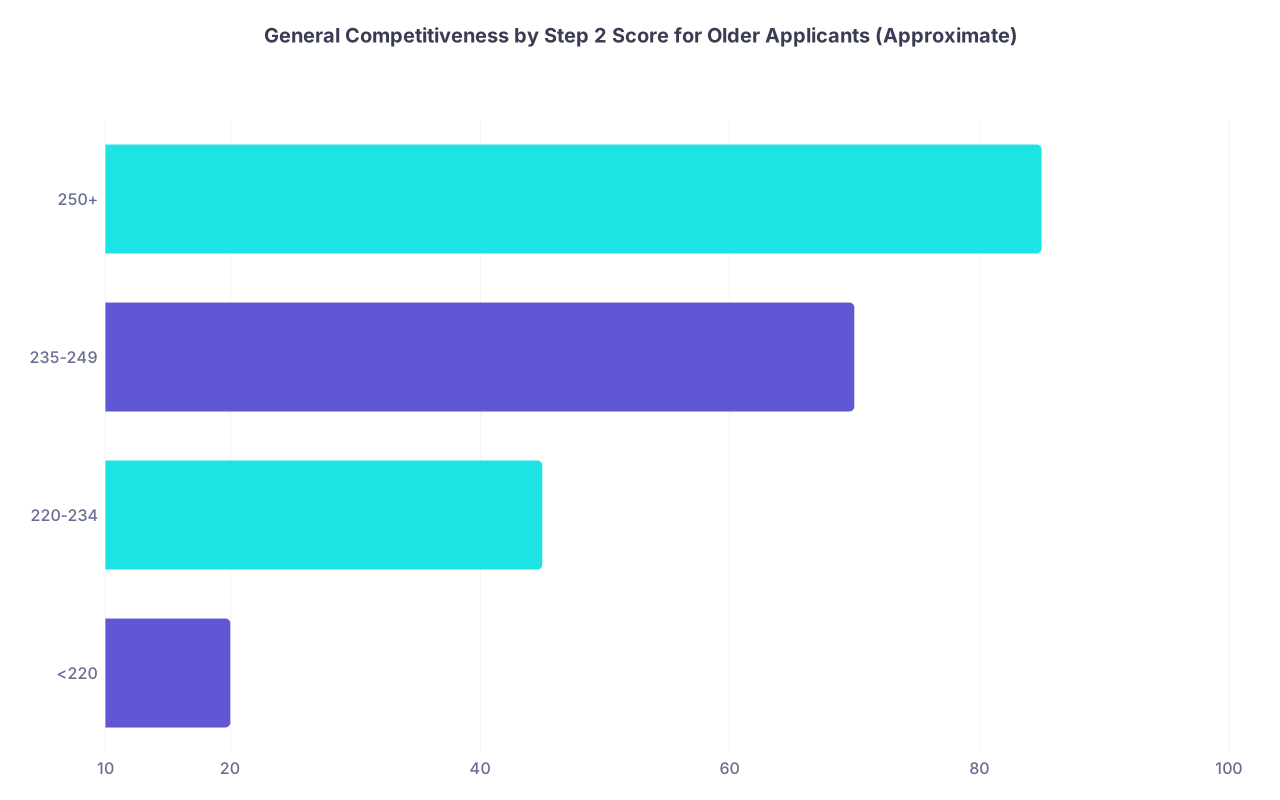
| Category | Value |
|---|---|
| <220 | 20 |
| 220-234 | 45 |
| 235-249 | 70 |
| 250+ | 85 |
(Those numbers are illustrative, not literal. The point: your odds climb fast as you move from low 220s to mid-230s and above.)
If you’re sitting with a 217 Step 2, 8 years since graduation, and no US experience, you’re not going to brute-force your way into a mid-tier university neurology program. Stop pretending you might. You need a different path.
2. Choose the Right Battlefield: Specialty and Program Type
Your non-linear path and age can be an asset—if you choose a specialty and program environment that values maturity, prior careers, and life experience. Some do. Some pretend they do and still don’t. Some absolutely do not.
You need to be ruthless about fit.
Less forgiving of low scores + older age:
- Dermatology
- Ortho
- Neurosurgery
- Plastics
- ENT
- Radiation oncology
Still competitive but uphill as an older, lower-score applicant:
- EM (especially with the recent chaos)
- Anesthesiology
- Radiology
- OB/GYN
- Neurology
- Most surgical subspecialties
Relatively more open, if you play it smart:
- Internal Medicine (especially community programs)
- Family Medicine
- Psychiatry (still competitive but more friendly to interesting stories)
- Pediatrics (to a degree, but they do notice large time gaps)
- Pathology (if you have research/analytical background)
Then you need to understand program types:
| Program Type | Typical Openness to Older / Non-Linear | Notes |
|---|---|---|
| Big-name academic | Low–medium | Score-heavy, research-focused |
| Mid-tier university | Medium | Can be swayed by strong story and mentors |
| University-affiliated community | Medium–high | Often sweet spot for you |
| Pure community (large) | High | Service-heavy, need reliable residents |
| Small community / rural | Variable | Some love non-traditional, some rigid |
If you’re older with low Step scores and still gunning for a competitive specialty at a brand-name academic center, that’s not “ambition.” That’s denial.
If you instead say: “I’m 38, Step 2 is 226, 6 years since graduation, former engineer, want IM or psych at strong community or mid-tier university programs in X region”—now we can actually work with that.
Pick your battlefield. Then we can talk weapons.
3. Fix the Two Biggest Red Flags: Time and Recency
Older + low scores is one thing. Older + low scores + stale clinical work is a death blow.
- Are you still clinically sharp?
- Are you used to the US system (if applicable)?
- Are you trainable and adaptable NOW, not 10 years ago?
So you need recent, continuous, and relevant activity on your CV in the 12–24 months before you apply.
Priority order, if you’re in or coming to the US:
US Clinical Experience (USCE) with strong letters
- Observerships are better than nothing, but hands-on electives, sub-I’s, or prelim work are gold.
- Target departments where the PD or APD is known to be open to non-traditional applicants.
- Your goal is not just a letter; it’s a champion. Someone who can email or call PDs and say, “I’ve worked with this person; take them.”
Research with clinical teams in your target specialty
- Even if you’re older, being on a couple of pubmed-able papers or abstracts helps smooth the “why now?” question.
- Better if your research team includes a PD, APD, or respected faculty.
Paid clinical-adjacent work
- Hospitalist scribe, clinical research coordinator, ED tech (where allowed), case manager (for those with prior careers).
- This covers gaps while showing you’re in the system, not just sitting at home studying and “figuring things out.”
If you’re already working a non-clinical job to survive financially, do not quit blindly. But you do need to carve out meaningful clinical exposure—weekends, short sabbaticals, blocked observerships. Programs don’t care that your corporate job is demanding. They care whether you’re current.
4. Turn Your “Non-Linear” Path into a Sharp, Coherent Story
Your story can either make people nervous or make them lean in.
Right now, a lot of older applicants write personal statements like confessionals. That’s a mistake. You’re not on trial. You’re interviewing for a job.
Your story needs three things:
A clear through-line
Why does everything you’ve done connect in a way that makes sense for your chosen specialty?Example:
- Former engineer → QA lead → went into medicine later → now applying to IM.
- Through-line: systems thinking, improving processes, and owning responsibility for outcomes.
An honest but contained explanation of bumps
- Step failure? Explain once, clearly: “I failed Step 1 on my first attempt in 2017 during a period when I was balancing full-time caregiving for a critically ill parent and underestimating the exam. I repeated it three months later after restructuring my approach and passed comfortably. Since then, I passed Step 2 on the first attempt and have had strong clinical evaluations.”
- Then move on. No self-pity. No defensive over-explaining.
A present-focused anchor
- Not “I’ve always wanted…”
- Instead: “In the last 18 months, working on X inpatient service and Y clinic, I’ve confirmed that I want the day-to-day life of an internist.”
That tells them you know what you’re actually signing up for.
Your age is not the main character. Your specialty fit and current readiness are.
5. Personal Statement and ERAS: How You Actually Write This
Let me be blunt: your ERAS application is not a memoir. It’s a marketing document.
Here’s what to do:
Personal Statement: Non-Linear, Tight, and Tactical
You should cover:
Opening: A present-tense snapshot that shows you in the role you’re aiming for.
Example: a short scene from a recent inpatient elective that illustrates you functioning like a resident.Brief background: Why your path is non-linear, in 1–2 paragraphs max.
“Before medical school, I worked for eight years as a project manager in software. It taught me X, Y, Z. I entered medicine later than most of my peers, but with a clearer sense of the kind of work that sustains me long term.”
That’s enough. Don’t write a life saga.Explain major red flags once: Step failures, big gaps, switching careers. Calm, factual, framed around what changed and what you’ve done since.
Current evidence: USCE experiences, recent evaluations, what attendings say about you. Show that the recent data contradicts the early weakness.
Why this specialty + what you bring, specifically as an older applicant:
- Reliability.
- Prior team leadership.
- Communication with difficult patients / families.
- Ability to handle stress from experience, not theory.
You are not asking for sympathy. You’re offering value.
Experiences Section: Stop Wasting Space
Make your non-medical past work for you. Don’t just list “Manager at XYZ Corp” with vague bullet points.
For each major pre-med career role, write:
- One line on what the role actually was.
- One line on a concrete responsibility (e.g., “led a team of 12 across 3 time zones”).
- One line on what skill translates to being a resident: conflict resolution, data-driven decision making, rapid learning under pressure.
Then, your recent clinical experiences need to scream: “Ready to function as a PGY-1.”
- Highlight continuity clinics, night calls, case load, responsibility.
- Quote feedback indirectly: “Consistently entrusted with complex admissions and sign-out.”
If your ERAS looks like an undergrad plus some random jobs and a few rotations, you’re toast. If it reads like: “This is a grown adult who has led teams, solved problems, and now has fresh clinical evidence”—very different impression.
6. Letters of Recommendation: You Need Champions, Not Generic Praise
Older, low-score applicants live or die by letters.
What you cannot afford:
- Lukewarm generic letters: “Hardworking, punctual, good team player.”
- Letters from 10 years ago.
- Letters that explain your story more than they endorse your performance.
What you need:
- Recent (within 1–2 years) letters from people who actually supervised you clinically in the US (if applying in the US).
- At least one letter that directly addresses your non-linear path in a positive way.
Example of what a useful letter says:
- “I was initially unsure what to expect from an applicant who was older than most students and had a prior career. In the first week, it became clear that their maturity and communication skills were an asset to the team.”
- “Given the previous Step challenges, I paid close attention to their clinical reasoning. They consistently synthesized complex data and presented organized, actionable plans.”
- “I would rank them in the top third of students I’ve worked with in the past five years and would be comfortable having them as an intern on my team.”
How to get those letters:
- Tell your letter writers the truth: “I’m older, my Step scores are not stellar, and I have a non-linear background. Programs will be wary. I’d be grateful if you could comment specifically on my clinical reasoning, work ethic, and how I function relative to typical interns.”
- Give them: your CV, personal statement draft, and a one-page “cheat sheet” of 3–5 cases you managed with them that show your strengths.
Do not be passive about this. You can’t afford “whatever they decide to write.”
7. Application Strategy: Volume, Targeting, and Timing
You don’t get to apply like a standard MS4.
Older + lower scores → you need three things: enough volume, precise targeting, and an early, clean application.
How Many Programs?
If you’re:
US grad, low Step 2 (220–230), older, going for IM/FM/psych:
- 60–120 programs is reasonable, weighted toward community/mid-tier, plus a few realistic reaches.
IMG/FMG, low Step 2, older:
- 120–200+ is not crazy, especially for IM/FM, with heavy focus on IMG-friendly programs.
Targeting
Stop carpet-bombing. You need filters:
Programs with:
- History of taking older or non-traditional applicants (you can often see ages on resident photos, LinkedIn, etc.).
- Residents with non-medical prior careers, visible gaps, or prior degrees.
- Higher proportion of IMGs if you’re IMG (pure US-grad programs are usually less forgiving on scores).
Regions:
- Your geographic ties matter. If you’re 40 with a house and kids in one city and you say you’ll happily move anywhere, some PDs will not buy it.
- Prioritize areas where you have real ties: family, prior work, long-term residence.
Timing
You must be early. Not “kind of early.”
- ERAS submitted on day 1.
- LoRs in the system early.
- MSPE (if applicable) ready.
- No missing exam scores.
Late + older + low scores = auto death in many places. They’ll already have enough applicants.
8. Interviews: Own Your Age and Path Without Apologizing
If your application does its job, your interviews will follow a predictable pattern:
They will test three things:
- Are you weird or rigid? Or actually normal and team-friendly?
- Are you stuck in your previous identity (engineer, lawyer, parent) or fully committed to being a resident?
- Are you going to struggle academically or clinically?
Prepare your answers to:
“Tell me about your path to medicine.”
- Have a 60–90 second answer. Not 5 minutes. Hit: prior career → one or two concrete things that led you to medicine → how you confirmed it’s the right long-term fit.
“Why now?”
- “I delayed this path because X, but once I committed, I’ve built Z recent experiences that confirm it’s sustainable and right for me.”
“How will you handle the hours and intensity at your age?”
- “I’ve already tested this. On my recent inpatient month, I consistently did 80-hour weeks with q4 call and still enjoyed the work. I’m used to high workload from my prior career; the difference is now the work is aligned with what I want long-term.”
Any Step failure or low score questions:
- Own it. Short explanation. Then pivot to: “Here is how I changed my approach, and here’s how my more recent performance reflects that.”
Be calm. Do not sound like you’re trying to convince them they made a mistake interviewing you.
9. If You Don’t Match: How an Older, Low-Score Applicant Regroups
I’ve seen this: older non-traditional applicant, marginal stats, decent story → applies once with weak targeting → no match. Then does it right the second time and lands solidly.
If you don’t match, your year cannot be “waiting and hoping.”
You need:
Active clinical engagement
- Research fellowship, prelim year, or consistent USCE with real responsibilities.
- Do not disappear into a non-medical job full-time and expect a different outcome next cycle.
Concrete skill or credential upgrade
- A new Step exam with a better score (if any are left to take and realistically improve).
- A masters or certificate is lower yield than actual clinical work, but can support a story of continued academic ability.
New, better letters
- From this “bridge” year. Preferably from people in or connected to residency leadership.
Brutal honesty about specialty and program list
- You may need to pivot from, say, neurology to IM, or from university-heavy lists to heavily community-based.
This is salvageable. But only if you treat the post-no-match year like an intervention, not a pause.
10. Mental Game: Dealing with Being “The Older One With Low Scores”
Let’s not pretend this part is easy.
You will compare yourself to 25-year-olds with 250+ scores and linear CVs. If you let that comparison run the show, it will leak into your interviews, emails, and general presence. People can smell insecurity.
Here’s the mindset shift:
You are not a defective version of a typical applicant.
You’re a fundamentally different product. Older, yes. But also:- Less likely to melt down at 3 a.m. over a rude consultant.
- More likely to show up consistently because you’ve already had a “normal” life and chose this again.
- More aware of what you don’t know.
Your job is not to “overcome” your age.
It’s to make your age and path obviously beneficial to a program:- The intern who steadies the team.
- The resident families and difficult patients gravitate to.
- The person who doesn’t freak out when logistics go sideways because you’ve lived through corporate chaos, kids, illness, etc.
But to cash in that edge, you have to be clinically sharp and humble. No “I’ve seen worse in industry” attitude. No hint that residency is beneath your prior status.
What You Should Do Today
Pick one concrete action and actually do it now, not “soon”:
- Open your ERAS CV (or a draft) and add a new section called “Recent Clinical Activity.” If it’s empty or thin for the last 12–24 months, your first mission is clear: line up one substantial USCE, research position, or clinical job and commit.
- Or: Write a 3–4 sentence answer to “Tell me about your path to medicine” and read it out loud. If it sounds like an apology or a long-winded story, cut it in half and make it cleaner.
Do that today. Then build the rest of your strategy around the reality that, yes, the game is stacked—but it’s still winnable if you stop playing it like everyone else.