
It’s late. You’ve got ERAS open on one screen, your Step transcript on another, and that LOA letter buried in a PDF folder you have not touched in months. Your Step score is objectively low for your specialty. You took a leave of absence that will force you to explain yourself in every serious interview.
You can feel the story forming in the program director’s head already: “Low Step score + LOA = red flags.”
Here’s the truth: they will notice both. They will talk about it in their rank meetings. You do not get to hide it. But you do get to control how coherent, honest, and reassuring the story looks.
That is the job right now.
This is how to handle it strategically, step by step.
Step 1: Get Clear on What You’re Actually Dealing With
Before you start crafting your narrative, you need to be brutally clear about your facts. Not vibes. Not how unfair it felt. The actual paper trail.
Pull out everything:
- NBME/USMLE report(s) – score, any fails, date(s)
- Official LOA documentation – duration and type (medical, personal, academic, research)
- MSPE/Dean’s Letter draft if available
- Transcript: preclinical and clerkship grades, any repeats/remediations
Write this down in one place (yes, literally write it):
- Step 1: ___ (pass/score), first attempt Y/N, date
- Step 2: ___ (score), first attempt Y/N, date
- Leave of absence: from ___ to ___ (months), stated reason in school record: ___
- Any course/clerkship failures or repeats: ___
- Current performance trend (last 12–18 months): ___
Now categorize yourself honestly:
| Scenario Type | Description |
|---|---|
| Mild | Low Step but no fail, short LOA clearly non-academic (e.g., family illness), solid recent grades |
| Moderate | Low Step + LOA, but decent Step 2, upward trend, no recent failures |
| Severe | Step fail(s) and LOA with academic component, multiple remediations, borderline Step 2 |
You’re not doing this to punish yourself. You’re doing it because your strategy depends on which bucket you’re in.
If you’re severe-red-flag territory, you need a different application list and a much more carefully engineered story than someone with a single soft spot.
Step 2: Decide What You’re Aiming To Prove
You are not trying to “explain away” the Step score or the LOA. You cannot. They exist.
What you are trying to prove:
You are safe to train.
Meaning: you will pass boards; you will not implode during residency.Your issues are past, not current.
Whatever happened is now resolved or managed with a clear pattern of stability.You understand yourself and you take responsibility.
No blame-shifting. No dramatic self-flagellation either. Just: here’s what happened, here’s what I learned, here’s what I changed.
Every part of your application that touches these topics should point in the same direction: risk identified, addressed, and now low.
Step 3: Build the Core Narrative – One Page, Three Parts
Do this before you touch ERAS text boxes or personal statements.
Open a blank doc. Draft 3 sections with bullet points first, then smooth later:
A. What Actually Happened (Facts, Not Drama)
Describe the LOA and the Step issue in 3–6 sentences. No adjectives. No defensive language.
Example (personal health LOA + low Step 1):
- M2 year, I developed severe migraines and insomnia that progressively impacted my concentration and attendance.
- I attempted to continue full-time but my academic performance and well-being declined.
- In consultation with Student Affairs, I took a formal medical leave from November 2019 to April 2020.
- I returned with accommodations and a structured treatment plan.
- My Step 1 score (20X) was taken shortly after return and was lower than my practice scores during healthier periods.
Example (family crisis LOA + Step fail):
- During my M2 year, a close family member was diagnosed with advanced cancer.
- I became the primary support person and traveled frequently, trying to balance full-time school with caregiving.
- My performance suffered, and I ultimately failed Step 1 on my first attempt.
- After discussions with our Dean, I took a leave of absence from March to August 2020 to focus on family and to reestablish stability.
- On my return, I approached Step preparation with a structured schedule and passed on my second attempt with a score of 21X.
You see the pattern: time-bound, concrete, and specific enough to show this was a real situation, not a vague “personal reasons” cloud.
B. What You Changed (Systems, Not Vibes)
This is where most people go vague with “I learned the importance of self-care and time management.” That line has been in a thousand applications. It does nothing.
You need: specific changes you made that are still in place.
Think:
- Study methods: question-first, spaced repetition, dedicated schedule, tutoring
- Support: therapist, PCP, disability services/accommodations, peer study groups
- Logistics: reduced work hours, stopped commuting 2 hours daily, moved closer to school, arranged childcare
- Monitoring: weekly NBME self-assessments, check-ins with advisor, scheduled board review meetings
Translate into 4–6 sentences like:
- I switched from primarily passive note review to a question-heavy approach using UWorld and daily spaced repetition.
- I worked with a learning specialist to create a weekly schedule that protected 2 uninterrupted study blocks per day.
- I began seeing a therapist regularly and adjusted my migraine medication regimen with my neurologist, resulting in far fewer symptomatic days.
- I now meet with my faculty advisor monthly to review progress and address concerns early.
Specific, actionable, and clearly transferable into residency life.
C. Concrete Evidence That You’re Stable Now
This is the part that convinces them you are not a current risk.
Pull anything you have:
- Strong Step 2 CK score compared to Step 1
- Honors/high passes in core clerkships after LOA
- Strong sub-I / acting internship evaluations
- Research productivity after the rough period
- Leadership or longitudinal commitments you maintained consistently
Convert into 4–8 bullets, then merge into a short paragraph.
Example:
- After returning from LOA, I completed M3 without any course failures and earned high passes/honors in Internal Medicine, Surgery, and Pediatrics.
- My Step 2 CK score (24X) was significantly higher than Step 1 and more representative of my subsequent performance.
- During my acting internship in internal medicine, my attending commented that I functioned at the level of an early intern, particularly in organization and reliability.
You need at least one objective, numbers-based or evaluation-based data point. Words alone will not save this.
Step 4: Decide Where Each Piece Belongs in ERAS
You have a few levers to pull: Personal Statement, ERAS Experiences, Additional Comments, MSPE addendum (if your school allows it), possibly a program director letter.
General rules:
- LOA explanation: brief, factual, usually in “Additional Comments” or a dedicated “Education” explanation box if your school prompts it.
- Low Step / Step fail explanation: short note in Additional Comments or discussed only in personal statement / interviews depending on severity.
- Growth and stability evidence: woven through LORs, MSPE, and your personal statement.
Do not write a 700-word personal statement that is 80% LOA explanation. You still need to sound like a future colleague, not a walking problem list.
Where to Put What (Practical Layout)
Here’s one way to distribute content:
| Content Piece | Best Location |
|---|---|
| Brief factual LOA explanation | ERAS Additional Comments or Education section |
| Step fail or low Step context | Additional Comments (short) or interview only if minor |
| Deeper “what I changed / what I learned” | Personal Statement middle section |
| Current performance evidence | Personal Statement + LORs + MSPE |
If your LOA is explicitly mentioned in your MSPE (it usually is), you should have some matching explanation in ERAS. If you do not, programs will assume the worst.
Step 5: Write the Actual Language (Concrete Examples)
Let’s get precise.
A. Sample “Additional Comments” Language – LOA + Low Step
You want 3–6 sentences. That’s it.
Example – Medical LOA, low Step (no fail):
During my second year of medical school, I developed a health condition that significantly affected my sleep and concentration. After attempting to continue full-time, I worked with Student Affairs to take a medical leave from November 2019 to April 2020 to focus on treatment and recovery. Since returning, I have remained under consistent care, implemented structured study and wellness routines, and have not required further leave. My subsequent clinical performance and Step 2 CK score more accurately reflect my current level of functioning.
Example – Family LOA, Step 1 fail:
I failed Step 1 on my first attempt during a period when I was balancing full-time coursework with being the primary support for a close family member with advanced cancer. Recognizing that I could not meet both responsibilities effectively, I took an official leave of absence from March to August 2020. During that time, I focused on ensuring my family member’s care was stable and developing a realistic plan for my return to school. On my return, I approached Step preparation in a structured way and passed on my second attempt. Since then, I have completed my clinical rotations on schedule with improving evaluations and no further leaves.
You’re stating cause and effect without begging for sympathy.
B. Sample Personal Statement Paragraph – Integrating the Story
You don’t lead with your LOA and Step score. But you also don’t pretend they don’t exist.
Think of it as one middle paragraph in a 3–4 paragraph personal statement.
Example:
My path through medical school has not been linear. During my second year, a combination of untreated migraines and insomnia led to a decline in my academic performance and ultimately a medical leave of absence. Around that time, my Step 1 score was substantially lower than my practice performance and did not reflect my capabilities when healthy. Working with a learning specialist, neurologist, and therapist, I developed sustainable study habits, sought treatment, and built a support structure that I continue to use. Since returning, I have been able to fully engage in my clinical rotations, earning strong evaluations and a Step 2 CK score that better reflects my progress. This experience forced me to confront my limits early and to develop the systems I now rely on to do consistent, careful work—skills I will carry into residency.
Key points:
- Acknowledge problem.
- Tie to action.
- End on evidence and future readiness.
If your situation is extremely complicated (multiple leaves, multiple fails), your personal statement may need a slightly larger chunk of space, but still keep it under control. You’re training them to see a resolved arc, not a lifelong chaos pattern.
Step 6: Make Your List Realistic and Strategic
You can craft the most flawless narrative imaginable and still not match if your list is delusional for your profile.
Here’s where most people in your situation mess up: they apply like a “borderline but okay” applicant when they’re actually a “you need volume and safety” applicant.
Very rough guidance:
- Competitive specialty (Derm, Ortho, Plastics, ENT, etc.) + low Step / LOA: you should seriously consider a parallel plan (IM, Peds, FM, Psych). I’ve watched too many people ignore this and scramble unmatched.
- Mid-competitive (EM, Anesthesia, OB/Gyn, Gen Surg, Neuro): heavy emphasis on community programs, newer programs, and a wide geographic net.
- Less competitive (FM, IM categorical at community programs, Peds, Psych): still apply broadly, but your story can be enough with a good Step 2 and strong clinical letters.
Use a chart like this for yourself:
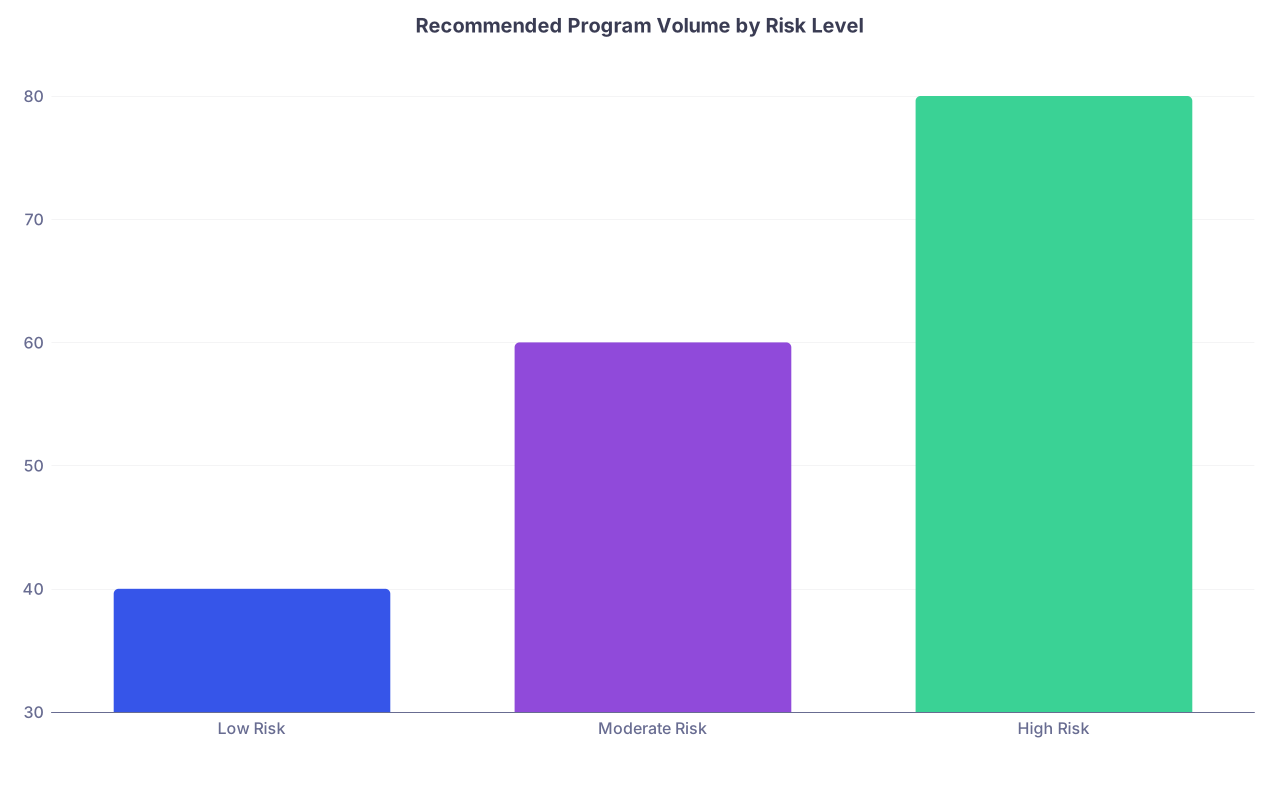
| Category | Value |
|---|---|
| Low Risk | 40 |
| Moderate Risk | 60 |
| High Risk | 80 |
Those numbers are not gospel, but they’re closer to reality than “I’ll apply to 25 university programs in one region and hope for the best.”
Step 7: Prepare for the Interview Conversation
If you do this right, your written story will already have framed things. But you’re still going to get:
- “Can you tell me more about your leave of absence?”
- “I see you had some difficulty with Step 1. What changed between Step 1 and Step 2?”
- “How do you know this won’t be an issue in residency?”
You need rehearsed but not robotic answers. Same structure as before:
- Short fact.
- What you changed.
- Evidence now.
- How that helps you as a resident.
Example answer:
“During my second year, I developed untreated migraines and insomnia that affected my function enough that I ultimately needed a medical leave to stabilize and set up a treatment plan. Since then, I’ve worked closely with my neurologist, started consistent therapy, and built structured study and work habits. You can see the effect in my improved performance after returning—no further leaves, stronger clerkship evaluations, and a significantly better Step 2 score. Going through that forced me to build systems for self-monitoring and asking for help early, which I think are critical to staying reliable in residency.”
What you do not do:
- Blame the exam (“Step doesn’t reflect clinical ability”).
- Attack your school (“they didn’t support me enough”).
- Overshare graphic medical or family details.
- Turn it into a 5-minute monologue.
If you tend to ramble, script your answer to ~60–90 seconds and practice with someone who will cut you off and tell you when you’re being weirdly apologetic or over-explanatory.
Step 8: Align Your Letters and School Support
You can’t write your own MSPE or LORs, but you can influence what’s emphasized.
When you meet with letter writers:
Say something like:
“I want to be transparent that I had a medical leave earlier in school and a low Step 1 score, which is visible on my application. Since then, I’ve worked hard to show consistent performance. If you feel comfortable, it would help if your letter could speak to how I’ve functioned clinically and whether I’ve performed at or above the level expected for a future intern.”
You’re not asking them to write a pity letter. You’re asking them to provide exactly what program directors are scanning for: “Are they okay now?”
If your school dean’s office writes an addendum, ask:
- Can they explicitly mention improvement and stability after return?
- Can they clarify that the LOA reason is now resolved/controlled?
You’re trying to replace the vague “LOA = unknown risk” with “LOA due to X, addressed, now stable with good performance.”
Step 9: Clean Up Sabotaging Behavior in Your Application
This is the part most people ignore.
You already have risk markers (low Step, LOA). You cannot afford extra sloppiness that screams “still not together.”
Run through this checklist:
- No typos, especially in program names and personal statement.
- Dates for LOA and rotations line up across ERAS, MSPE, and your CV.
- No angry or bitter tones anywhere. Not even subtle.
- No vague “personal reasons” if your MSPE spells out the details anyway.
- No weirdly inflated descriptions of research or leadership that will crumble under mild questioning.
You want a boringly consistent file: “Yes, they had a rough stretch. Yes, it’s clearly addressed. No, there’s nothing else hiding.”
Because what kills applicants in your situation is not just the Step or the leave. It’s the pattern: Step issue + leave + inconsistent narrative + defensive interview = no rank.
Step 10: Accept the Reality – But Don’t Self-Destruct
You are dealing with harder odds. That’s true.
A low Step score and a leave of absence will close certain doors no matter how beautifully you spin the story. You are not going to rewrite the fundamental competitiveness equation for Derm with a 205 and a year-long LOA.
But there’s a big difference between:
- Torpedoing your application by avoiding the topic, getting defensive, or pretending nothing happened
vs. - Owning it with a clear, coherent, grounded story and backing it up with recent performance.
I’ve watched applicants in your exact situation match solid programs when they did the second thing well and applied smartly. I’ve also watched their classmates with similar metrics come up empty because they treated the whole issue like a shameful secret or a war they needed to win with program directors.
You’re not at war. You’re making a case.
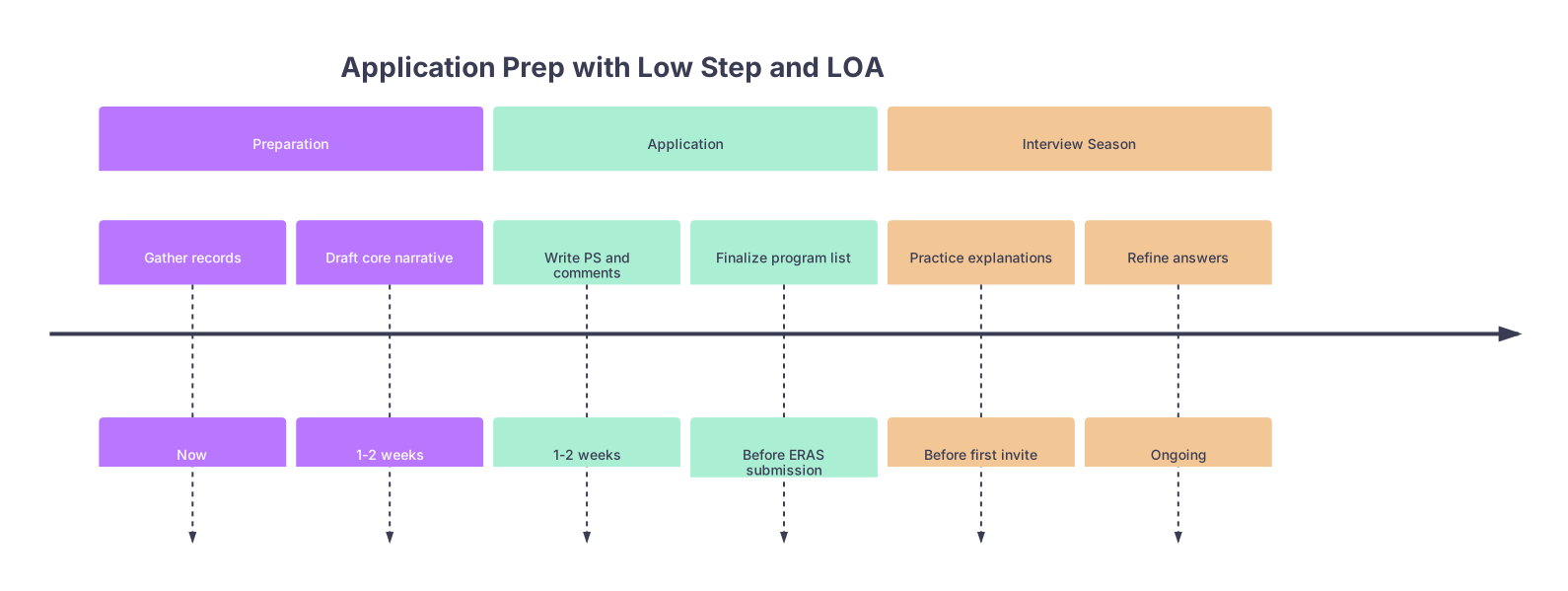
| Period | Event |
|---|---|
| Preparation - Gather records | Now |
| Preparation - Draft core narrative | 1-2 weeks |
| Application - Write PS and comments | 1-2 weeks |
| Application - Finalize program list | Before ERAS submission |
| Interview Season - Practice explanations | Before first invite |
| Interview Season - Refine answers | Ongoing |
Bottom Line: What Actually Matters
If you remember nothing else:
- Do not hide the low Step or LOA; frame them with clear facts, concrete changes, and hard evidence of stability.
- Your Step 2 score and post-LOA performance are your strongest weapons. If they’re good, feature them. If they’re weak, you need volume and realistic specialty choices.
- Every part of your application—ERAS comments, personal statement, MSPE, letters, and your interview answers—should tell one consistent story: “I had a defined problem. I addressed it. Here is proof that I am now a safe, reliable future resident.”