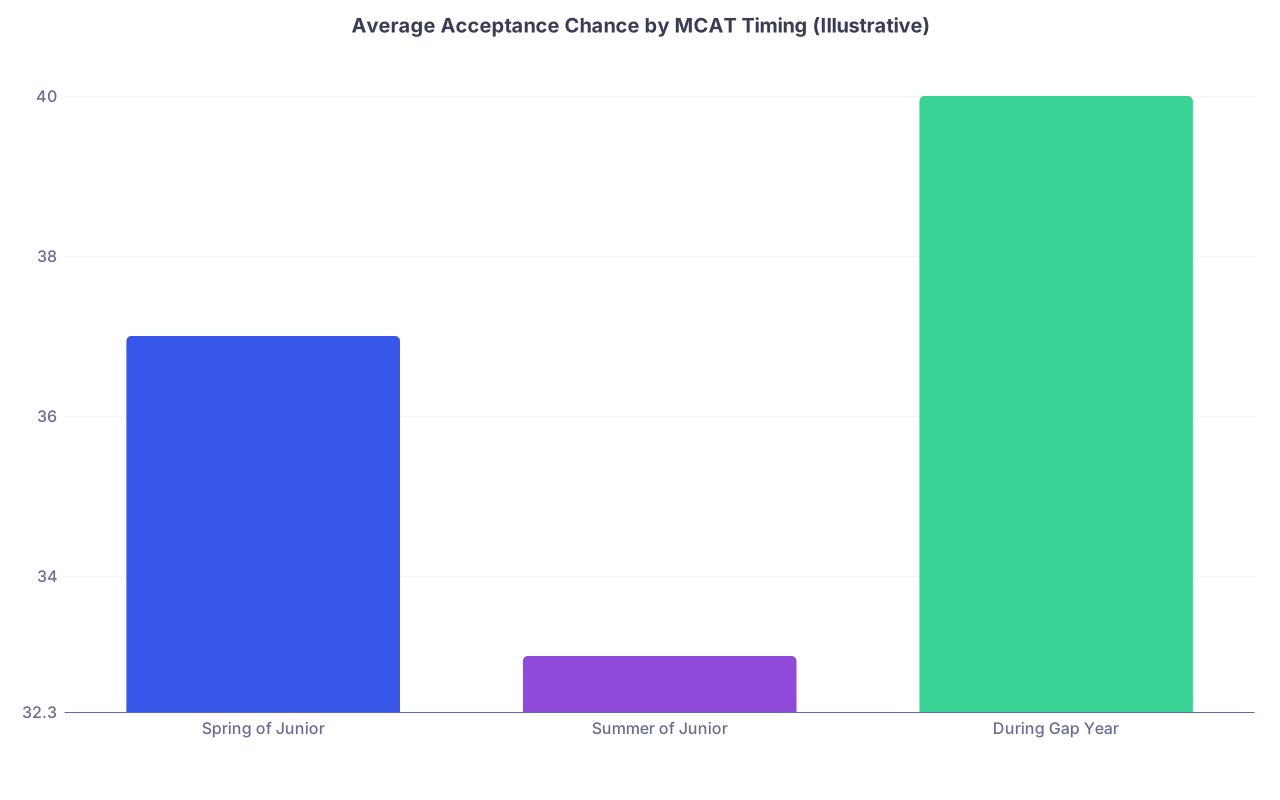
You've been sold a fantasy. The empty summer calendar. The "I'll lock in for eight weeks and crush it" speech you give yourself in April. The Instagram posts of color-coded schedules taped above a clean desk. It looks efficient. It feels decisive. And it is exactly how most applicants hand the admissions committee a lower score than they were capable of earning.
I'm going to tell you what actually happens behind the closed doors of program director meetings and in the quiet post-mortems faculty run after each cycle: the summer sprint is usually a trap dressed up as strategy. The semester marathon, messy, interrupted, and unglamorous, is the approach that keeps producing the top 5% of scores. Not because those students are smarter. Because they refused the illusion.
The Illusion of the Empty Calendar
If you are struggling to maintain this balance during a heavy course load, consider handling MCAT prep during a heavy STEM semester to avoid burnout.
Summer freedom is romanticized the same way medical school is romanticized before you start: long open days, zero competing deadlines, pure focus. Reality is harsher. You sit down in June with a fresh notebook and by week three you're staring at the same CARS passage for the fourth time while your brain quietly mutinies. I've watched this pattern for years. The students who treat summer like a sacred empty vessel almost always walk into August burned out, second-guessing every answer choice, and wondering why their practice scores plateaued twenty points below their goal.
Here's the part admissions committees won't put in their glossy "how to prepare" PDFs. They prefer consistency over intensity. A spike of heroic effort sitting in the middle of an otherwise empty summer looks like poor planning to them. It signals that you only perform when the external world is cleared for you. Medical school never clears the external world. They know it. You should too.
The hidden cost is worse than burnout. When you cram the entire content volume into a compressed window, you lose roughly 40% of the material to simple forgetting before test day. No drama, no moral failure, just the forgetting curve doing what it always does when information is not revisited longitudinally. You "covered" amino acid properties in week one of your sprint. By week six they're ghosts. You sit for the real exam and the questions feel familiar but the answers won't surface. That is not a knowledge gap. That is a design failure.
I've sat with program directors who can smell a summer-only prep from the score report and the timeline alone. They don't punish it overtly. They just stop being impressed. Consistency reads as maturity. Intensity without structure reads as desperation.
The Anatomy of a Summer Sprint: Why Most Crash and Burn
Eight to ten hours of daily study sounds disciplined until you understand cognitive load. Your working memory is not a hard drive. After about four to five high-quality hours of true active learning, returns collapse. The extra hours become theater, highlighting, re-watching videos you've already seen, rearranging Anki decks. You feel productive. You're mostly reheating cold leftovers.
Program directors notice the shape of the effort. A sharp spike sitting in a summer void looks like you treated the MCAT as a discrete project you could schedule around convenience rather than a skill you built while life continued. That is the opposite of how residency will feel. They are already filtering for people who can learn while the pager is going off.
Then there's the forgetting curve, which most commercial prep companies quietly hope you ignore. Cramming is temporary data storage, not learning. You load the material fast, your short-term scores look decent, then the decay starts. Practice exams begin showing high error rates on content you "knew" three weeks earlier. Panic sets in. You study harder. Burnout peaks right when you need clarity most.
For those unsure if their scores are trending correctly, identifying which MCAT practice scores all over the place are worth trusting is a critical diagnostic step.
I've seen the post-score debriefs. The student who "did everything right" for eight brutal weeks and still walked out with a 508 they can't explain. The explanation is simple: they never gave the material time to become automatic. They stored it. The test asked them to use it under pressure. Storage failed.
The Semester Marathon: The Secret Weapon of the Top 5%
The students who quietly dominate this exam do something counter-intuitive. They study while they are already taking organic chemistry, biochemistry, physics, and psychology. That dual load is not a bug. It is the feature.
When you encounter a metabolic pathway in class and then see the same pathway in an MCAT practice passage the same week, you get free spaced repetition without manufacturing it. Neural pathways strengthen because the material keeps colliding with real coursework. Passive recall stops being a chore you schedule and becomes something your brain does automatically between classes.
Low-stakes practice is the other hidden advantage. Integrating thirty to sixty minutes of MCAT work into a normal academic day creates mastery the same way clinical skills are built, by repeated, non-catastrophic exposure. You are not performing for a score yet. You are just getting fluent. By the time the high-stakes exams arrive, the format itself feels ordinary.
Balancing academic rigor with MCAT prep without tanking your GPA is simpler than the panic forums claim. You do not add a second full-time job. You replace low-yield study habits with high-yield ones. Drop the passive re-reading of class notes. Replace it with practice questions that pull double duty for both the course and the MCAT. Protect your sleep. Protect one full rest day. The GPA does not have to bleed if you stop treating every hour as a zero-sum contest between two masters.
I've watched students run this model for three consecutive semesters and walk into a spring or early summer test date already operating at their ceiling. Their practice scores don't spike. They just keep rising and then hold. That stability is what a 520 actually looks like from the inside.
The chart is not subtle. One line is a rocket that falls out of the sky. The other is a climb you can actually stand on.
The Truth Behind the Scoring Ceiling
Admissions committees are not impressed by how fast you did it. They are impressed by how you managed it. A 515+ earned across a full academic year signals something more valuable than raw intellect: you can sustain high cognitive output while other obligations continue. That is the exact skill medical school and residency demand. A 515 earned in a vacuum of free time signals less.
The hidden signaling of a top score is time management and discipline under realistic constraints. When they see a strong score next to a full course load, research, and clinical hours, they relax. You have already proven you will not collapse when the schedule gets ugly. When they see a strong score next to an empty summer, they still wonder.
Real talk: a sprint is sometimes necessary. The only clean use case is the high-performing re-tester who already possesses deep content mastery, has a clear diagnostic of the remaining weaknesses, and needs a focused four-to-six week polish. Everyone else is using the sprint as a procrastination tax. You delayed the real work, so now you try to compress it. That rarely ends well.
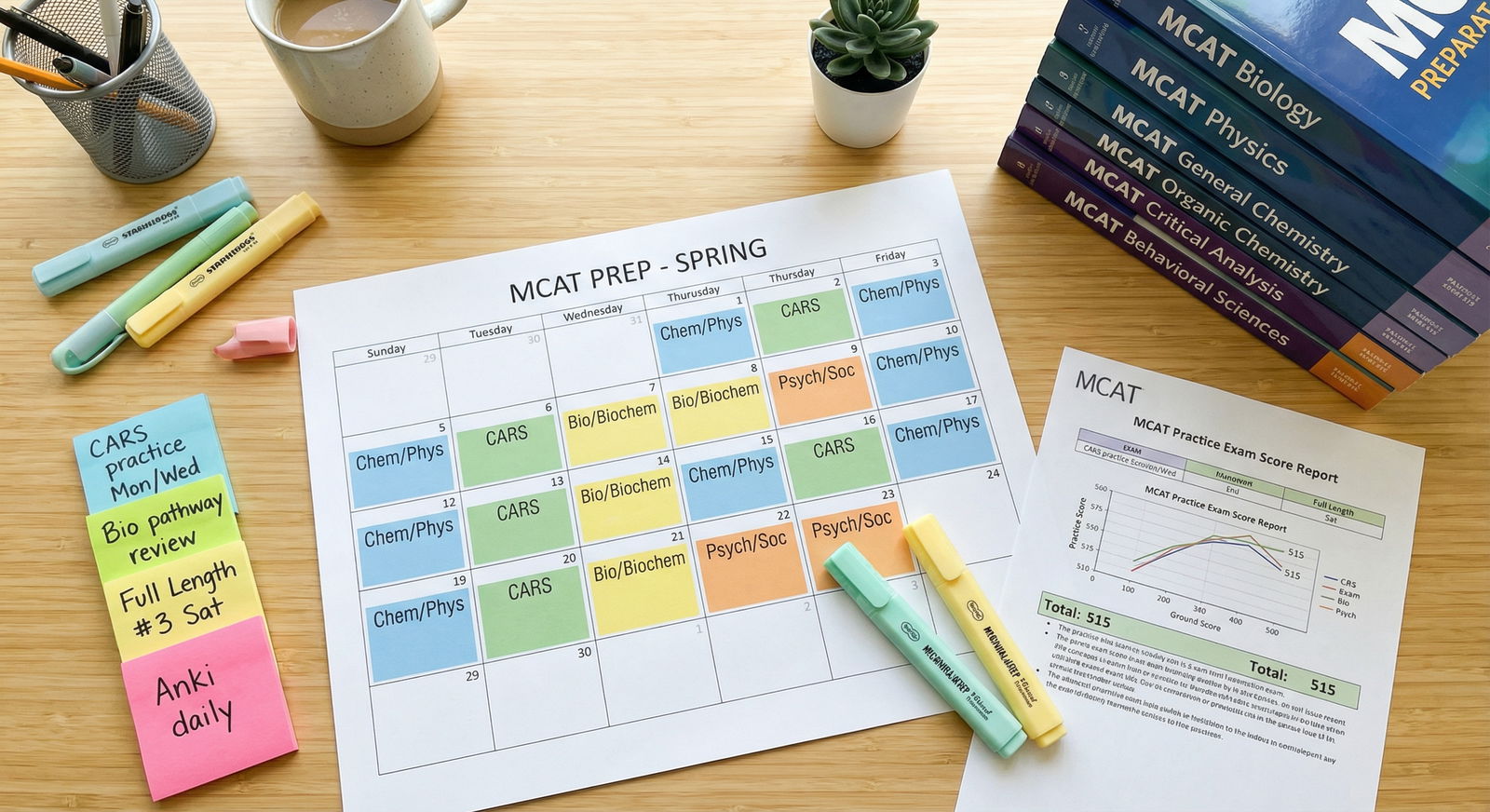
Faculty talk about this more than you think. The applicants who look "ready for the long haul" get the benefit of the doubt on the rest of the application. The ones who look like they only perform in ideal conditions get scrutinized harder.
Strategic Execution: When to Pull the Trigger
Start with an honest diagnostic, not a fantasy schedule. Take a full-length under realistic conditions before you commit to any timeline. If your baseline is more than fifteen points from your target and your content gaps are broad, you do not have a summer sprint problem. You have a foundation problem. Give it the semester it needs.
Build a safety valve into every plan. If you start a sprint and by week three your practice scores are flat and your sleep is wrecked, pivot. Stretch the timeline. Move the test date. The sunk-cost fallacy has ruined more MCAT attempts than any single content area. I have seen students salvage entire cycles by admitting the sprint was failing and converting it into a longer, saner ramp.
The best time to take the MCAT is the window where you can study the most deeply, not the window that looks cleanest on a calendar. Depth beats density. Every time.
If you are early in your premed years, begin light, consistent exposure now. If you are already in the thick of it, stop waiting for a perfect empty summer that will betray you. Weave the work into the life you already have. That is the only preparation that survives contact with the actual exam.
One last reminder, the one I give every student who sits across from me convinced that intensity will save them: longitudinal study consistently outperforms the summer sprint because it refuses to let foundational knowledge decay. Admissions committees read your prep timeline as a proxy for medical school maturity, show them balance, not just a heroic burst. The forgetting curve is the real opponent; beat it with active recall repeated over months, not brute-force reading crammed into weeks. Do not let the convenience of an open summer override the effectiveness of a sustained habit that actually sticks.
You already know which version of yourself shows up when the calendar is empty and which version shows up when life is full. Build the plan for the second one. That is the student who scores.