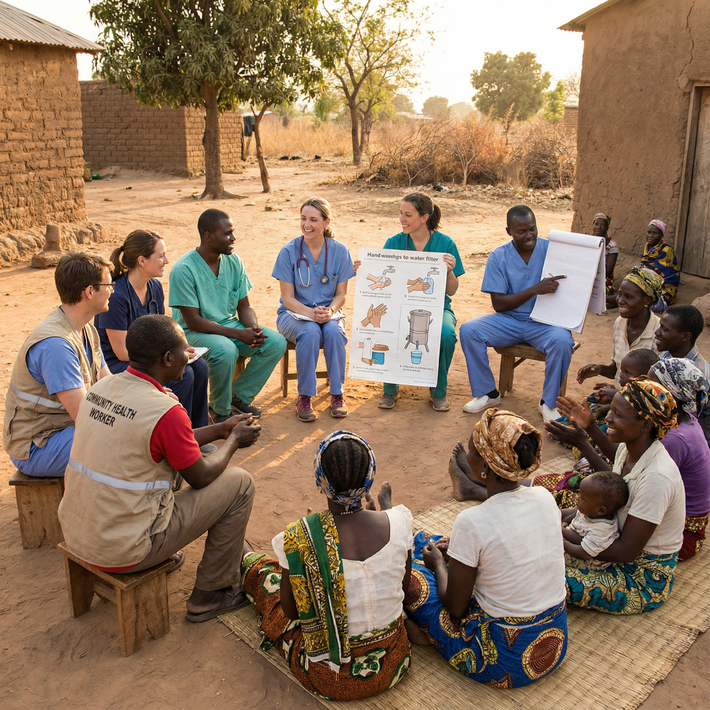
You’re in the interview. It’s going fine. Not amazing, but fine. Then the interviewer asks about a meaningful service experience, and you bring up your mission trip. You tell the story you’ve practiced twelve times. You mention the clinic, the long days, how eye-opening it was, how it strengthened your desire to serve underserved communities.
And then. That little pause.
The interviewer smiles politely and says, “I see.”
That’s the moment your brain starts eating itself alive. Great. I blew it. I sound fake. I sound privileged. I sound like I used poor people as a personal growth retreat. Now they think I’m one of those applicants who flies somewhere for a week, takes photos near a blood pressure cuff, and comes home calling it transformation.
I’ve seen this happen. Not because mission trips are automatically bad, and not because interviewers are secretly waiting to punish you for volunteering abroad. It’s because mission trip stories are dangerously easy to tell badly. They can come out polished, generic, and weirdly self-congratulatory even when the experience meant something real to you. That’s the trap.
And for medical school applicants, it feels especially loaded. Medicine already attracts scrutiny around status, privilege, and motive. So if your answer sounds naïve or savior-minded, it doesn’t just feel awkward. It feels disqualifying.
The good news? Usually the problem isn’t the trip itself. It’s the framing. If you can talk about the experience with reflection, humility, and actual specificity, it can absolutely work.
Why Mission Trip Stories Sound Hollow
Mission trip answers fall flat for a simple reason: too many applicants talk about what the trip meant to them before they show what they actually saw, did, or learned. That’s backwards.
If your story sounds like, “I sacrificed so much, it was eye-opening, it made me grateful, and I realized I want to help people,” that’s not memorable. Worse, it sounds like a brochure. Interviewers have heard that answer a hundred times. They know the rhythm of a performance when they hear one.
There are a few red flags that instantly drain the life out of these stories. Savior language is the biggest one. Phrases like “we went to help them” or “they had nothing” or “I realized how much of a difference I could make” land badly. Not because service is bad. Because those phrases flatten complex communities into props. They erase local clinicians, local knowledge, and the fact that short-term volunteers usually have a very limited role. If you talk like you parachuted in and saved the day, the answer is dead on arrival.
Another problem is overpolish. Applicants rehearse these stories so hard that every sentence feels lacquered. Every beat is inspirational. Every detail points toward “and that’s why I’m perfect for medicine.” Honestly? That makes people suspicious. Real reflection is usually messier. It includes discomfort, uncertainty, ethical tension, and the humbling realization that your role was probably smaller than you wanted it to be.
A hollow answer also skips the hard stuff. No mention of language barriers. No acknowledgment of scope of practice. No curiosity about sustainability. No reflection on whether short-term volunteerism has limits. That absence is loud. Interviewers notice when an applicant talks about a mission trip as if good intentions automatically made everything good. That’s not maturity. That’s fantasy.
How to Reframe the Story So It Sounds Real
Here’s the fix. Stop trying to summarize the whole trip.
That’s where applicants get in trouble. They try to cover the country, the clinic, the mission, the emotions, the values, the takeaway, the future career plans. All in ninety seconds. The result sounds like a fundraising speech.
Instead, pick one moment. One real, grounded, specific moment.
Maybe it was a morning in a temporary clinic when you watched a local physician explain, through a translator, why a patient’s hypertension couldn’t be managed by a one-time visit alone. Maybe it was sorting medications and realizing how much care depends on systems, continuity, and boring logistics no one romanticizes. Maybe it was standing there feeling useless when a cultural nuance went over your head and a local team member stepped in with calm authority. Good. Use that. That sounds human.
Start with context. Briefly. Where were you, what was the setting, and what was your actual role? Not your imagined role. Your actual role.
If you mostly did intake, logistics, patient flow, education support, or observation, say that plainly. Don’t inflate it. Inflating a minor role into “providing care” is one of the dumbest interview mistakes applicants make. You will sound much stronger saying, “I helped with intake and supply organization, and most of my learning came from observing how the local clinicians navigated limited resources,” than pretending you were somehow functioning as a mini-physician.
Then move to action. What happened in the moment? Who was involved? What did you do? Keep it concrete. Sensory details help. The line of patients outside. The stack of handwritten charts. The pause before translation. The local nurse quietly correcting your assumption. That kind of detail signals that you were actually present, not just spiritually enriched.
Then comes the part that saves the whole answer: reflection.
Not “it changed my life.” That phrase is exhausted. Reflection means you explain what the moment taught you about medicine, ethics, and yourself. Maybe you learned that access to care isn’t just about goodwill; it’s about infrastructure, follow-up, transportation, affordability, and trust. Maybe you learned that being useful often means supporting a system rather than starring in it. Maybe you learned how quickly outsiders can misunderstand a community if they arrive with a script.
That’s the level interviewers want. Insight, not applause lines.
Finally, give the lasting impact. And be careful here. Don’t claim the trip “confirmed” your destiny in some dramatic way. That sounds juvenile. Instead, connect it to how you now think and act. Maybe it changed how you approach service in your own community. Maybe it pushed you toward longitudinal work instead of one-off volunteering. Maybe it made you more attentive to interpreters, continuity, and patient context during clinical experiences back home.
A clean structure works every time:
Context. Action. Reflection. Impact.
Something like this:
I joined a short-term clinic trip in rural Guatemala, and my role was mostly nonclinical—I helped with intake, patient flow, and supply coordination while observing the local physician and nursing team. One moment that stayed with me was watching a patient with poorly controlled diabetes return after traveling hours to be seen, only for the team to focus less on a dramatic intervention and more on what follow-up would realistically be possible with limited transportation and medication access. I remember realizing how easy it is for outsiders to think of care as a single encounter, when the real challenge is continuity. That experience made me more thoughtful about the limits of short-term service and more interested in sustainable, team-based care. Since then, I’ve looked for ways to serve locally in settings where I can build longer-term relationships and understand barriers more deeply.
That answer works because it doesn’t try to make you a hero. It makes you credible.
What Interviewers Actually Want to Hear
They do not want a virtue pageant. They want evidence that you can think.
A strong mission trip answer tells an interviewer four things very quickly. First, you can observe carefully. Second, you understand your limits. Third, you can reflect ethically instead of just emotionally. Fourth, the experience changed how you behave, not just how you describe yourself.
They want to hear that you know the difference between helping and imposing. That distinction matters. A lot. The worst answers assume that showing up with good intentions is inherently beneficial. It isn’t. Medicine is full of people who meant well and still caused harm because they didn’t understand context, power, or continuity.
They also want to know whether the experience shaped your approach at home. If your big takeaway from an international trip is only that you “want to serve underserved communities someday,” that’s thin. If your takeaway is that you became more committed to listening, working within teams, respecting local expertise, and pursuing sustained service where you can be accountable, that’s mature.
And yes, they may challenge you. They may ask whether mission trips are sustainable, ethical, or more beneficial to volunteers than to communities. Don’t flinch. A defensive answer makes you sound fragile and undercooked. A mature answer acknowledges the criticism directly and explains that the value of the experience, for you, was not pretending to solve structural problems but learning about partnership, access, humility, and the limits of short-term work.
Practice Phrases That Sound Credible, Not Defensive
This is where wording matters more than applicants realize. Tiny phrasing choices can make you sound reflective or ridiculous.
Bad phrase: “I went there to help people who had nothing.” Better phrase: “I joined a short-term service trip, but what stayed with me most was how much I learned from the local team about barriers to follow-up and continuity of care.”
Bad phrase: “We provided desperately needed care.” Better phrase: “I supported intake and logistics while observing local clinicians who were already doing the hard, ongoing work.”
Bad phrase: “The trip showed me how much impact I can make.” Better phrase: “The trip showed me how limited short-term interventions can be without local partnership and long-term systems.”
If they ask, “Why did you choose that trip?” don’t get sugary. Say something real. Maybe you were initially drawn by service, faith, language immersion, or global health interest, but the more important part is what you learned after you got there. Interviewers trust self-correction. They trust people who can admit, “I went in with a simplistic view, and the experience complicated it in a good way.”
If they ask about ethics or sustainability, try this: “I understand the criticism of short-term mission work, and I think some of it is absolutely valid. What made the experience meaningful to me wasn’t the idea that we were fixing a problem in a week. It was seeing how local clinicians navigated access barriers and realizing how important humility, partnership, and continuity are.”
That works. It’s calm. Not defensive. Not smug.
And please, don’t force an inspirational ending. Not every story needs a violin soundtrack. Sometimes the most powerful ending is, “It made me more careful.” That’s medicine, honestly. Less hero fantasy. More respect.
Practice the answer out loud until it sounds like something you’d actually say when nervous. Because you will be nervous. If it only works when recited perfectly, it’s too rehearsed.
Closing: Turn Anxiety Into a Better Answer
If you’re panicking that your mission trip will ruin your interview, breathe. The trip itself is probably not the problem. The framing is.
You do not need to prove you’re a saint. You need to show that you paid attention. That you understand limits. That you can talk about people and communities with respect instead of using them as scenery in your personal statement sequel.
So here’s the fix, stripped down. Be specific. Be humble. Be reflective.
Take your current mission trip answer and rewrite it tonight using this structure: context, action, reflection, impact. Then practice it with a mentor, advisor, or brutally honest friend who will tell you if it still sounds polished in the bad way. Do that, and your answer won’t land with a thud. It’ll sound like what interviewers are actually hoping to hear: a future physician who can learn without centering themself.