Why Research Matters for DO Graduates in EM-IM
As a DO graduate entering (or aiming for) an Emergency Medicine–Internal Medicine (EM-IM) combined residency, you’re stepping into one of the most versatile and demanding career paths in medicine. Between high-acuity ED shifts and complex inpatient management, it can be hard to imagine where research fits in. Yet research during residency is one of the most powerful levers you have to shape your long-term career—especially if you’re coming from a DO background.
For a DO graduate, research can:
- Counter residual bias about osteopathic training by demonstrating scholarly productivity
- Strengthen fellowship applications (e.g., critical care, cardiology, toxicology, ultrasound, administration)
- Open doors to academic residency tracks and junior faculty positions
- Enhance day-to-day clinical decision-making and critical appraisal skills
- Build a niche—such as emergency medicine internal medicine overlap syndromes, sepsis, resuscitation, or ED-ICU models
This article will walk you through how to approach research during residency as a DO graduate in an EM-IM combined program, including how to get started, find mentors, select feasible resident research projects, and align your work with long-term goals in an academic residency track.
Understanding the Research Landscape in EM-IM Combined Programs
EM-IM combined residencies are uniquely positioned for impactful clinical research because they span two high-yield fields: emergency medicine internal medicine. That overlap creates opportunities that single-specialty programs sometimes miss.
Common Research Domains in EM-IM
As an EM-IM resident, you’ll see patients across settings—ED, wards, ICU, and often longitudinal clinic. This generates rich opportunities for resident research projects, including:
- Acute care & resuscitation
- Sepsis identification and treatment bundles across ED and inpatient
- ED-ICU models of care and outcomes
- Shock recognition and management (cardiogenic vs septic vs obstructive)
- Transitions of care
- Handoff quality from ED to medicine service
- 30-day readmission rates for high-risk conditions admitted from the ED
- ED-based interventions that reduce admissions (e.g., rapid follow-up clinics)
- Chronic disease management in the acute setting
- Heart failure exacerbations: ED risk stratification and disposition
- COPD/asthma pathways, ED-initiated long-term therapies
- Diabetes decompensation and ED-based education or referral programs
- Systems, quality, and patient safety
- Door-to-antibiotic or door-to-needle times
- ED crowding, boarding, and inpatient flow collaboration
- Diagnostic error and delayed diagnoses
- Education & training
- Simulation curricula for EM-IM residents
- Osteopathic principles in emergent care and inpatient medicine
- Feedback models and competency assessments across two departments
These areas are not only relevant but also feasible for busy residents because much of the data already exists in the electronic health record (EHR) or quality-improvement infrastructure.
EM-IM vs Single-Specialty EM or IM: A Research Advantage
Being in an EM-IM combined track can actually enhance your research portfolio:
- Broader patient population: You can study problems across ED, ward, ICU, and ambulatory settings.
- Two departmental resources: Access to both emergency medicine and internal medicine research groups, mentors, and databases.
- Bridging perspective: You can design resident research projects that bridge gaps between services—exactly where many system failures and research opportunities lie.
As a DO graduate residency trainee, emphasizing your ability to connect emergency and internal medicine perspectives—and to integrate an osteopathic, whole-person approach—can set your research apart.

Getting Started: Laying the Foundation in PGY-1 and PGY-2
The biggest barrier to research during residency is not a lack of interest—it’s time, structure, and early planning. For DO graduates in particular, starting early can magnify your impact and help distinguish you from peers.
Step 1: Clarify Your Goals
Before jumping into a project, ask yourself:
- Do I see myself in an academic or community practice?
- Am I considering fellowship (e.g., critical care, cardiology, ultrasound, toxicology, administration, EM-IM critical care hybrid roles)?
- Do I want an academic residency track (e.g., clinician-educator, research, QI/patient safety, administration)?
- What topics excite me clinically in EM-IM—sepsis, cardiology, pulmonary, ED-ICU, hospital administration, medical education?
You don’t need definite answers, but your responses will shape:
- The type of mentor you seek (research-intensive vs QI-focused vs education)
- The scope and design of your resident research projects
- How deeply you invest in methods training (e.g., statistics, study design, implementation science)
Step 2: Survey the Local Research Environment
Within the first 3–6 months of residency:
Review program resources
- Is there a formal scholarly activity requirement?
- Are there EM and IM research directors or vice chairs for research?
- Are there resident research tracks or protected time?
- Any existing EM IM combined research initiatives?
Identify potential mentors
- EM faculty who publish regularly, especially in:
- Sepsis, trauma, ultrasound, operations, medical education, toxicology
- IM or subspecialty faculty (cardiology, pulmonary/critical care, hospital medicine)
- Faculty with DO backgrounds who’ve built academic careers—valuable role models
- EM faculty who publish regularly, especially in:
Attend division/department meetings
- Research-in-progress or journal clubs
- QI/patient safety meetings
- Fellows’ research presentations
This helps you see what ongoing projects exist and where you can plug in quickly.
Step 3: Start Small and Attach to Existing Projects
For PGY-1 and early PGY-2, joining an ongoing project is often smarter than trying to start a large prospective study from scratch. Examples:
- Retrospective chart review that’s already IRB-approved, where you help with:
- Data extraction
- Chart adjudication
- Abstract or poster creation
- Quality improvement projects already prioritized by the ED or inpatient services:
- Improving time to antibiotics in sepsis
- Reducing ED-to-floor admission delays for specific diagnoses
- Education research where you:
- Help design or implement a new simulation scenario
- Collect survey data pre- and post-intervention
Your first objective is to understand the process: IRB, data collection, analysis, abstracts, posters, and manuscripts. Output from these early experiences can support your CV and help secure more autonomy later.
Choosing the Right Project: High-Yield Ideas for DO EM-IM Residents
Not all research during residency is equally feasible. Your goal is to identify a project that fits your:
- Time constraints and schedule structure
- Institutional resources and data access
- Statistical support
- Personal interest and long-term goals
Below are realistic, high-yield project templates tailored to EM-IM combined training.
1. ED-Initiated Interventions That Impact Inpatient Outcomes
Example topic: “Effect of ED-initiated guideline-directed therapy for acute decompensated heart failure on inpatient length of stay and 30-day readmission.”
Why it fits EM-IM residents:
- You see both the ED presentation and inpatient course.
- Data is typically accessible through the EHR.
- Results are interesting to both EM and IM departments (and journals).
Possible outcomes:
- Abstract at SAEM, ACEP, SHM, or ACP
- Manuscript in a journal focused on emergency medicine internal medicine interface or quality improvement
2. Transitions of Care and Communication
Example topic: “Impact of a structured ED-to-IM handoff tool on early inpatient adverse events.”
You might:
- Implement or refine a standardized handoff checklist.
- Collect data on:
- Omitted critical information
- Early ICU transfers
- Rapid responses within 24 hours of admission
For a DO graduate, emphasizing whole-person, longitudinal continuity perspectives can add a distinct osteopathic voice to the project narrative.
3. Sepsis and ED-ICU Collaboration
Example topic: “Predictors of ICU admission among ED patients with suspected sepsis initially admitted to general medicine.”
As an EM-IM resident, you’re well-positioned to:
- Look at initial ED management and inpatient trajectory.
- Evaluate which factors (labs, vitals, comorbidities) predict deterioration.
- Propose changes to triage or admission criteria.
This aligns nicely if you’re leaning toward critical care or an academic residency track with a heavy acute-care focus.
4. Education and Simulation Research
If you’re drawn to teaching, consider:
Example topic: “Effectiveness of a simulation-based curriculum for EM-IM residents on management of undifferentiated shock in the ED.”
You could:
- Develop or adapt a simulation scenario.
- Measure knowledge/comfort via pre- and post-curriculum surveys.
- Assess performance with standardized checklists.
Education projects are often:
- Less dependent on complex statistics
- Easier to implement within residency constraints
- Attractive for clinician-educator pathways
5. Osteopathic Integration in EM-IM Settings
As a DO graduate residency trainee, you can highlight osteopathic principles in the acute and inpatient settings:
Example ideas:
- Survey study on attitudes toward osteopathic manipulative treatment (OMT) for pain management among ED or inpatient physicians.
- Pilot study of an OMT protocol for specific indications (e.g., rib dysfunction in COPD exacerbations, low back pain in hospitalized patients).
These can showcase your identity as a DO and your ability to integrate osteopathic concepts into modern EM-IM practice.
Practical Strategies: Balancing Research, Rotations, and Real Life
The core challenge of research during residency is balancing intense clinical work with scholarly productivity. EM-IM schedules can be particularly complex, with alternating ED and ward months. Here’s how to make it sustainable.
Protecting Time and Structuring Your Effort
Use “soft” time wisely
- Post-night shift mornings (after rest)
- Ambulatory or elective blocks
- Low-acuity ED shifts or call days where downtime exists
Chunk your work
- Identify micro-tasks that fit into 20–40 minute windows:
- Reading 1–2 papers
- Editing a paragraph of a manuscript
- Cleaning a small batch of data
- Larger tasks (writing proposals, analyzing big data sets) may need half-days during elective or lighter rotations.
- Identify micro-tasks that fit into 20–40 minute windows:
Plan around rotation intensity
- On ward-heavy months: focus on smaller tasks (literature review, methods refinement).
- On elective or research rotations: schedule major writing sessions and meetings.
Building a Support Network
- Primary research mentor
- Ideally someone in EM, IM, or a subspecialty with active publications.
- Good mentor traits: accessible, organized, realistic, supportive of DO graduates.
- Secondary mentors or co-mentors
- Methodology expert (biostatistics, epidemiology, or QI)
- Content expert in sepsis, cardiology, pulmonary, etc.
- Peer collaborators
- Co-residents (EM-IM or categorical EM/IM residents) who can share tasks.
- Medical students or rotators who can assist with data collection.
Meeting with your mentor(s) every 4–8 weeks, even briefly, keeps projects from stalling.
Navigating IRB, Data, and Statistics
IRB (Institutional Review Board)
- QI projects may qualify for expedited or exempt review; retrospective chart reviews are common and manageable.
- Ask for examples of previous successful protocols from your department.
Data access
- Learn who manages data extraction (hospital analysts, EM/IM research coordinators).
- Clearly define your variables and outcomes to avoid “data sprawl.”
Statistical support
- Many academic centers offer free or subsidized biostatistics consultation.
- Prepare before meetings: bring your research question, data dictionary, and draft aims.
Understanding basic concepts (p-values, confidence intervals, regression, risk ratios) is enough to collaborate effectively; you don’t need to be your own statistician.
Turning Projects into Tangible Output
Aim for tiered deliverables from each substantial project:
- Local – Departmental or hospital research day presentation
- Regional/national – Abstracts at SAEM, ACEP, ACP, SHM, SCCM, or EM-IM–relevant subspecialty societies
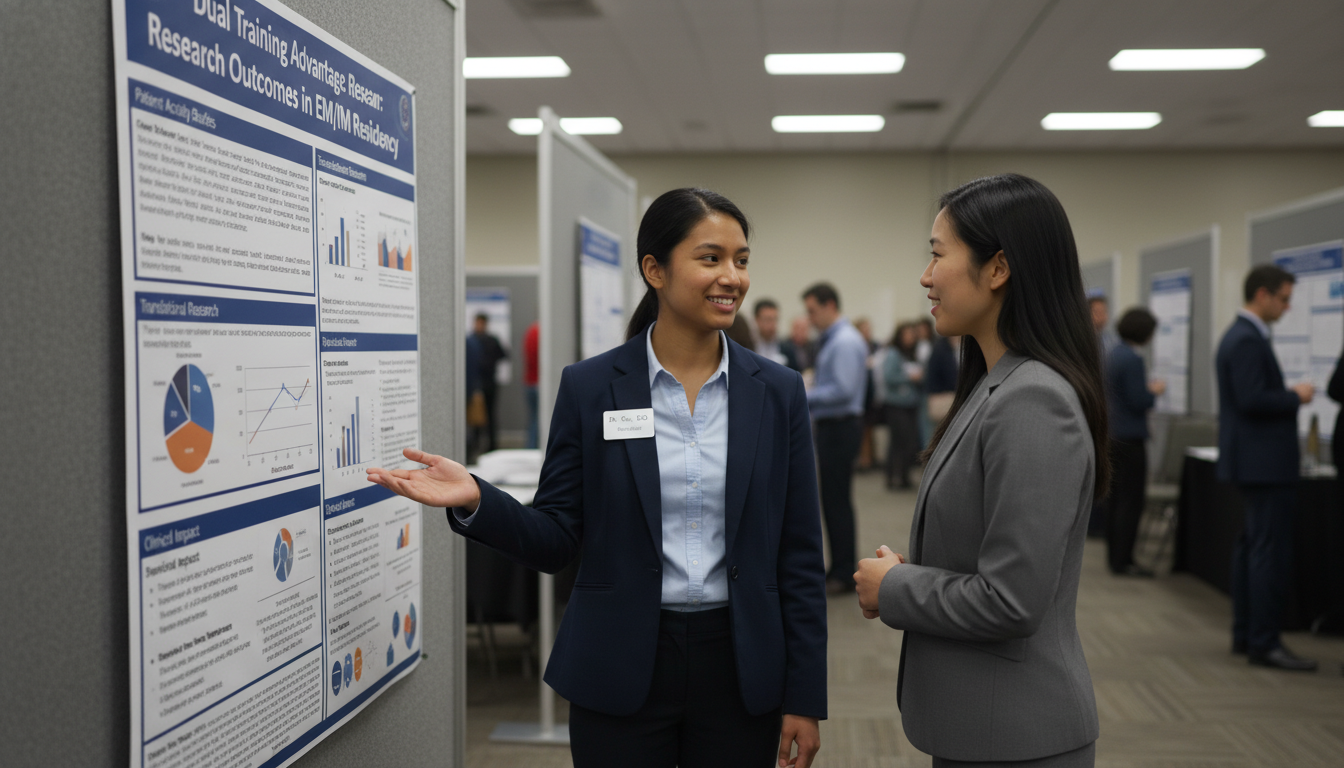
- Manuscript – Even a brief report or case series counts
For DO graduate residency trainees, multiple outputs signal that you can see projects through—essential for osteopathic residency match graduates applying for competitive fellowships or academic posts.
Positioning Yourself for an Academic or Hybrid Career
If you’re considering an academic residency track or a career combining clinical practice with teaching and research, your EM-IM training plus focused scholarly work is a strong foundation.
Building an “Academic Narrative”
Think of your CV as telling a coherent story. As you progress:
- Choose projects that align around a theme, such as:
- ED-ICU and critical care outcomes
- Transitions of care and readmissions
- Cardiovascular emergencies
- Education and simulation
- Highlight your EM-IM and DO perspective:
- Continuum of care from ED triage to inpatient management to follow-up
- Whole-person, systems-based approach grounded in osteopathic philosophy
This narrative helps program directors and fellowship directors quickly grasp who you are and where you’re headed.
Leveraging EM-IM Flexibility
As someone trained across both specialties, you can:
- Join dual-department committees (sepsis task force, transitions of care teams).
- Serve as a bridge in research collaborations:
- EM study that needs inpatient follow-up data
- IM project that requires understanding ED workflow and constraints
Your EM IM combined identity is itself a research asset—lean into it.
Thinking Beyond Residency: Fellowships and Early Faculty Positions
Fellowships that value EM-IM plus research:
- Critical Care (especially ED-ICU interfaces and ICU triage)
- Cardiology (acute coronary syndromes, HF, arrhythmias)
- Pulmonary/ICU (ARDS, respiratory failure, COPD/asthma)
- Hospital Medicine or Administration (systems, QI, patient safety)
- Medical Education (if your projects focus on curricula or assessment)
In your applications, emphasize:
- Specific research during residency (titles, roles, outcomes)
- How your DO training and EM-IM combined residency give you a broader systems view
- Future plans to continue resident research projects and mentor learners
Frequently Asked Questions (FAQ)
1. I’m a DO graduate in an EM-IM program with very little prior research experience. Is it too late to start?
No. Many residents begin research during residency, even without prior experience. The key is to:
- Start early in PGY-1 or PGY-2
- Attach to an existing project to learn the process
- Seek a mentor who’s used to working with novices
As a DO graduate residency trainee, even one or two well-executed projects can substantially strengthen your fellowship or academic applications.
2. How many research projects should I aim for during my EM-IM residency?
Depth usually matters more than raw numbers. A realistic target:
- 1–2 major projects (where you play a significant role and aim for publication)
- 1–3 smaller contributions (co-authorships, case reports, QI initiatives, or educational projects)
If you’re pursuing a heavily research-oriented academic residency track, you might aim higher, but feasibility and quality are more important than volume.
3. Do fellowship directors really care about research for EM-IM graduates?
For many fellowships—especially critical care, cardiology, pulmonary/ICU, and academic hospital medicine—yes, research is viewed very favorably. It signals:
- Intellectual curiosity
- Ability to complete scholarly work
- Familiarity with evidence-based medicine
As a DO graduate, having clear research output (presentations, manuscripts, QI leadership) can help counteract any remaining bias and highlight your readiness for advanced training.
4. What if my program has limited formal research infrastructure or EM-IM–specific projects?
You still have options:
- Work with hospital or system-level QI teams (sepsis, readmissions, throughput).
- Collaborate with categorical EM or IM residents and faculty on their projects.
- Focus on education research, which often needs fewer institutional resources.
- Seek multi-institutional collaborations through national societies, especially if your mentors are active at the national level.
Even modestly resourced programs can support valuable, publishable resident research projects.
Research during residency is not about becoming a full-time scientist; it’s about learning to ask better questions, understand the evidence, and contribute to improving care. As a DO graduate in a combined Emergency Medicine–Internal Medicine program, you occupy a unique vantage point at the intersection of acute care, chronic disease management, and systems-level thinking. Thoughtful research, aligned with that perspective, can define your professional identity and open doors long after graduation.