
Most premeds are stressing about publications way too early.
Let’s answer your actual question head-on:
If you’re a premed or early medical student, no—you do NOT “need” a publication to be a strong applicant. Yes—posters and abstracts can absolutely be enough, as long as:
- You can clearly explain your role
- The work shows commitment and follow-through
- You're not just collecting “lines on a CV” but actually learning from the process
(See also: Should I Prioritize Depth or Breadth in My Research Experiences? for more insights.)
But there are some important nuances, especially if you’re aiming super competitive specialties later on.
Let’s walk through it in a way that lets you figure out where you stand and what you should do next.
1. What Schools Actually Care About (Not Just the CV Line)
Medical schools are not sitting there with a checklist that says:
- Publication in PubMed-indexed journal: yes/no → admit/deny
What they care about instead:
- Can you stick with something intellectually demanding over time?
- Do you understand how research works enough to be a good consumer of data as a physician?
- Can you talk about your project like someone who actually did it, not like someone who showed up once a month?
- Do you show curiosity, initiative, and persistence?
A poster or abstract can show all of that if:
- You worked on a real project (not a 1-week “shadow-research” experience)
- You understand the question, methods, results, and clinical/research implications
- You can describe specific tasks you did (not just “I helped with data”)
Publications are one way to demonstrate this. They’re not the only way, especially at the premed and early med school stage.
2. Posters vs Abstracts vs Publications: What’s the Difference?
Here’s the simple breakdown:
Abstract
A short summary of a study, usually submitted to a conference. Could be:- Published in a conference supplement
- Used for poster or oral presentation
- Often not peer-reviewed as rigorously as a full paper
Good for: early involvement, first steps, smaller roles
Poster presentation
A visual summary of your project on a big board at a conference. Shows:- Your PI trusted you enough to put your name on a presentation
- You showed up, discussed your work, answered questions
- You engaged with the scientific community
Good for: building communication skills, networking, early recognition
Oral presentation (talk)
You (or someone on your team) present the study verbally. Typically:- More competitive than a poster at some meetings
- Viewed a bit more “prestigiously” for the same study
Good for: strong communication signal, leadership in the project
Peer-reviewed publication
Full paper, in a journal, indexed (often on PubMed). Stronger signal because:- Work survived peer review
- Project actually got to completion
- Usually more substantial contributor roles documented
Hierarchy in terms of raw “CV weight” (very simplified):
Publication > Oral presentation > Poster > Abstract only
But remember: context matters more than hierarchy.
A single first-author poster where you can describe the project in depth can be far more impressive in an interview than a 7th-author publication you barely understand.
3. Do I “Need” a Publication as a Premed?
For most premeds applying to MD or DO programs:
- You do not need a publication to be competitive.
- A solid research experience with posters/abstracts is often more than enough.
- Many successful applicants have no publications and still match into good residencies later.
Where publications start to matter more:
- MD/PhD programs
- Research-heavy programs (e.g., certain top-10 MD schools)
- Combined programs (e.g., research scholars tracks)
If you're:
- Applying to a typical US MD or DO program
- Have 1–2 years of consistent research involvement
- Have at least a poster or abstract and can explain your project clearly
You’re in good shape. You do not need to delay applying just to chase a maybe-publication 18 months from now.
4. When Posters and Abstracts Are Absolutely Enough
Posters and abstracts are often enough in any of these scenarios:
You’re early in your journey
- College sophomore/junior or M1
- Just started in a lab or clinical research office
- You have 1 poster, maybe a second abstract in progress
Your role was meaningful
- You did data collection, chart reviews, or surveys
- You helped clean/analyze data with guidance
- You contributed to drafting the poster or abstract text or figures
You can talk about the project like it’s yours In an interview, you can answer:
- What was the research question?
- What was the hypothesis?
- What were the methods (in plain English)?
- What did you find?
- What do you wish you’d done differently?
If you can do that with one or two poster/abstract projects, your research experience will often come across as authentic and strong, even without a publication.
5. When You Should Push Harder for a Publication
There are situations where you should try to go beyond “just” posters and abstracts.
Situation 1: You’re Aiming for MD/PhD or Top-Tier Research Schools
Programs like:
- Harvard, UCSF, Stanford, Penn, WashU
- MD/PhD at any major academic center
These programs often expect:
- Longitudinal research (1–3+ years)
- At least one publication (first- or middle-author)
- Sometimes multiple outputs (posters + pubs)
Here, posters and abstracts alone might not be enough, especially if:
- Your metrics (GPA/MCAT) are strong and you’re competing with very research-heavy applicants
- You’re pitching a future academic research career
Situation 2: You Have Tons of Time in Research but No Output
If you’ve:
- Spent 2–3 years in a lab or ongoing project
- Logged 500–1000+ research hours
- And you have no publications, no posters, no abstracts
That can raise questions:
- Was the project poorly managed?
- Was your role extremely limited?
- Did you not follow through?
In this case, even a single poster or conference abstract helps show:
- “I didn’t just sit in a lab; we actually finished something.”
If you already have multiple posters/abstracts, then pushing to convert at least one project into a publication is ideal.
Situation 3: You Know You Want a Competitive Specialty Later
For neurosurgery, dermatology, ortho, plastics, ENT, etc., residency programs care a lot more about:
- Number of publications
- Quality of journals
- Research relevance to the specialty
But here’s the key: Residency cares, not med school.
You’ll have 4+ years during med school to build your publication list.
If you’re premed now:
- Focus on learning research skills
- Get some form of output (poster/abstract)
- Don’t obsess if you don’t have an actual paper yet
If you’re a late M3/M4 aiming for a hyper-competitive field with 0 publications? That’s when it becomes more urgent.
6. How Schools and Committees Actually Look at This
Here’s how an admissions committee member might mentally parse your research section:
“Did this person just stand next to a poster once, or did they actually contribute to a project and learn something real?”
They’ll look at:
- Consistency – 1 semester vs 2 years
- Depth – simple data entry vs designing parts of the study
- Ownership – are you first author on anything? Did you present the poster yourself?
- Story – does this research connect to your interests, essays, or future goals?
If your CV says:
- “Poster presentation, Local University Research Day, 2023, 2nd author”
- “Abstract, Regional Conference, 2024, 1st author”
…and you talk about:
- Designing the survey
- Screening charts
- Running simple stats under supervision
- Presenting to strangers and answering questions
That can be VERY compelling, even without a formal journal article.
7. Red Flags You Want to Avoid
These situations don’t look great:
“I did 2 years of research.”
But:- You can’t articulate the hypothesis
- You say “I don’t really remember the details”
- Your only output is “I attended lab meetings”
“I’m 7th author on 5 publications.”
But:- You barely know what any of the papers are about
- You can’t explain your contribution beyond “I helped”
- It sounds like your name was just added
You clearly chased titles, not skills.
When pressed, you crumble on specific questions like:- “How did you handle missing data?”
- “What were your inclusion/exclusion criteria?”
Committees care a lot more about honest, real involvement than about having a certain number of PubMed entries.
8. How to Turn Posters/Abstracts into Something More Powerful
If right now you only have:
- 1–2 posters
- 1–2 abstracts
- No publications
Here’s how to level it up without obsessing over a journal acceptance:
Know your project cold.
Before interviews, write out:- 1–2 sentence research question
- 2–3 sentence method summary
- 2–3 key results
- 1–2 implications or “what’s next?”
Ask your PI: “Can we aim to publish this?”
- Offer to help draft the intro or methods
- Start with a smaller journal or case report if appropriate
- Be clear that you’re willing to do the grunt work
Ask for another discrete, finishable project.
- A chart review with limited scope
- A quality improvement project
- A case series
Present locally if you can.
- Medical school research day
- University symposium
- Specialty society regional meetings
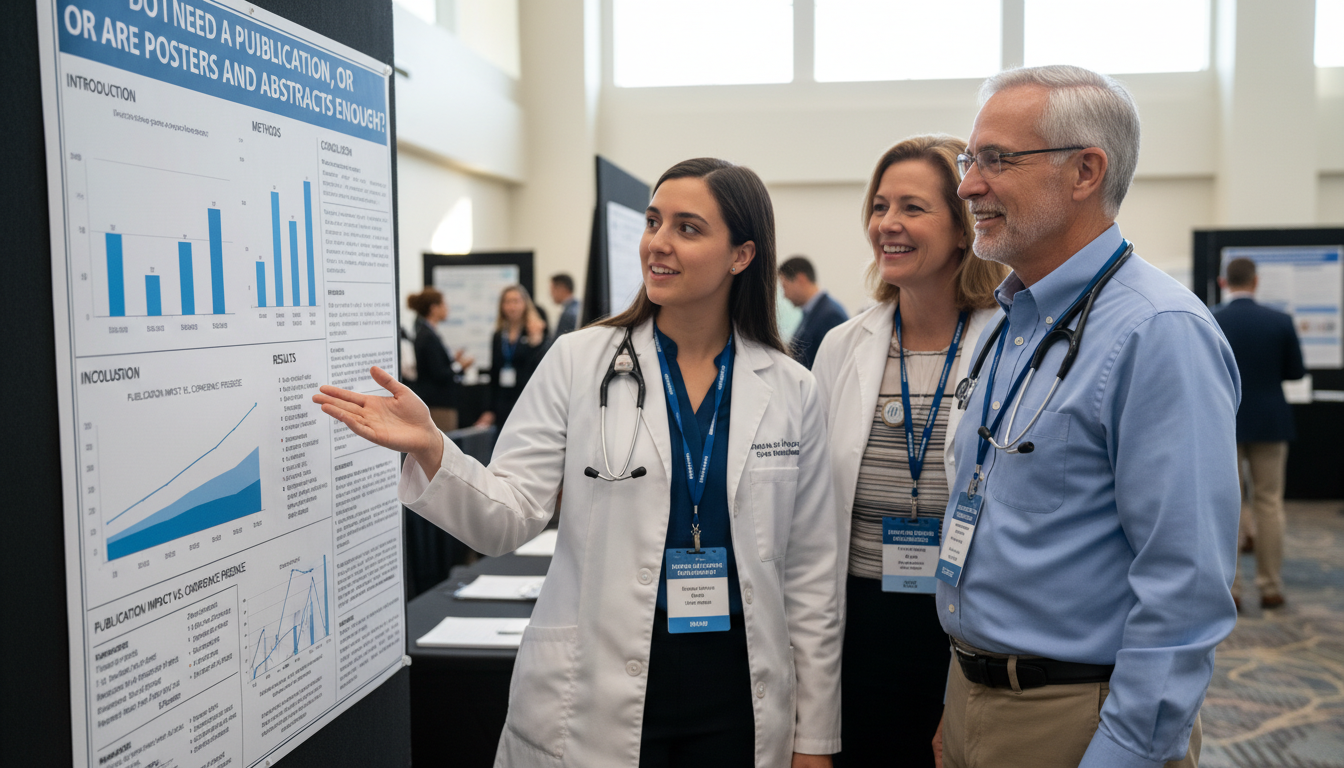
Every presentation not only fills the “research” box more strongly but also gives you stories, talking points, and skills.
9. A Simple Decision Framework: Do You Need a Publication?
Use this quick guide:
You’re a premed or early med student.
Ask yourself:
- Do I have at least one substantial research experience (6+ months)?
- Do I have any output (poster, abstract, presentation)?
- Can I confidently explain my project to a non-expert?
If:
- Yes, yes, yes → You’re fine. Posters/abstracts are enough for now.
- Yes, but no outputs yet → Push for at least a poster or abstract.
- No research at all → Start with finding a project; forget about publications for the moment.
If you’re aiming for MD/PhD or top-10 MD programs:
- Same questions, but you’ll eventually want at least one publication if possible.
- Still, don’t delay your entire life waiting on reviewers.
10. The Bottom Line
For premeds and early medical students:
- No, you do not need a publication to be a strong applicant.
- Yes, posters and abstracts can absolutely be enough, especially if you:
- Have consistent research involvement
- Understand the work deeply
- Can discuss your role with specificity and clarity
Use research as a way to:
- Learn how to think like a scientist
- Work on a team
- Communicate complex ideas clearly
The CV lines (poster, abstract, publication) are signals, not the goal. The real value is in what you learn and how you can talk about it.
FAQ (Exactly 6 Questions)
1. Will not having any publications hurt my chances at MD schools?
For most MD programs, no. Many accepted students have no publications but do have:
- Solid research exposure
- At least a poster or abstract
- Strong letters and essays that show curiosity and follow-through
Publications help, but they’re not a requirement for the majority of schools.
2. Should I delay my application a year to wait for a publication?
Usually, no. If the only reason you’re delaying is to maybe get a paper out:
- Editors and peer review timelines are unpredictable
- You might still be “under review” when you apply
- A strong overall application this year may be better than a slightly stronger research section next year
Delay only if:
- You have multiple weaknesses (GPA, MCAT, clinical exposure) that all need time, and
- Research productivity is a key part of your long-term goals.
3. Is a first-author poster better than a middle-author publication?
They’re different signals:
- A first-author poster says: “I drove this project or major parts of it and can present it.”
- A middle-author publication says: “I contributed to a project that reached peer-reviewed publication level.”
For premeds, either can be great. In interviews, your ability to discuss the project in depth often matters more than the specific label.
4. How many posters/abstracts should I aim for before applying?
There’s no magic number. For most students:
- 1–2 meaningful projects with at least one poster or abstract each is plenty
- Depth > sheer quantity
If you’ve got one strong project where you:
- Worked for 1+ year
- Know it well
- Presented it once
You’re already in a very good place.
5. Does research even matter if I just want to be a clinician?
Yes, but not because you’re expected to become a full-time researcher.
Research experience:
- Trains you to critically read medical literature
- Helps you question assumptions and evaluate evidence
- Shows schools you can handle complex, open-ended problems
You don’t need to love research to benefit from a well-done research experience.
6. What’s one concrete step I can take this week to improve my research profile?
Email your PI or research mentor and say something like:
“I’ve really appreciated working on [project name], and I’m hoping to strengthen my research experience before I apply. Are there any opportunities to help with preparing a poster, abstract, or manuscript from our work? I’d be happy to take on specific tasks to move things forward.”
That one email can turn a passive experience into something with real, visible output.
Now, open your activities list or CV draft and put a star next to your main research experience. Ask yourself: If someone grilled me on this for 10 minutes, could I carry that conversation with confidence? If not, that’s where you start.