Why Research During Emergency Medicine Residency Matters for MD Graduates
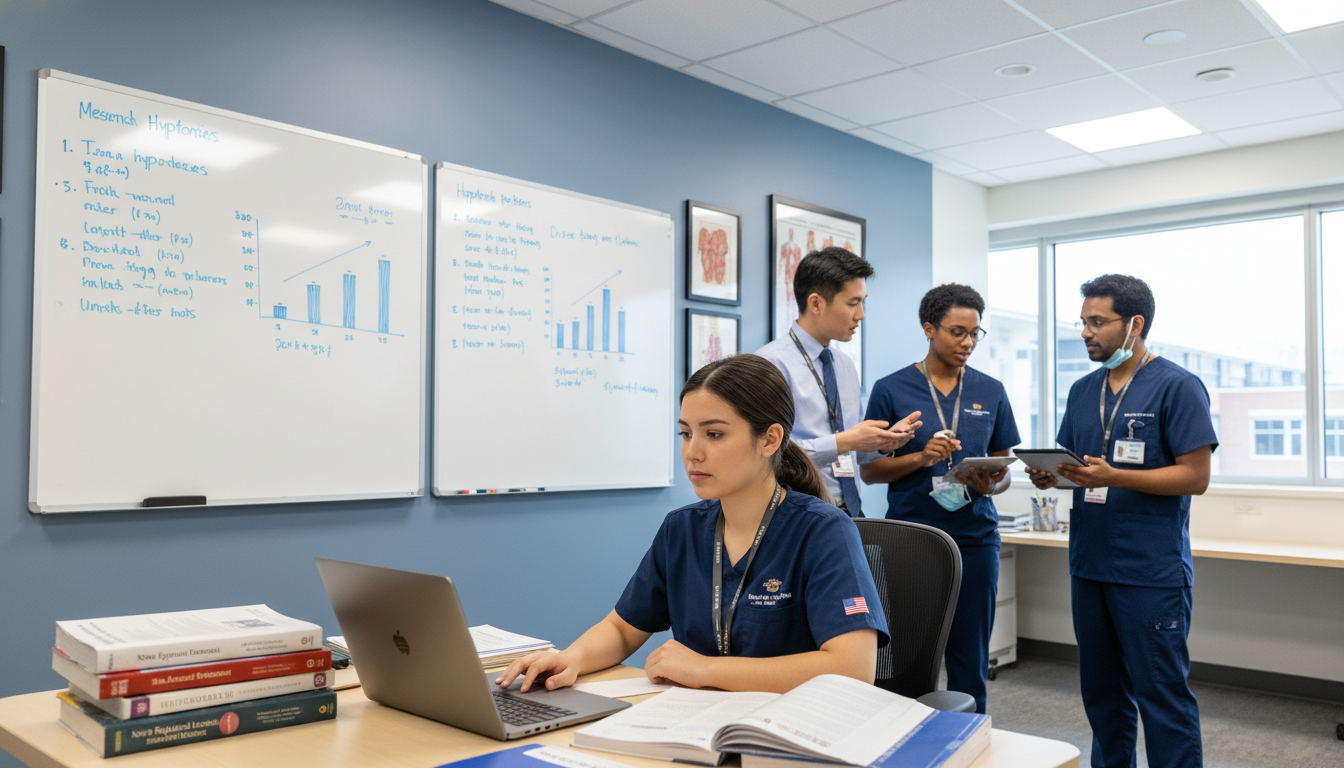
For an MD graduate heading into (or already in) an emergency medicine residency, research may feel optional compared with mastering procedures, optimizing differential diagnoses, and surviving night shifts. Yet research during residency can quietly shape the trajectory of your entire career—whether you envision yourself as an academic EM physician, community clinician, future fellowship applicant, or department leader.
In the current allopathic medical school match environment, programs increasingly look for residents who can ask good questions, evaluate evidence critically, and contribute to departmental scholarship. Even community-focused emergency medicine residency programs recognize that research skills translate into better quality improvement (QI), protocol development, and leadership in evidence-based practice.
This article breaks down how and why to engage in research during residency, with a focus on:
- How to get started with research in emergency medicine
- Choosing between different types of resident research projects
- Balancing research with a demanding EM schedule
- Positioning yourself for an academic residency track or fellowship
- Making research meaningful even if you plan a primarily clinical career
Throughout, the emphasis is on practical, step-by-step advice tailored to MD graduates in EM training.
Understanding the Role of Research in Emergency Medicine Training
How Research Fits into the EM Training Landscape
Emergency medicine sits at the intersection of acute care, systems management, public health, and diagnostics. That makes it inherently fertile ground for:
- Clinical research (e.g., sepsis pathways, trauma care, stroke protocols)
- Operational research (e.g., throughput, triage, staffing models)
- Education research (e.g., simulation training, procedural competency)
- Public health research (e.g., overdose prevention, injury prevention)
For a typical MD graduate residency experience in EM, research may appear as:
- A required scholarly project (often for EM program accreditation)
- Optional participation in ongoing faculty research
- Opportunities through clinical trials networks or multi-center studies
- Departmental initiatives like QI projects that border on research
If you come from an allopathic medical school match background with some prior research experience, residency is where you can sharpen those skills in a more applied, clinically relevant environment.
Why Research Is Valuable Even for Non-Academic Careers
You do not need to be “research track” or “academic-bound” to benefit:
Evidence-based practice
Research experience improves your ability to:- Appraise literature quickly on shift
- Question dogma and outdated protocols
- Advocate for changes based on data, not opinion
Career differentiation
In a competitive EM job market, a track record of resident research projects can:- Support applications to leadership roles (ED director, QI director)
- Help you negotiate for protected non-clinical time
- Make you the “go-to” person for data-driven initiatives
Fellowship and advanced training
For those considering:- Pediatric EM
- Critical care
- Ultrasound
- Toxicology
- EMS
- Research/clinical investigator fellowships
…research during residency is often a de facto prerequisite.
Professional satisfaction
Asking and answering your own questions keeps your career intellectually fresh. Many EM physicians report that scholarship prevents burnout and adds variety to their work.
Getting Started: First-Year Strategy for EM Residents
The hardest part of research during residency is rarely the statistics or IRB—it’s carving out a feasible path that fits your schedule and goals.
Step 1: Clarify Your Goals Early
During your first 3–6 months of PGY-1, take stock:
Ask yourself:
- Do I see myself on an academic residency track?
- Am I mainly interested in clinical excellence, with research as a bonus?
- Do I want to aim for a competitive fellowship?
- What topics do I naturally gravitate toward (airway, resuscitation, ultrasound, education, operations)?
Your answers will influence:
- How ambitious your projects should be
- Whether to prioritize first-author work, large collaborative trials, or rapid QI projects
- Which mentors and sections of the department to approach
Step 2: Map the Local Research Ecosystem
Every emergency medicine residency has a different research culture. Early in PGY-1:
Meet the research leadership
- Research director or vice chair for research
- EM faculty known to be active investigators
- Department or institutional research coordinator
Ask these concrete questions:
- What are the resident research requirements? (e.g., poster, manuscript, presentation)
- Which ongoing projects need residents right now?
- How many recent residents have published or presented, and in which venues?
- Is there an academic residency track or a research-focused pathway?
Review existing projects
Many departments maintain:- A list of active or pending IRB-approved studies
- Registries or databases you can use for secondary analyses
- Partnerships with EM research networks (e.g., PECARN for pediatric EM, stroke or trauma networks)
This reconnaissance keeps you from reinventing the wheel and reveals ready-made, high-yield opportunities.
Step 3: Start Small, Then Scale
For most MD graduate residency trajectories in EM, the most successful path is:
Year 1: Join something that already exists
- Enroll patients in a clinical trial
- Help with data collection for an operations or sepsis project
- Assist with chart review on a defined dataset
Year 2: Lead a small, focused project
- Retrospective chart review on a narrow clinical question
- Education research related to an EM simulation curriculum
- ED process-improvement project with measurable outcomes
Year 3+: Design or co-lead a larger or more complex project
- Multi-site collaboration
- Prospective observational or interventional study
- Manuscript as first or senior resident author
This stepped approach lets you build skills while also generating tangible scholarly products each year.
Choosing the Right Research Project in Emergency Medicine
The “best” project is not always the flashiest; it’s the one you can actually complete during residency while learning meaningful skills.
Common Types of Resident Research Projects in EM
Retrospective Chart Review
- Example: Evaluating outcomes of ED patients with suspected sepsis pre- and post-implementation of a sepsis bundle.
- Pros: Low cost, feasible within residency timeline, often exempt or expedited IRB.
- Cons: Limited by documentation quality, can be time-consuming to abstract data.
Prospective Observational Study
- Example: Collecting bedside ultrasound findings and correlating with CT or formal radiology results.
- Pros: High educational value, closer to “real research” experience.
- Cons: Requires more planning, IRB time, potential patient recruitment challenges.
Interventional or Protocol-Based Studies
- Example: Testing a new triage tool to identify high-risk chest pain patients.
- Pros: Clear clinical impact, can influence departmental practice.
- Cons: Complex IRB, logistics, need for stakeholder buy-in.
Educational Research
- Example: Implementing a new simulation-based airway curriculum and measuring its effect on resident performance.
- Pros: Aligns with teaching roles; often natural for residents who enjoy education.
- Cons: Requires careful study design to avoid weak outcome measures.
Quality Improvement (QI) with Scholarly Output
- Example: Reducing time-to-analgesia for long bone fractures through a nurse-driven protocol.
- Pros: Practical, often strongly supported by the department, can produce both patient benefit and publishable results.
- Cons: Must be designed carefully to meet both QI and research standards if publication is planned.
Secondary Analyses / Database Studies
- Example: Using an existing trauma registry to identify predictors of ED disposition in geriatric trauma.
- Pros: Data already collected; efficient for busy residents.
- Cons: Less control over variables, may be more statistical heavy.
Criteria for Selecting a Feasible Project
To choose wisely, evaluate each idea against:
Scope vs. Time
Can this realistically be completed (data collection, analysis, write-up) in 18–24 months?Mentorship
Is there a mentor with:- Topic expertise
- A track record of completing projects
- Time to meet regularly?
IRB and Regulatory Complexity
- Minimal risk vs more than minimal risk
- Retrospective vs prospective
- Need for consent vs waiver
Statistical Requirements
- Do you have access to a biostatistician?
- Are the methods appropriate for your target journal?
Alignment with Your Career Goals
- Want critical care? Consider shock, ventilator management, or resuscitation studies.
- Interested in operations/administration? Focus on throughput, flow, or ED crowding.
- Drawn to ultrasound? Explore point-of-care ultrasound (POCUS) diagnostic accuracy or education.
Example: A Realistic PGY-2 EM Resident Project
- Question: Does a nurse-initiated POCUS protocol for suspected DVT reduce time to diagnosis in the ED?
- Design: Retrospective pre/post chart review or prospective observational study.
- Scope: Single center, 6–12 months of data.
- Outcome:
- Primary: Time from arrival to DVT diagnosis.
- Secondary: ED length of stay, rate of return ED visits.
This is grounded, feasible, clinically meaningful, and aligns with ultrasound and operations interests.
Balancing Research With the Demands of an EM Residency
Emergency medicine schedules can be brutal. Shift work, nights, off-service rotations, and high cognitive load make time management essential.
Creating a Sustainable Research Routine
Block Out Dedicated Research Time
- Use elective blocks, research rotations (if available), or lighter rotation months.
- Add weekly 1–2 hour “research sprints” to your calendar like mandatory shifts.
Break Projects into Micro-Tasks Instead of “work on project,” define:
- Draft introduction outline
- Extract data from 20 charts
- Revise figures based on mentor feedback
This approach turns an overwhelming project into small, executable steps.
Use the Team Effectively
- Delegate data entry across co-residents or med students.
- Lean on research coordinators for IRB submission, REDCap builds, or patient follow-up calls.
- Ask your mentor to help with connecting you to statisticians or co-investigators.
Prepare for High-Intensity Blocks On ICU months or M3-heavy overnight stretches:
- Shift to mental tasks that require less continuous time (e.g., reading background literature, annotating articles).
- Pause data collection if it demands on-shift attention and resume during lighter periods.
Avoiding Common Pitfalls
Pitfall 1: Overly Ambitious Scope
- Symptom: A multi-center, complex prospective trial with seven outcomes and no dedicated support.
- Fix: Narrow the question, limit to a single site, prioritize 1–2 primary outcomes.
Pitfall 2: Late Start
- Symptom: Beginning your first project in PGY-3.
- Fix: Aim to join a project by mid-PGY-1 and lead one by mid-PGY-2.
Pitfall 3: Weak Mentorship
- Symptom: Mentor is clinically excellent but has little research time or recent publications.
- Fix: Add a co-mentor with active research projects, even if from another department (e.g., critical care, cardiology, biostats).
Pitfall 4: Data Without a Plan for Dissemination
- Symptom: You have a large dataset that never becomes a poster or paper.
- Fix: Set specific target conferences and journals early; draft abstract templates while data are being collected.

Positioning Yourself for an Academic Residency Track or Future Career
For MD graduates considering careers beyond purely clinical work, research during residency is a foundational investment.
If Your Program Has an Academic Residency Track
Many allopathic emergency medicine residency programs now offer:
- Academic or research tracks
- “Scholar” designations
- Protected time for specific residents
If your program offers this:
Apply Early
- Express interest during intern year.
- Demonstrate commitment via early research involvement.
Set Clear Expectations
- How much protected time is guaranteed?
- What are the output expectations (e.g., one first-author publication by graduation)?
- Are you paired with a specific research mentor?
Leverage Institutional Resources
- Clinical and Translational Science Institute (CTSI) resources
- Biostatistics consult services
- Grant-writing workshops or research methodology courses
If Your Program Does Not Have a Formal Track
You can still create an “academic-style” training experience:
- Identify one or two high-yield projects and see them through to publication.
- Seek co-mentorship from faculty in other departments with strong research portfolios.
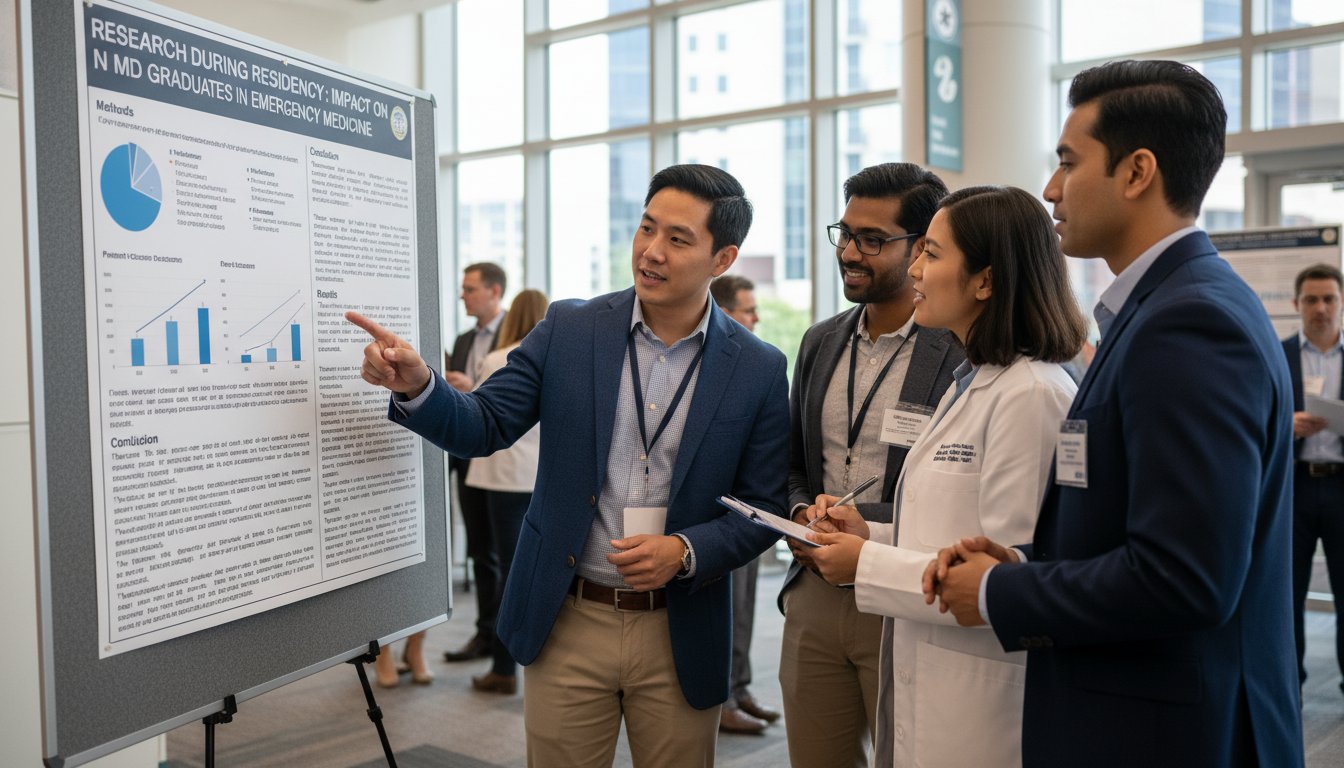
- Attend national EM conferences and present posters or oral abstracts.
- Consider short courses in research methods (online or local CME).
Building a Cohesive Research Narrative
Think about your research during residency as telling a story about your interests and growth:
- Theme: e.g., “My work focuses on optimizing ED care for critically ill patients,” or “I study operational interventions to improve ED flow and safety.”
- Outputs:
- 1–2 first-author abstracts/posters
- 1–2 co-author publications or major collaborative projects
- Evidence of involvement from design to dissemination
This narrative becomes extremely helpful when:
- Applying for fellowships
- Interviewing for academic positions
- Negotiating for protected research time or startup support
Research and the EM Match (Perspective for Future Applicants)
While you are now past the allopathic medical school match, your experience can later help advise future applicants:
- Many EM programs value research, but it is one of multiple factors (clinical evaluations, SLOEs, board scores, professionalism).
- Your resident research projects can become attractive tools for recruiting and mentoring students interested in emergency medicine residency and the EM match process.
- Over time, you may help build a departmental pipeline for student and resident investigators.
Translating Resident Research Into Long-Term Career Impact
Skills You Take Forward from Research During Residency
Regardless of where you practice, you’ll walk away with:
- Study design literacy: Ability to dissect trial methods, appreciate bias, and critique evidence.
- Data fluency: Comfort with basic statistics, understanding confidence intervals, and interpreting regression outputs.
- Writing and communication: Increased clarity in writing notes, protocols, policies, and grant requests.
- Project management: Coordinating teams, setting deadlines, and sustaining long-term projects—skills directly translatable to ED leadership.
Career Pathways Research Can Open
Academic EM Attending
- Protected time for research and teaching.
- Potential path to promotion through scholarly productivity.
Fellowship-Trained Specialist
- Critical care, ultrasound, EMS, pediatric EM, toxicology, research fellowships, etc.
- Research portfolio strengthens applications and later job searches.
Clinical Leader with Data-Driven Focus
- ED medical director, QI director, or operations chief.
- Ability to design and interpret resident research projects and department QI initiatives.
Hybrid Roles (Industry, Public Health, Global Health)
- Pharmaceutical trials, device development, health policy, international EM development.
- Research skills are foundational to all of these.
Making It Count in Applications and Interviews
When applying for jobs or fellowships:
Explicitly describe your role in each project:
- “Designed data collection tool and performed 80% of chart abstraction.”
- “Led IRB submission and primary outcome analysis.”
Highlight impact:
- “Our sepsis triage project led to a 20-minute reduction in time to antibiotics and is now standard policy in our ED.”
Frame research as part of your overall EM identity:
- “I’m an emergency physician who enjoys solving operational problems using data,” or
- “My academic interest is in resuscitation outcomes for critically ill ED patients.”
FAQs: Research During Residency for MD Graduates in Emergency Medicine
1. I had minimal research experience during medical school. Is it too late to get involved during residency?
No. Many MD graduates begin research in residency. Start by joining an existing project early in PGY-1 or PGY-2 to learn the basics: IRB, data collection, and manuscript structure. Choose a mentor who is experienced and willing to teach. You don’t need prior publications to make a meaningful contribution and even lead your own project before graduation.
2. How much research is “enough” if I want an academic job after residency?
There is no strict number, but a competitive academic applicant often has:
- 1–2 first-author abstracts or posters at national EM meetings
- At least one peer-reviewed publication (first or co-author)
- Clear trajectory or focus area (e.g., ultrasound, operations, resuscitation, education)
Quality, follow-through, and your demonstrated role in the work matter much more than total volume.
3. Can quality improvement (QI) count as research during residency?
Yes—if you approach it correctly. Many ED QI projects can be turned into scholarly work by:
- Clearly defining your intervention and outcomes
- Collecting pre- and post-intervention data systematically
- Consulting with a statistician or methodologist
- Discussing whether IRB review is needed (requirements vary by institution)
Submit your QI project as an abstract or brief report to EM or QI-focused journals to create a citable product.
4. How do I balance emergency medicine shifts, studying for boards, and research without burning out?
Prioritize and structure. Start with one well-scoped project instead of several scattered ones. Use lighter rotations and electives for high-intensity research tasks (IRB, data analysis), and reserve brief weekly time blocks on heavy months for small tasks (reading, revising paragraphs). Maintain boundaries—protect sleep, set realistic milestones with your mentor, and remember that your primary job is still to become a competent, safe emergency physician. Research should complement, not undermine, that mission.
Engaging in research during your emergency medicine residency is not about becoming a full-time scientist overnight; it’s about learning to think like a clinician-investigator, even if you spend most of your career at the bedside. When approached strategically, resident research projects can enrich your training, expand your opportunities, and leave a lasting impact on your patients and your department.