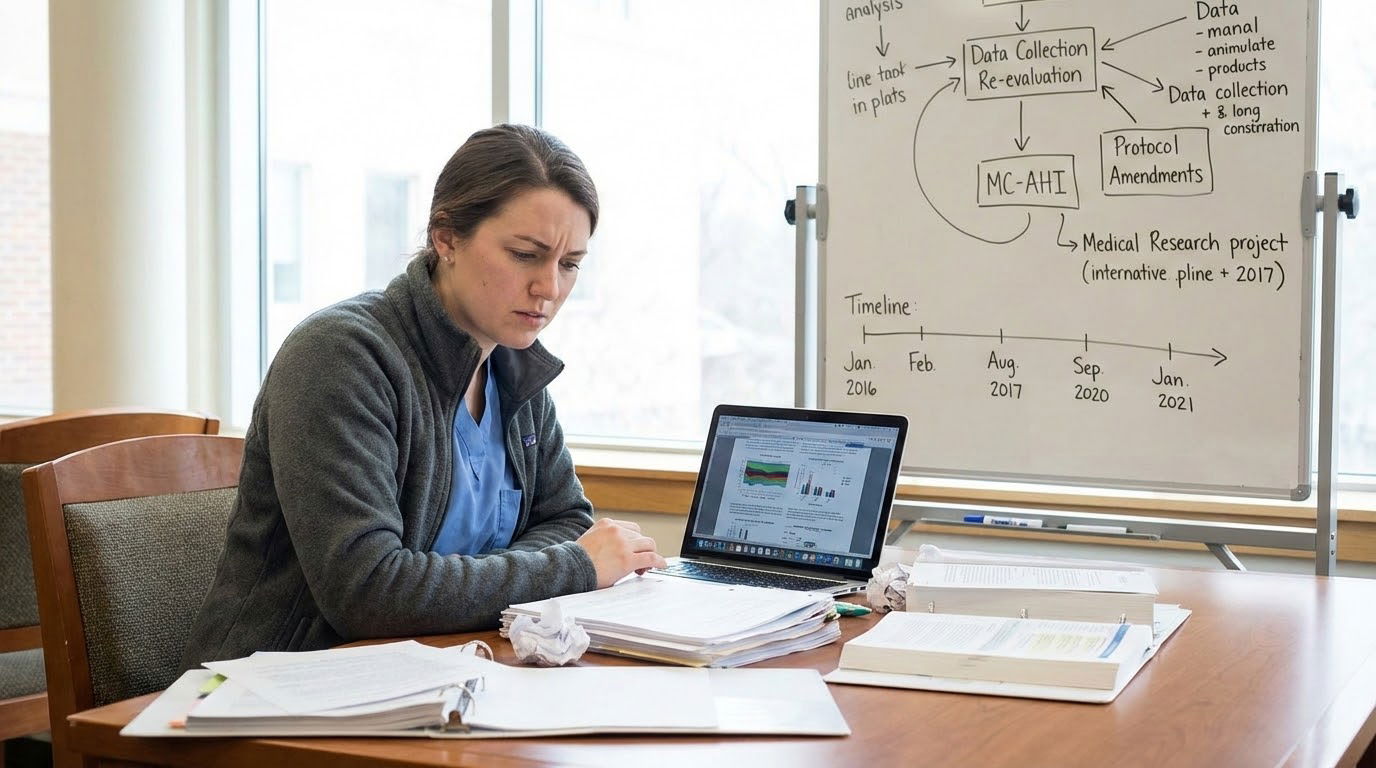
It is 9:30 p.m. You are at the campus library.
Your SPSS file has not been opened in three weeks. The IRB approval email is buried somewhere in your inbox. Your mentor has not replied to your last message. The abstract deadline you were aiming for is two months away, and you are starting to wonder if this whole project is quietly dying.
This is the point where most premeds and early medical students either:
- Let the project fade out with a vague “it just did not work out,” or
- Try to brute-force their way through with random late-night effort and no real plan.
(See also: How to Ask for a Strong Research LOR Without Sounding Awkward for tips on securing recommendations.)
You are going to do something different: treat this like a resuscitation.
Below is a step-by-step protocol to triage, stabilize, and rescue a stalled research project so it actually turns into something you can list on your CV and talk about confidently in interviews.
Step 1: Rapid Triage – Diagnose Why the Project Stalled
Before you do anything, you need a clear diagnosis. “I got busy” is not a diagnosis. You need specific, operational reasons.
Take 20–30 minutes and write down concrete answers to four questions:
Where exactly did you stop?
Identify the last completed step, not just “we were doing data collection.”Examples:
- “We finished 42/100 surveys.”
- “We drafted the intro and methods, but no results section.”
- “We submitted the IRB but have not responded to their comments.”
What is the next action that has not been done?
Not a vague step. A single, executable action that could be done in under 60–90 minutes.Examples:
- “Email Dr. Shah the revised survey questions for final approval.”
- “Extract 10 more charts from the EMR using the data collection form.”
- “Run descriptive statistics in SPSS for the primary outcome.”
What is the primary barrier?
Use this short list and pick the main one:- Access barrier (data, EMR, survey platform, lab space)
- Mentor barrier (no response, no guidance, conflict)
- Skill barrier (stats, coding, writing)
- Motivation / time barrier (burnout, exam block, schedule)
- Structural barrier (IRB issues, protocol flaws, feasibility)
What is your actual goal now?
You may have started thinking “high-impact journal.” At this point, your goal may need to shift.Choose a realistic target:
- Abstract/poster at a local or regional conference
- Undergraduate research event at your university
- A short communication, case report, or letter
- At minimum: a completed project with an internal presentation
This triage gives you a working “problem list” so you are not trying to fix everything at once. You are going to design the rescue plan around the main barrier you identify.
Step 2: Decide Whether to Salvage, Pivot, or Declare Time of Death
Before investing more effort, you need to decide if the project is salvageable in its current form. You are not “quitting” if you make a strategic decision to pivot. You are acting like a PI who understands sunk costs.
Ask yourself three blunt questions:
Is the project still feasible this year with your current schedule?
Consider:- Exam dates (MCAT, Step 1/2, shelf exams)
- Applications (AMCAS, primary/secondary writing periods)
- Clinical rotations or heavy course blocks
Is there at least one engaged mentor or senior person who cares about this project?
- If your only mentor has left the institution or changed jobs and no one else owns the project, your effort may be wasted.
- If a resident or fellow is eager to shepherd it, that changes everything.
Can this realistically produce something tangible?
- Poster at a student research day or specialty-specific meeting
- Manuscript, even if for a smaller or student-focused journal
- Strong letter of recommendation based on your contribution
Based on those answers, choose one of three paths:
Path A: Salvage as Planned (Project is Viable)
Criteria:
- Data and approvals are in place or close
- Mentor is responsive (or can be re-engaged)
- You can carve out 3–5 hours per week consistently for 2–3 months
Action: Continue the main project but with a strictly defined timeline and scope (details in Step 3 and 4).
Path B: Pivot to a Smaller, Contained Product
Criteria:
- Original design was too ambitious for your current reality
- Some data exist or partial work has been done
- You need something completed within 3–6 months, not 12–18
Possible pivots:
- Convert to:
- A pilot / feasibility study
- A descriptive analysis instead of complex modeling
- A single-center instead of multi-center analysis
- A case series instead of a large cohort
- An educational innovation report instead of a full curriculum trial
Path C: Declare Time of Death and Extract Value
Criteria:
- Critical access or approvals are gone (no EMR, no IRB, mentor has left and cannot transfer the project)
- You have zero time due to life changes, board exams, or application timing
- No realistic endpoint exists in the next 12 months
This does not mean “nothing to show for it.”
You can usually salvage:
- A brief write-up for internal presentation
- A methods summary to re-use in a future project
- A relationship with a mentor who sees you handled this professionally
If you end up on Path C, your goal shifts to closing things cleanly and setting up your next project better.
Step 3: Re-engage Your Mentor the Right Way
Many stalled projects are really stalled relationships. You and your mentor stopped communicating clearly and regularly. You can fix that with a structured, respectful reset.
Here is a specific email template that works well with faculty:
Subject: Quick plan to complete [Project Topic] – request for brief meeting
Body:
Dr. [Last Name],
I hope you are well. I wanted to follow up on our project, “[Working Title],” and share a concise update with a proposal for moving it forward.
Current status:
- [1–2 bullet points of what is complete]
- [1–2 bullet points of what remains]
My proposed plan:
- Over the next [X] weeks I can dedicate [Y] hours per week.
- I suggest we focus on [realistic target: poster at X conference / manuscript aiming for Y journal / internal presentation].
- Immediate next steps I can take:
- [Step 1, with time estimate]
- [Step 2, with time estimate]
Would you be willing to meet for 15–20 minutes sometime in the next 1–2 weeks to confirm priorities and timeline? I can adjust the plan based on your preferences.
Thank you again for your mentorship and for the opportunity to work on this project.
Best regards,
[Your Name]
[Year/School]
Key principles here:
- You show ownership and initiative, not helplessness.
- You propose a realistic endpoint (poster, small paper, etc.).
- You make it easy for the mentor to say “yes” and guide, not rebuild the project.
If your mentor does not respond after 2 polite follow-ups spaced 7–10 days apart, you likely have a mentor barrier. At that point:
- Ask a resident, fellow, or another faculty member in the same division:
“Dr. X and I started a project on [topic]. I have [brief summary of progress]. Would you be willing to give brief guidance on how to bring this to a tangible endpoint (poster or short paper)?”
You are not accusing the original mentor of anything. You are asking for help completing something that already exists.

Step 4: Scope Compression – Shrink the Project Without Killing Its Value
Ambition is often what stalled the project in the first place. You tried to do a multi-year, multi-variable, multi-site analysis as a premed with 10 hours per week. That rarely works.
You need scope compression.
A. Compress the Research Question
Take your original research question and make it narrower, answerable with what you already have or can realistically collect.
Example 1 – From big to small:
- Original: “What demographic, clinical, and socioeconomic factors predict 30-day readmission among all adult heart failure patients across three hospitals from 2015–2023?”
- Compressed: “What is the 30-day readmission rate and basic demographic profile of adult heart failure admissions at Hospital A in 2022?”
Example 2 – Educational research:
- Original: “Does a new simulation curriculum improve medical student performance, confidence, and long-term retention across three clerkships?”
- Compressed: “What are student confidence ratings before and after a single simulation session in one clerkship, and how do they rate the session overall?”
B. Compress the Outcomes
Limit the number of primary outcomes and analyses. More variables = more chances to get stuck.
- Choose 1 primary outcome and at most 2–3 secondary outcomes.
- Avoid complex modeling (multivariate regression, etc.) unless:
- You have a stats collaborator
- You actually need it for your target journal
- You can complete it within 2–3 weeks
C. Compress the Timeframe or Sample
If your dataset is enormous or incomplete, you can:
- Use:
- A single year instead of five
- One clinic instead of three
- First 100 consecutive patients instead of all available
This is not “cheating.” It is turning an impossible project into a pilot study, which is a legitimate scholarly product.
Once you have compressed the scope, write a one-paragraph revised “mini-protocol” and confirm it with your mentor. That becomes the new contract.
Step 5: Build a 4-Week Rescue Sprint
Now you need an operational plan, not vague intentions. Think like you are running a 4-week clinical trial on yourself.
Week 0 (Setup Week)
Block time on your calendar.
- Choose:
- 2 × 90-minute blocks on weekdays
- 1 × 2–3 hour block on a weekend
- Treat them like mandatory lab sessions.
- Choose:
Create a “Project Command Center.”
You need everything in one place:- A folder (physical or digital) labeled with the project name
- Subfolders:
- /IRB and approvals
- /Data
- /Analysis
- /Manuscript or Poster
- A one-page project snapshot:
- Working title
- Team + contact info
- Current status
- Target endpoint and deadline
Pick and set up your tools:
- Data: Excel, Google Sheets, REDCap, or SPSS
- Writing: Google Docs (easier for collaboration) or Word in OneDrive
- Task management: simple is fine
- A single page in Notion
- A checklist in Google Docs
- Even a paper checklist
Weeks 1–4 (Execution)
Break the work into discrete, weekly goals:
Week 1 – Data Reality Check and Completion Plan
Verify what data you already have:
- How many charts/surveys/records completed?
- Any obvious missingness or errors?
Decide what “enough” looks like:
- Minimum N for a descriptive project (sometimes 30–50 is enough for a student project or pilot)
- Decide on a hard cap: e.g., “Stop data collection when we reach 80 charts or 4 weeks, whichever comes first.”
Build a data completion schedule:
- Example:
- Monday block: 10 charts
- Thursday block: 10 charts
- Saturday block: 20 charts
- Aim to finish data collection in 2–3 weeks, not 2–3 months.
- Example:
Week 2 – Clean and Organize Data
Create a data dictionary:
- Variable name
- Description
- Type (continuous, categorical)
- Allowed values/coding
Clean actively:
- Check for impossible values (e.g., age 4 in an adult ICU study)
- Decide how to handle missing data (exclude vs. “unknown” category)
Run simple descriptive stats:
- Means, medians, ranges for continuous variables
- Frequencies and percentages for categorical variables
Do not worry about fancy analyses yet. You just need a clean, interpretable dataset.
Week 3 – Basic Analysis and First Draft of Results
Identify the 3–5 key tables or figures needed to answer your compressed question:
- Example set:
- Table 1: Baseline characteristics
- Table 2: Outcome frequencies
- Simple figure: bar chart or line graph
- Example set:
Use simple tests unless the question requires more:
- Chi-square or Fisher’s exact for categorical comparisons
- t-test or Mann-Whitney for two-group continuous comparisons
- If you are not comfortable with stats, ask a senior student, biostatistician, or your mentor for one 30–60 minute consult. Come with a specific question and your data ready.
Write a rough “Results” section while the numbers are fresh. Do not aim for perfect wording. Aim for completeness.
Week 4 – Writing and Product Creation
By now you should have:
- Clean data
- Basic analyses
- Tables/figures
Turn that into a concrete product:
If your target is a poster:
- Download a conference or institutional poster template
- Fill in:
- Background (3–4 sentences max)
- Methods (a single concise column)
- Results (your tables/figures + 3–4 bullet points)
- Conclusion (2–3 sentences focused on what you found and what it suggests)
If your target is a manuscript:
- Start with:
- Methods (easiest to write because you already know what you did)
- Results (you have them from Week 3)
- Then draft the Introduction and Discussion
- Start with:
Send a rough draft to your mentor at the end of Week 4, even if it is not polished. You want feedback early, not after spending months perfecting the wrong thing.

Step 6: Handle the Most Common Barriers Head-On
Certain problems derail projects repeatedly. Here is how to neutralize them.
Barrier 1: You Are Lost with Statistics
Protocol:
Clarify your question in one sentence.
Prepare a one-page summary:
- Study design (retrospective cohort, cross-sectional survey, etc.)
- Variables you have
- What you want to compare or test
Ask for help efficiently:
- Biostatistics core at your institution
- Stats-savvy resident/fellow
- Your mentor’s collaborator
Use this script:
“I have a retrospective study with [N] patients. I want to know if [X] is associated with [Y]. I have [list of variables]. What is the simplest appropriate test to answer this question, and can you show me how to run it once?”
Do not ask, “What analyses should I run?” without doing this prep. That leads to confusion and delay.
Barrier 2: No Time with Exams or Applications Approaching
You cannot manufacture hours out of nowhere. You can compress, sequence, and protect.
Short-term exam crush (2–3 weeks):
- Put the project on a planned pause.
- Email your mentor:
“I have [exam] on [date]. I will pause project work until then, then resume with [specific task] in the following week.” - Put a calendar event for the exact “resume” date with the first task.
Application season (AMCAS or residency):
- Shift your goal: complete enough for a credible “Research in Progress” entry.
- Aim to have:
- A clearly defined project description
- Your role clearly articulated
- At least one concrete outcome pending (poster submitted, manuscript in draft)
Barrier 3: Mentor is Unresponsive or Disengaged
You have already tried email. Now:
Try an in-person or scheduled channel:
- Catch them quickly after a conference/lecture
- Ask their assistant for a brief slot
- Use the wording: “I want to be respectful of your time and either move this project forward efficiently or close it out appropriately.”
If they truly remain non-responsive:
- Document what you did and when (emails, attempts).
- Seek a secondary mentor where possible.
- Keep your tone factual and professional; do not vent about them to others.
Your goal is not to “fix” the mentor. It is to get the project to a finish line while maintaining professionalism.
Barrier 4: IRB or Regulatory Problems
Common situations:
- IRB asked for revisions you never answered
- You collected pilot data without IRB and now are stuck
- Your IRB approval expired
Actions:
If revisions are pending:
- Draft the responses in a single document.
- Ask your mentor to review and then submit.
- Put an immediate calendar reminder for any future continuing reviews.
If you collected data without IRB for something that clearly requires it:
- You cannot retroactively fix this.
- Ask your mentor if:
- The data can be used as internal QI only, or
- You can design a new IRB-compliant version going forward.
- Do not try to sneak non-approved data into a publication.

Step 7: Turn the Rescued Project Into Interview-Ready Material
You are doing this not only to “have a publication,” but to have something you can talk about intelligently in personal statements and interviews.
Once your project reaches a tangible endpoint (poster, submission, presentation), write a concise narrative for yourself:
1–2 sentences: What question did you ask and why?
“We wanted to describe [X] in [Y population] because [gap/need].”2–3 sentences: What did you do and what was your role?
“This was a [study design]. I was responsible for [data collection, analysis, drafting].”2–3 sentences: What did you actually find?
Specific numbers or clear directional findings.1–2 sentences: What did you learn about research or medicine from it?
Focus on:- How you handled obstacles
- How you managed timelines
- How you collaborated
This becomes the spine of how you list it on your CV, describe it in AMCAS Work & Activities, and answer questions like “Tell me about your research” in interviews.