Why Research During Anesthesiology Residency Matters for IMGs
For an international medical graduate (IMG), anesthesiology residency in the United States is already a demanding journey. Adding research on top of clinical work can feel overwhelming. Yet, research during residency can be one of the most powerful ways to:
- Differentiate yourself in the anesthesia match (if you’re still applying or planning a transition to another program or fellowship)
- Build an academic profile for a future academic residency track or faculty position
- Strengthen your CV for competitive fellowships (cardiac, critical care, pediatric, pain, obstetric anesthesiology)
- Develop skills in critical appraisal, quality improvement, and evidence-based practice
- Expand your U.S. professional network beyond your home department
For IMGs specifically, research productivity often helps address common concerns that selection committees may have—such as limited U.S. clinical background or unfamiliar medical school systems—by demonstrating excellence, initiative, and integration into the academic culture.
This IMG residency guide focuses on how to think about, start, and succeed in research during anesthesiology residency, with detailed, practice-oriented strategies tailored to international medical graduates.
Understanding the Research Landscape in Anesthesiology
Types of Research Projects You’ll Encounter
Anesthesiology is uniquely positioned at the intersection of surgery, critical care, pain medicine, and perioperative medicine. This translates into multiple research domains:
Clinical Research
- Examples:
- Comparing two analgesic techniques in total knee arthroplasty
- Evaluating postoperative delirium rates in elderly patients
- Investigating predictors of hypotension after spinal anesthesia
- Typical outputs: retrospective chart reviews, prospective observational studies, randomized controlled trials
- Examples:
Quality Improvement (QI) and Patient Safety Projects
- Examples:
- Reducing OR turnover time with a new workflow
- Implementing a checklist to decrease central line infections in the ICU
- Standardizing pre-op fasting guidelines and measuring NPO time reduction
- QI projects are often quicker and more feasible within residency timelines and can still lead to conference posters or publications.
- Examples:
Education Research
- Examples:
- Evaluating a new airway simulation curriculum
- Studying the impact of a flipped-classroom model on trainee performance
- Particularly attractive if you foresee an academic residency track with educational leadership roles.
- Examples:
Basic Science / Translational Research
- Examples:
- Mechanisms of volatile anesthetics on neuroprotection
- Animal models of neuropathic pain
- Typically more time-intensive, often requires protected research time or dedicated research track.
- Examples:
Health Services and Outcomes Research
- Examples:
- Studying hospital-level factors influencing postoperative complication rates
- Cost-effectiveness of ERAS (Enhanced Recovery After Surgery) pathways
- Increasingly popular and well-aligned with large administrative datasets.
- Examples:
As an IMG in anesthesiology residency, you don’t need to do everything. You do need to understand the range of possibilities so you can pick research during residency that fits your interests, time, and career goals.
Setting Realistic Research Goals as an IMG Resident
Start With Your Long-Term Vision
Ask yourself early, ideally in PGY-1 or CA-1 year:
- Do I see myself in:
- Academic medicine (faculty, researcher, educator)?
- Private practice with occasional research or QI?
- A hybrid role (e.g., private group with academic affiliation)?
Your answer shapes your research strategy:
Academic career goal:
- Aim for multiple projects, at least one first-author publication, and national conference presentations.
- Consider an academic residency track or research track if your program offers one.
Mixed or private practice goal:
- Focus on 1–2 well-done projects, ideally related to QI or clinical outcomes.
- Target at least one peer-reviewed publication or high-quality presentation.
SMART Research Goals During Residency
Think in terms of “SMART” goals: Specific, Measurable, Achievable, Relevant, Time-bound.
Examples tailored to anesthesiology IMGs:
- “By the end of CA-1 year, I will join at least one ongoing research project and complete my CITI (human subjects) and HIPAA research training.”
- “By the end of CA-2 year, I will submit at least one abstract as first author to a national anesthesia meeting (e.g., ASA).”
- “By the end of residency, I will have at least one peer-reviewed publication in anesthesiology or perioperative medicine.”
These goals are concrete and easy to track. For IMGs, they also help demonstrate progressive achievement on annual evaluations and during fellowship or job applications.

Finding and Starting Research Projects in Anesthesiology
Step 1: Map the Research Environment Early
In your first months:
Identify key research faculty
- Ask co-residents: “Who is productive in research and accessible to residents?”
- Check your department website for:
- Faculty with many publications
- Directors of research, QI, and fellowships
- Leaders in pain, cardiac, ICU, or pediatric anesthesiology
Learn your program’s structure
- Is there:
- A resident research director?
- A formal research curriculum?
- Required QI projects for graduation?
- Are there protected research electives (e.g., 2–4 weeks during CA-2 or CA-3)?
- Is there:
Attend local conferences and grand rounds
- Departmental research days
- Fellow and faculty presentations
- Resident project showcases
These settings help you see what kind of resident research projects are realistic in your environment.
Step 2: Approach Potential Mentors Strategically
As an IMG, you may be less familiar with informal U.S. networking. Use a structured approach:
Do your homework
- Search faculty names in PubMed or Google Scholar.
- Skim their recent work—know what they actually study.
Send a concise, professional email
- Include:
- Who you are (CA-1 anesthesiology resident, IMG from [country])
- Your interests (e.g., regional anesthesia, ICU outcomes, pain medicine)
- Specific ask: “I’m interested in getting involved with research during residency, especially in perioperative outcomes. Would you be open to a brief meeting to discuss how I might help with ongoing or upcoming projects?”
- Attach an updated CV.
- Include:
Prepare for the first meeting
- Bring 1–2 concrete ideas, even if rough:
- Example: “I noticed we don’t have standardized documentation for PONV prophylaxis. Could we study adherence and outcomes before and after a protocol change?”
- Ask:
- “What projects are currently ongoing that might need resident involvement?”
- “What has worked well for previous residents working with you?”
- “What timeline would you envision for a project I join now?”
- Bring 1–2 concrete ideas, even if rough:
Step 3: Choose the Right First Project
Your first project should be:
Feasible:
- Can be started quickly (e.g., retrospective chart review, QI, small observational study)
- Minimal reliance on external funding or rare patient populations
Well-defined roles:
- Clear expectations about:
- Data collection
- Literature review
- Drafting sections of the manuscript
- Clarified authorship plan (especially first authorship) at the beginning
- Clear expectations about:
Well-mentored:
- A mentor who:
- Responds to email
- Has a track record of getting residents to publication
- Understands the constraints of your clinical schedule
- A mentor who:
Example: A Realistic First Project for an IMG in Anesthesiology
- Project: Retrospective analysis of intraoperative hypotension and postoperative acute kidney injury (AKI) in high-risk surgical patients.
- Your role:
- Learn to use the EMR and departmental database
- Extract predefined variables (age, comorbidities, blood pressure trends, meds)
- Help with data cleaning and basic statistics (with support)
- Draft introduction and methods sections under supervision
- Timeline:
- 1–2 months for IRB approval
- 3–4 months for data collection
- 2–3 months to write and revise manuscript
- Output: Submission to a perioperative medicine or anesthesiology journal, plus abstract submission to ASA or another national meeting.
Balancing Research With Clinical Duties as an IMG Resident
Understand the Time Reality
Anesthesia residency is intense:
- Early starts, variable call schedules, ICU rotations, nights, and pre-op clinics.
- As an IMG, you might also be:
- Adjusting to a new healthcare system and documentation style
- Managing visa/logistics
- Possibly supporting family abroad
So research must be intentionally scheduled and protected.
Micro-Time Management: 30–60 Minute Blocks
Use small pockets of time:
- 30 minutes after sign-out:
- Review 3–5 abstracts in your topic area
- Clean a small batch of data
- Post-call afternoon (if not exhausted):
- Draft or revise 1–2 paragraphs of your manuscript
- Weekend mornings:
- Do more intensive work: analyses, deep literature review, or writing sections
Actions:
- Use tools like:
- Reference managers (Zotero, Mendeley, EndNote)
- Citation organizers and note-taking apps (Notion, OneNote, Obsidian)
- Keep a “research task list” broken into very small steps so you can use even 20-minute windows productively.
Make Use of Protected Time and Electives
Ask your program leadership:
- Are there research electives for residents?
If yes:- Plan them at a time when your project is data-heavy or writing-intensive.
- Can call frequency be adjusted temporarily during a major project?
- Are there funded resident research tracks:
- Designated CA-2/CA-3 months for research
- Additional mentorship from PhD statisticians or research scientists
As an IMG, you may feel hesitant to ask for special arrangements. Remember: if you are productive and your projects benefit the department, leadership is often willing to support you.
Communication With Mentors
To avoid misunderstanding due to cultural or language differences:
- Be transparent about your schedule:
- “This month I am on ICU nights, so I may be slower with data collection. I will aim to complete X by [specific date].”
- Agree on check-ins:
- Monthly or biweekly 20-minute meetings to review progress
- Send concise updates:
- “Since our last meeting, I have finished 60% of data abstraction and drafted the introduction. Next, I will focus on finalizing data by [date].”
This builds trust and prevents the project from stalling.
Maximizing Research Impact: From Data to Publications and Beyond
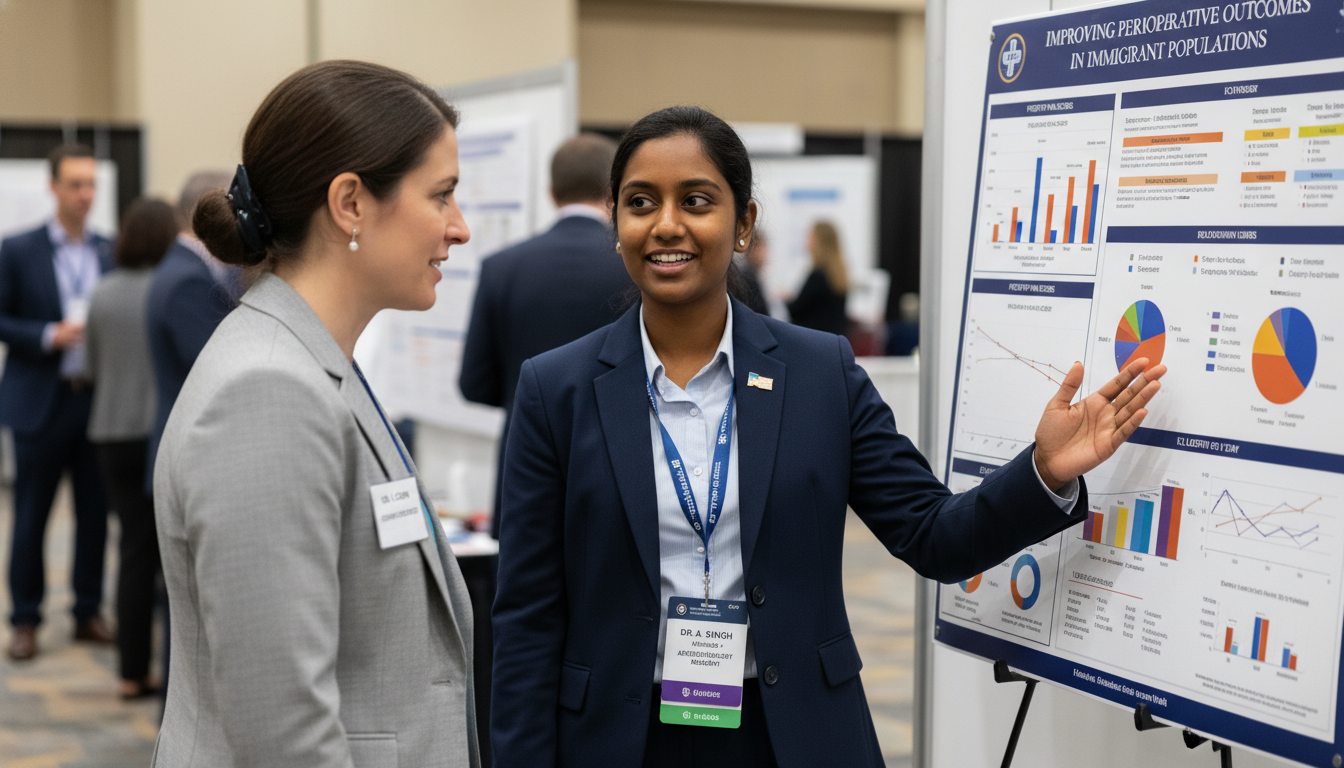
Designing Projects That Lead to Presentations and Publications
To strengthen your CV and future applications:
Think “abstract + manuscript” from the start
- Ask your mentor:
- “Is this project likely to be publishable?”
- “Where do you think we could submit this (journal or meeting)?”
- Ask your mentor:
Target relevant anesthesiology venues
- Conferences:
- ASA (American Society of Anesthesiologists)
- IARS, SCA, ASRA, SCCM, SPA depending on your niche
- Journals:
- Anesthesiology, Anesthesia & Analgesia, British Journal of Anaesthesia, Regional Anesthesia & Pain Medicine, specialty society journals, quality and safety journals
- Conferences:
Document your progress
- Keep updated copies of:
- Accepted abstracts (with final title and author list)
- Posters and slides
- Accepted journal articles and DOIs
- This will be crucial when completing fellowship or job applications.
- Keep updated copies of:
Authorship and Academic Etiquette
As an IMG, be aware of expectations around authorship:
- Authorship is based on meaningful intellectual contribution, not just simple tasks.
- Discuss authorship order early and revisit if roles change.
- Understand the International Committee of Medical Journal Editors (ICMJE) recommendations on authorship.
If you are putting in major effort (conceptualizing, designing, analyzing, drafting), you should appropriately seek first authorship on at least some of your resident research projects.
Resident Research Projects That Stand Out for Anesthesiology
Examples of high-impact research during residency:
- Perioperative outcomes:
- Large database study on postoperative pulmonary complications in obese patients receiving different ventilation strategies.
- ERAS and efficiency:
- QI project that led to reduced PACU length of stay via modified pain protocol and regional anesthesia.
- Airway and safety:
- Study on predictors of difficult airway in a specific population and the impact of a pre-op airway screening tool.
Such projects demonstrate not only scholarship but also real-world impact—something fellowship and hiring committees value.
Research Skills That Translate to Long-Term Success
Regardless of where you practice:
- Critical appraisal of the literature
- Understanding basic statistics and methodology
- Presenting complex data clearly (to colleagues, surgeons, patients)
- Writing skills—for publications, protocols, quality reports, and guidelines
These skills strongly differentiate you as an international medical graduate who can bridge clinical care and evidence-based practice.
Planning for an Academic Career and Fellowship as an IMG
Using Residency Research to Build an Academic Track Record
If you’re considering an academic residency track or future faculty role:
Aim for:
- Multiple abstracts at national meetings
- At least 1–2 first-author peer-reviewed papers
- Additional co-authorships on team projects
Get involved beyond the data:
- Participate in journal clubs and help design them
- Join departmental research committees when possible
- Take online or institutional coursework in clinical research methods or biostatistics
Positioning Yourself for Competitive Fellowships
Fellowship directors in critical care, cardiac, pediatric, and pain anesthesiology value research during residency. As an IMG:
Align your projects with your desired fellowship
- Critical care: outcomes in septic shock, ventilator strategies, ICU QI initiatives
- Cardiac: perioperative anticoagulation, hemodynamic management in cardiac surgery
- Pain: chronic pain registries, interventional outcomes, opioid-sparing strategies
- Pediatric: pediatric airway research, emergence delirium, pediatric regional analgesia
Use your CV strategically
- Create a “Research and Scholarly Activity” section:
- Peer-reviewed articles
- Conference abstracts and presentations
- QI initiatives with measurable outcomes
- Highlight your role and impact, not just the titles.
- Create a “Research and Scholarly Activity” section:
Secure strong letters of recommendation
- From research mentors who can attest to:
- Your independence and initiative
- Your ability to learn complex methods
- Your professionalism and reliability
- From research mentors who can attest to:
Long-Term Pathways for IMGs in Anesthesiology Research
If you are strongly research-oriented:
Consider:
- Post-residency research fellowships
- Combined clinical-research faculty tracks
- Additional degrees (e.g., MS in Clinical Research, MPH, PhD) if feasible
Look for:
- Departments with protected research time for junior faculty
- Institutional research infrastructure (biostatistics support, grants offices, databases)
Your residency research portfolio is your launching pad into these long-term academic residency track options.
Common Pitfalls and How IMGs Can Avoid Them
Pitfall 1: Overcommitting to Too Many Projects
- Symptom:
- You have 5–7 ongoing projects but few completed products (no abstracts or publications).
- Cure:
- Prioritize 1–2 high-yield projects and explicitly pause or defer the rest.
- Use a project tracking spreadsheet to assess:
- Stage (idea, IRB, data collection, analysis, writing, submission)
- Likelihood of completion within residency.
Pitfall 2: Lack of Early Planning
- Symptom:
- Starting serious research only in CA-3 year, leaving little time to publish.
- Cure:
- Begin exploring and joining research during residency in PGY-1 or CA-1.
- Aim to have at least one project underway by mid CA-1.
Pitfall 3: Communication Gaps With Mentors
- Symptom:
- Long periods of inactivity, missed opportunities, misunderstandings about responsibilities.
- Cure:
- Schedule regular check-ins and send brief email updates.
- Clarify expectations about timelines and deliverables.
Pitfall 4: Underestimating IRB and Administrative Timelines
- Symptom:
- IRB approval or data access delays make you miss conference submission deadlines.
- Cure:
- Start IRB process early.
- Work with research coordinators who know your institution’s system.
- Always check abstract deadlines months in advance.
Pitfall 5: Not Showcasing Your Work
- Symptom:
- You have done solid QI or research but do not present or publish it.
- Cure:
- Present locally first (department research day), then regionally or nationally.
- Convert QI projects into abstracts and, where appropriate, formal manuscripts.
FAQs: Research During Residency for IMGs in Anesthesiology
1. Do I need research during residency to get a good anesthesiology job as an IMG?
Not necessarily, but it helps. For purely private practice roles, strong clinical skills and references often matter more than publications. However, research during residency can:
- Strengthen your overall profile
- Provide a safety net if your career goals change
- Support visa or academic opportunities that value scholarly output
If you aim for academic positions, competitive fellowships, or an academic residency track, research becomes particularly important.
2. I did research in my home country. Will that still help me in the U.S.?
Yes, especially if you have peer-reviewed publications. However:
- U.S. programs often value recent and U.S.-based research more highly because it shows your integration into their system.
- Try to build at least some research experience within your U.S. residency: join local projects, attend U.S. conferences, and collaborate with your new department.
3. What if I have no prior research experience and feel intimidated?
You can absolutely start from zero during residency:
- Begin with small, well-scoped projects (retrospective chart reviews, structured QI projects).
- Ask mentors for guidance on basics—literature reviews, data collection, simple statistics.
- Use institutional resources: research workshops, librarian support, biostatistics consultations. Many successful anesthesiology faculty started research only during residency.
4. How many publications should I aim for by the end of residency as an IMG?
There is no strict number, but realistic and helpful targets are:
- For a fellowship- and academics-oriented path:
- 1–2 first-author publications
- Several abstract presentations and possible co-authorships
- For a primarily clinical/private practice path:
- 1 meaningful project that leads to at least a conference presentation or publication
Focus on quality, clear roles, and completion rather than chasing a high count of unfinished projects.
- 1 meaningful project that leads to at least a conference presentation or publication
Research during residency is not just an optional add-on for international medical graduates in anesthesiology; it is a strategic tool that can transform your career trajectory. By understanding the types of projects available, setting realistic goals, identifying strong mentors, managing your time wisely, and converting work into tangible scholarly products, you can build a compelling academic and clinical profile that opens doors long after residency.