Understanding Research During Interventional Radiology Residency as an IMG
For an international medical graduate (IMG) entering or aiming for interventional radiology (IR), research during residency is not a luxury—it is a strategic necessity. Interventional radiology is a rapidly evolving, highly academic specialty. Devices, techniques, and indications change quickly, and programs increasingly expect residents and fellows to contribute to the evidence base.
This IMG residency guide focuses on how to navigate research during residency in interventional radiology: what counts as meaningful research, how to start even if your background is limited, how to balance service with scholarship, and how research can support an academic residency track, future IR match competitiveness (for early-stage candidates), and long-term career growth.
While the emphasis is on IMGs in IR, much of the advice applies broadly to any trainee entering a research-oriented residency or integrated IR/DR program.
Why Research Matters So Much in Interventional Radiology for IMGs
Interventional radiology has a strong culture of innovation. Almost everything you do clinically—ablation, embolization, complex venous work, interventional oncology—was once a research project. Programs know this and look for residents who understand and value research.
Key reasons research is critical in IR residency (especially for IMGs)
Academic credibility and career flexibility
- Research productivity (abstracts, posters, publications) gives you academic credibility in a field where many leaders are prolific researchers.
- Even if you’re not sure you want an academic career, having research experience keeps the door open for future academic residency track or faculty roles.
Stronger candidacy for competitive fellowships and jobs
- For residents in DR who will later apply to an independent interventional radiology residency or IR fellowship, a strong research record in IR-related topics can be a major differentiator.
- Hiring committees look at your ability to critically evaluate data, work in teams, and generate scholarship—all clearly demonstrated through research.
Compensating for “IMG hurdles”
- As an international medical graduate, you may face implicit bias, visa issues, or doubts about the rigor of your prior training.
- A robust portfolio of resident research projects signals that you can perform at or above the level of locally trained peers, regardless of where you went to medical school.
Understanding and shaping emerging IR practice
- IR is full of rapidly changing evidence: new devices for peripheral arterial disease, expanding indications for interventional oncology, evolving thrombectomy criteria, etc.
- Conducting research during residency puts you on the front line of these changes and helps you develop critical appraisal skills that elevate your clinical decision-making.
Networking and mentorship opportunities
- Collaboration on IR match–related or technique-driven studies often pairs resident researchers with program leadership and national figures in IR.
- For IMGs, these relationships can be invaluable for letters of recommendation, career guidance, and visibility within societies like SIR (Society of Interventional Radiology).
Types of Research You Can Do in IR Residency (and How to Start)
Research in interventional radiology is not limited to randomized controlled trials or complex basic science. As a resident, your most realistic and impactful opportunities often come from well-designed clinical and educational projects.
1. Clinical research (retrospective and prospective studies)
These are the backbone of IR scholarship.
Examples:
- Retrospective outcomes of TACE vs Y90 for hepatocellular carcinoma at your institution
- Complication rates after percutaneous gastrostomy in head and neck cancer patients
- Technical success and short-term outcomes of complex IVC filter retrievals
- Longitudinal patency rates after iliac venous stenting with different techniques
Actionable steps:
Identify a feasible project
- Ask IR faculty: “Do you have any database or ongoing project where a resident could help and take ownership?”
- Look for areas where your department has volume and data: interventional oncology, PAD, venous disease, dialysis access, trauma.
Start small and concrete
- A single-center retrospective study with clear inclusion criteria is a good starting point.
- Focus question: one population, one intervention, clear primary endpoint (e.g., technical success, complication rate, survival, readmission).
Learn the research workflow early
- IRB basics (more on this below)
- Data extraction from PACS and EMR
- Proper de-identification and data storage
- Statistical planning with a mentor or biostatistician
2. Case reports and case series
For IMGs newer to research, this can be the entry point into IR scholarship.
Good candidates:
- Rare or novel procedures (e.g., unusual embolization target, creative approach to complex anatomy)
- Unexpected complications with important teaching points
- Off-label use of a device with a strong rationale
How to approach:
- Ask your attendings whenever you see an unusual case: “Is this publishable?”
- Collect images and clinical details as the case unfolds, not months later.
- Follow the CARE guidelines for case reports to structure your manuscript.
Case reports won’t build your career alone, but several well-written ones—especially if presented at meetings—help demonstrate engagement and can lead to more substantial projects.
3. Educational and curriculum research
Residency education itself is a fertile area, particularly relevant if you’re interested in an academic residency track.
Examples:
- Evaluating the impact of a new IR simulation-based bootcamp for residents
- Studying how an IR consult service affects residents’ understanding of patient selection
- Analyzing the effectiveness of flipped-classroom modules vs traditional lectures for IR anatomy
For IMGs:
- You may have unique perspectives on teaching procedural skills, imaging interpretation, or cross-cultural communication.
- Consider resident research projects that address gaps you personally experienced (e.g., resources for non-native English speakers, or tools to understand U.S. healthcare systems).
4. Quality improvement (QI) projects
Many residency programs require QI; you can align QI with IR research questions.
Sample QI topics in IR:
- Reducing contrast dose in high-risk CKD patients for IR procedures
- Improving pre-procedural anticoagulation management pathways
- Standardizing post-embolization pain control protocols
- Decreasing time from consult to procedure for emergent GI bleeds
Some QI projects can be written up as research papers or conference abstracts if rigorously designed and analyzed.
5. Basic science, translational, and device development
These are more challenging to start during residency but can be a great fit if:
- Your institution has strong IR or radiology research labs.
- You have prior bench research experience and want to continue.
- You’re considering a physician-scientist track.
Examples:
- Animal models of drug delivery in interventional oncology
- Biomechanical analysis of new stent or catheter designs
- Radiomics or AI-based prediction models for IR outcomes
For IMGs, working in a translational lab can strengthen your CV significantly, but you must plan early because these projects often take longer and require more protected time.
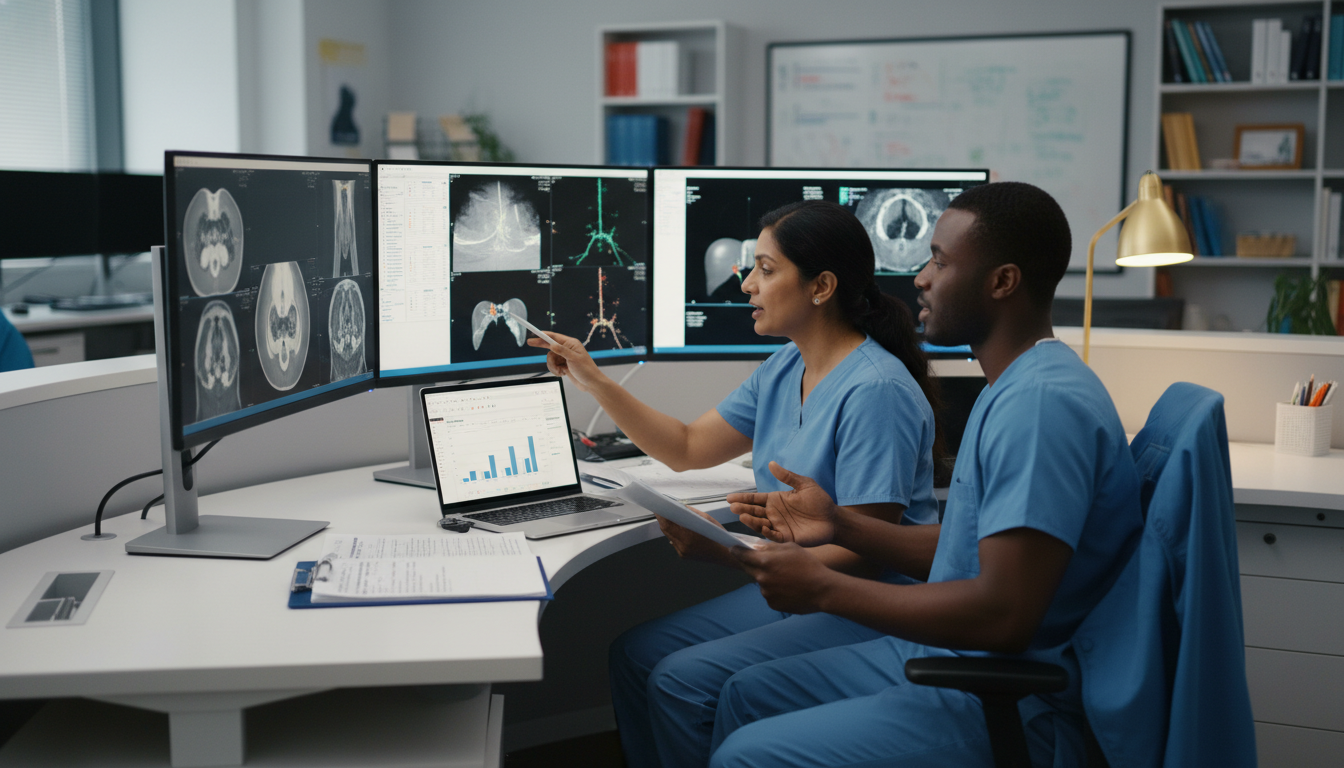
How to Find Mentors, Projects, and an Academic Track as an IMG
Mentorship and environment are the main determinants of research success in residency. This is even more true for IMGs who may be less familiar with the U.S. academic system.
Identifying the right mentors in IR
Look for faculty who:
- Actively publish in reputable IR or radiology journals
- Present regularly at SIR, RSNA, CIRSE, or other national meetings
- Are involved in resident research projects already
- Have a track record of helping trainees get first-author publications
When you approach them:
Be specific:
- Instead of “Can I do research with you?”, ask:
- “I’m very interested in interventional oncology and have limited prior research experience. Do you have a specific project where I can contribute data collection and writing, ideally with a clear path to authorship?”
Show commitment:
- Mention any prior work or skills (e.g., statistics, programming, or writing).
- Make it clear you’re willing to retain ownership and follow through.
Clarify expectations early:
- Target timeline for abstract submission or manuscript
- Your role in data collection, analysis, and writing
- Authorship order and criteria
Leveraging formal structures: Academic residency tracks
Many radiology and IR programs offer an academic residency track or research pathway. These structures can provide:
- Protected research time
- Formal mentorship committees
- Access to institutional research funds or biostatistics support
- Clear expectations for scholarly output
As an IMG, ask programs these targeted questions:
- “Does your IR/DR program have an academic residency track or dedicated research pathway?”
- “How many months of protected research time are available, and in which years?”
- “In the last five years, how many residents were first author on IR publications or SIR abstracts?”
Even if your program does not have a formal track, you can often negotiate:
- Elective blocks dedicated to research
- Combined IR/DR and research rotations
- Time to attend conferences and present your work
Building a research network beyond your home program
To overcome limited local opportunities, IMGs can expand into regional, national, or international collaborations:
Society of Interventional Radiology (SIR):
- Join early as a trainee member.
- Explore resident and fellow sections, research committees, and mentorship programs.
- Volunteer for multi-institutional resident research projects or registries.
Multi-center collaborations:
- Ask your mentors whether the division is part of clinical trials or registries you can help coordinate or analyze.
- Multi-institution data tends to be more publishable and higher impact.
Online platforms:
- Research networks, academic Twitter/X, and LinkedIn can connect you with IR researchers seeking help with systematic reviews or data analysis (approach carefully and professionally).
Practical Workflow: Balancing Research with a Busy IR Residency
Time is the main obstacle to research during residency. IR call, long procedure days, consults, and reading room duties can easily consume your schedule. The solution is not to “wait for a lighter rotation” but to build a sustainable system from the start.
Step 1: Start with a realistic portfolio
At any given time, aim for:
- 1–2 main projects that you are actively moving toward publication
- 1–2 smaller or collaborative tasks (e.g., data extraction for someone else’s project, a case report, or a review article)
Too many simultaneous projects often mean none get finished.
Step 2: Protect micro-blocks of time
- Reserve 2–4 hours per week specifically for research (e.g., one evening, one weekend morning).
- Use short windows (20–40 minutes) for discrete tasks:
- Extracting 5–10 patient records
- Editing 2–3 paragraphs of a manuscript
- Responding to co-author comments
Step 3: Use structured tools
- Project tracker:
- A simple spreadsheet or Trello/Notion board listing project title, mentor, your role, current stage, next task, and deadline.
- Standardized data collection forms:
- Use REDCap or secure institutional databases whenever possible to avoid messy, inconsistent spreadsheets.
- Writing templates:
- Keep templates for IMRAD (Introduction, Methods, Results, Discussion), case reports, and abstracts.
- Use previously accepted abstracts or papers from your department as a model (without copying text).
Step 4: Understand IRB and ethics
Many IMGs are unfamiliar with the U.S. Institutional Review Board process.
Activities needing IRB review:
- Prospective clinical research
- Retrospective chart reviews where you intend to publish
- Many QI projects if they cross into research territory
Your action plan:
- Ask your mentor to walk you through one IRB submission early in residency.
- Learn the difference between exempt, expedited, and full-board review.
- Do not collect data for publication without IRB clearance if required.
Step 5: Learn basic statistics and study design
You do not need to become a biostatistician, but you should understand:
- Common study designs (cohort, case-control, cross-sectional, randomized)
- Basic measures (odds ratios, hazard ratios, sensitivity/specificity)
- P-values, confidence intervals, and simple regression concepts
Many academic centers offer short courses or online modules; complete at least one. As an IMG, strengthening this “language” quickly improves your confidence in academic discussions.
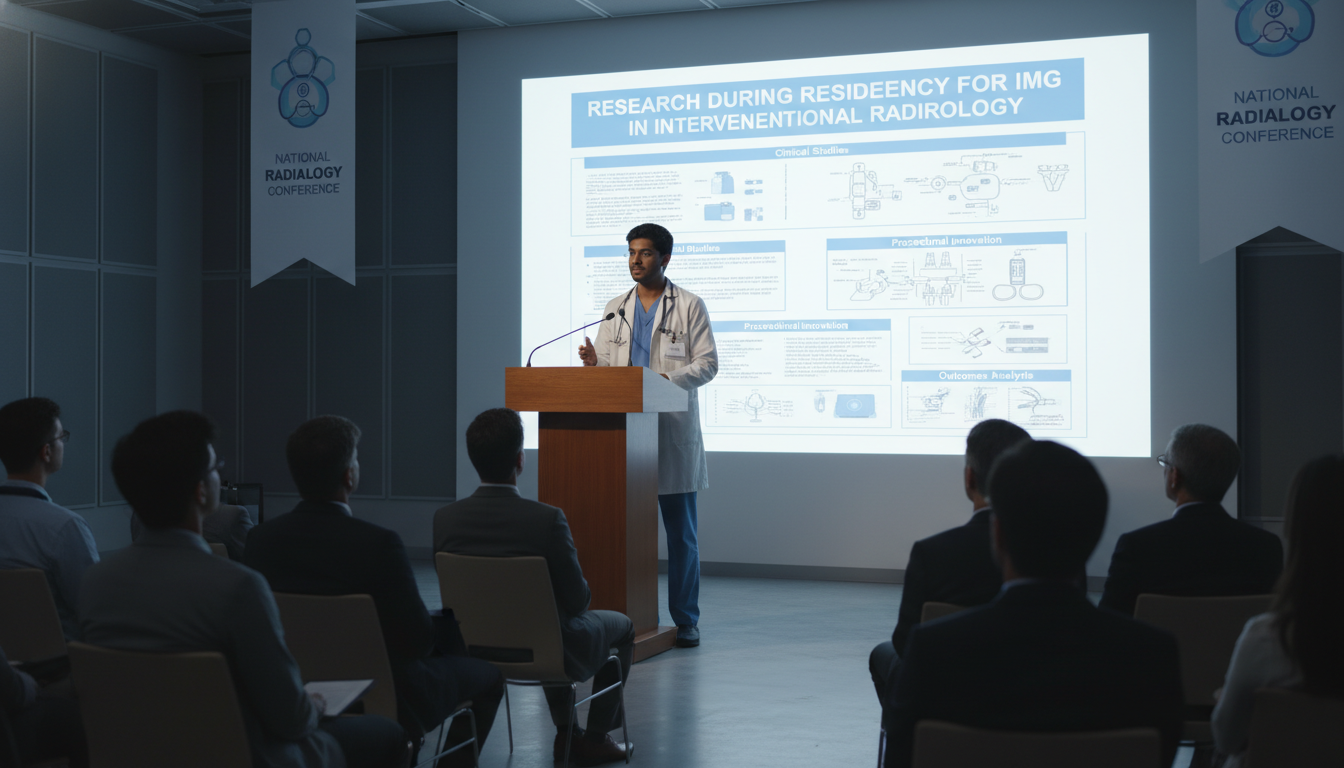
Turning Resident Research Projects into Presentations and Publications
Doing research is only half the journey; dissemination is what makes it count for your career.
Abstracts, posters, and oral presentations
Key IR and radiology venues:
- Society of Interventional Radiology (SIR) Annual Scientific Meeting
- RSNA (Radiological Society of North America)
- Regional IR or DR societies (e.g., state chapters, specialty meetings)
- Institutional research days or graduate medical education symposia
Strategy:
- Time your projects to abstract deadlines.
- Ask your mentor which meetings are realistic and beneficial.
- Practice elevator pitches: be ready to summarize your study in 1–2 minutes.
Presenting, even a poster, enhances your CV, allows networking, and often leads to manuscript development.
Manuscripts and choosing the right journal
When writing up your study:
- Match your paper to the right tier of journal. For example:
- High-impact IR journals for robust, novel IR studies
- More specialized or regional journals for small series, educational studies, or QI work
For each paper, clarify:
- Target journal before finalizing the format and references
- Authorship order, acknowledging your contributions clearly
- Timelines for revision and resubmission if rejected (common and normal)
Addressing common IMG-specific challenges in publication
Language and writing style:
- If English is not your first language, consider:
- Writing the full draft, then asking a co-author to help polish language.
- Using institutional writing resources or editorial services (where available).
- Focus on clarity, structure, and logic rather than overly complex phrasing.
- If English is not your first language, consider:
Imposter feelings:
- Many IMGs assume “everyone else knows research better.” They don’t.
- The best way to overcome this is repeated exposure: serve as co-author on a few projects, then lead one as first author once you understand the process.
Limited early opportunities:
- If your IR division is small, look to:
- Cross-collaboration with vascular surgery, oncology, hepatology, or neurology for IR-adjacent projects
- Multidisciplinary tumor boards as a source of ideas for interventional oncology research
- If your IR division is small, look to:
How Residency Research Supports Your Long-Term IR Career
Research during residency is more than “checking a box” for your CV. For an international medical graduate in interventional radiology, it can shape your trajectory in multiple ways.
If you aim for an academic interventional radiology career
- Your track record of research during residency will be scrutinized when you apply for faculty positions, grants, and leadership roles.
- Demonstrated progress—from case reports to retrospective analyses to multi-center or funded studies—tells hiring committees that you can grow as a clinician-investigator.
- Publishing on resident education or curriculum design can position you for associate program director or program director roles later.
If you lean toward private practice IR
- Strong research experience signals that you bring more than procedural skills; you bring innovation and quality improvement.
- You’ll be better positioned to:
- Lead protocol development and service-line expansions
- Evaluate technology pitched by vendors
- Contribute to registries and outcomes tracking that differentiate your practice
If you foresee visa or geographic constraints
- Solid research credentials provide flexibility if clinical opportunities are temporarily limited.
- Post-residency research fellowships or academic appointments might be smoother paths for some IMGs needing specific visa sponsorships.
- Contribution to multi-center IR projects increases your professional network across institutions and even countries.
FAQs: Research During IR Residency for IMGs
1. I have almost no prior research experience. Can I still build a strong portfolio during residency?
Yes. Many successful IR physicians started with minimal experience. Focus on:
- Joining 1–2 active projects as a contributor (data collection, basic analysis) to learn the process.
- Completing at least one project where you are first author, even if it’s a retrospective study or robust case series.
- Using each project to build skills: IRB basics, data handling, writing, and presentation.
Consistency and completion matter more than doing something “huge” in PGY-2.
2. How many publications should I aim for during residency?
There is no universal number, but for an IMG in a research-friendly environment, a reasonable goal across a 4–5 year DR/IR pathway might be:
- 1–3 first-author publications or significant abstracts in IR or related fields
- Additional co-authorships on collaborative projects
- Regular presentations at local or national meetings
The quality and relevance to IR are more important than raw count.
3. What counts more—clinical IR research or basic science?
For most interventional radiology careers, clinical research has the most immediate impact and visibility:
- Outcomes in interventional oncology
- Peripheral vascular interventions
- Venous disease, trauma, dialysis access, etc.
Basic or translational science can be extremely valuable if you’re aiming for a physician-scientist or device-development career, but it usually requires further commitment (e.g., dedicated research years, postdoc time). As an IMG, starting with clinical research is generally more feasible and directly relevant to everyday IR practice.
4. How can I show research interest if I’m still an IMG abroad applying for IR-related training in the U.S.?
If you’re early in the pipeline and still outside the U.S.:
- Seek any IR-related or imaging-based projects at your home institution (case reports, small chart reviews, or educational projects about IR awareness).
- Collaborate remotely if you have contacts in U.S. or European centers; offer help with data extraction, literature reviews, or preliminary manuscript drafting.
- Attend virtual IR conferences or webinars, participate actively, and document this experience in your application.
- Emphasize how your early work led you to pursue an interventional radiology residency and solidified your commitment to evidence-based practice.
By approaching research during residency with intentionality, structure, and the right mentorship, an international medical graduate can transform potential disadvantages into clear strengths. In interventional radiology, where innovation and evidence drive nearly every clinical decision, your research contributions will not only distinguish you as a trainee—but also shape the future of the specialty you’re joining.