Understanding Research During a Preliminary Surgery Year as an IMG
For an international medical graduate (IMG), a preliminary surgery year can feel like a sprint: high clinical workload, new healthcare system, visa and licensing worries, and the pressure of planning the next career step. Adding research during residency to that mix may seem overwhelming—but it can be one of the most powerful levers to move your career forward.
Whether your goal is to reapply to categorical general surgery, shift to another specialty (e.g., anesthesia, radiology, IM), or pursue an academic residency track, strategically chosen and well-executed resident research projects can clearly differentiate you from other applicants.
This IMG residency guide will walk you through:
- What “research during a prelim surgery residency” realistically looks like
- How to find and choose the right research opportunities
- How to be productive with limited time and resources
- How to showcase your work effectively for future applications
- Common pitfalls IMGs face and how to avoid them
Throughout, the focus is on actionable steps tailored to IMGs in a preliminary surgery year, where every month counts.
1. Why Research Matters for IMGs in a Preliminary Surgery Residency
1.1 Unique challenges for IMGs in prelim surgery
As an international medical graduate in a prelim surgery residency, you face a distinct set of challenges:
- Limited job security: Most preliminary spots are 1-year contracts with no guarantee of continuation.
- Fewer institutional ties: You may be new to the hospital system and unknown to program leadership.
- Visa and time pressure: You often have only one cycle (sometimes two) to improve your application.
- High clinical workload: Prelim surgery often has some of the heaviest schedules in the hospital.
Despite this, program directors in both surgical and non-surgical specialties often look at whether a candidate:
- Used their year productively
- Demonstrated intellectual curiosity and academic potential
- Showed commitment to a specialty (or at least coherent career goals)
Research can help you answer “yes” to all three.
1.2 How research strengthens your profile as an IMG
For IMGs, strong US-based research can be a differentiator, especially when Step scores and grades are similar across applicants. Research can:
Show engagement in academic medicine
Particularly for university-affiliated or university-based programs that value publication and scholarship.Demonstrate persistence and initiative
Starting and finishing projects while working a demanding clinical schedule reflects excellent work ethic and time management.Provide strong letters of recommendation
Research mentors who know you well can write detailed, specific letters that stand out.Document your contributions in a measurable way
Abstracts, posters, oral presentations, and publications become concrete achievements listed on your ERAS application.Support a shift to a different specialty
If you discover that categorical general surgery is not realistic or not desired, focused research (e.g., in critical care, cardiology, radiology, anesthesia, emergency medicine) can help reposition your application.
2. Types of Research Opportunities During a Prelim Surgery Year
Not all resident research projects require protected time or a formal research track. In a busy preliminary surgery year, the most realistic opportunities are usually:
2.1 Case reports and case series
Why they’re ideal for prelim residents:
- Fast turnaround (weeks to a few months)
- Directly connected to your daily clinical work
- Good entry point if you’ve never published in the U.S. system
Common surgical examples:
- Rare postoperative complications
- Unusual presentations of common conditions
- Innovative or non-standard management approaches
- Interesting imaging correlated with intraoperative findings
How to capitalize:
- Keep a running list of “interesting cases” (HIPAA-compliant, no identifiers).
- When you encounter something unusual, ask:
“Has anyone published something similar? Could we write this up as a case report?” - Approach your chief resident or attending:
“Dr. Smith, this patient seems unique because of X, Y, Z. Would you be open to working on a case report together?”
Case reports may not be as heavily weighted as original research, but they’re realistic and help you build momentum.
2.2 Retrospective chart reviews
Retrospective chart reviews are often the most practical form of research during residency for busy prelim residents.
Examples in a surgical department:
- Outcomes of laparoscopic vs. open procedures for a specific indication
- Readmission rates after a particular operation
- ER consults for acute appendicitis and factors predicting perforation
- Postoperative pain control strategies and length of stay
Why these projects work well for IMGs:
- Data is already in the electronic health record (no patient recruitment needed).
- Can often be completed with flexible hours (e.g., evenings, post-call).
- Multiple residents and students can share the workload.
You’ll need:
- A mentor/PI (attending or senior faculty)
- IRB approval (institutional review board)
- A clearly defined question and data points to collect
These projects, if well-designed, can lead to posters and sometimes full manuscripts.
2.3 Quality improvement (QI) and patient safety projects
Many programs emphasize QI and may even require residents to complete such a project.
Examples:
- Reducing central line–associated bloodstream infections in the SICU
- Standardizing perioperative antibiotic prophylaxis
- Improving DVT prophylaxis compliance on surgical floors
- Decreasing time to OR for appendicitis in the ED-surgery workflow
QI projects are often more feasible than traditional clinical research because:
- They are directly linked to patient care and hospital initiatives.
- They sometimes don’t require full IRB review (depending on your institution).
- They can be presented at hospital QI days or local/regional conferences.
For an academic residency track, QI projects plus a related publication or abstract show you understand systems-based practice and improvement science.
2.4 Basic science and translational research (with caution)
Basic science projects during a prelim surgery year are more challenging:
- Lab timelines are long (often 1–2 years for meaningful output).
- You rarely have protected time.
- You may not be familiar with the techniques or institutional systems.
However, if you already have lab experience or if a lab is actively seeking resident help with data analysis or manuscript preparation, you might contribute to:
- Data interpretation
- Literature reviews
- Co-authoring a paper or review article
If your goal is a highly research-heavy academic residency track, a connection with a lab can be helpful, but only if timelines are realistic for your 1-year prelim position.
2.5 Database and collaborative multi-center projects
Some surgical departments participate in:
- National or regional databases (e.g., NSQIP, institutional surgery registries)
- Multi-center resident research collaboratives
These can be a good fit for IMGs:
- Data sets are often already collected.
- Analysis and manuscript writing can be done on your own time.
- Being part of a collaborative signals you can function in a larger academic network.
3. Finding and Securing Research Opportunities as an IMG
3.1 Start early—within the first 4–6 weeks
Your preliminary year moves quickly. Applications for the next cycle open early in PGY-1. Ideally:
- Begin searching for research opportunities within your first month or two.
- Aim to have at least one ongoing project by the middle of the year.
- Target concrete outputs (poster/presentation/abstract) before ERAS submission.
If your match cycle is already coming up, focus on smaller, more achievable projects like case reports, QI, and retrospective studies with near-complete data.
3.2 Mapping the research landscape at your program
Systematically learn where the research lives in your institution:
Check the department website
- Look at faculty profiles and recent publications.
- Identify faculty whose work aligns with your interests (surgery subspecialties, ICU, trauma, outcomes research, etc.).
Ask senior residents and fellows
- “Which attendings are good for resident research projects?”
- “Who usually has data sets that need analysis or papers to finish?”
Look for institutional resources
- Office of research or GME scholarly activity coordinators
- Biostatistics or clinical research core labs
- Resident research seminars or QI committees
Attend conferences and grand rounds
- Listen for ongoing projects that might need help.
- Introduce yourself briefly after talks.
3.3 How to approach potential research mentors
As an IMG, you may feel hesitant approaching faculty, but this is normal and expected in U.S. training. A clean, professional approach works best.
Example email template:
Subject: PGY-1 Prelim Surgery Resident Interested in Assisting with Research
Dear Dr. [Last Name],
My name is [Your Name], and I’m a PGY-1 preliminary surgery resident in the Department of Surgery. I have a strong interest in [specific area – e.g., acute care surgery, surgical outcomes research], and I noticed your work on [brief reference to one of their recent papers or projects].
I’m very interested in becoming involved in ongoing resident research projects and would be grateful for the opportunity to assist with data collection, chart review, literature review, or manuscript preparation. I understand the demands of a surgery schedule and am prepared to work efficiently during evenings and post-call time.
Would you be available for a brief meeting to discuss whether there might be a role for me on one of your projects?
Thank you for your time and consideration.
Sincerely,
[Your Name], MD
PGY-1 Preliminary Surgery Resident
[Institution]
Tips:
- Be specific: show you’ve read at least one of their articles.
- Emphasize reliability and willingness to do the “unpopular” tasks (data entry, chart review).
- Don’t overstate your experience; instead, emphasize that you are eager and teachable.
3.4 Choosing the right mentor for your situation
For an IMG in a busy prelim year, mentor selection can make or break your efforts.
Look for:
Track record of publishing with residents
Have prior residents under them produced abstracts and papers?Clear communication style and expectations
You want someone who outlines realistic timelines and roles.Willingness to support your next application cycle
Ask directly: “If we work closely together, would you be open to writing me a detailed letter of recommendation for my next application?”Alignment with your long-term goals
If you hope to continue in surgery, mentors in general surgery or surgical subspecialties are ideal; if you’re considering switching specialty, a research link in your target field is very valuable.
4. Executing Research Efficiently with a Heavy Clinical Schedule
4.1 Time management strategies that actually work
Your biggest constraint during a preliminary surgery year is time. To be productive:
Block micro-sessions
- 25–45 minutes of focused work post-call or in the evening.
- Use techniques like the Pomodoro method to stay concentrated.
Create a weekly research schedule
Example:- Tuesday evening: 1 hour for data extraction
- Thursday post-call: 90 minutes bibliography and writing
- Sunday morning: 2 hours manuscript drafting
Use your lighter rotations effectively
- ICU or ward rotations may be slightly more predictable than trauma nights.
- Try to initiate or intensify research during these months.
Batch tasks
- One session for literature search; another for data cleaning; another for actual writing.
4.2 Clarifying scope and realistic goals
Before starting, ask your mentor:
- What exactly is the research question?
- What is the expected timeline?
- What is my role (data collection, analysis, writing, all of the above)?
- What is the target output (poster, abstract, full manuscript)?
- How will authorship be determined?
For a 1-year prelim resident, shorter, well-defined projects are usually more strategic than large, unfocused ones that may never get completed.
4.3 Practical tools and workflows
Reference management:
- Use EndNote, Zotero, or Mendeley to manage citations.
- Install citation plugins for Word or Google Docs so you can insert references instantly.
Data management:
- Learn basic Excel or Google Sheets skills if you don’t already have them.
- For more advanced work, R or SPSS may be used, but this depends on the department.
Writing:
Start with a skeleton:
- Introduction (1–3 paragraphs)
- Methods (structured, clear)
- Results (figure and table outlines first)
- Discussion (key points and limitations)
Write in small pieces:
- One paragraph of Introduction on Monday
- One sub-section of Methods on Thursday
Consistency over perfection is critical.
4.4 Protecting your academic reputation
As an IMG in a new system, your professional reputation is under constant formation. When it comes to research:
Don’t take on more than you can finish
It’s better to complete one strong project than start five and finish none.Communicate early about delays
If your schedule explodes (e.g., trauma rotation), email your mentor:
“This month has been clinically intense; I may be delayed by 1–2 weeks on the next round of data entries. I still plan to finish.”Be meticulous with data and privacy
Never share patient identifiers outside approved channels.
Double-check data accuracy; serious errors can damage trust.Understand authorship ethics
Don’t demand first authorship unless it’s clearly justified and agreed upon early.
Do not list yourself as an author on anything you did not meaningfully contribute to.

5. Translating Research into Career Advancement
5.1 Documenting your research for ERAS and CV
As you progress through your preliminary surgery year, maintain a research log with:
- Project title and brief description
- Your specific role
- Dates of involvement
- Status (in progress, submitted, accepted, published)
- Conference presentations or posters
When you apply for your next match cycle:
- List all research activities in ERAS Scholarly Activities.
- Distinguish between:
- Published/accepted work (with PMID if available)
- Submitted or in-progress projects (clearly labeled as such)
Being transparent is essential; programs are used to seeing “submitted” or “in preparation” entries, but misrepresenting status is unacceptable.
5.2 Building a coherent narrative, especially if changing specialty
If you remain committed to general surgery:
- Emphasize how your research demonstrates your interest in surgical outcomes, perioperative care, or subspecialty fields.
- In your personal statement, connect your prelim surgery residency clinical experiences with your resident research projects.
If you are transitioning to another specialty (e.g., internal medicine, anesthesia, radiology):
Identify the overlap:
- ICU or perioperative outcomes research (relevant to IM, CCM, anesthesia).
- Imaging-heavy projects (relevant to radiology).
- ED-to-OR pathways (relevant to EM).
In your personal statement, show how your surgical year and related research:
- Deepened your understanding of that specialty’s interface with surgery
- Motivated your pivot to a better fit for your skills and interests
Programs value a congruent story, even if you change direction.
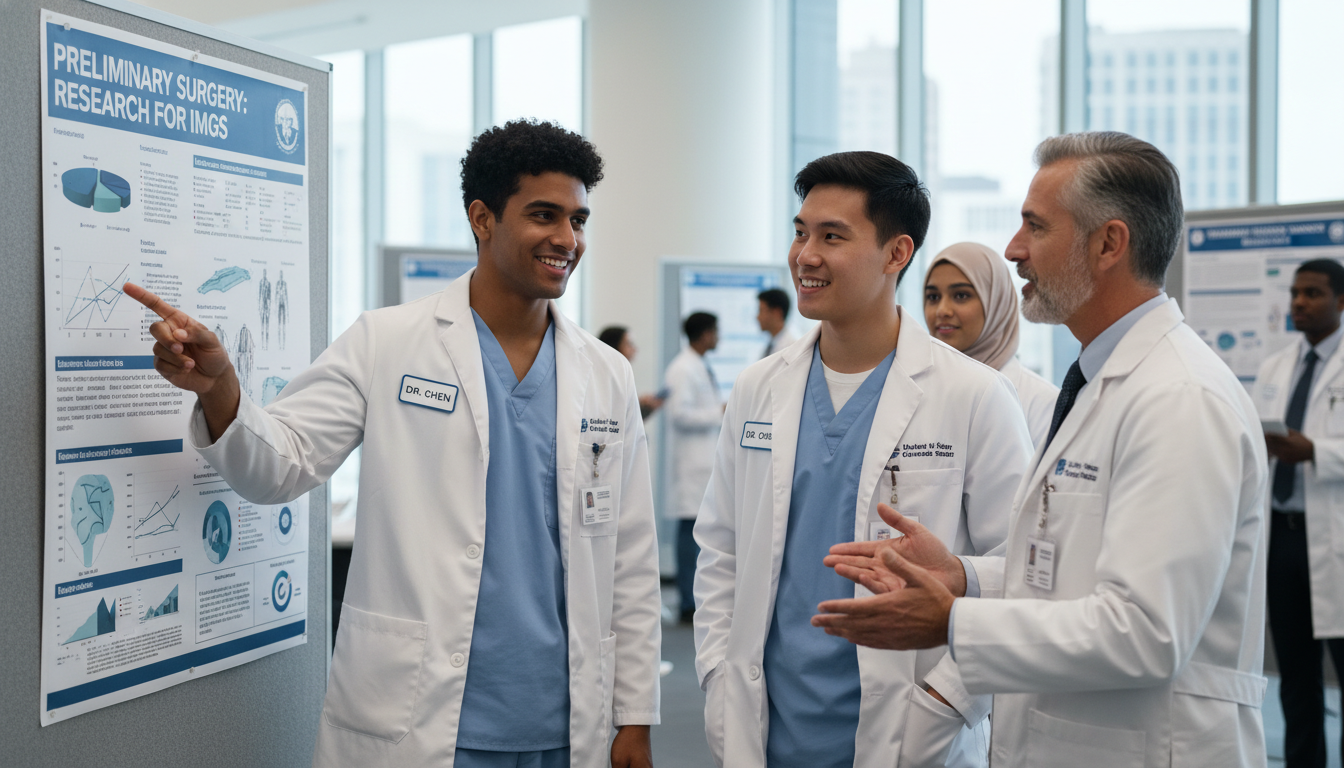
5.3 Maximizing impact through presentations and networking
Presenting your research is often as important as producing it.
- Aim for:
- Hospital research days or QI days
- Regional surgery or specialty society meetings
- National conferences if feasible (e.g., ACS, EAST, trauma meetings, specialty-specific national societies)
At conferences:
Introduce yourself succinctly:
“I’m Dr. [Name], an IMG doing a preliminary surgery year at [Institution], working on [topic]. I’m exploring opportunities in [target specialty or categorical surgery].”Ask for advice:
“Given my background and this project, do you have any suggestions for how I can strengthen my application for [specialty/program type]?”
A single strong mentor interaction or networking contact can meaningfully affect your future trajectory.
5.4 Aligning with an academic residency track
If your goal is clearly an academic residency track (in surgery or another field), prioritize:
- Projects that can reasonably lead to peer-reviewed publications.
- Multi-author collaborations that expose you to academic culture.
- Understanding basics of:
- Study design
- Biostatistics
- Peer review and revision processes
When interviewing, be prepared to discuss:
- The hypothesis and methods of your primary project.
- Limitations and how you would improve the study in the future.
- What you learned about teamwork, ethics, and patient care from doing research.
6. Common Pitfalls and Practical Solutions for IMG Prelim Residents
6.1 Taking on overly ambitious projects
Problem: Large multi-year projects that won’t produce tangible outputs before ERAS.
Solution:
- Combine a “big” project (for long-term potential) with one or two smaller, quickly achievable projects (case reports, QI, retrospective analyses with existing data).
- Clarify expected timelines at the outset.
6.2 Lack of clarity about expectations and authorship
Problem: Confusion about who is first author, or whether your contribution will be acknowledged.
Solution:
- Have an explicit early conversation:
- “If I handle data collection and first draft of the manuscript, would I be considered for first authorship?”
- Document agreements by email to avoid misunderstandings.
6.3 Poor communication due to cultural or language barriers
Problem: As an IMG, you may feel shy about speaking up or asking questions.
Solution:
- Prepare written questions before meetings.
- Use concise, respectful email updates:
- “I have completed data collection on 60 of 120 patients; I plan to finish by [date]. Are there any changes you’d recommend to the data fields?”
Mentors appreciate clarity, not perfection.
6.4 Not leveraging your unique background
Problem: Trying to blend in and downplaying your international experience.
Solution:
Your background can be a strength:
- Global health perspective
- Different clinical exposure
- Bilingual or multilingual skills
Consider projects that connect U.S. data to international patterns or compare approaches, as long as data sources are accessible and ethics are respected.
FAQs: Research During Residency for IMGs in Preliminary Surgery
1. Is it realistic to do research during a busy preliminary surgery year?
Yes—if you choose projects wisely and manage your time strategically. You probably cannot lead multiple large trials, but you can meaningfully contribute to:
- 1–2 case reports or small series
- 1 retrospective chart review or QI project
- Possibly a collaborative or database-based study
The key is to start early, be selective, and commit to finishing what you begin.
2. How many publications do I need to improve my residency chances?
There is no fixed number, and quality matters more than quantity. For an IMG in prelim surgery:
- 1–3 solid, U.S.-based scholarly outputs (posters, abstracts, or papers) can significantly strengthen your application, especially if tied to strong letters.
- A single well-executed project with a strong recommendation letter from a respected mentor can sometimes be more impactful than many minor or low-quality entries.
3. Does research in surgery help if I end up applying to another specialty?
Usually yes, especially if:
- The topic overlaps with that specialty (e.g., ICU, perioperative medicine, pain management, imaging, trauma systems).
- You can clearly explain the relevance and what you learned that applies to the new field.
Program directors value evidence that you can think critically, contribute academically, and complete scholarly work—traits that are transferable across specialties.
4. I have no prior research experience. How do I start without feeling lost?
Begin with small, structured steps:
- Tell your chief residents and attendings you’re interested in research.
- Ask if you can help on an existing project with well-defined tasks (data collection, literature review).
- Read a few recent review articles on your topic to build background knowledge.
- Ask your mentor or co-residents to show you how to structure a case report or retrospective study.
Your first project is rarely perfect; the important thing is to learn the process, contribute reliably, and build from there.
By approaching research with a clear strategy, realistic expectations, and strong mentorship, an international medical graduate in a prelim surgery residency can turn a challenging year into a powerful platform for career advancement—whether toward categorical surgery or another long-term specialty home.