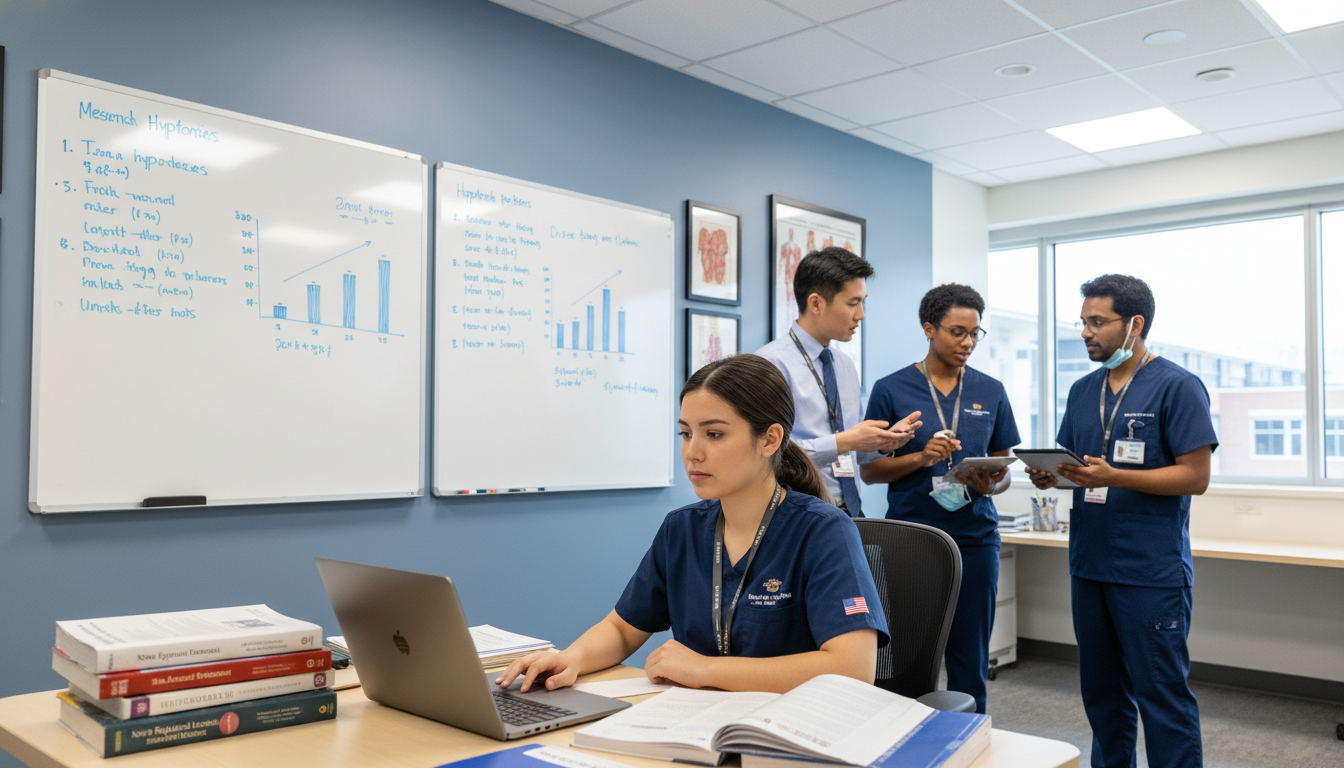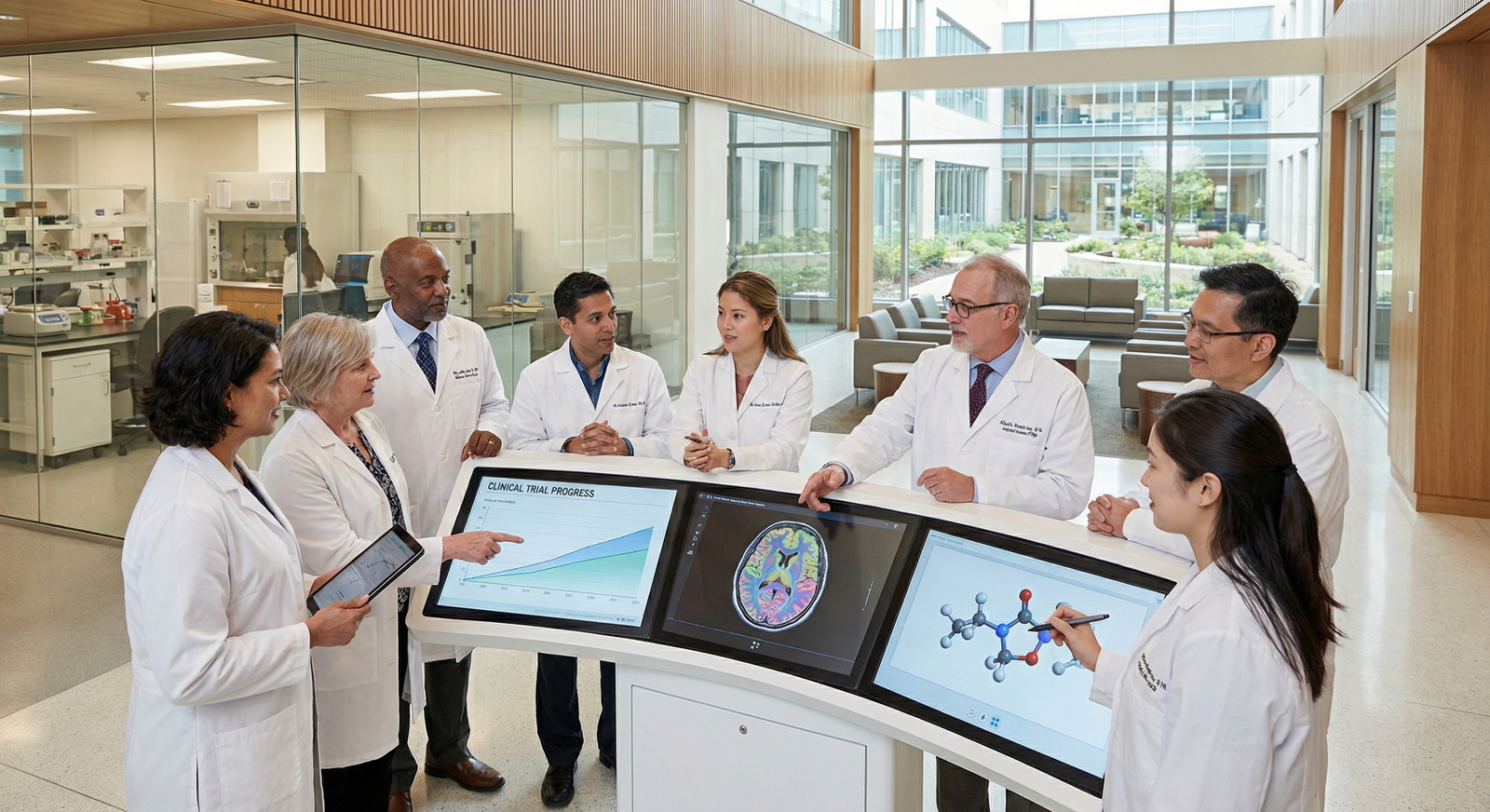
Why Research During Urology Residency Matters for IMGs
For an international medical graduate (IMG) entering urology residency, research can feel like one more item on a long list of challenges—visa issues, cultural adaptation, clinical learning, exams, and language barriers. Yet, research during residency is one of the most powerful levers you can pull to shape your career in urology.
Whether you see yourself in private practice or on an academic residency track, research offers:
- Credibility in a competitive field like urology
- Visibility among program leadership and national societies
- Career flexibility (fellowships, academic positions, industry roles)
- Skill-building in critical appraisal, statistics, and scientific writing
- Networking that can offset the disadvantage many IMGs feel in the urology match and beyond
This IMG residency guide focuses specifically on how to do effective research during residency as an international medical graduate in urology—practically, strategically, and sustainably.
Understanding the Research Landscape in Urology Residency
The Role of Research in Modern Urology
Urology is a rapidly evolving specialty: robotics, minimally invasive surgery, molecular diagnostics, focal therapies, and artificial intelligence are transforming practice. Residency programs increasingly emphasize:
- Evidence-based practice and guideline-directed care
- Quality improvement (QI) and patient safety initiatives
- Clinical trials and outcomes research
- Translational research (from bench to bedside)
- Health services and disparities research
For IMGs, understanding how your program fits into this research ecosystem is a critical first step.
Types of Urology Research You May Encounter
You don’t have to be in a basic science lab to do meaningful research. Common categories of resident research projects in urology include:
Clinical Research
- Retrospective chart reviews (e.g., outcomes after robotic prostatectomy)
- Prospective observational studies (e.g., complications after stone surgery)
- Clinical trials (drug or device studies)
Translational / Basic Science
- Animal models of bladder cancer
- Molecular markers in kidney tumors
- Biomaterials for reconstructive urology
Outcomes, Health Services, and Disparities
- National database analyses (NSQIP, SEER, NIS)
- Access to prostate cancer screening among underserved populations
- Cost-effectiveness of different BPH treatments
Quality Improvement (QI)
- Reducing catheter-associated UTIs
- Standardizing perioperative antibiotic use
- Improving postoperative pain management pathways
Educational Research
- Simulation-based training in ureteroscopy
- Assessment tools for resident operative performance
- Curriculum innovations for teaching urologic oncology
For an IMG, clinical and outcomes research are often the most accessible types, especially early in residency, because they depend more on data analysis and collaboration than on lab infrastructure.
Expectations: What Programs Look For
Expectations vary widely:
- Community-based programs
- May have limited infrastructure but welcome resident-led clinical or QI projects.
- Academic programs
- Often have formal resident research requirements, protected time, and established mentorship structures.
- Highly research-oriented programs
- Can expect you to produce abstracts, publications, and possibly complete a dedicated research year.
As an IMG, ask early:
- “What are the research expectations for urology residents here?”
- “Is there a minimum number of projects, abstracts, or manuscripts expected before graduation?”
- “Is there protected research time, and how is it scheduled?”
Knowing this helps you plan your trajectory and avoid last-minute panic in your chief year.

Getting Started: Building Your Research Foundation as an IMG
Step 1: Clarify Your Goals
Before jumping into research during residency, ask yourself:
- Do I want an academic career or primarily clinical practice?
- Am I aiming for a competitive fellowship (e.g., urologic oncology, pediatrics, endourology, FPMRS)?
- Do I already have a research background from medical school or previous training?
This informs how deeply you should commit to research. Even for those focused on private practice, a few well-chosen projects can significantly enhance your skills and CV.
Example goal-setting for an IMG PGY-1 in urology:
Short-term (1–2 years):
- Learn basics of study design and statistics
- Join at least 1–2 ongoing clinical projects
- Present at 1 national or regional urology meeting
Long-term (3–5 years):
- First-author 2–3 manuscripts
- Contribute to a multi-center or database study
- Obtain a strong research-based letter of recommendation
Step 2: Identify the Right Mentors
A strong mentor is often the difference between a stalled project and a published paper. As an international medical graduate, you may not have a pre-existing network, so you must build one intentionally.
Look for faculty who:
- Have a track record of recent publications (check PubMed, departmental website)
- Are involved in resident research or listed as program research leads
- Have time and interest in mentoring (ask senior residents who is “resident-friendly”)
- Work in an area you find interesting (stone disease, oncology, reconstruction, etc.)
When approaching a potential mentor:
- Be prepared with a short introduction about your background, interests, and goals.
- Ask, “Do you have any ongoing projects where a motivated resident could help and learn?”
- Follow up with a brief email recap and proposed next steps.
Step 3: Pick the Right First Project
Your early success matters. A poorly scoped, overly ambitious project can lead to frustration, especially as you adapt to a new healthcare system.
For your first project, prioritize:
- Feasibility: Can it be done with your current skills and time?
- Timeline: Can you realistically complete it within 6–12 months?
- Mentorship: Is there clear guidance and accessible supervision?
Examples of realistic first projects for an IMG PGY-1–2:
- A retrospective review of postoperative UTI rates after ureteroscopy at your hospital
- A QI project to improve adherence to AUA guidelines for hematuria evaluation
- A case series of complex reconstructive procedures with standardized outcomes
Avoid starting with:
- Complex basic science projects requiring heavy lab work (unless you have protected time)
- Large multi-center trials where your role is poorly defined
- Projects where the PI has a history of not finishing or publishing work
Practical Strategies to Succeed in Resident Research Projects
Balancing Research with Clinical Demands
As an IMG, you may initially spend more time catching up with documentation systems, communication nuances, and local standards of care. This makes time management essential.
Practical approaches:
- Block off micro-time
- 20–30 minutes early morning or after sign-out for reading or data entry.
- Use post-call carefully
- Dedicate 60–90 minutes (before resting) on lighter research tasks (e.g., reading papers, organizing references).
- Set weekly goals
- Example: “By Friday, I will extract data for 10 patients,” or “I will draft the Methods section.”
Skills You Need to Build Early
Literature Search and Critical Appraisal
- Learn to use PubMed filters, MeSH terms, and citation tracking.
- Read landmark urology trials and guideline-defining papers.
- Practice summarizing a paper in 3–4 sentences.
Basic Study Design and Biostatistics
- Understand study types: RCT, cohort, case-control, cross-sectional.
- Learn basics: p-values, confidence intervals, regression, survival analysis.
- Attend your institution’s resident research curriculum or online courses (e.g., Coursera biostatistics, NEJM Resident 360).
Data Management
- Use REDCap or Excel spreadsheets with clear variable definitions.
- Ensure patient identifiers are handled according to IRB and HIPAA regulations.
- Keep a data dictionary so others can understand your dataset.
Scientific Writing
- Start with case reports or brief communications to build skills.
- Reuse templates (Introduction/Methods/Results/Discussion) from prior published papers (from your mentor’s work).
- Learn reference managers (EndNote, Zotero, Mendeley).
Navigating the IRB and Regulatory Process
For many IMGs, the ethics and regulatory landscape is unfamiliar.
Key steps:
- Complete your institution’s research ethics / human subjects training (e.g., CITI program).
- Learn when a project requires:
- Full IRB review
- Expedited review
- Exemption (e.g., de-identified retrospective data)
- When in doubt, ask your mentor or IRB office early; delays at this stage are common.
You don’t need to become an expert in IRB regulations, but you should know the process well enough to avoid preventable delays.
Working on Multiple Projects: How Much Is Too Much?
Ambitious IMGs often overcommit. A practical guideline:
- Early PGY-1–2:
- 1 main project + 1 smaller or supporting project
- PGY-3–4:
- 1–2 lead projects + 1–2 collaborative projects
- PGY-5 (chief):
- Focus on completing and publishing, not starting many new projects
It is better to finish two solid projects than to have six incomplete ones on your CV.
Maximizing Academic Impact: Conferences, Publications, and Networking
Turning Your Work into Presentations
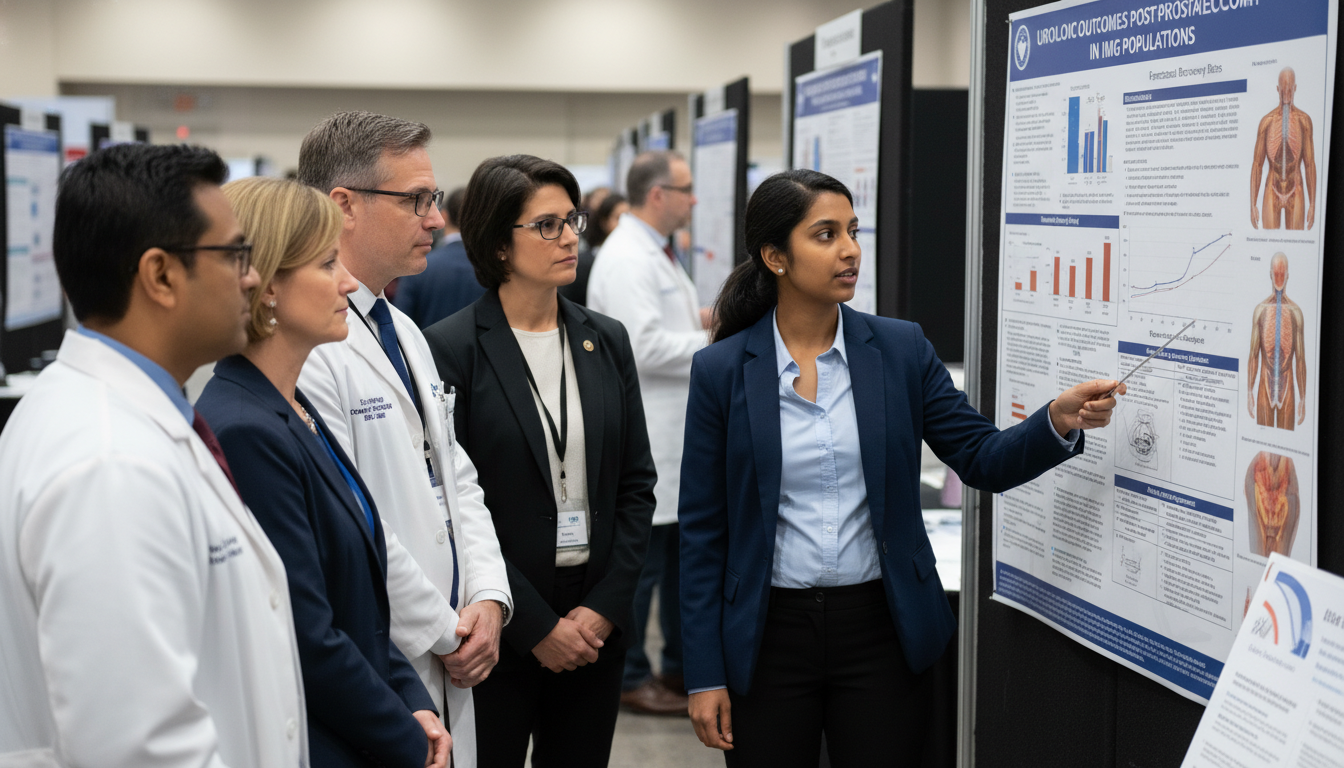
Presentations are often easier to achieve quickly than full manuscripts and are highly valued in urology.
Common venues:
- National meetings
- American Urological Association (AUA) annual meeting
- Subspecialty societies (SUO, Endourological Society, SPU, SUFU)
- Regional meetings
- Sectional AUA meetings (e.g., North Central Section)
- Institutional research days
Action steps:
- Ask your mentor which meeting the project is targeting and what the abstract deadlines are.
- Keep a calendar of abstract deadlines—AUA abstracts usually due ~6–8 months before the meeting.
- Start drafting the abstract early; ask a senior resident to review for style and clarity.
Writing and Publishing Manuscripts as an IMG
To convert your resident research projects into publications:
Plan for publication from the beginning
- Decide on a target journal early (e.g., The Journal of Urology, Urology, BJU International, subspecialty journals).
- Align the study scope and data collection with the journal’s standards.
Break the writing into steps
- Methods and Results can often be drafted while data are being analyzed.
- Introduction and Discussion can be refined after you have main findings.
Clarify authorship early
- Discuss with your mentor who will be first, second, and senior author.
- As the primary resident investigator, you should usually be first author.
Be systematic about revisions
- When asked for revisions by a journal, respond promptly.
- Use tracked changes and a point-by-point response to reviewers.
Networking as an International Medical Graduate
Research is not only about data; it is also about people. For IMGs, conferences and collaborative projects are critical networking platforms.
Practical networking strategies:
- At conferences:
- Attend early-morning courses and resident sessions.
- Introduce yourself to presenters in your area of interest.
- Ask short, focused questions after talks (e.g., “How did you handle X in your study?”).
- Online:
- Create or update a professional LinkedIn and/or Twitter/X profile focusing on urology.
- Follow leaders in your subspecialty, your mentors, and major urology journals.
- Within your institution:
- Present at departmental grand rounds when possible.
- Volunteer to help with department-level QI or guideline implementation.
These relationships can lead to multi-center collaborations, fellowship opportunities, and letters of recommendation, which are particularly valuable for IMGs with limited local training history.
Preparing for an Academic Residency Track or Fellowship
Building a Competitive Academic CV During Residency
If you are considering an academic residency track or academic urology career, you should think more strategically about your portfolio.
Key elements:
- Consistent research theme
- Example: Most of your work relates to kidney stone disease, bladder cancer, or reconstructive urology.
- Increasing responsibility over time
- Early: Data collection and co-authorship
- Later: Study design, first-authorship, leading a small team of students/junior residents
- Combination of outputs
- Original research papers
- Review articles or book chapters
- National presentations and invited talks
By PGY-4, academic-minded IMGs should aim to have:
- Several first-author publications
- A visible role in at least one multi-center or database study
- A mentor who can write a strong, detailed letter about your research capability
Using Research to Strengthen Fellowship Applications
For competitive fellowships (oncology, pediatrics, FPMRS, endourology), research is often a key differentiator.
To leverage research for fellowship:
- Align your major projects with your desired subspecialty.
- Present at the relevant subspecialty society meetings.
- Seek opportunities to co-author guidelines, review papers, or book chapters with your mentor.
- Ask your mentor to introduce you to key faculty at fellowship programs you’re interested in.
Fellowship directors often look not only at the number of publications, but also at:
- The quality of journals
- Your role (first vs. middle author)
- Evidence that you can independently conceptualize and execute a project
Considering a Dedicated Research Year
Some urology programs offer or require a dedicated research year, typically between PGY-2 and PGY-4.
Pros for IMGs:
- Protected time to build a robust research portfolio
- Opportunity to learn advanced methodology (e.g., clinical trials, bioinformatics)
- Ability to collaborate on cross-disciplinary projects (e.g., oncology, radiology)
Cons:
- Delayed clinical progression
- Possible visa/contract implications (clarify with your program and GME office)
- Not all residents are interested in prolonging training
If you are strongly interested in academic medicine and feel you need more time to build a record, a research year can be a powerful investment—especially for an international medical graduate trying to stand out.
Common Challenges for IMGs—and How to Overcome Them
1. Language and Scientific Writing Barriers
Even with strong spoken English, academic writing can be daunting.
Solutions:
- Read well-written urology papers and model your structure on them.
- Ask mentors or co-authors to focus specifically on language and style in early drafts.
- Use tools like grammar checkers and writing resources (AMA Manual of Style, journal author guidelines).
2. Limited Prior Research Experience
Many IMGs come from systems where formal research training was minimal.
How to compensate:
- Attend your institution’s research workshops and statistics lectures.
- Start with manageable projects (case reports, single-center retrospective studies).
- Request to be involved in all stages of the project—design, IRB, data collection, analysis, and writing—to accelerate learning.
3. Time Constraints and Burnout Risk
Balancing call, OR days, clinics, and research is universally hard, but the learning curve is steeper for IMGs.
Approaches:
- Use project management tools (Trello, Notion, even simple to-do lists).
- Have honest conversations with mentors about realistic timelines.
- Protect at least one evening or half-day per week for research, if possible.
4. Feeling Isolated or “Behind”
It’s common for IMGs to feel they are “behind” compared to US graduates who had pre-existing networks or structured research experiences.
Counter this by:
- Actively seeking mentorship rather than waiting to be approached.
- Joining national societies’ IMG or international sections when available.
- Celebrating small wins (abstract acceptance, data collection milestones) to maintain motivation.
FAQs: Research During Urology Residency for IMGs
1. Do I need a strong research background to match into a urology residency as an IMG?
Research helps in the urology match, but it is not the only factor. Once you are already in residency, the most important thing is what you do during residency. Even if your pre-residency research is limited, you can build a competitive profile through:
- Focused resident research projects
- Presentations at AUA or regional meetings
- Strong letters from research mentors
Programs and future employers will pay close attention to your trajectory and what you achieved in the structured environment of residency.
2. How many publications should I aim for during residency if I want an academic career?
There is no absolute number, but for an IMG aiming at an academic residency track or competitive fellowship, a reasonable target by the end of PGY-5 might be:
- ~3–5 first-author publications
- Several co-authored publications
- Multiple national presentations
More important than raw numbers is that your work is coherent, high-quality, and shows progression toward independence.
3. Can quality improvement (QI) projects really “count” as research?
Yes, QI projects can absolutely be meaningful, especially if:
- They are methodologically sound and use accepted QI frameworks (e.g., PDSA cycles).
- You collect pre- and post-intervention data.
- You analyze outcomes systematically and link them to evidence-based interventions.
Many QI projects are publishable and presentable at conferences, and they also directly improve patient care—something urology departments and accreditation bodies value highly.
4. What if my program has limited research resources or no research year?
You can still build a strong research profile by:
- Focusing on retrospective chart reviews, small prospective studies, or QI projects that don’t require extensive funding.
- Leveraging multi-center database projects with national collaborators.
- Seeking collaboration with other departments (oncology, radiology, pediatrics) that have active research infrastructure.
- Using off-hours efficiently and planning projects that fit your schedule and resources.
Even in resource-limited settings, well-designed, focused projects can significantly enhance your CV and open doors in urology.
By approaching research during residency strategically—choosing the right mentors, picking feasible projects, and steadily building your skills—you can transform potential disadvantages as an international medical graduate into distinct strengths. Whether your goal is an academic residency track, a specialized fellowship, or being a clinically focused urologist who practices evidence-based medicine, research will be one of your most valuable tools throughout your career.