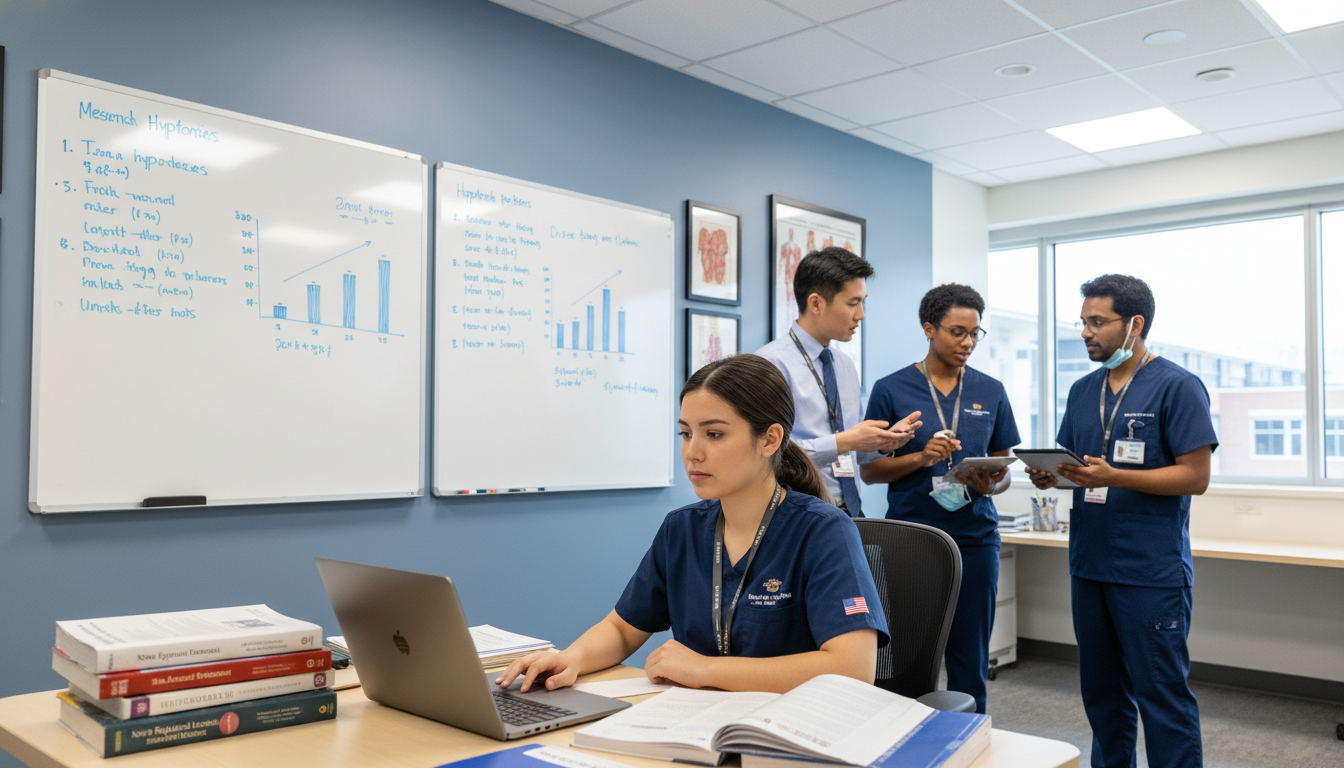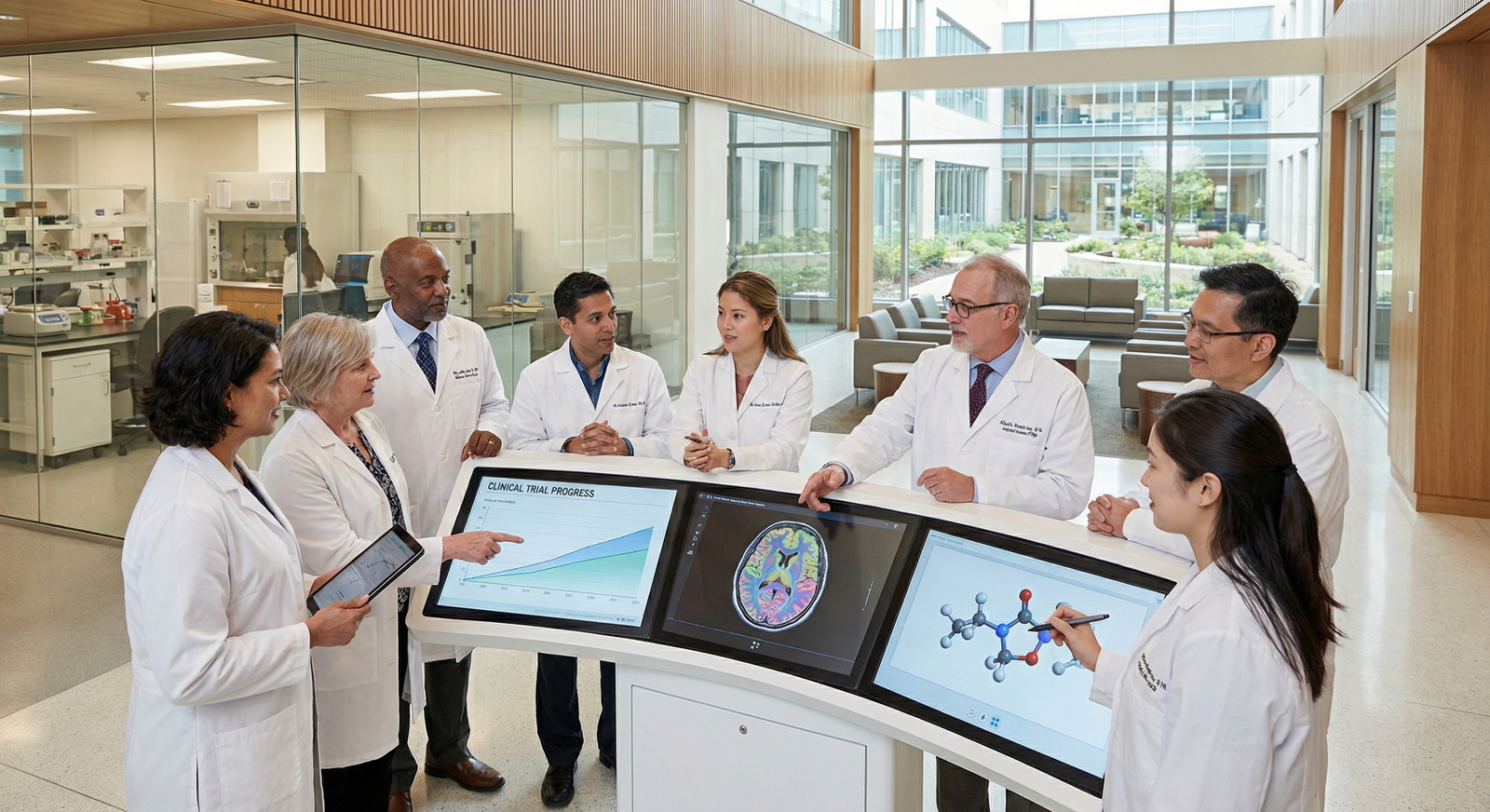
As a non-US citizen IMG in a preliminary surgery year, research can feel like just one more demand on an already intense experience. Yet, it is also one of the most powerful tools you have to improve your chances of securing a categorical position—whether in surgery or another specialty—and to build a long-term academic career. This article will walk you through why research matters, the unique challenges you face as a foreign national medical graduate, and concrete strategies to make research during residency both realistic and impactful.
Why Research Matters for Non-US Citizen IMGs in Preliminary Surgery
For a non-US citizen IMG in a prelim surgery residency, your situation is fundamentally different from that of categorical residents:
- Your contract is usually only 1 year.
- You may not have a guaranteed PGY-2 position.
- You are competing not only with other prelims but also with categorical residents and applicants still in medical school.
In this high-stakes context, research can:
Strengthen your application for a categorical spot
Program directors look carefully at scholarly activity when deciding which prelims to promote or which applicants to interview. Resident research projects signal:- Academic motivation and curiosity
- Ability to complete projects
- Professionalism, persistence, and time management Even a few well-chosen abstracts or papers can meaningfully upgrade your profile.
Differentiate you as a foreign national medical graduate
As a non-US citizen IMG, you may lack:- US medical school “brand name”
- Home program advocacy
- Long-standing networks in US academic surgery
Research partially compensates by showing you can: - Integrate into US academic culture
- Work within institutional systems (IRB, data, multi-author teams)
- Contribute intellectually, not just clinically
Support visa and academic career goals
If your long-term plan involves:- An academic residency track
- Fellowship in a competitive subspecialty
- Future NIH or foundation-funded work
Then a track record of research during residency helps you: - Build early collaborations
- Accumulate publications and presentations
- Demonstrate potential as an academic surgeon
Create “rescue paths” if surgery does not work out
Not every prelim surgery resident secures a categorical surgical spot. Robust research experience may improve your transition into:- Categorical positions in other specialties (anesthesia, radiology, internal medicine, etc.)
- Dedicated research fellowships
- Master’s programs (e.g., MPH, clinical research) that extend your visa and strengthen your CV
The key is to approach research strategically—focusing on feasible, high-yield projects aligned with your limited time and visa constraints.
Understanding the Research Landscape in a Preliminary Surgery Year
Your preliminary surgery year is extremely busy. Before committing to any project, you must understand your environment and constraints.
1. Time and Schedule Realities
Prelim surgery residents often shoulder heavy clinical workloads:
- Long OR days and call nights
- Rotations with early start and late finish
- Weekend coverage and cross-cover responsibilities
This has implications:
- Unpredictable availability means you need flexible research roles.
- Longitudinal prospective projects may be unrealistic to lead during a single year.
- Short, discrete tasks that can be done in 30–90 minute blocks (data entry, chart review, revisions) are far more realistic.
2. Institutional Culture and Expectations
Academic programs vary significantly:
- Some expect all residents to participate in resident research projects and provide:
- Protected time
- Research mentors
- Databases and statisticians
- Others are primarily community-based with:
- Limited research infrastructure
- Few ongoing projects
- Minimal expectation for scholarly output
You must quickly assess:
- Are there established research conferences or “research days”?
- Do faculty highlight their publications and grants?
- Are other residents actively presenting at meetings?
If you are in a highly academic residency track environment, it’s about picking the right mentors and projects. If not, you may need to be more proactive and creative in identifying opportunities.
3. Visa and Employment Considerations
As a non-US citizen IMG, you may be on:
- J-1 visa (most common for GME)
- H-1B visa (less common in surgery prelims, more likely in certain institutions)
Implications:
- Research must be integrated into your approved training program; independent paid work or “side jobs” are not allowed.
- Authorship or unpaid collaboration is usually fine, but ensure:
- No off-contract employment
- No visa violations involving unauthorized work
- If you anticipate extending your stay via a research fellowship, you’ll need:
- Program support
- Clear documentation of your research role
- Timely planning around visa changes or extensions
Discuss these issues early with a program coordinator, GME office, or international office.

Types of Research You Can Realistically Do as a Prelim Surgery Resident
Not all research is equally attainable in a busy preliminary surgery year. Focus on types that match your time frame, skills, and institutional resources.
1. Retrospective Chart Review Studies
Why ideal for prelims:
- Uses existing data from electronic medical records.
- No need to follow patients prospectively.
- Timeline from start to abstract submission can be 3–9 months.
Common topics in surgery:
- Outcomes after specific procedures (e.g., laparoscopic cholecystectomy complications).
- Risk factors for postoperative infection or readmission.
- Comparisons between treatment approaches or protocols.
Actionable tips:
- Join an existing project where:
- IRB approval is already in place.
- The research question and variables are defined.
- Volunteer for:
- Data collection
- Data cleaning
- Drafting Methods/Results sections
- Negotiate authorship expectations clearly at the beginning.
2. Case Reports and Case Series
Best for:
- Rare events, unusual complications, or unique management strategies.
- Early-career residents with limited time.
Advantages:
- No need for large sample sizes.
- Great opportunities on trauma and emergency surgery services.
- Can be submitted to journals quickly.
Workflow:
- Identify an interesting case (rare disease, unexpected finding, innovative management).
- Discuss with the attending if they are interested in publishing.
- Review journal guidelines for case reports.
- Draft introduction, case description, and brief discussion.
- Address HIPAA and patient consent requirements per hospital policy.
Case reports won’t transform your CV alone, but a series of case reports + small studies + posters signals consistent scholarship.
3. Quality Improvement (QI) and Patient Safety Projects
For a prelim surgery resident, QI projects are attractive because:
- They’re often encouraged by hospital administration.
- Data can be simpler (compliance, process metrics, basic outcomes).
- Implementation timelines can be short.
Examples:
- Reducing central line infections through a bundle protocol.
- Improving time to antibiotics for open fractures.
- Standardizing VTE prophylaxis across surgical services.
Key points:
- Many QI projects don’t need full IRB review, but always verify.
- They may be presented at institutional QI days, then written up as manuscripts.
- A QI project can double as a scholarly project and a real patient-care improvement.
4. Systematic Reviews and Narrative Reviews
As a non-US citizen IMG, you may bring strong literature-review skills from your home country. These projects are:
- Less dependent on local patient data or IRB.
- Flexible in timing (often can be done from home after shifts).
Challenges:
- Require strict methodology (for systematic reviews).
- May be time-consuming if done thoroughly.
- Need a faculty supervisor to help position the manuscript for a good journal.
How to proceed:
- Approach a faculty member with a focused topic idea:
Example: “Systematic review of outcomes for emergency vs elective repair of giant ventral hernias.” - Propose a timeline and division of labor.
- Use established guidelines (e.g., PRISMA for systematic reviews).
5. Education and Simulation Research
If your program has access to a simulation center or uses OSCEs, FLS, or skills labs, you may:
- Help design or evaluate a training curriculum.
- Study how simulation affects performance or confidence.
- Co-author educational resources or evaluation tools.
These projects:
- Fit well with an academic residency track interest.
- Align with surgical education fellowships or future leadership in GME.
Finding and Securing Research Opportunities as a Non-US Citizen IMG
The hardest step is often the first one: getting included in a project team.
1. Map the Research Ecosystem Early
In your first 4–6 weeks:
- Attend:
- M&M conferences
- Grand rounds
- Research or journal clubs (if available)
- Identify:
- Who presents data regularly?
- Which attendings mention ongoing studies during rounds?
- Which residents seem research-active?
Make a short list of 3–5 potential mentors who:
- Are visibly engaged in research.
- Interact positively with residents.
- Have ongoing or new projects.
2. Craft a Targeted Outreach Strategy
Approach potential mentors professionally and concretely. For example:
“Dr. Smith, I’m a preliminary surgery resident with a strong interest in outcomes research and a long-term goal of an academic career. I have prior experience with data collection and manuscript writing. Given my limited prelim year, I’m especially interested in short-to-medium term projects where I can contribute meaningfully. Would you be open to meeting for 15–20 minutes to discuss any active or upcoming projects where I might help?”
Key principles:
- Be honest about your time constraints and schedule unpredictability.
- Emphasize reliability and follow-through.
- Be clear that you are driven and willing to work hard but do not want to over-promise.
3. Leverage Senior Residents and Fellows
Often, surgical fellows and senior residents are the real engines behind resident research projects. They:
- Know which datasets already exist.
- Need help with data abstraction, literature review, or figure creation.
- May be more approachable than senior faculty.
Ask PGY-3/4/5s:
- “Are there any projects where an extra pair of hands would be helpful?”
- “Is anyone looking for a resident to help with chart review or manuscript drafting?”
Once you prove yourself to one person, word-of-mouth spreads quickly.
4. Build a Mini-Portfolio of Skills
Common needs in resident research projects include:
- Data extraction from EMR
- Basic statistics in Excel, SPSS, R, or Stata
- Reference management with EndNote, Zotero, or Mendeley
- Manuscript formatting and figure/table preparation
Invest a small amount of time early to learn:
- Basic statistical concepts (p-values, confidence intervals, logistic regression).
- How to structure IMRaD (Introduction, Methods, Results, Discussion).
- IRB basics and research ethics.
This makes you much more attractive as a collaborator and allows faculty to trust you with more responsibility.
Balancing Clinical Demands and Research: Practical Strategies
Managing research during residency is fundamentally about time, priorities, and communication.
1. Protect Micro-Blocks of Time
You will rarely get full free days for research. Instead, use:
- Short breaks between cases
- Post-call afternoons (if not exhausted)
- Weekend mornings or evenings
Strategies:
- Keep a list of “small tasks” (e.g., extract 10 charts, edit one section, fix references).
- Use a cloud-based platform (Google Docs, shared drives) for manuscripts.
- Turn downtime in call rooms or lounges into 20–30 minute work bursts.
2. Set Realistic Goals With Your Mentor
At the start of any project, clarify:
- Expected timeline (e.g., “abstract by October,” “manuscript by March”).
- Your specific role and time availability.
- Milestones and check-ins (e.g., monthly short meetings or emails).
As a prelim surgery resident, be especially conservative in estimating what you can do. It is better to:
- Complete one meaningful project than
- Start three and abandon them.
3. Use “Low-Cognitive Load” Time Wisely
Not all work must be done at peak mental performance:
- After a long call night, do simpler tasks:
- Formatting references
- Proofreading
- Updating literature search
- Reserve more rested times for heavy writing or new analysis.
4. Maintain Transparent Communication
If your clinical schedule changes or you get overwhelmed:
- Inform your project lead early:
- “My call schedule changed and I’m more stretched than expected. I can still contribute, but I may need to slow down my timeline for the next 3 weeks.”
- Offer alternatives:
- “Can I focus mainly on editing and responses to reviewers while another resident continues data collection?”
Most mentors will respect honesty and appreciate your professionalism.
5. Document Everything
Keep a personal record of:
- All projects you joined (with titles, PIs, expected outputs).
- Your tasks and approximate hours.
- Presentations, abstracts, and publications with full citations.
This is crucial for:
- ERAS application updates
- Fellowship or categorical position interviews
- Potential future visa or academic appointments
Turning Resident Research Projects Into Long-Term Opportunities
Your preliminary surgery year might last only 12 months, but your research can extend beyond that.
1. Extend Projects After You Leave the Program
As a non-US citizen IMG, your path may include:
- Switching institutions
- Changing specialties
- Entering a research fellowship
If your research mentor is supportive, you can often:
- Continue editing manuscripts remotely.
- Collaborate on follow-up data or secondary analyses.
- Stay involved in multicenter studies you joined.
Clarify:
- What role you’ll maintain after leaving.
- How authorship and correspondence will be handled.
- How to access data or drafts securely and appropriately.
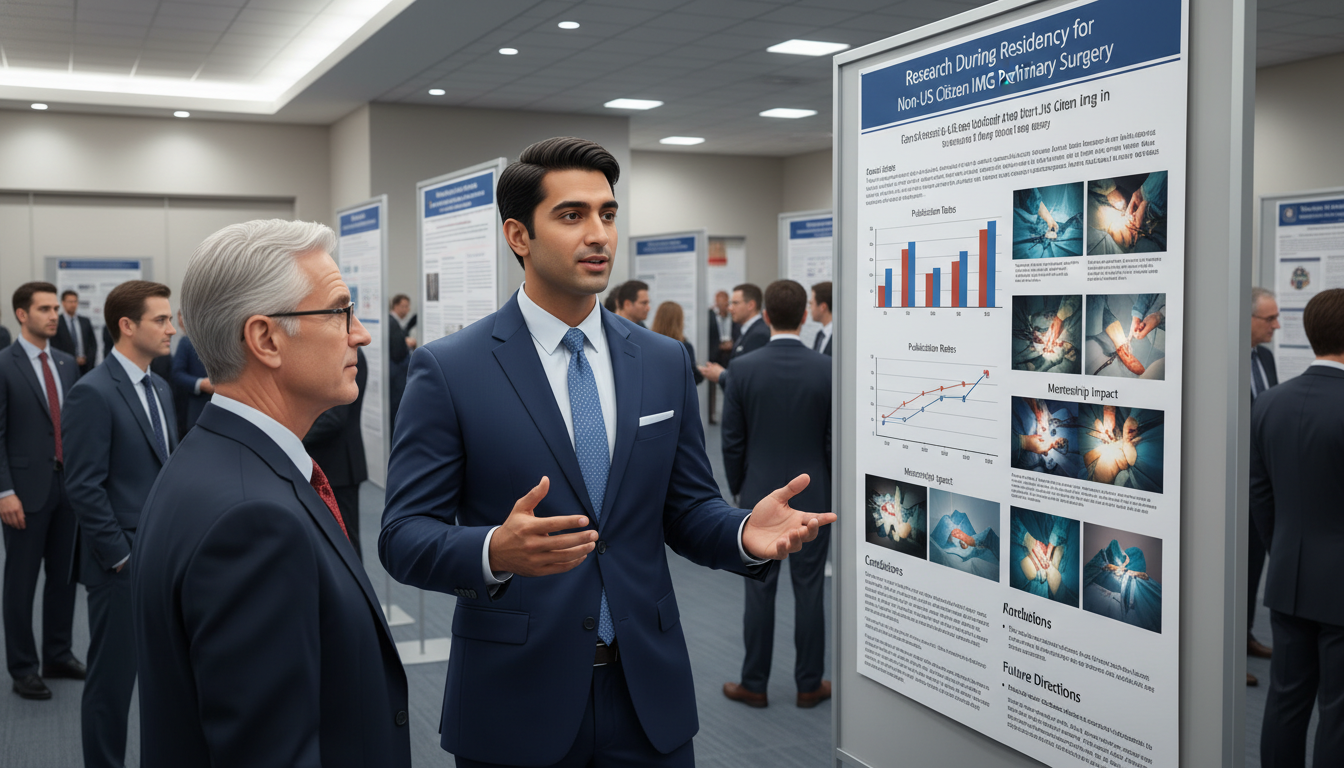
2. Aim for Presentations and Visibility
Try to convert each project into at least one of:
- Podium or poster presentation at a regional or national meeting.
- Institutional research day presentation.
- Online or virtual research forum.
Presentations serve multiple purposes:
- Enhance your CV.
- Provide talking points for interviews.
- Help you connect with faculty and programs you might apply to later.
As a non-US citizen IMG, visibility is especially important to counter biases and highlight your academic strengths.
3. Consider a Dedicated Research Year or Fellowship
If you complete your preliminary surgery year without a secure categorical spot, a research year or dedicated research fellowship can:
- Extend your visa under a university or hospital appointment.
- Allow you to publish multiple papers.
- Build connections that open categorical or fellowship doors later.
Questions to consider:
- Does your current institution offer research positions to foreign national medical graduates?
- Could your research mentor sponsor you as a research fellow or scholarly associate?
- Are there funded positions that can support your living expenses?
This path is common among non-US citizen IMGs who ultimately secure academic residency track positions or competitive fellowships.
4. Align Research With Your Long-Term Specialty Goal
Not all prelim surgery residents remain in surgery. If you are considering:
- Anesthesiology
- Radiology
- Emergency medicine
- Internal medicine or critical care
Then strategically select some projects that:
- Are relevant to perioperative medicine, imaging, critical care, or trauma systems.
- Demonstrate your broader interests beyond the OR.
- Can be reframed as cross-disciplinary scholarship on your next application.
This way, your research during residency remains valuable regardless of your final specialty.
FAQs: Research During Residency for Non-US Citizen IMG in Preliminary Surgery
1. Is research absolutely necessary to secure a categorical surgery position?
Not absolutely—but it can be a significant advantage. For a non-US citizen IMG in a preliminary surgery year, research:
- Helps compensate for lack of a US medical school background.
- Provides concrete evidence of academic engagement.
- Differentiates you from other prelims with similar board scores and clinical evaluations.
High-quality clinical performance is essential; research adds a critical second dimension, especially in academic programs.
2. I have no prior research experience. Is it too late to start during my prelim year?
It is not too late. Many residents publish their first paper during residency. Focus on:
- Joining a well-structured project (not designing a complex study from scratch).
- Learning basic research skills from senior residents and fellows.
- Completing at least one project to the stage of submission or presentation.
Your attitude, reliability, and willingness to learn matter as much as your starting skill level.
3. Will my visa status limit my ability to do research?
Typically, your visa (especially J-1) allows you to engage in research activities that are part of your residency training. Limitations include:
- You cannot take on separate paid research jobs outside your approved program.
- Any extended research fellowship or added roles may require visa review or modifications.
Always:
- Verify with your GME office or international office.
- Ensure all positions and activities are documented and compliant.
4. How should I list ongoing or incomplete projects on ERAS or my CV?
Be transparent and precise:
- Use categories like “Manuscript in preparation” or “Data collection in progress.”
- Avoid listing projects as “submitted” or “accepted” unless that is verified.
- For each research during residency experience, briefly describe:
- Your role (data collection, analysis, first author drafting, etc.).
- The specific topic or title if finalized.
Program directors appreciate honesty and detail more than inflated claims.
Research during a preliminary surgery residency is challenging—but for a non-US citizen IMG, it can be transformational. By choosing realistic project types, aligning with supportive mentors, and managing your time strategically, you can turn a demanding year into a launching pad for categorical positions, academic careers, and long-term success in medicine.