Why Research During Residency Matters for Caribbean IMGs in Anesthesiology
For a Caribbean IMG in anesthesiology, residency is often framed as the time to “just survive” call schedules, OR days, and board preparation. Yet research during residency can quietly become one of your most powerful career multipliers—especially if you trained at a Caribbean medical school and want to maximize your competitiveness, credibility, and long-term options.
Well-designed resident research projects can:
- Offset perceived disadvantages of being a Caribbean IMG
- Strengthen your CV for fellowships and academic jobs
- Help you stand out in the anesthesia match if you later pursue another match (fellowship, academic track)
- Build a professional network beyond your home program
- Improve your understanding of evidence-based anesthesia practice
Whether you’re at a large SGU residency match–friendly academic center or a smaller community program, you can carve out a meaningful research path. This article will guide you through how to do that strategically as a Caribbean IMG in anesthesiology.
Understanding the Value of Research for Caribbean Anesthesiology Residents
1. Addressing the “Caribbean IMG” label
Caribbean graduates often face extra scrutiny compared to US grads. Program directors and fellowship committees sometimes wonder:
- How strong was your preclinical training?
- Can you handle academic rigor?
- Will you be productive in an academic residency track?
Research provides tangible, objective signals that help answer these questions:
- Peer-reviewed publications show you can work through complex projects and finish them.
- Abstracts and poster presentations prove you can translate clinical experiences into scholarly work.
- Quality improvement (QI) initiatives highlight your ability to improve systems, not just treat individuals.
For example, if you completed your MD at an SGU, a clear section on your CV showing “first-author abstract at ASA” or “co-author on perioperative outcomes study” can positively differentiate you from many peers with similar board scores.
2. Enhancing your anesthesiology skill set
Research in anesthesiology connects directly to daily clinical practice:
- Perioperative outcomes research can teach you to interpret risk models and outcome predictors.
- Regional anesthesia trials can deepen your understanding of nerve blocks and analgesia pathways.
- Airway management or critical care research strengthens your approach to complex cases in the OR and ICU.
As you participate in research, you naturally:
- Read more literature
- Question routines more thoughtfully
- Understand why guidelines exist
- Develop a habit of evidence-based decision-making
This translates into safer, more thoughtful anesthetic care—and that is very visible to attendings.
3. Improving competitiveness for fellowships and academic careers
If you are eyeing:
- Critical care
- Pain medicine
- Cardiac anesthesia
- Pediatric anesthesia
- Neuroanesthesia
- Obstetric anesthesia
research experience is often a crucial differentiator. Many competitive fellowships receive large numbers of applications with similar board scores and letters. Strong research during residency can be a tiebreaker.
Fellowship directors often look for:
- At least one meaningful project in their subspecialty
- Evidence you can complete scholarly work (not just start it)
- Comfort presenting at regional or national meetings
If you hope to pursue an academic residency track or an attending role at an academic center, research becomes even more important. It signals you can contribute to the department’s scholarly mission—something hiring committees value highly.
Types of Research Opportunities in Anesthesiology Residency
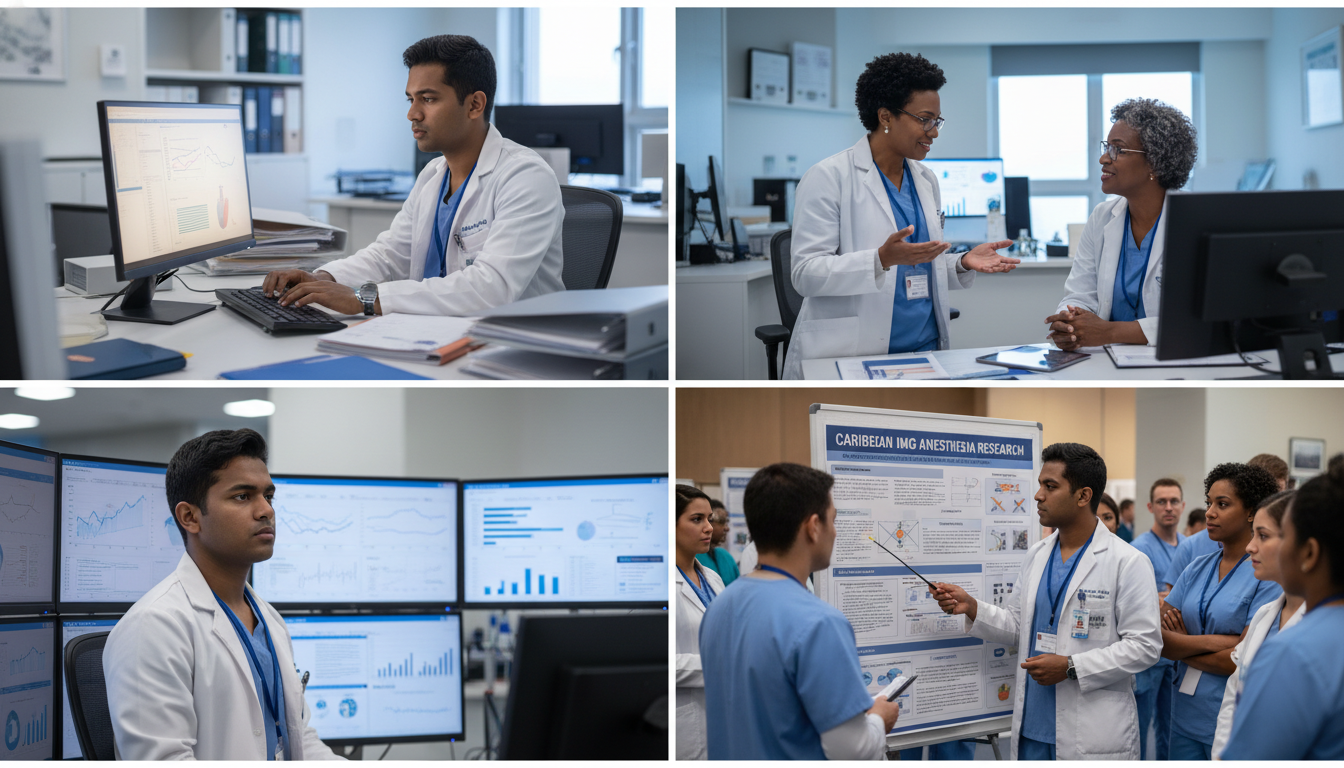
Not all research looks the same, and you don’t have to be a statistician or basic scientist to make meaningful contributions. As a Caribbean IMG, understanding the spectrum of options helps you identify realistic, high-yield choices.
1. Clinical research
Definition: Studies using patient data to answer questions about outcomes, medications, techniques, or perioperative processes.
Examples:
- Retrospective review of postoperative nausea and vomiting rates with different antiemetic protocols
- Study comparing outcomes in patients receiving ultrasound-guided regional blocks vs. traditional techniques
- Analysis of airway complications in obese surgical patients
Benefits for residents:
- Often feasible in smaller or community-based programs
- Commonly used patient data already exists in the EHR
- Many attendings are familiar with these designs and can mentor you
Typical steps:
- Formulate a focused clinical question
- Obtain IRB approval
- Extract data from EHR
- Analyze data (with biostatistician support)
- Present at a conference and/or submit a manuscript
2. Quality improvement (QI) projects
Definition: Systematic efforts to improve patient care processes—often required for ACGME milestones.
Examples in anesthesiology:
- Reducing OR start time delays due to incomplete pre-op evaluations
- Improving compliance with perioperative antibiotic timing
- Increasing adherence to enhanced recovery after surgery (ERAS) protocols
- Reducing unplanned ICU admissions after specific surgeries
QI projects are particularly friendly for busy residents because:
- They can often be done within your institution and within a year
- They count for both ACGME requirements and scholarly activity
- Many journals and conferences accept QI-focused abstracts
For Caribbean IMGs, a well-designed QI project can be one of the fastest ways to show you can lead a successful scholarly effort.
3. Case reports and case series
Definition: Detailed descriptions of unique, rare, or educationally valuable clinical cases.
Examples:
- A rare airway anomaly discovered during induction
- Unusual reaction to an anesthetic drug or regional block
- Complex perioperative management of a patient with multiple rare comorbidities
Advantages:
- Faster turnaround than full clinical studies
- Great entry point if you’ve never written a paper
- Useful to learn literature review and academic writing
Limitations:
- Lower impact than large studies
- May not weigh heavily for some academic positions or fellowships
Still, for a Caribbean IMG trying to build a scholarly footprint early, 2–3 solid case reports can be a strong start.
4. Educational or simulation research
Definition: Projects that evaluate teaching methods, curricula, or simulation-based training.
Examples:
- Implementing a new simulation-based curriculum for managing anaphylaxis in the OR
- Assessing the effectiveness of a new ultrasound-guided block workshop
- Studying resident confidence before and after a crisis resource management simulation series
This is a particularly good domain if your program has a strong simulation center or education-focused faculty. Educational research aligns well with residents who envision future academic roles with teaching responsibilities.
5. Basic science or translational research
Definition: Lab-based research exploring physiology, pharmacology, or mechanisms related to anesthesia or pain.
Examples:
- Mechanisms of local anesthetic neurotoxicity in animal models
- Molecular pathways underlying opioid tolerance
- Experimental models of ischemia-reperfusion injury during surgery
Challenges:
- Requires significant time and often protected research blocks
- More common in large academic centers
- Learning curve for lab techniques and benchwork
For many Caribbean IMGs in standard anesthesiology residencies—especially those without research tracks—basic science may be less accessible. However, if your program offers an academic residency track with protected research time, this may be a valuable option.
Getting Started: How a Caribbean IMG Can Build a Research Pathway
Many residents—especially IMGs—struggle not because of lack of interest, but because they don’t know where or how to start. Use a structured, stepwise approach.
1. Clarify your goals early in PGY-1 or CA-1
Ask yourself:
- Do I want a fellowship? Which one?
- Am I interested in an academic vs. community career?
- How much time can I realistically commit given my residency workload?
If you’re not sure yet, assume you might want a competitive fellowship. That assumption encourages you to keep doors open.
A reasonable target for a motivated anesthesiology resident:
- 1–2 abstracts or posters presented regionally/nationally
- 1–3 published papers (case reports, QI, or clinical studies), even as co-author
- Solid involvement in at least one meaningful resident research project
2. Learn your program’s research ecosystem
Within your first 3–6 months, identify:
- Research director or scholarly activity coordinator
- Faculty with active projects in anesthesia subspecialties
- Existing resident research projects you can join
- Institutional resources: IRB office, biostatistics support, medical librarian services
Ask senior residents:
- “Which attendings are most resident-friendly for research?”
- “Who actually helps residents get papers or conference abstracts done?”
- “Which projects have been successful in the last 2–3 years?”
If you’re at a program known for supporting Caribbean IMGs (for example, sites with a strong SGU residency match presence), there’s a good chance there are established research pathways you can plug into quickly.
3. Find and approach a mentor strategically
A good research mentor in anesthesiology should offer:
- Ongoing, not one-time, guidance
- A track record of residents finishing projects with them
- Responsiveness and realistic expectations
When approaching a potential mentor:
- Read 1–2 of their recent papers
- Prepare a brief introduction of your background (Caribbean medical school, PGY level, areas of interest)
- Express clear goals: “I’d like to complete at least one abstract and one manuscript during residency.”
Sample email:
Dear Dr. [Name],
I’m a CA-1 anesthesiology resident with a prior background as a Caribbean IMG (MD from [School]). I’m very interested in perioperative outcomes and would like to become involved in research during residency, with the goal of producing at least one abstract and one manuscript.
I’ve read your recent paper on [topic] and found it especially relevant to my interests. Would you have 15–20 minutes to meet and discuss potential opportunities to get involved with your work or related projects?
Thank you for your time and consideration,
[Name]
4. Choose your first project wisely
For your first real project, prioritize:
- Feasibility: Can you complete it in 6–12 months?
- Mentor engagement: Is your mentor responsive and experienced?
- Clear role for you: Are you first author or at least doing a substantial portion of the work?
Good starter options:
- A case report based on a unique case you encountered
- A small retrospective chart review (e.g., outcomes after a particular block)
- A QI project that aligns with a department initiative
Avoid overly ambitious, multi-year, multi-center trials as your first attempt unless your program gives you significant protected time.
Making Research Work With a Resident Schedule
Time is the biggest barrier for most residents. For Caribbean IMGs, who may feel extra pressure to excel clinically, research often gets pushed aside. The key is to treat research like a longitudinal rotation with clear structure.

1. Block your time intentionally
Strategy:
- Reserve 2–4 hours/week consistently for research (e.g., Sunday mornings, one post-call afternoon).
- Use short, focused sprints instead of waiting for large open blocks that never come.
- Protect that time like you would a mandatory conference.
During a typical 4-week rotation:
- Week 1: refine research question, meet with mentor
- Week 2: complete a focused literature review, outline methods
- Week 3: draft IRB or begin data collection
- Week 4: refine protocol, start analysis planning
Over months, these small increments compound into real progress.
2. Use tools and workflows that boost efficiency
Helpful tools:
- Reference managers: Zotero, Mendeley, or EndNote for organizing PDFs and citations
- Cloud storage: Institutional OneDrive or Google Drive for shared documents
- Task trackers: Trello, Notion, or a simple spreadsheet to track project steps
Workflow suggestions:
- Create templates for your abstract, manuscript sections, and IRB forms
- Keep a “research log” document with dates, decisions, and next steps
- Batch tasks: do literature search in one session, writing in another, analysis in another
3. Learn basic statistics and study design
You don’t need to be a statistician, but you should understand:
- Common study designs (retrospective cohort, case-control, randomized trials)
- Basic stats concepts (p-values, confidence intervals, regression at a conceptual level)
- Issues like bias, confounding, and power
Practical steps:
- Attend your institution’s research or biostatistics workshops
- Take a short online course in clinical research methodology (often free through your hospital or university)
- Meet early with a biostatistician before collecting data to avoid design errors
As a Caribbean IMG, demonstrating literacy in research methods helps counter any bias about your training background.
4. Aim for presentations and publications
Always ask: Where will this project go?
High-yield targets:
- ASA, IARS, ASRA, SCCM, SOAP or major subspecialty meetings for abstracts/posters
- Specialty journals like Anesthesiology, Anesthesia & Analgesia, Regional Anesthesia & Pain Medicine, or more targeted journals for QI or simulation
Timeline to aim for:
- 3–6 months: project design and IRB
- 6–12 months: data collection and preliminary analysis
- 12–18 months: abstract submission and manuscript drafting
Residency is 3–4 years. If you start in CA-1, you can realistically see results before graduation.
Special Considerations for Caribbean IMGs and Strategic Career Planning
As a Caribbean IMG in anesthesiology, research can be more than just a checkbox—it can shape your long-term trajectory.
1. If you matched at a smaller or community program
You may have:
- Fewer large-scale clinical trials
- Limited basic science infrastructure
- Less formal protected research time
But you do have:
- Access to real-world patient data
- Opportunities for QI and practice-focused studies
- Potential collaboration with nearby academic centers
Strategies:
- Focus on QI, retrospective chart reviews, and case reports—high-yield and realistically doable.
- Seek cross-institution collaboration if your hospital is affiliated with a university.
- Look for faculty who have previously trained at academic centers—they often maintain research connections.
2. If your ultimate goal is academic anesthesiology
You should aim to:
- Build a consistent research narrative (e.g., “perioperative outcomes in high-risk surgical patients” or “regional anesthesia for orthopedic surgery”)
- Seek involvement in resident research projects that already have institutional momentum
- Present at national conferences and network with future colleagues
Also consider:
- Applying for an academic residency track or research track if your institution offers it
- Using elective time strategically for research blocks
- Asking mentors about T32 or other research-focused fellowship pathways
3. If you trained at SGU or another major Caribbean school with strong US ties
Many SGU residency match graduates land in programs familiar with Caribbean IMGs. You may find:
- Alumni in anesthesiology who have built academic careers
- Faculty who already trust the training background of SGU and similar schools
- Established templates for promoting IMGs into academic or leadership roles
Use that network actively:
- Reach out to SGU or Caribbean alumni in anesthesia for advice and collaborative opportunities
- Ask about successful past projects Caribbean graduates have completed at your institution
- Advertise your alumni connections as strengths when approaching mentors elsewhere
4. Planning ahead for the anesthesia match and fellowships
You’re already in anesthesiology residency, but research remains relevant for:
- Fellowship applications (pain, critical care, cardiac, peds, etc.)
- Potential second matches (e.g., if considering a second residency or research-focused role)
- Academic positions directly after residency
Programs will look at:
- Quantity and quality of your scholarly work
- Progression over time (did you grow from case reports to more substantial projects?)
- Relevance of your research to your target fellowship or academic niche
For instance, if you’re applying for a critical care fellowship, resident research projects related to perioperative sepsis, postoperative ICU outcomes, or ventilator strategies will be especially compelling.
Practical Example: A Caribbean IMG’s Three-Year Research Roadmap in Anesthesiology
To make this concrete, imagine you’re a Caribbean IMG (MD from SGU or similar) entering CA-1 year at a mid-sized academic anesthesiology program.
CA-1 (PGY-2)
- Q1: Meet with research director; identify mentor in perioperative outcomes
- Q1–Q2: Write and submit IRB for retrospective study on postoperative nausea and vomiting in same-day surgery patients
- Q2–Q3: Complete a case report on a complex airway case you saw with your mentor
- Q4: Submit case report to a peer-reviewed journal; start data extraction for your retrospective study
CA-2 (PGY-3)
- Q1: Complete data collection and preliminary analysis; submit an abstract to ASA meeting
- Q2: Draft manuscript for retrospective study; begin a QI project focused on improving timeouts or antibiotic timing
- Q3: Present poster at ASA; network with faculty from programs offering your desired fellowship
- Q4: Submit QI project abstract to a regional or national conference
CA-3 (PGY-4)
- Q1: Finalize manuscripts (retrospective study and QI project); ask mentors for letters of recommendation emphasizing your research productivity
- Q2: Apply for fellowship, highlighting your research narrative and output
- Q3–Q4: Mentor a junior resident or medical student on a small project, demonstrating leadership and academic involvement
By graduation, you could realistically have:
- 1–2 national presentations
- 1–3 published or in-press manuscripts
- A coherent story of perioperative outcomes and QI interest
- Strong letters that explicitly note your ability to complete scholarly work
For a Caribbean IMG, this portfolio can dramatically strengthen your profile for fellowships, academic roles, and leadership positions.
FAQs: Research During Anesthesiology Residency for Caribbean IMGs
1. I’m a PGY-2 anesthesiology resident and have no research yet. Is it too late?
No. Starting in early CA-2 is still very workable. Prioritize:
- A feasible retrospective or QI project with clear goals
- A case report or two for quicker wins
- At least one abstract for a major meeting before graduation
You may not build a huge publication list, but you can still create a clear signal of scholarly engagement, which matters for fellowships and academic jobs.
2. Does research really help Caribbean IMGs if my board scores and clinical evaluations are already strong?
Yes. For Caribbean IMGs, research helps in multiple ways:
- Counters lingering bias about Caribbean medical school residency backgrounds
- Distinguishes you from other high-performing residents
- Signals readiness for an academic residency track or academic career
- Enhances your competitiveness for top fellowships in anesthesiology subspecialties
Strong clinical performance is essential, but research adds a second pillar of credibility.
3. How many publications do I “need” for a competitive anesthesiology fellowship?
There’s no universal number, but realistic targets:
- 1–3 publications (case reports, QI, or clinical studies)
- 1–2 national or regional presentations
What matters more than raw count is:
- Completion of projects (not just “in progress”)
- Relevance to your fellowship area (e.g., pain, critical care, cardiac)
- Strong letters from mentors attesting to your role and initiative
4. My program has limited research resources. What can I do?
You still have options:
- Focus on QI projects and retrospective chart reviews that fit your hospital’s capabilities
- Seek collaborations with nearby academic centers or through professional societies
- Use online tools and courses to learn methods and statistics
- Make case reports a foundational part of your scholarly activity
Even in resource-limited settings, a motivated Caribbean IMG can build a credible research portfolio by choosing projects strategically and using mentorship and networks effectively.
By approaching research during residency with intention, structure, and realistic goals, Caribbean IMGs in anesthesiology can transform scholarly work from an optional add-on into a core strength that shapes their careers—whether in the OR, ICU, pain clinic, or academic anesthesia department.