Why Research During Vascular Surgery Residency Matters for Caribbean IMGs
For a Caribbean medical school graduate entering or aiming for a vascular surgery residency in the US, research is not just a “nice-to-have.” It is one of the strongest tools you have to:
- Compete with US graduates
- Overcome bias around Caribbean medical school training
- Build an academic reputation in a small but highly specialized field
- Open doors to integrated vascular programs, fellowships, and academic careers
Vascular surgery is an innovation‑heavy specialty: endovascular techniques, new devices, complex clinical decision-making, and outcomes research all drive practice changes. Program directors increasingly expect residents—especially those considering an academic residency track—to understand research methods and contribute to scholarly work.
For Caribbean IMGs, research during residency can:
- Strengthen your portfolio if your test scores or pedigree are less traditional
- Support a later goal of a competitive fellowship or faculty position
- Help you network with influential vascular surgeons who can write strong letters
- Demonstrate that you can thrive in the academic environment many programs value
This article will walk you through how to strategically approach research during residency as a Caribbean IMG in vascular surgery—whether you matched through an SGU residency match or another Caribbean medical school residency pathway—and how to use research to shape your long‑term career.
Understanding the Research Landscape in Vascular Surgery
Vascular surgery offers a wide range of research opportunities. Understanding these will help you choose projects aligned with your interests, skills, and available time.
1. Major Types of Vascular Surgery Research
a. Clinical Outcomes and Quality Improvement
- Focus: Patient outcomes (e.g., limb salvage, mortality, complications, readmissions)
- Data sources: Institutional registries, electronic health records (EHR), VQI (Vascular Quality Initiative), NSQIP
- Examples:
- Comparing outcomes of open vs endovascular repair for aortic aneurysms in specific patient populations
- Evaluating predictors of graft failure in infrainguinal bypass procedures
- Measuring the impact of a new PAD (peripheral arterial disease) clinic pathway on time-to-intervention
b. Device and Technique Innovation
- Focus: New stents, grafts, access techniques, imaging methods, or procedural workflows
- Often industry-supported or multi-center collaborations
- Examples:
- Early experience with a new thrombolysis device for acute limb ischemia
- Feasibility and safety of a novel closure device for large-bore access sites
c. Basic and Translational Science
- Focus: Vascular biology, thrombosis, atherosclerosis, graft healing, biomaterials
- Methods: Animal models, cell cultures, molecular assays
- More common in large academic centers
- Best suited to residents planning an academic residency track with protected research time
d. Health Services and Disparities Research
- Focus: Access to vascular care, geographic variation, race/ethnicity or socioeconomic disparities
- Particularly powerful for Caribbean IMGs who may have a unique lens on underserved populations
- Examples:
- Examining disparities in amputation rates among different racial/ethnic groups
- Evaluating how distance from a vascular center affects presentation severity of chronic limb-threatening ischemia
e. Education and Simulation Research
- Focus: How vascular surgery is taught, assessed, and practiced
- Examples:
- Evaluating the impact of a new endovascular simulation curriculum on fluoroscopy time in the OR
- Studying the effect of a structured ultrasound course on resident procedural competence
2. Where Caribbean IMGs Fit In
As a Caribbean IMG, you may have:
- Limited prior research experience
- Some pubmed-indexed case reports or student research from a Caribbean medical school residency pipeline
- Strong motivation but less familiarity with US research infrastructure
You can be extremely competitive if you:
- Learn basic study design and statistics quickly
- Become reliable and consistent
- Choose feasible projects that lead to abstracts and papers during residency—not years later
- Leverage mentors who understand vascular surgery’s academic ecosystem
Your goal is not simply “do research” but “produce meaningful, completed research outputs” that support your career trajectory.

Getting Started: First 6–12 Months of Residency
The way you approach research in your first year (intern or PGY‑1) sets the tone for the rest of your training.
1. Step 1: Understand Your Program’s Culture
Programs vary widely in how they handle research during residency:
Highly academic programs
- Formal research curriculum
- Dedicated research faculty
- Possible protected research time or a research year
- Strong expectation of resident research projects and publications
Hybrid community–academic programs
- Some faculty engaged in research, often clinical outcomes or quality improvement
- Residents can do research, but initiative is required
- Less formal structure; opportunities depend on individual attendings
Primarily community programs
- Focus on clinical volume rather than scholarly work
- Research is possible (especially QI projects, case series) but usually self-directed
- May not have a vascular-specific research infrastructure
As soon as you start:
- Ask your program director (PD) and vascular surgery faculty:
- “What are the expectations for research during residency?”
- “Are there current vascular resident research projects I could join?”
- “Is there a resident research requirement for graduation?”
- Identify if there is:
- A research director
- A statistics/biostatistics core
- Access to institutional or vascular registries (e.g., VQI)
For a Caribbean IMG, this early clarity helps you plan realistically around clinical demands.
2. Step 2: Choose the Right Mentor
For Caribbean IMGs, the right mentor can be transformative. Look for:
- Productivity: Someone who publishes regularly in vascular journals or presents at SVS, VEITH, or regional vascular meetings.
- Access: Someone willing to include residents on projects, not just senior faculty or fellows.
- Alignment: If you’re eyeing an academic residency track or integrated vascular program/fellowship, prioritize mentors with academic credibility.
How to approach a potential mentor:
- Read their recent papers (1–3 is enough to start).
- Send a concise email:
- Introduce yourself as a Caribbean IMG and new vascular resident.
- Express specific interest in one of their topics (e.g., carotid disease, CLTI, aortic pathologies).
- Ask if they have ongoing resident research projects or if you could help with data collection, literature review, or manuscript preparation.
- Follow up once (after 7–10 days) if no response.
3. Step 3: Start Small but Finish Something
Instead of immediately chasing large prospective cohort studies, start with projects that can realistically be completed in a year:
- Case reports with educational value or unusual pathology
- Retrospective chart reviews with limited sample size
- Secondary analysis of an existing VQI or institutional dataset
- QI projects with pre/post intervention analysis
Example starter project for a PGY‑1 Caribbean IMG:
- Topic: “Impact of a standardized limb salvage pathway on time to revascularization and amputation rates”
- Design: Retrospective cohort
- Tasks:
- Define inclusion criteria and variables
- Extract data from the EHR
- Work with a biostatistician for basic statistics
- Write abstract → submit to a regional vascular meeting
- Prepare a manuscript
This kind of project is large enough to matter, but narrow enough to finish.
4. Step 4: Learn the Basics of Research Methods and Statistics
You don’t need a PhD, but you do need fundamentals:
- Study designs: retrospective vs prospective, cohort vs case-control, randomized trials, registry-based studies
- Common statistical tests:
- t-tests, chi-square, logistic regression, Cox regression, Kaplan–Meier survival curves
- Key concepts: confounding, bias, p-values vs confidence intervals, effect size
Practical ways to learn:
- Online courses (Coursera, edX) on biostatistics or clinical research
- Your institution’s research seminars or journal club
- Asking the biostatistician to explain the reasoning behind chosen methods
As a Caribbean IMG, this knowledge strengthens your credibility, especially if others initially underestimate your training background.
Integrating Research Into a Busy Vascular Surgery Residency
Vascular surgery residency (or general surgery residency followed by vascular fellowship) is time‑intensive. Balancing the OR, call, clinics, and research during residency is a real challenge—but it is doable with a system.
1. Time Management Strategies That Actually Work
Micro-sessions during the week
- 20–30 minutes per day is enough to:
- Screen 5–10 abstracts
- Draft a paragraph of a methods section
- Review edits from your mentor
- Use “dead time”:
- Between cases when you’re not needed in the room
- During outpatient clinic no‑show gaps
- Early morning before pre‑rounds (if feasible)
Protected weekly research block (even if unofficial)
- Block out a 2–3 hour window once a week on a lighter day.
- Inform your senior or chief:
- “I’m working on my vascular resident research projects from 4–6 PM if not needed clinically.”
- Be flexible—if the OR needs you, they win—but having a standing plan increases the chance you’ll use free time effectively.
2. Using Tools to Stay Organized
- Reference managers: Zotero, Mendeley, or EndNote to handle citations
- Project management: Trello, Notion, or a shared Google Sheet to track:
- Project title
- Team members
- Status (idea, data collection, analysis, abstract submitted, manuscript in progress, under review, published)
- Templates: Keep templates for:
- IRB applications
- Abstract formats for major vascular conferences
- Standard sections of a clinical paper (introduction, methods structure)
3. Making Call and Night Float Work for You
Night shifts can be powerful for research if you plan ahead:
- When things are quiet:
- Perform focused literature searches
- Clean datasets or check for missing data
- Revise manuscripts or respond to reviewer comments
- Always prioritize patient care and safety, but small bursts during low‑acuity nights add up over months.
4. Communicating Realistic Timelines
To avoid disappointing mentors:
- Always overestimate how long tasks will take early in training.
- Example:
- Instead of “I’ll finish data collection by Monday,” say “I can realistically finish within 2–3 weeks around my call schedule.”
- Provide periodic updates:
- “I completed data collection on 75/120 patients. I expect to finish the rest in the next 10 days.”
Mentors who have worked with residents—and particularly Caribbean IMGs navigating new systems—understand clinical demands, but they value transparency.
Building an Academic Track Record: From Abstracts to Publications
Your goal is to leave residency with a coherent research narrative—not just a random list of activities. This is especially important if you later apply to an integrated vascular program (if you started in general surgery) or a competitive vascular fellowship or faculty role.
1. Prioritizing Projects With “Finishability”
When choosing among potential projects, ask:
- Is the dataset already available, or will we have to build it from scratch?
- Is the study design feasible without years of follow‑up?
- Does the attending have a strong track record of actually publishing completed studies?
As a Caribbean IMG, your time and “academic leverage” are precious. One completed, published study is worth more than three unfinished “great ideas.”
2. Strategic Outputs: What to Aim For Year by Year
PGY‑1 to PGY‑2: Foundation
- 1–2 case reports or case series, especially on unusual vascular pathologies
- Participation in 1–2 retrospective clinical projects
- At least one abstract submitted to:
- Society for Vascular Surgery (SVS) Vascular Annual Meeting
- Regional vascular or surgical meetings (e.g., New England Society for Vascular Surgery, Southern Association for Vascular Surgery)
PGY‑3 to PGY‑4: Development
- Take on larger dataset projects (VQI-based, institutional registries)
- Aim to be first author on at least one publication
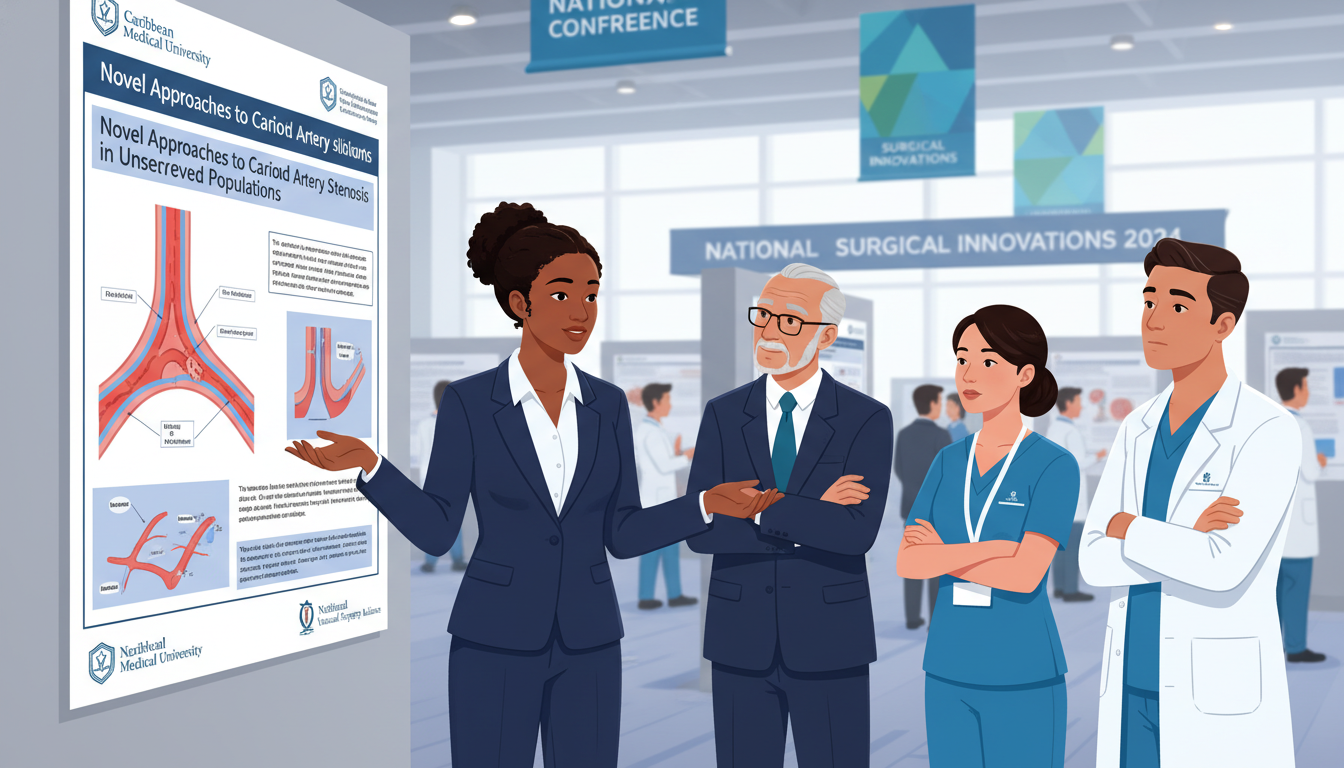
- Present oral or poster presentations at national meetings
- Potentially co‑mentor junior residents or medical students (which also helps if you work with SGU or other Caribbean medical school programs to involve students)
PGY‑5+ / Vascular Fellowship (if applicable): Consolidation
- Focus projects around your emerging niche (e.g., CLTI, aortic disease, dialysis access, carotid disease)
- Consider multi-center collaborations or prospective QI initiatives
- Prepare review articles or book chapters with your mentors
3. Telling a Coherent Story
Program directors and hiring committees value a consistent research story:
- Instead of 10 random topics, aim for 3–4 projects in a related domain:
- Example: “Amputation prevention and limb salvage outcomes in underserved populations”
- Narrative example for a Caribbean IMG:
- “As a graduate of a Caribbean medical school residency pathway, I became particularly interested in how health system barriers affect limb salvage. During my vascular training, I conducted a series of studies examining CLTI presentation patterns, time to intervention, and amputation disparities, including multi-center analyses using VQI data.”
This narrative builds a recognizable identity in the field.
4. Networking Through Research
Research is a powerful networking tool, especially for IMGs who may not have US medical school alumni networks.
Ways to leverage it:
- When presenting at conferences:
- Introduce yourself to discussants and senior faculty who ask questions
- Follow up with a short, polite email and attach your abstract or paper
- Offer collaboration:
- “If you’re ever looking for residents to help with multi-center vascular resident research projects, I’d be very interested in contributing.”
- Stay visible:
- Update your CV yearly with new projects
- Use professional platforms (e.g., LinkedIn, ResearchGate) to connect with vascular surgeons in your area of interest
Special Considerations for Caribbean IMGs: Overcoming Bias and Maximizing Opportunity
Caribbean IMGs often face implicit bias and skepticism, whether in an SGU residency match or other Caribbean medical school residency outcomes. Research excellence is one of the most practical and objective ways to counter that.
1. Turning Your Background Into an Asset
Your Caribbean training can positively shape your research profile:
- Perspective on underserved and resource-limited settings:
- You may be particularly attuned to delayed presentation, access issues, and diagnostic limitations, all central to vascular outcomes.
- Potential cross-border collaborations:
- You might collaborate with Caribbean institutions on vascular disease patterns, which can differentiate you from US grads.
You can position this explicitly:
- In personal statements for advanced positions
- In cover letters for academic residency track or faculty positions
- In presentations where you highlight your journey as a Caribbean IMG
2. Common Challenges and How to Address Them
Challenge 1: Less prior research experience
- Solution:
- Start with well-scoped projects and strong mentorship
- Take advantage of any institutional research workshops
- Be proactive in learning SPSS, Stata, R, or basic data analysis tools
Challenge 2: Time pressure in high-volume programs
- Solution:
- Share the load: join team-based projects where you focus on a component (e.g., data abstraction, literature review, drafting the discussion)
- Use micro-sessions and plan around call shifts
- Avoid overcommitting to too many projects
Challenge 3: Perceived “second-tier” training background
- Solution:
- Let your results speak: presentations at major meetings, first-author publications, strong letters from US vascular faculty
- Be consistently excellent in clinical performance and professional behavior—research builds on, not replaces, clinical credibility
3. Research and the Integrated Vascular Program Pathway
If you start in general surgery and are considering an integrated vascular program (either switching or reapplying):
- Research becomes even more important, as integrated vascular programs are highly competitive.
- Strategies:
- Seek vascular electives early and align with vascular faculty
- Get your name on vascular surgery papers before applying
- Highlight your progression from a Caribbean medical school residency pipeline to increasingly advanced vascular research
Even if you remain in a traditional general surgery → vascular fellowship route, a strong research foundation gives you an edge for top fellowships.
FAQs: Research During Residency for Caribbean IMGs in Vascular Surgery
1. I’m a Caribbean IMG with no prior publications. Is it too late to start in residency?
No. Many successful vascular surgeons began research during residency. The key is to:
- Quickly find a committed mentor
- Start with feasible projects (case reports, small retrospective reviews)
- Aim for at least one meaningful first‑author publication by mid‑residency
- Build a coherent research theme over time
Your trajectory—improvement and productivity during residency—is more important than how much you did as a student.
2. How much research do I need if I’m aiming for an academic career in vascular surgery?
There’s no absolute number, but for an academic trajectory, a typical competitive profile by the end of training might include:
- Several abstracts presented at national meetings (SVS, regional vascular societies)
- 3–6 peer‑reviewed publications, with at least 1–2 as first author
- A recognizable niche (e.g., CLTI outcomes, aortic disease, disparities, dialysis access)
Quality and impact matter more than raw quantity. Strong letters from research mentors and visible engagement at conferences can compensate for fewer but higher-quality projects.
3. Does research during residency help if I trained at a Caribbean medical school but am in a primarily community-based residency?
Yes. In fact, it may matter even more:
- It differentiates you from peers who may only have clinical experience.
- Even if your program is community-focused, you can:
- Do QI projects
- Collaborate with academic centers (e.g., via multi-center registries or research networks)
- Involve medical students from SGU or other Caribbean schools in your projects
- Well-executed community-based outcomes research can be highly publishable and relevant.
4. How can I find multi-center or national research during residency as a Caribbean IMG?
Options include:
- Ask your vascular mentors if they participate in:
- VQI-based collaborative projects
- SVS-sponsored registries
- Industry-sponsored device studies
- Network at conferences:
- Express interest in helping with multi-center projects
- Follow up after the meeting with specific offers to assist (e.g., data abstraction, coordinating with your institution’s IRB)
- Explore formal research collaboratives:
- Some regions or societies have resident-led initiatives where you can join as a site investigator.
Multi-center work strengthens your CV and connects you with a broader vascular community—especially valuable for Caribbean IMGs building their professional network from scratch.
By approaching research during residency strategically—choosing the right mentors, projects, and narrative—you can transform your status as a Caribbean IMG into a powerful, distinctive asset in vascular surgery. Research is not only a pathway to publications; it is a platform for credibility, opportunity, and long-term impact in a rapidly evolving specialty.