Why Research During Anesthesiology Residency Matters for DO Graduates
For a DO graduate entering anesthesiology, residency can feel packed already: long OR days, call, reading, boards, and adapting to a new culture. Adding “research during residency” to that list might seem unrealistic.
Yet for anesthesiology, research is becoming a key differentiator—especially for DO graduates who may still be overcoming lingering biases in competitive academic settings. Thoughtful involvement in research can:
- Strengthen fellowship applications (cardiac, critical care, pain, peds, regional)
- Boost credibility in programs where osteopathic training is less familiar
- Open doors to leadership and academic roles
- Make you a better clinician through deeper engagement with evidence
This article walks you through how a DO graduate in anesthesiology can realistically build a research portfolio during residency—even if you did minimal research in medical school, and even if you’re in a community-heavy program. We’ll cover strategy, logistics, and concrete examples tailored to the anesthesia match environment and the realities of residency.
Understanding the Value of Research for a DO in Anesthesiology
The unique position of a DO graduate
As a DO graduate, you bring strengths in whole-person care, physical exam skills, and often more clinical contact early in training. But in some anesthesiology residency environments, you may still encounter:
- Fewer faculty who trained in osteopathic programs
- Misconceptions about COMLEX vs. USMLE
- Questions about how your training compares
Research isn’t a cure-all, but it’s a highly visible way to demonstrate:
- Intellectual rigor
- Comfort with statistics and critical appraisal
- Commitment to advancing the field
When PDs and fellowship directors see your name on posters, abstracts, and papers, it reframes you not just as a trainee, but as a contributor to anesthesiology.
How research supports your career trajectory
Whether you see yourself in private practice or on an academic residency track, research during residency can:
Strengthen fellowship applications
- Competitive fellowships increasingly value scholarly activity.
- A DO graduate with robust resident research projects can stand out, especially when competing with MDs from strong research institutions.
Enhance your anesthesia match “story” (for prelim/transfers)
- If you’re considering a different academic environment later (e.g., a research-heavy fellowship or even a transfer), prior research signals you can thrive in that setting.
Develop critical thinking
- Learning to ask answerable questions, interpret data, and understand study design improves:
- How you read literature
- How you adopt or question new practices
- How you justify your clinical choices during M&M or QI meetings
- Learning to ask answerable questions, interpret data, and understand study design improves:
Build professional networks
- Co-authors, mentors, and collaborators can later:
- Write stronger letters
- Connect you to jobs and fellowships
- Invite you into multi-center trials or committees
- Co-authors, mentors, and collaborators can later:
Leverage osteopathic strengths
- You can bring an osteopathic lens to:
- Perioperative functional status
- Chronic pain and OMT-adjacent concepts
- Multidimensional perioperative risk (biopsychosocial)
- This gives you unique angles for study questions and grants.
- You can bring an osteopathic lens to:
Types of Research You Can Realistically Do During Anesthesia Residency
Not all research is a multi-year randomized trial. As a resident—especially in a demanding specialty like anesthesiology—you need projects that are:
- Feasible in small time blocks
- Comfortable under IRB and institutional timelines
- Clear in authorship roles
Here are the main categories and how they fit into a DO anesthesiology resident’s life.
1. Case Reports and Case Series
Why they’re ideal early on:
- Minimal statistical requirements
- Good entry point to IRB and writing
- Directly related to your OR and ICU experiences
Examples tailored to anesthesiology:
- Unusual intraoperative arrhythmia in a patient on an uncommon herbal supplement
- Difficult airway management in a patient with craniofacial abnormalities, tying in osteopathic structural considerations
- Rare anesthetic complication in a patient with EDS or severe spinal deformity
Action steps:
- Keep a small “research log” on your phone: interesting cases, MRN (stored securely per policy), key features, involved attending.
- Ask early: “Would this be a publishable case?” Once an attending agrees, move quickly before details fade.
- Target journals that welcome anesthesia case reports or DO-focused publications.
2. Retrospective Chart Reviews
These are the backbone of many resident research projects.
Why they work:
- You can leverage existing data (EHR, perioperative databases).
- Topics align well with anesthesia match and fellowship interests.
Anesthesia-specific examples:
- Comparing postoperative nausea and vomiting (PONV) rates before and after a departmental protocol change.
- Association between opioid-sparing techniques and PACU length of stay.
- Outcomes in patients receiving regional blocks vs. general anesthesia for specific surgeries.
DO-specific angle:
- Explore outcomes related to preoperative functional assessments or osteopathic structural findings (if documented).
- Examine differences in perioperative outcomes in patients followed in DO-run clinics vs. other settings (if identifiable and appropriate).
3. Quality Improvement (QI) Projects
QI projects can count as scholarly activity and often have lower barriers than formal research.
Common anesthesiology QI topics:
- Improving compliance with intraoperative temperature monitoring.
- Reducing delayed first-case starts.
- Increasing adherence to multimodal analgesia pathways.
Why they’re powerful:
- Direct impact on your department’s metrics.
- Often integrated into residency requirements.
- Frequently lead to posters at ASA, regional society meetings, or institutional QI days.
4. Prospective Observational Studies
More complex but high yield if designed well.
Examples:
- Observing hemodynamic responses to different induction regimens in high-risk cardiac patients.
- Tracking incidence of residual neuromuscular blockade with different reversal strategies.
- Collecting patient-reported outcomes for regional blocks and recovery quality.
These require stronger mentorship and IRB planning but can produce higher-impact publications.
5. Education and Simulation Research
If you’re interested in an academic residency track, education research is a natural fit.
Examples:
- Studying the impact of a new airway simulation curriculum on resident performance.
- Assessing how spaced repetition (e.g., Anki decks integrated into didactics) affects written board scores.
- Evaluating a structured feedback tool in OR teaching.

Getting Started: Step-by-Step Plan for a DO in Anesthesiology
Step 1: Clarify Your Goals and Constraints
Ask yourself:
- Do I want academia, private practice, or I’m undecided?
- Am I targeting a fellowship where research is weighted heavily (cardiac, ICU, pain)?
- How many hours per week can I realistically dedicate without compromising patient care or wellness?
For most PGY-2 CA-1 residents, aiming for 2–4 hours/week of research is a good starting point during non-ICU, non-call-heavy months.
Step 2: Map Your Program’s Research Landscape
As a DO graduate, you may not have the same built-in research exposure as some MD peers. Compensate with deliberate reconnaissance:
Identify key faculty:
- Who publishes regularly (check PubMed with your institution’s name)?
- Who leads resident research projects?
- Who is DO-friendly or trained in osteopathic institutions?
Use program resources:
- Ask chiefs or senior residents: “Who is good at helping residents complete projects?”
- Attend departmental research meetings or morbidity and mortality (M&M) conferences.
Look for existing datasets:
- Does your institution have a perioperative outcomes registry?
- Are there ongoing multi-center anesthesia studies you can join?
Step 3: Find a Mentor (or Two)
You do not need a superstar NIH-funded mentor. You need:
- Someone reliable
- Someone who finishes projects
- Someone familiar with the expectations of the anesthesia match ecosystem and fellowships
Strategy as a DO:
- Seek at least one mentor who actively supports DOs or is neutral and data-driven.
- Where possible, find:
- A content mentor (e.g., cardiac anesthesiologist)
- A methods mentor (e.g., someone comfortable with stats, QI, or education research)
How to approach them:
Email template structure:
- Briefly introduce yourself (PGY level, DO grad, interest area).
- State you’re looking to get involved in ongoing projects or start something feasible.
- Mention your realistic time availability.
- Attach a brief CV.
Make it easy for them to say yes by being specific and realistic.
Step 4: Start Small and Finish Something
Nothing impresses a PD or fellowship director more than completed work:
- Abstracts accepted
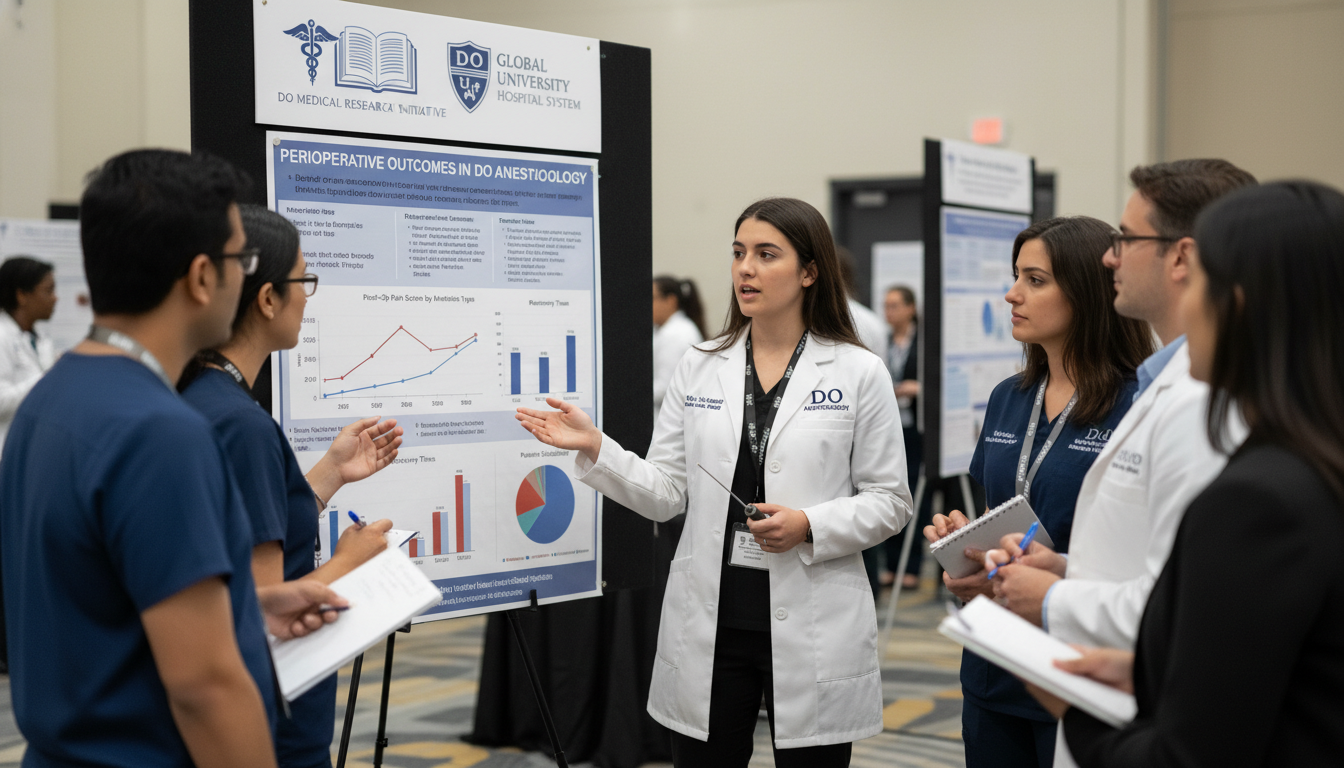
- Posters presented
- Manuscripts submitted (even under review)
Early wins to target as a CA-1:
- 1–2 case reports
- Joining a senior resident’s ongoing retrospective study
- A small QI project that can lead to a poster at a regional meeting
Once you’ve shown you can finish, mentors will entrust you with higher-impact resident research projects.
Step 5: Protect Research Time and Build Systems
Residency is chaotic; structure matters.
Systems that work:
- Block scheduling: Reserve a fixed 2-hour block on a post-call day (when appropriate) or on a lighter OR day to work on writing or data analysis.
- Task chunking:
- Week 1–2: IRB draft, background literature search
- Week 3–4: Data definitions, REDCap setup
- Following weeks: Data collection, then analysis, then drafting sections
- Use tools:
- Reference managers: Zotero, Mendeley
- Project management: Trello, Notion, or even a simple spreadsheet
- Shared drives: Maintain organized folders for protocols, data dictionaries, drafts
As a DO resident, showing you can manage time and projects professionally counters any assumption that you’re less prepared academically.
Building a Competitive Research Portfolio by PGY-4
If you start purposefully in CA-1, a realistic but strong research portfolio by graduation might include:
- 1–2 published or accepted manuscripts (case reports, retrospective studies, or education/QI)
- 2–4 abstracts or posters at regional or national meetings (ASA, SCA, ASRA, SCCM, AAPM)
- Documented involvement in at least one meaningful QI initiative
Aligning Research with Future Plans
If you’re targeting an academic residency track or fellowship
Prioritize:
- A focused theme (e.g., “cardiac outcomes,” “regional anesthesia and pain,” “ICU hemodynamics,” “education research”)
- Projects that can lead to multi-author manuscripts
- Presentations at national meetings to get on programs’ radar
Explicitly highlight in your CV and personal statement:
- Your research focus
- Your role (design, data collection, analysis, first author)
- Outcomes (awards, invited talks, guidelines, or practice changes)
If you’re planning on community or private practice
Research still matters, but you can tailor it:
- Emphasize QI projects that mirror private practice concerns:
- On-time starts
- PACU throughput
- ERAS pathway adherence
- Focus on topics such as:
- Opioid stewardship
- Cost-effectiveness of anesthesia techniques
- Patient satisfaction and perioperative communication
Programs appreciate residents who can translate data into practice improvements—skills that extend beyond academic walls.

Practical Tips: Time, Productivity, and Common Pitfalls
Managing Time During a Busy Residency
- Cap active projects: Aim to be deeply involved in 1–2 projects at any time. Being “on” 8 dormant projects rarely leads to completed work.
- Leverage research months/electives:
- If available, front-load data collection and analysis.
- Use this time to learn basic statistics (R, SPSS, or Stata with institutional support).
- Use “micro-blocks” productively:
- 15–20 minutes between cases: update a reference list, do a quick PubMed search, or draft a figure legend.
- Commutes (audio): listen to podcasts or lectures on research methods and stats.
Choosing the Right Collaborators
Favor mentors who:
- Have a track record of resident publications.
- Respond to emails in a timely way.
- Respect your call schedule and duty hours.
Be clear about authorship early:
- Ask: “If I lead data collection and initial drafting, would I be first author?”
- Get expectations in writing (email is fine) to avoid conflict later.
Avoiding Common Pitfalls for DO Residents
Overcommitting early
- As a DO graduate eager to prove yourself, it’s tempting to say yes to everything. Overextension leads to stalled projects and burnout.
Not clarifying expectations
- Some mentors may assume you have more research background than you do. Be honest about your experience; most will gladly teach the basics.
Ignoring IRB and compliance details
- Even “simple” projects must be vetted. Learn:
- Your institution’s IRB workflow
- Who can help (research coordinators, IRB office)
- Mishandling this can delay or block publication.
- Even “simple” projects must be vetted. Learn:
Under-documenting your work
- Keep a running document of:
- Project titles, your role, dates
- Abstract submissions and acceptances
- Presentations given
- This makes it easy when it’s time to apply for chief, fellowships, or jobs.
- Keep a running document of:
Positioning Your Research for Maximum Impact
Presenting at Meetings
Focus on venues recognized in anesthesiology and perioperative medicine:
National meetings
- American Society of Anesthesiologists (ASA)
- Society of Cardiovascular Anesthesiologists (SCA)
- American Society of Regional Anesthesia and Pain Medicine (ASRA)
- Society of Critical Care Medicine (SCCM)
Regional or state anesthesia societies
- Easier acceptance rates
- Great practice for national presentations
Tips:
- When submitting abstracts, explicitly mention your role (first author, presenting author).
- If funding is an issue, ask your program about:
- Resident travel grants
- Institutional funding for conference presentations
Turning Posters into Publications
Many resident research projects die at the poster stage. To avoid this:
- Set a deadline to convert the poster into a manuscript (e.g., within 3–6 months of the meeting).
- Use the poster layout as a skeleton for your paper:
- Background → Introduction
- Methods → Methods section
- Results → Expanded Results with tables/figures
- Conclusion → Discussion
Ask your mentor early: “Which journal should we target?” so you can structure word count and formatting accordingly.
Highlighting Research in Fellowship and Job Applications
When applying for fellowship or jobs:
- Include a distinct “Research and Scholarly Activity” section on your CV.
- Emphasize:
- Completed projects (published or accepted)
- Ongoing projects with clear status (e.g., “Manuscript in revision”)
- During interviews, be ready to succinctly:
- Explain your key project
- Describe your role
- Share what you learned (clinical implications, methodological insights)
For DO graduates, this is also an opportunity to show how your osteopathic background informed research questions, especially in pain, functional outcomes, or holistic perioperative assessment.
Frequently Asked Questions (FAQ)
1. I did almost no research in medical school as a DO. Am I too late to start in residency?
No. Many anesthesiology residents, DO and MD, begin formal research during residency. Start small with case reports or QI projects, find a mentor, and aim to finish at least one project early in residency. Consistent progress from CA-1 onward can still yield a strong scholarly profile by graduation.
2. My program is more community-focused. Can I still build a research portfolio?
Yes. Community or hybrid programs often have rich clinical volumes and excellent opportunities for retrospective studies and QI. Focus on:
- Practical, high-yield topics (PONV, ERAS pathways, PACU throughput, opioid stewardship).
- Partnering with a research-friendly attending or a system-wide QI office. If necessary, consider multi-center collaborations or mentorship from nearby academic institutions.
3. How much research do I need for a competitive anesthesiology fellowship as a DO graduate?
There is no strict number, but a profile that stands out typically includes:
- At least 1–2 peer-reviewed publications (case reports or original research).
- Several abstracts/posters at reputable meetings.
- Evidence of sustained interest in a field related to your targeted fellowship (e.g., cardiac, ICU, pain). Strong letters highlighting your role and initiative in resident research projects can be as important as raw numbers.
4. Do I need advanced statistics skills to do meaningful research during residency?
Not at the beginning. You should:
- Understand basic concepts (p-values, confidence intervals, common study designs).
- Be able to interpret primary outcomes and limitations of a study. Most institutions provide access to biostatistical support. Over time, learning basic analysis (e.g., using R or SPSS with guidance) will make you more independent and valuable as a collaborator, especially if you envision an academic residency track.
By approaching research during residency intentionally—choosing feasible projects, finding committed mentors, and steadily building your skills—you can transform your DO background into a distinctive strength in anesthesiology. Your scholarly work will not only enhance your anesthesia match and fellowship prospects but also shape you into a clinician who practices with curiosity, evidence, and impact.