Why Research During Emergency Medicine Residency Matters
Research during residency in emergency medicine (EM) is no longer a niche interest reserved for future physician-scientists. Increasingly, it’s part of the core identity of many programs and a key differentiator in the EM match and beyond. Whether you’re headed for an academic emergency medicine career, a community ED, or a hybrid pathway, resident research projects can shape how you think, how competitive you are for fellowships and jobs, and how you contribute to the specialty.
Emergency medicine uniquely lends itself to meaningful research:
- You see undifferentiated patients with a wide spectrum of pathology.
- You work at the interface of multiple specialties.
- You practice in a fast-paced, data-rich environment (EHR, EMS data, registries).
- You have exposure to quality improvement, operations, and systems-based care.
This guide will unpack why and how to pursue research during residency in emergency medicine, how to choose projects, navigate time constraints, and leverage an academic residency track if that’s your goal.
Understanding the Role of Research in Emergency Medicine
Why EM Programs Care About Resident Research
Most EM residency programs now emphasize scholarly activity, even those that are not explicitly research-heavy. Reasons include:
- Accreditation requirements: ACGME requires documentation of scholarly activity by both residents and faculty.
- Culture of inquiry: Research fosters critical thinking, evidence-based practice, and intellectual curiosity.
- Program reputation: Publications, presentations, and grants enhance the visibility and prestige of the department.
- Recruitment and retention: Strong research opportunities help attract competitive candidates in the EM match and retain them as junior faculty.
Even programs that brand themselves as “community-focused” or “clinically heavy” usually have at least some pathway for residents interested in research during residency.
Why Research Matters for You as a Resident
You don’t need to be a future PhD or NIH-funded PI to benefit from research. Concrete benefits include:
- Stronger clinical reasoning: Designing a study forces you to interrogate assumptions and interpret literature more critically.
- Competitive edge for fellowships: EMS, ultrasound, critical care, toxicology, and pediatric EM fellowships often favor candidates with a research track record.
- Versatility in career options: Academic positions and some leadership roles look for evidence of scholarly productivity.
- Professional network: Working on resident research projects connects you with faculty, statisticians, and collaborators across departments.
- Skill development: You’ll gain competency in study design, data interpretation, and scientific communication—skills that translate directly to quality improvement and operational projects later in your career.
Academic vs. Community Career Paths
- Academic track: Research experience is often expected. An academic residency track or research-focused EM program can jump-start this path.
- Hybrid roles: Many faculty work clinically in busy EDs while participating in a modest but consistent stream of scholarly work (e.g., a few projects per year).
- Community practice: Even if you plan to work primarily in the community, experience with research during residency can prepare you to lead QI initiatives, introduce new protocols, or collaborate with regional hospital systems on outcomes projects.
Your goal doesn’t have to be “publish in NEJM.” A well-done, realistic project in residency can be far more valuable than an overly ambitious study that never finishes.
Types of Research You Can Do in EM Residency
Emergency medicine is broad, and so are the types of resident research projects you can choose. Knowing the main “buckets” helps you identify what fits your interests, skills, and time constraints.
1. Clinical Research
Definition: Studies involving patient care, diagnosis, treatment, or outcomes in the ED setting.
Examples:
- Retrospective chart review on sepsis bundle compliance and ED mortality.
- Prospective study on a new triage tool for chest pain patients.
- Observational study of pediatric asthma management in the ED.
Pros:
- Directly relevant to your day-to-day clinical practice.
- Often easier to “sell” to EM faculty and journals.
- Can use existing ED data (EHR, registries).
Cons:
- IRB and data access can be time-consuming.
- Prospective projects can be vulnerable to enrollment challenges (patient volumes, consent issues).
2. Quality Improvement (QI) and Operations Research
Definition: Projects aimed at improving systems, workflows, patient safety, or efficiency.
Examples:
- Reducing “left without being seen” rates through triage process changes.
- Improving ED-to-ICU handoff quality via standardized checklists.
- Implementing a new order set and measuring impact on door-to-antibiotic time.
Pros:
- Often aligns with institutional priorities and leadership support.
- May involve simpler IRB or be exempt as QI.
- Highly translatable to future leadership roles in ED administration.
Cons:
- Publication may require careful framing (QI vs. research).
- Data can be messy, and causality is hard to establish.
3. Medical Education Research
Definition: Studies about how we teach and learn in emergency medicine.
Examples:
- Evaluating a new ultrasound curriculum for interns.
- Assessing the impact of simulation-based training on team performance.
- Studying burnout and wellness interventions for residents.
Pros:
- Great fit if you’re drawn to teaching or future program leadership.
- Often integrates naturally with your role as a resident educator.
- Many EM education conferences welcome this work.
Cons:
- Methodology (surveys, qualitative analysis) may be unfamiliar at first.
- Outcomes can be subjective (perceptions, satisfaction) rather than hard clinical endpoints.
4. Ultrasound, EMS, and Subspecialty Research
Emergency ultrasound: Image quality, diagnostic accuracy, new protocols (e.g., RUSH exams, cardiac arrest echo).
EMS: Prehospital care, triage criteria, airway choices in the field, telemedicine applications.
Toxicology, critical care, pediatric EM, global EM: Each has its own research culture and mentors.
Pros:
- Strong link to popular EM fellowships and subspecialty careers.
- Often have dedicated faculty champions and infrastructure.
Cons:
- May require niche skills or equipment.
- Some projects depend on partnerships (EMS agencies, ICU, poison centers).
5. Secondary Research: Reviews, Meta-analyses, and Education Products
If you have limited time for prospective data collection, consider:
- Systematic or scoping reviews.
- Meta-analyses (often with mentorship and statistical support).
- Evidence-based clinical guidelines or protocols.
- Online educational resources (blogs, podcasts) tied to scholarly output.
These can still be meaningful scholarly work that bolsters your CV and teaches you how to synthesize literature.

Getting Started: Finding a Research Niche and Mentorship
Step 1: Clarify Your Goals
Ask yourself:
- Do I see research as:
- A core part of my career (academic residency track, fellowship, junior faculty)?
- A secondary interest (occasional projects, mainly QI/education)?
- A requirement I want to fulfill efficiently but well?
Your answer will guide the scope and ambition of your projects.
Step 2: Take Inventory of Your Interests and Skills
Reflect on:
- Clinical areas you find intriguing (e.g., resuscitation, ultrasound, toxicology).
- Nonclinical interests (education, global health, health equity, informatics).
- Strengths from prior experiences (statistics, programming, writing, public health).
Example: If you have a biostatistics background and love operations, ED throughput and predictive modeling might be your niche.
Step 3: Learn the Research Landscape at Your Program
Early in PGY-1 (or even before the EM match, if possible):
- Review your department’s recent publications and conference abstracts.
- Identify which faculty publish regularly and in what areas.
- Ask senior residents who has been a strong mentor and which projects actually finish.
Look for:
- Ongoing projects that need help (data collection, literature review).
- Infrastructure: research assistants, ED research coordinators, statisticians, IRB support.
- Formal structures: research track, protected time, resident research requirements.
Step 4: Find a Primary Mentor (and Maybe a Team)
A strong mentor is often more important than a perfect project idea. Ideal mentor qualities:
- Active in scholarship (publishing, presenting, or leading QI).
- Available and responsive.
- Realistic about resident time constraints.
- Willing to help you navigate IRB, data, and authorship issues.
In EM, especially at academic centers, consider a mentorship team:
- Primary EM research mentor.
- Methodologist or statistician.
- Content expert (e.g., ICU attending for sepsis project).
- Educational mentor if your project is med-ed focused.
Step 5: Start Smaller Than You Think
Ambition is good, but residency is busy. Aiming for a manageable first project is usually wise:
- A retrospective chart review instead of a large RCT.
- A single-site pilot QI project rather than a multi-center trial.
- A focused med-ed curriculum evaluation instead of a broad, multi-year initiative.
You can always scale successful pilot work into larger studies, especially if you stay on as faculty or do a fellowship.
Designing and Executing a Resident Research Project
Identifying a Feasible Research Question
Good research questions in residency share three traits:
- Clinically relevant: Align with real ED challenges.
- Methodologically feasible: Can be done with your program’s resources.
- Timeline-appropriate: Achievable within 1–2 years (often less).
Use the FINER criteria:
- Feasible
- Interesting
- Novel
- Ethical
- Relevant
Example (Strong Question):
“In adult patients presenting to our ED with suspected sepsis, does implementation of a standardized triage protocol reduce time to first antibiotic dose compared with usual care?”
Choosing a Study Design that Fits Residency Life
Common designs for EM resident research projects:
- Retrospective cohort: Uses existing records; good for outcomes, associations.
- Prospective observational: Enrolls patients as they arrive; useful for risk scores, diagnostic tools.
- Before-after QI intervention: Measures change after implementation of a new protocol.
- Survey studies: For attitudes, behaviors, educational outcomes (requires good survey design).
- Simulation studies: Team performance, procedural training.
Choose the design that achieves your goal with the fewest moving parts. Prospective RCTs are rarely realistic as a first resident project.
Navigating IRB and Regulatory Issues
- Meet with your mentor and possibly a research coordinator before drafting your IRB.
- Clarify whether your project is research or QI; this affects approvals and timelines.
- Use institutional templates for protocols and consent forms.
- Start the IRB process early—approvals can take weeks to months.
Tip: Many EM departments have “standard” language and templates for chart reviews, minimal-risk studies, and consent processes. Ask for these to save time.
Data Collection and Management
Poor data is the fastest way to sabotage a project. To avoid this:
- Create a detailed data dictionary (variables, definitions, coding rules).
- Pilot test your data collection form on a small number of charts or patients.
- Use secure, approved tools (e.g., REDCap) for data entry and storage.
- Train anyone helping you (co-residents, students, RAs) with a brief written protocol.
Plan how you’ll:
- Handle missing data.
- Check for data entry errors.
- De-identify data to protect patients.
Basic Statistics and Analysis Planning
You don’t need to be a statistician, but you do need:
- A clear primary outcome.
- A small set of key secondary outcomes or exploratory analyses.
- A priori plan for what tests you’ll use (e.g., chi-square, t-test, logistic regression).
Seek help from:
- A statistician (often available through your institution).
- A faculty member experienced in analysis.
- Research curriculum or workshops if your program offers them.
Decide sample size expectations early (even rough) so you don’t end up underpowered without realizing it.
Writing and Disseminating Your Work
Aim for dissemination beyond your own residency:
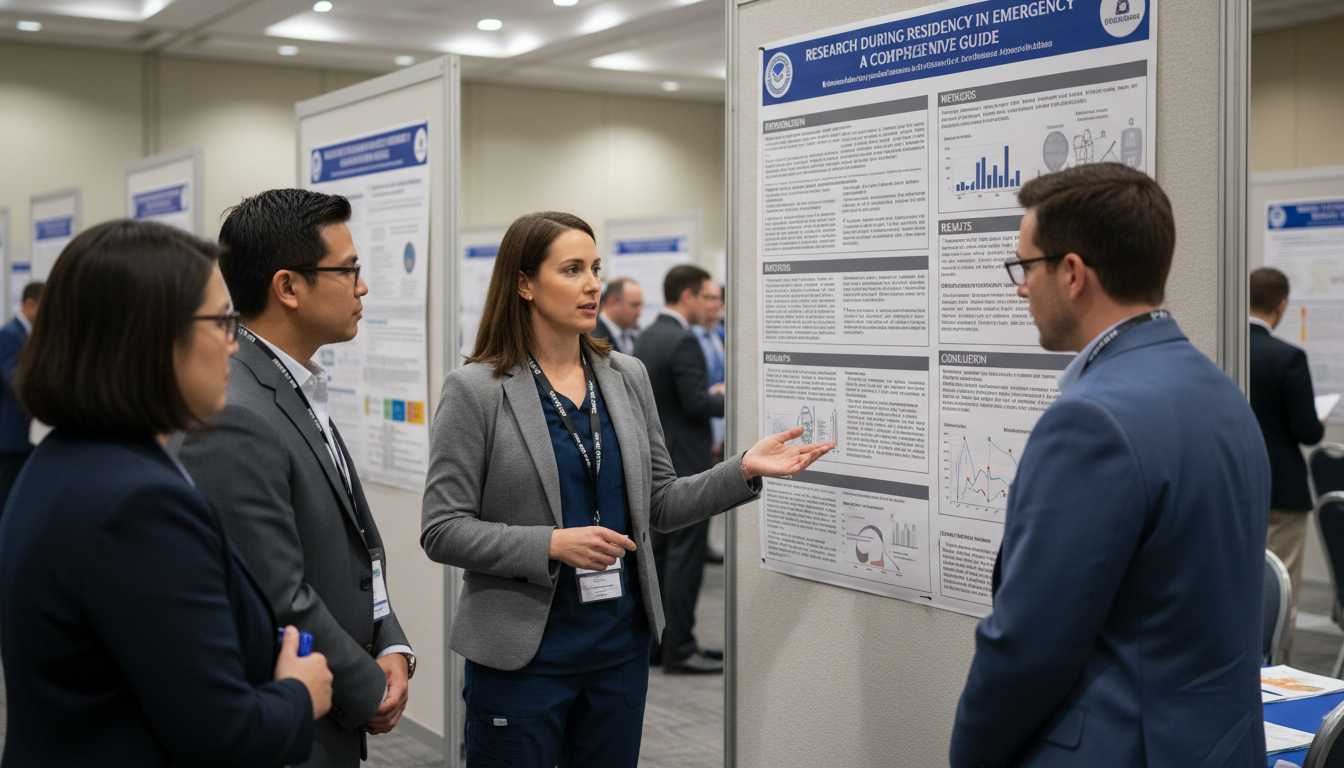
- Abstracts to regional or national EM conferences (SAEM, ACEP, AAEM, CORD, etc.).
- Poster or oral presentations at your institution’s research day.
- Manuscripts to EM journals or subspecialty journals.
Writing tips:
- Start with the methods (often easiest) while you’re still in the data phase.
- Use published papers in your topic area as structural models.
- Meet with your mentor regularly to get drafts moving.
- Set internal deadlines (first draft, co-author review, submission).
Balancing Research with Clinical Work and Life
Time Management Strategies
Emergency medicine schedules are irregular, which can be both a challenge and an advantage:
- Use lighter rotations (e.g., elective, ultrasound, research month) for concentrated writing and analysis.
- Block off regular “research sessions” on your calendar (e.g., two 2-hour blocks per week).
- Batch similar tasks: literature search one week, data collection sessions another, then dedicated writing days.
Treat your research time with the same respect as your shifts: show up, stay focused, minimize distractions.
Choosing the Right Number of Projects
More projects are not always better. Consider:
- One primary project you are first author on (your main scholarly identity).
- One or two supporting roles (data collector, middle author) on others’ projects, if time permits.
Overcommitting:
- Leads to burnout.
- Increases risk of unfinished work.
- Weakens the quality of each project.
Leveraging Academic Residency Tracks and Protected Time
Many EM programs offer an academic residency track or scholarship track, which might include:
- Protected research time during certain rotations.
- Formal mentorship and regular research seminars.
- Support to attend and present at national meetings.
- Opportunities to co-author with faculty on ongoing studies.
If you are strongly interested in research during residency:
- Ask about academic tracks during interviews and before you rank programs in the EM match.
- Clarify what “protected time” truly means (is it really free of clinical and non-research duties?).
- Explore whether fifth-year chief resident positions or junior faculty roles support continuation of projects.
Avoiding Common Pitfalls
Common challenges and how to counter them:
- Scope creep: Keep revisiting your original aims and timelines.
- Perfectionism: A solid, finished project is better than an “ideal” but incomplete one.
- Communication gaps: Schedule recurring check-ins with your mentor and project team.
- Burnout risk: Protect sleep, exercise, and nonclinical time; research should enhance, not destroy, your residency experience.
Maximizing the Career Impact of Your Research
Aligning Projects with Your Long-Term Plans
Think strategically about how your resident research projects tell a story:
- Interested in critical care? Focus on sepsis, shock, airway, post-arrest care.
- Interested in EMS? Get involved with prehospital protocols, out-of-hospital cardiac arrest research.
- Interested in ultrasound? Combine clinical questions with image acquisition or interpretation studies.
- Interested in med-ed? Study simulation, assessment, or curriculum development.
A small portfolio of related projects often looks stronger than a scattered mix of unrelated topics.
Building a Scholarly Brand
During residency, you can start to build a modest scholarly brand by:
- Consistently working in a niche area (e.g., ED pain management, geriatric EM).
- Presenting at multiple venues (local, regional, national).
- Co-authoring review articles or book chapters in your interest area.
- Participating in national EM organizations’ committees or interest groups aligned with your niche.
This can help when applying to:
- Fellowships.
- Academic junior faculty jobs.
- Leadership roles in professional societies.
Presenting Yourself on Applications and in Interviews
When you apply for fellowships or jobs:
- Highlight your role in each project (conceptualization, data collection, stats, writing).
- Emphasize outcomes: accepted abstracts, posters, oral presentations, publications.
- Be ready to discuss:
- What question you asked and why.
- What you found (or didn’t find) and what it means.
- What you learned about research (challenges, problem solving).
Programs and employers understand that resident projects can have limitations; they mainly look for evidence of curiosity, persistence, and thoughtful engagement with evidence.
Transitioning Projects Beyond Residency
If you’re leaving your residency site:
- Plan for handoff of ongoing projects (to junior residents, faculty, or incoming fellows).
- Clarify authorship expectations early, especially if you’ll be working on the manuscript after graduation.
- If you’re staying in the same system (as a fellow or faculty), consider how your residency project can be the foundation for:
- Larger multi-center studies.
- Grant applications.
- Longitudinal QI initiatives.
FAQs About Research During Emergency Medicine Residency
1. Do I need research experience to match into an emergency medicine residency?
You don’t strictly need prior research to match EM, especially for community-focused programs. However, in a competitive EM match environment, having some scholarly work (even small projects, case reports, or QI) can:
- Demonstrate initiative and curiosity.
- Differentiate you from other applicants.
- Show comfort with evidence-based medicine.
For applicants targeting research-heavy academic programs or an academic residency track, meaningful research experience before residency is particularly advantageous.
2. How much research is realistic during a busy EM residency?
Realistically, most EM residents can complete:
- One primary project (with a manuscript drafted or submitted).
- One or two secondary roles on collaborators’ projects.
Programs with strong infrastructure or academic tracks may support more, but quality and completion matter more than quantity. Aim for at least one substantial, well-executed project rather than many half-finished efforts.
3. I’m interested in a community EM career. Is research still worth doing?
Yes. Even if you plan to practice in a community ED, research during residency can:
- Prepare you to lead QI initiatives and protocol changes.
- Strengthen your ability to critically appraise new evidence.
- Make you more competitive for leadership roles within your group or hospital.
- Give you skills to collaborate with academic centers on outcomes or registry projects.
Your research does not need to be highly technical; practical QI and operations work can be especially valuable in community practice.
4. What if I start a project and it seems like it’s failing?
Most projects encounter obstacles—slow enrollment, data issues, negative or inconclusive results. This is normal. Steps to take:
- Talk with your mentor early; adjust aims or methods if needed.
- Consider reframing: a “negative” or feasibility study can still be publishable.
- If a project truly cannot be salvaged, aim to extract some value:
- Use your experience to improve your next project design.
- Present lessons learned at a local conference or resident research day.
- Contribute your partial data as pilot work for a future, improved study.
The resilience and insight you gain from a “failing” project are often as educational as a smooth, successful one.
Research during residency in emergency medicine can be a powerful catalyst for your development as a clinician, educator, and leader. By choosing feasible questions, finding strong mentorship, leveraging your program’s resources, and aligning your projects with your long-term goals, you can create a scholarly experience that enhances—not overwhelms—your training and sets you up for a fulfilling EM career.