Why Research During Residency Matters in Global Health
Research during residency is one of the most powerful ways to shape a meaningful career in global health. Whether you imagine yourself leading international medicine initiatives, designing interventions for underserved populations, or pursuing an academic residency track, developing research skills early will expand your impact, career options, and credibility.
In global health, research is not just about publications. It is about:
- Asking answerable questions that matter to communities
- Generating data to improve care in low-resource settings
- Evaluating whether global health residency track initiatives are working
- Ensuring that well-intentioned projects actually help—and do no harm
This guide walks you through how to plan, execute, and leverage research during residency with a focus on global health. It’s written for medical students and early residents who want to integrate research into a busy training schedule without losing sight of clinical priorities and community needs.
Understanding the Landscape: Research in Global Health Residency
Global health is broad, and so are the research opportunities. Before you dive into a project, it helps to understand the types of research that fit well within residency constraints and global health priorities.
Common Types of Global Health Research During Residency
Clinical outcomes research
- Example: Comparing maternal morbidity before and after introduction of a new antenatal screening protocol at a district hospital.
- Typical outputs: Retrospective chart reviews, prospective cohort studies, quality improvement (QI) initiatives.
Implementation science and quality improvement
- Example: Studying how best to implement a new tuberculosis screening algorithm in a rural clinic.
- Focus: “How do we make this work in this context?” rather than “Does this work in perfect conditions?”
- Highly aligned with hospital priorities and often very feasible in residency.
Health systems and policy research
- Example: Evaluating the effects of task-shifting HIV care from physicians to nurse practitioners.
- Methods: Mixed methods, program evaluation, policy analysis.
Community-based and public health research
- Example: Assessing vaccination coverage in an informal settlement and identifying barriers to immunization.
- Methods: Household surveys, focus groups, participatory research with community members.
Medical education research in global health
- Example: Examining whether a global health residency track improves resident competency in cross-cultural care.
- Particularly relevant if you are in or applying to an academic residency track with a global health emphasis.
Where Research Fits in Different Residency Pathways
Global health residency track
- Often includes protected time for international medicine projects, mentorship in global health research, and sometimes required scholarly work.
- You may have structured guidance on identifying feasible resident research projects aligned with institutional global partnerships.
Academic residency track
- Designed for trainees who anticipate careers in academic medicine.
- May provide extended research blocks, seminars in research methods, and expectations for submission to conferences or journals.
Standard clinical track
- Research is still possible, but may require more self-direction and careful time management.
- Quality improvement projects and smaller retrospective studies can be ideal starting points.
Residents in any track can contribute meaningfully to global health research. The key is aligning your interests and capacity with the resources available and the priorities of partner institutions.
Choosing a Feasible and Ethical Global Health Research Project
Selecting the right project is the single most important step. A well-chosen project sets you up for success; an overly ambitious or poorly scoped project can lead to burnout and unfinished work.
Principles for Choosing a Resident-Friendly Project
Use these criteria as a checklist:
Feasible within your time and training level
- Aim for projects that can:
- Be designed within 1–3 months
- Collect data in 6–12 months
- Be analyzed and written up in another 3–6 months
- Avoid large, multi-year cohort studies as the primary project unless you are joining an existing team.
- Aim for projects that can:
Supports local priorities, not just your CV
- Ask: “If I left tomorrow and never published, what piece of this work would still be useful to the local team?”
- Align with needs expressed by local clinicians, ministries of health, or community organizations.
Ethically sound and non-extractive
- Ensure community and local investigators are involved from the beginning.
- Plan for sharing results in accessible formats with local partners.
Methodologically manageable
- Start with designs you can learn quickly and execute well:
- Retrospective chart review
- Cross-sectional survey
- QI project using PDSA (Plan–Do–Study–Act) cycles
- Simple pre–post intervention study
- Collaborate with experienced mentors for anything more complex.
- Start with designs you can learn quickly and execute well:
Mentor and resource availability
- Confirm you have:
- At least one mentor with content expertise (e.g., HIV, maternal health, non-communicable diseases)
- One mentor with methodologic expertise (e.g., epidemiology, biostatistics, qualitative research)
- Confirm you have:
Examples of Realistic Global Health Resident Research Projects
Retrofit and evaluate a triage system
- Question: Does implementing an emergency triage score reduce waiting time and in-hospital mortality for high-acuity patients?
- Setting: District hospital emergency department in a low-resource region.
- Design: Pre–post observational study using routinely collected data.
Antibiotic stewardship in a mission hospital
- Question: Are antibiotics being prescribed appropriately for pediatric respiratory infections?
- Design: Retrospective chart review comparing prescriptions with WHO or national guidelines.
- Impact: Identifies overuse patterns and informs a stewardship intervention.
Barriers to antenatal care utilization
- Question: What are the main barriers that pregnant women face in attending four or more antenatal visits?
- Design: Mixed methods—quantitative survey plus focus groups with pregnant women and community health workers.
- Impact: Directly informs local outreach strategies or policy changes.
Telemedicine follow-up for chronic disease
- Question: Does nurse-led phone follow-up improve medication adherence among patients with hypertension or diabetes?
- Design: Simple prospective cohort or pragmatic randomized trial, depending on resources.
Avoiding Common Pitfalls at the Project Selection Stage
- Overly complex statistics: If your project needs advanced modeling (e.g., multi-level structural equation modeling), reconsider unless strong biostatistical support is guaranteed.
- Data you cannot access or control: Cross-country datasets owned by ministries or NGOs can be hard to obtain or clean within residency timelines.
- Unclear ownership and authorship: Clarify roles early with mentors and partners, including first authorship, corresponding author, and local co-authors.

Building Your Research Plan: From Question to Protocol
Once you have a feasible idea, you need a structured plan. This is especially critical when your clinical schedule is busy and fragmented.
Step 1: Clarify Your Research Question
Use the PICO framework for clinical questions:
- Patient/Population: Who is the focus? (e.g., adults with HIV at a rural clinic)
- Intervention/Exposure: What are you studying? (e.g., same-day ART initiation)
- Comparison: What are you comparing to? (e.g., delayed initiation)
- Outcome: What outcome matters? (e.g., retention in care at 12 months)
For policy/implementation questions, frameworks like SPICE (Setting, Perspective, Intervention, Comparison, Evaluation) or PEO (Population, Exposure, Outcome) can be more appropriate.
Example PICO in international medicine:
- P: Adults with newly diagnosed HIV at a district hospital clinic
- I: Same-day ART initiation
- C: ART initiation >7 days after diagnosis
- O: Retention in care at 12 months
Step 2: Choose a Study Design That Fits
Match the design to both your question and your constraints.
Retrospective chart review
- Best when data already exist in paper or electronic records.
- Lower cost and time, but data quality may be variable.
Prospective observational study
- Good for follow-up outcomes; allows you to define data collection from the start.
- Requires systems to track patients over time.
Intervention/QI study
- Ideal in hospitals where practice can realistically change.
- Often easier to gain institutional support, as improvements are tangible.
Qualitative or mixed methods
- Essential for understanding context, culture, and behavior.
- Feasible in smaller samples (e.g., 15–30 interviews), but requires training in interviewing and analysis.
Step 3: Plan for Ethics and Regulatory Approvals
Global health research nearly always involves multiple layers of review:
Home institution IRB
- Required if your residency program is in a different country.
- May require formal data-use agreements with partner sites.
Local ethics committee or IRB
- Non-negotiable when working with human subjects in another country.
- Factor in variable timelines (often 2–6 months or more).
Ministry of health or NGO approvals
- Often needed if using national program data or working through specific clinics/programs.
Build these timelines into your overall plan. For a 3-year residency, aim to:
- Finalize your proposal in PGY-1 or early PGY-2
- Obtain approvals by mid-PGY-2
- Collect data late PGY-2 through early PGY-3
- Focus on analysis and dissemination in PGY-3
Step 4: Develop a Practical Data Collection Plan
In low-resource settings, ideal solutions may not be available. Plan for:
- Paper-based tools that can later be double-entered into a database (e.g., REDCap, Excel, OpenClinica)
- Standardized forms to minimize missing or inconsistent data
- Training for local collaborators who will help with data entry or collection
- Backup strategies for:
- Power outages
- Internet connectivity issues
- Staff turnover
Step 5: Map Out a Timeline Around Your Rotations
Create a Gantt-style timeline (even a simple one in a spreadsheet) that includes:
- Proposal writing and mentor meetings
- IRB submission and revisions
- Time-limited data collection windows
- Specific analysis tasks (e.g., descriptive stats, regression, thematic coding)
- Drafting an abstract, presentation, and manuscript
Be explicit: for each 4-week block of residency, note what’s realistically achievable. Build in buffer time around intense rotations like ICU or night float.
Integrating Research into a Busy Residency Schedule
The biggest challenge is rarely motivation—it’s competing priorities. Knowing how to integrate research into your workflow is critical.
Using Different Levels of Research Engagement
Think about three “layers” of engagement:
Foundational participation (low time, high learning)
- Join an existing project as a co-investigator or data collector.
- Tasks: data extraction, literature review, assisting in manuscript revisions.
- Benefit: learn the mechanics of research without bearing full responsibility.
Primary resident research project (moderate to high time)
- A project where you are first author and primary driver.
- Typically the core scholarly requirement for graduation.
Long-term career-building projects (lower intensity but extended)
- Multi-center or multi-year studies led by your mentors.
- You might join for a specific analysis or sub-study and stay involved beyond residency.
Aim to have at least:
- One main project where you are first author
- One or two smaller roles in other projects for additional publications and learning
Time Management Strategies That Actually Work
Block your calendar weekly
- Reserve 2–4 hours per week, every week, even on busy rotations.
- Treat research time like a standing clinic or conference: non-negotiable unless an emergency arises.
Use “micro-tasks”
- Break work into small chunks you can finish in 20–30 minutes:
- Write one paragraph of the introduction
- Clean one variable in your dataset
- Draft 5 survey questions
- This prevents paralysis during limited free time.
- Break work into small chunks you can finish in 20–30 minutes:
Leverage lighter rotations
- Front-load heavier tasks (protocol drafting, IRB prep, quantitative analysis) onto ambulatory or elective rotations.
- Use ICU and night float for simpler tasks (reading papers, commenting on drafts).
Collaborate smartly
- Share workload with co-residents: one person leads data extraction, another focuses on analysis, another on writing.
- Clearly define authorship and roles early to minimize conflict.
Collaborating With Global Partners
Sustainable, ethical global health research is inherently collaborative.
Engage local stakeholders from the start
- Ask partners which questions matter to them.
- Include local clinicians, data managers, and trainees as co-authors.
Be realistic and transparent about your availability
- If you can only visit a site for 4–8 weeks, design a project that can continue without you.
- Set up regular virtual check-ins (e.g., monthly) across time zones.
Plan for continuity
- Hand off data collection or follow-up responsibilities to local team members.
- Enlist junior residents or students to extend your project beyond your graduation.
Turning Projects Into Impact: Analysis, Dissemination, and Career Building
Doing research is only half the story; translating it into impact for patients, communities, and your own career is the other half.
Basic Analysis Strategies for Residents
If you’re new to statistics or qualitative methods, start with structured support.
Quantitative basics
- Descriptive statistics: means, medians, proportions, confidence intervals.
- Bivariate tests: chi-square, t-tests, non-parametric equivalents.
- Simple regression: logistic or linear regression with a small number of key predictors.
Qualitative basics
- Transcription and translation processes (if applicable).
- Coding frameworks: start with a priori codes linked to your research questions, then refine inductively.
- Thematic analysis: identify patterns and representative quotes.
Work closely with mentors or statisticians. Many academic residency track programs have dedicated research support services—use them early rather than after you’ve already collected problematic data.
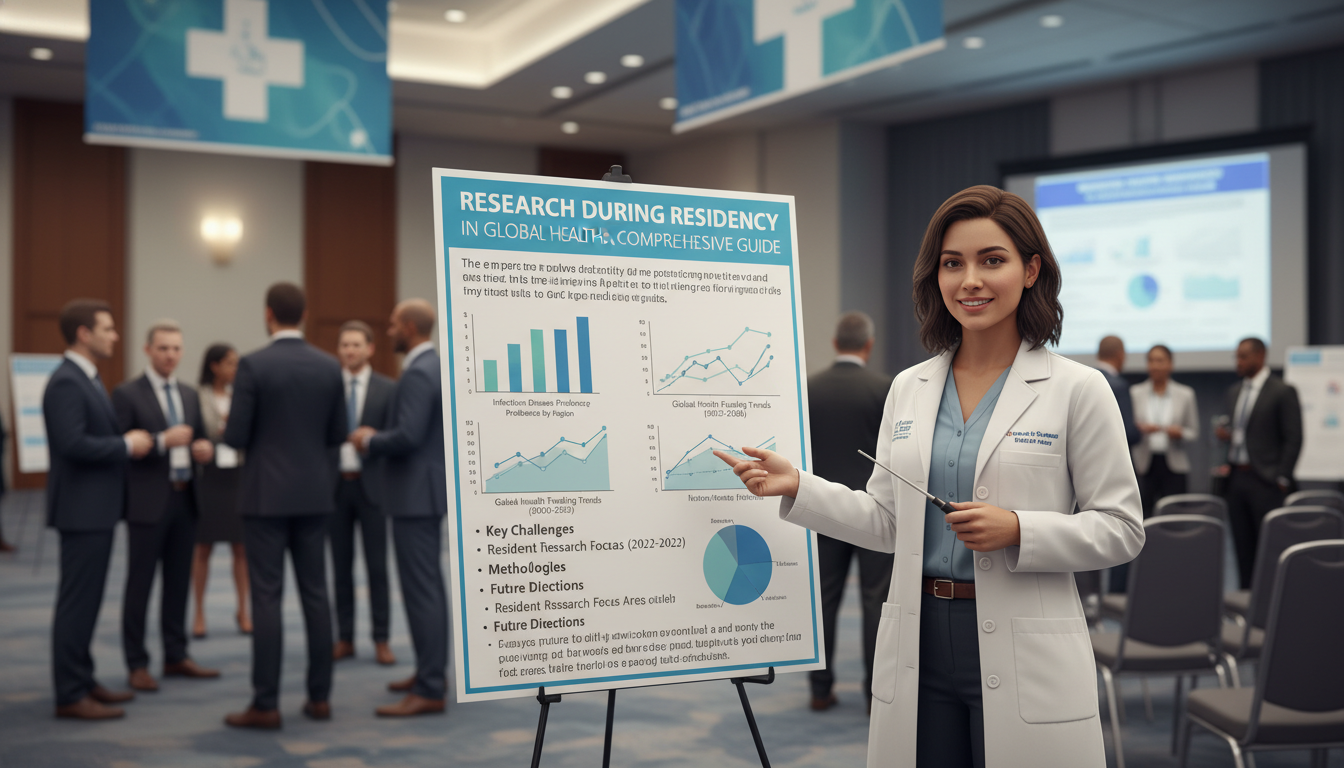
Disseminating Your Work
Aim to present and publish your research during or shortly after residency. This is essential for:
- Fellowship applications (especially in global health, infectious disease, maternal-child health)
- Academic job competitiveness
- Establishing credibility with international partners
Key options:
Conferences
- Global health-specific:
- Consortium of Universities for Global Health (CUGH)
- ASTMH (American Society of Tropical Medicine and Hygiene)
- Regional conferences (e.g., Africa Health Agenda, regional medical associations)
- General medical conferences:
- Society of General Internal Medicine, AAFP, ACP, APA, etc.
- Strategy:
- Submit abstracts early; many accept works-in-progress.
- Consider joint presentations with local collaborators.
- Global health-specific:
Peer-reviewed journals
- Target journals that publish international medicine and implementation work, including:
- BMJ Global Health
- Global Health: Science and Practice
- Journal of Global Health
- Specialty journals in infectious diseases, pediatrics, or internal medicine
- Consider open-access or regional journals for locally relevant topics.
- Target journals that publish international medicine and implementation work, including:
Local dissemination
- Present findings to:
- Hospital staff meetings or morbidity and mortality (M&M) conferences
- Ministry of health or district health officials
- Community forums in accessible language
- Share simple one-page summaries or infographics for frontline clinicians and community members.
- Present findings to:
Building a Long-Term Global Health Research Profile
If you envision a long-term career in global health research, start positioning yourself early:
Develop a coherent narrative
- Link your resident research projects around a theme (e.g., HIV care delivery, maternal health, NCDs in low-resource settings, refugee health).
- When applying for fellowships, show progression from:
- Early exposure → resident research project → career goals
Pursue additional training
- Certificates, MPH, or MSc in global health or epidemiology.
- Short courses in:
- Implementation science
- Qualitative methods
- Grant writing
Find longitudinal mentorship
- Ideally with a mentor who:
- Has ongoing partnerships in a region you care about
- Publishes regularly in global health
- Has experience navigating funding (Fogarty, NIH, foundations, etc.)
- Ideally with a mentor who:
Consider post-residency fellowships
- Global health fellowships (medicine, pediatrics, EM, family medicine)
- Research-focused fellowships with protected research time and mentorship.
Your resident research projects are often your first real step into this world; treat them as both an educational experience and the beginning of a long-term portfolio.
FAQs: Research During Residency in Global Health
How early should I start planning global health research during residency?
Ideally, start in late medical school or the first 6–12 months of residency. If you are applying to a global health residency track or academic residency track, mention your interest in resident research projects and ask about:
- Existing international partnerships
- Available mentors
- Protected research time
By early PGY-2, you should aim to have:
- A clear research question
- A preliminary protocol
- Identified mentors
- IRB plans underway
Can I do meaningful global health research if I only travel abroad briefly?
Yes, if you design the project carefully and collaborate deeply with local partners. Strategies include:
- Using existing datasets or routinely collected clinical data
- Training local staff or trainees to continue data collection after you leave
- Conducting remote meetings for analysis and interpretation
- Focusing on QI or implementation projects that build sustainable capacity
In many cases, your physical time on-site is less important than your commitment to sustained partnership and follow-through.
Do I need advanced statistical skills to do research during residency?
You do not need to be a statistician, but you should:
- Understand basic concepts (variables, confounding, p-values, confidence intervals)
- Be able to interpret simple regression outputs
- Know when to seek expert help
Most programs with a research or global health focus provide access to biostatistics support. Take advantage of workshops, online modules, and mentorship. For qualitative projects, invest time in learning systematic approaches to coding and thematic analysis.
How does global health research during residency help my career long-term?
Engaging in research during residency:
- Demonstrates intellectual curiosity and scholarly potential
- Strengthens applications for fellowships and academic positions
- Builds your reputation with international medicine partners and mentors
- Equips you with skills to evaluate and design programs, not just provide individual patient care
For those aiming at a career that combines clinical work, international medicine, and research, resident research projects are often the foundation of a strong academic portfolio and a meaningful, sustainable role in global health.
By approaching research during residency with careful planning, strong mentorship, and true partnership with local collaborators, you can make an impact that reaches far beyond a single paper or rotation—and lay the groundwork for a fulfilling career in global health.