Why Research During Residency Matters in Medicine-Psychiatry
As an MD graduate residency applicant or early trainee in a med psych residency, you occupy a uniquely powerful position for clinical investigation. Medicine-psychiatry combined programs sit at the intersection of complex medical illness and mental health—exactly where some of the biggest unanswered questions in healthcare live.
Doing research during residency is not just “nice to have”; it can:
- Deepen your understanding of both internal medicine and psychiatry
- Open doors to an academic residency track and future faculty roles
- Help you stand out for fellowships in psychosomatic medicine/consult-liaison psychiatry, addiction, or hospital medicine
- Give you tools to evaluate evidence and improve patient care in real time
For MD graduates from an allopathic medical school match, residency is often the first time you can own a project from question to publication. This article will walk through:
- How research fits realistically into a busy med-psych residency schedule
- Types of feasible resident research projects
- How to find mentors and a research home
- Stepwise guidance from idea to IRB to publication
- How to leverage research for long-term career development
Understanding the Research Landscape in Med-Psych Residency
Where Medicine-Psychiatry Sits in the Research World
Medicine-psychiatry combined training is perfectly positioned for “bridge research”:
- Interface of physical and mental illness
- Depression and heart failure, COPD, diabetes, chronic pain, HIV, transplant
- Delirium, catatonia, neurocognitive disorders in medically ill patients
- Health services and systems-based research
- Integrating behavioral health into primary care or hospital medicine
- Improving psychiatric care on medical wards
- Psychopharmacology and medical safety
- Antipsychotics and metabolic syndrome
- Antidepressants in cardiac or renal disease
- Drug–drug interactions in complex polypharmacy
- Population health and disparities
- How serious mental illness affects care for cancer, diabetes, or cardiovascular disease
- Impact of social determinants of health on multimorbidity
As a med-psych resident, you see patients where standard pathways fail: medically complex, psychiatrically complex, with high utilization. That vantage point often generates impactful research questions.
How Programs Structure Research Time
Combined medicine psychiatry residency structures vary, but most allopathic medical school match programs fall into one of three patterns:
Dedicated research tracks / academic residency track
- Guaranteed research time (e.g., 3–6 months spread across PGY-3–5)
- Formal mentorship and scholarly oversight committee
- Often tied to a specific department (medicine, psychiatry, or both)
- Strong pathway to clinician-investigator careers
Elective-based research opportunities
- Use elective time (e.g., 2–8 weeks blocks) to work on a project
- Research can occur in medicine, psychiatry, or consult services
- More flexibility, but requires greater self-direction and planning
Ad hoc or opportunistic involvement
- Join existing ongoing studies as an extra investigator
- Work on case reports, quality improvement, or chart reviews during rotations
- Minimal protected time, but still meaningful if well-structured
Knowing how your specific med psych residency handles research during residency is crucial. Early in PGY-1 or at the time of your MD graduate residency offer, ask:
- “Is there an academic residency track or research pathway?”
- “How much protected time is available, and in which years?”
- “Are there formal expectations for resident research projects (e.g., required QI, poster, or manuscript)?”

Getting Started: Finding Your Niche and Your Mentors
Clarifying Your Research Goals
Before diving in, clarify what you want research to do for your career. Typical goals for MD graduates in medicine psychiatry combined programs include:
- Strengthen your academic CV for fellowship or junior faculty jobs
- Explore whether a long-term research career is right for you
- Gain enough skill to be a clinically focused physician who can critically evaluate evidence and possibly lead smaller clinical projects
- Develop a specific niche (e.g., psychosis in medically ill patients, addiction in primary care, depression and heart disease)
Your goal will shape what kind of research during residency makes the most sense:
- If you’re academically focused → aim for original data projects, multi-site collaborations, or RCT involvement
- If you primarily want clinical excellence → targeted QI, case series, or practice-changing implementation projects may be ideal
Identifying a Research Focus in Med-Psych
To find a focus, pay attention to recurrent clinical questions during rotations:
- On medicine wards:
- “Why do our patients with schizophrenia and diabetes have such poor glycemic control?”
- “How can we better identify delirium early in older inpatients?”
- On psychiatry:
- “What is the best workup for first-episode psychosis with red-flag medical features?”
- “How do we stratify medical risk when starting clozapine?”
- On consult-liaison / med-psych rotations:
- “Can we predict which medically ill patients will need psychiatric consultation?”
- “Does proactive consult-liaison involvement reduce LOS or readmissions?”
Keep a running list of questions in a note on your phone. After a month, you’ll likely see themes. Those themes often become excellent resident research projects.
Finding Mentors (Often More Than One)
Robust mentorship is the single most important determinant of research success during residency.
For a med psych residency, you ideally want:
Primary content mentor
- Expert in your topic area (e.g., delirium, addiction, integrated care)
- Usually faculty in psychiatry, internal medicine, or psychosomatic/CL psychiatry
Methodologic or statistical mentor
- Can be from biostatistics, epidemiology, or health services research
- Helps with study design, sample size, analysis plan
Career/identity mentor (often another med-psych faculty or graduate)
- Guides you in navigating a dual-identity career
- Helps you prioritize realistic projects given your rotation schedule
Practical steps to identify mentors:
- Scan your department and hospital websites for:
- “Consult-liaison psychiatry,” “psychosomatic medicine,” “behavioral medicine,” “integrated care,” “population health,” “hospital medicine + psychiatry”
- Ask your program director or chief residents:
- “Which faculty regularly work with residents on research?”
- Attend grand rounds and approach speakers whose topics match your interests.
- Email prospective mentors with a focused request:
- Who you are (MD graduate in med psych residency, PGY-X)
- Your interests in medicine psychiatry combined research
- A short list of clinical questions you might want to study
- Request a 20–30 minute meeting to discuss potential projects
Choosing a Feasible First Project
For your first substantial project, aim for something:
- Narrow in scope
- Feasible within 12–18 months
- Realistic given your clinical demands
Good starter project types for a med psych MD graduate residency trainee:
- Retrospective chart review (e.g., “Characteristics and outcomes of inpatients receiving antipsychotics for delirium on our medicine wards”)
- Quality improvement project (e.g., “Implementation of a delirium screening tool in the ICU and its impact on consult patterns”)
- Case series or small observational cohort (e.g., “Hospital course of patients with severe mental illness admitted for heart failure”)
- Secondary analysis of existing data (e.g., using a CL service database)
Larger, prospective, multi-site trials are typically better as second-stage projects once you’ve built some basic experience.
Types of Research Opportunities for Med-Psych Residents
Clinical Research at the Medicine–Psychiatry Interface
Clinical med-psych research during residency can address:
- Diagnostic dilemmas
- Differentiating primary psychiatric illness from steroid-induced psychosis, metabolic encephalopathy, or autoimmune encephalitis
- Treatment outcomes
- Impact of SSRIs on recovery from MI or stroke
- Safety of antipsychotics in patients with prolonged QTc or heart failure
- Integrated care models
- Collaborative care in primary care
- Psychiatry embedded in oncology, transplant, cardiology
Examples of resident projects:
- Prospective study: implementing PHQ-9 screening for depression in an outpatient heart failure clinic and tracking referral and treatment outcomes
- Chart review: comparing 30-day readmission rates among medically ill patients with and without documented psychiatric comorbidities
Quality Improvement (QI) and Implementation Science
Because med-psych residents work at systems interfaces, they are well-positioned for QI:
- Examples of QI projects:
- Increasing rates of metabolic monitoring (A1c, lipids, BMI) for patients on antipsychotics admitted to the medical service
- Standardizing delirium screening and documentation on a general medicine ward
- Reducing benzodiazepine use in older inpatients with insomnia or anxiety
These projects can be structured as scholarly work:
- Identify a problem (e.g., low metabolic monitoring rates)
- Collect baseline data
- Implement interventions (provider education, order set changes, EMR reminders)
- Reassess outcomes
- Present locally and write it up
Many journals now publish QI and implementation-focused studies, making such projects legitimate resident research projects with real impact.
Research During Psychiatry vs. Medicine Blocks
Your approach may differ depending on rotation:
During psychiatry blocks:
- Time may be more flexible in some programs
- Good for writing IRB protocols, planning data collection, writing manuscripts
- Ideal for projects centered on psychiatric outcomes, psychopharmacology, or integrated care clinics
During medicine or ICU blocks:
- Workload is heavier; plan narrow, well-defined tasks
- Good for:
- Prospectively recruiting participants (if feasible)
- Collecting specific clinical variables during admissions
- Observing system issues for QI ideas
Planning with your mentor is essential so that tasks match your rotation intensity.
Step-by-Step: From Idea to Publication
1. Refining Your Research Question
Use the FINER criteria: Feasible, Interesting, Novel, Ethical, Relevant.
Example transformation:
- Vague: “I want to study depression in hospitalized patients.”
- Refined: “Among general medicine inpatients at our hospital, what proportion screens positive for moderate to severe depressive symptoms using the PHQ-9, and how often do they receive formal psychiatric evaluation before discharge?”
Check novelty by searching:
- PubMed (keywords like “depression hospitalized patients PHQ-9 consult liaison”)
- Google Scholar
- Specialty journals (Psychosomatics, General Hospital Psychiatry, Journal of Hospital Medicine, etc.)
2. Study Design and Methodology
Common designs accessible to residents:
- Retrospective cohort: using existing charts/EMR data
- Prospective observational: enrolling patients as they’re admitted
- Before-and-after QI: measuring outcomes pre- and post-intervention
- Cross-sectional surveys: surveying residents, nurses, or patients
Work with a methodologic mentor to clarify:
- Inclusion/exclusion criteria
- Primary and secondary outcomes
- Sample size estimates
- Statistical tests you’ll use
3. IRB and Regulatory Steps
Almost all clinical projects require institutional review board (IRB) review.
Steps:
- Complete required research ethics and HIPAA training (e.g., CITI training).
- Draft a protocol with:
- Background and rationale
- Objectives and hypotheses
- Methods and data collection plan
- Risk/benefit assessment
- Determine whether your project is:
- Exempt (many QI projects)
- Expedited
- Full review
Your mentor or departmental research coordinator can guide you. Factor IRB timelines (often 1–2 months) into your schedule.
4. Data Collection and Management
Efficient data handling is critical for a busy resident:
- Use a secure platform (e.g., REDCap) if available through your institution
- Design your data collection sheet carefully with:
- Clear variable definitions
- Coded responses for easy analysis
- Plan who will collect the data (just you vs. team of residents/med students)
- Schedule protected data time:
- e.g., 2–4 hours per week on a lighter rotation
5. Statistical Analysis
You don’t need to be a statistician, but you should:
- Understand basic descriptive statistics (means, medians, proportions)
- Know what t-tests, chi-square tests, and simple regression models do in principle
- Be able to interpret p-values and confidence intervals
Work closely with a biostatistician or methods mentor, especially for:
- Choosing the correct tests
- Handling missing data
- Adjusting for confounders
Use common tools:
- Institutional support (biostatistics consult service)
- Software like SPSS, Stata, R, or even Excel for simpler projects
6. Writing and Presenting Your Work
Aim for multiple outputs from each project:
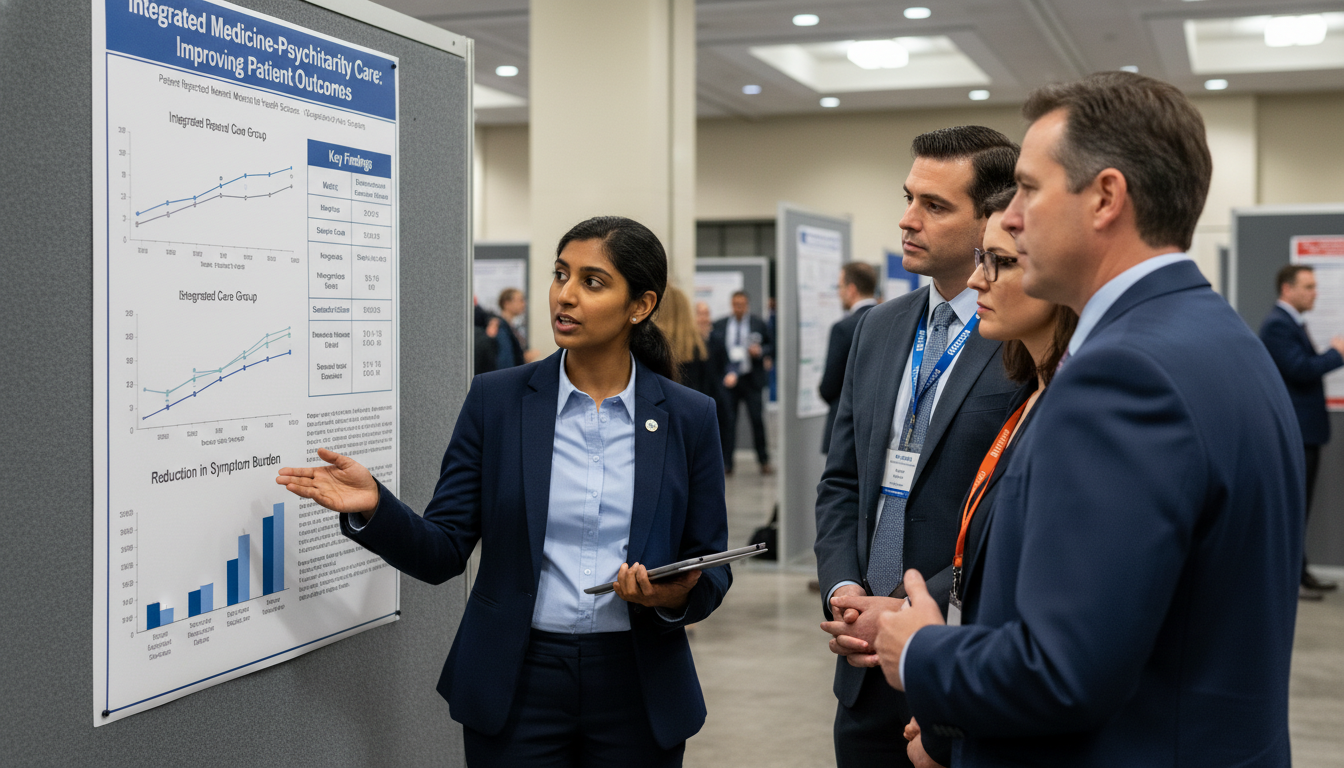
Abstracts and posters
- Submit to:
- Academy of Consultation-Liaison Psychiatry (ACLP)
- American Psychiatric Association (APA)
- Society of General Internal Medicine (SGIM)
- American College of Physicians (ACP)
- Presenting at conferences is valuable for networking and career development
- Submit to:
Oral presentations
- Local department grand rounds
- Residency research day
- Hospital QI showcases
Manuscripts
- Target journals aligned with your topic:
- Psychosomatics, General Hospital Psychiatry, Journal of Psychosomatic Research
- Journal of Hospital Medicine, Academic Medicine
- Specialty-specific journals (cardiology + psychiatry, oncology + psychiatry, etc.)
- Target journals aligned with your topic:
Early on, volunteer to write first drafts. As a med psych MD graduate residency trainee, first-authorship on med-psych interface topics is particularly powerful on your CV.
Balancing Research with Clinical Demands and Career Planning
Time Management Strategies for Busy Residents
To make research during residency sustainable:
- Start early: Ideally, initiate planning in PGY-1 or early PGY-2
- Align with your rotation calendar:
- Use outpatient or psychiatry blocks for writing and planning
- Use inpatient medicine blocks for data that require real-time clinical observation
- Micro-task your project:
- Break down work into 30–60 minute tasks (e.g., “abstract data from 5 charts,” “write introduction section paragraphs 1–3”)
- Build a small team:
- Involve medical students or co-residents for data abstraction
- Delegate well-defined tasks, supervised by you and your mentor
Choosing Between Academic Residency Track vs. Clinically Focused Path
If your program offers an academic residency track:
- You might be a strong candidate if:
- You enjoy the process of asking questions and working with data
- You’d like a future role as faculty, especially in psychosomatic medicine or integrated care models
- You’re considering additional research training (e.g., MPH, MS in Clinical Investigation, T32 fellowships)
If you’re more clinically focused:
- One or two solid resident research projects are still beneficial:
- They teach you how to read literature critically
- They demonstrate scholarly engagement to fellowship programs
- They prepare you to lead practice-changing QI efforts in your future workplace
Using Research to Shape Your Career Niche
Think strategically:
- If you see yourself in outpatient integrated care:
- Focus on primary care–behavioral health integration, chronic disease + mental health, SMI and metabolic disease
- If you are drawn to hospital-based practice:
- Emphasize delirium, catatonia, severe agitation management, medically complex psychiatric patients, or CL psychiatry
- If you’re considering leadership roles:
- Health services, systems redesign, and QI projects can be very influential
Over time, a coherent series of resident research projects can give you a recognizable professional identity even before fellowship graduation.
FAQs: Research During Med-Psych Residency for MD Graduates
1. I matched into a med psych residency but have very little prior research experience. Is it too late to start?
No. Residency is a perfectly acceptable time to begin serious research engagement. Many successful clinician-investigators started during residency, especially in combined programs.
Steps if you’re starting from scratch:
- Take an institutional research skills workshop or short course (often offered by GME or your university).
- Join an existing project led by a faculty member rather than immediately launching your own.
- Aim first for a manageable project (case series, QI, or retrospective chart review).
- Use your first project primarily to learn process: IRB, data, analysis, and manuscript basics.
2. How many research projects should I aim for during residency?
Quality matters more than quantity. For most medicine psychiatry combined residents:
- 1–2 substantial projects (leading to posters and at least one manuscript) plus
- Several smaller contributions (co-authorships, QI reports, or case reports)
is sufficient to demonstrate meaningful engagement, especially if your work clearly centers on the medicine–psychiatry interface.
If you are actively pursuing a long-term academic career, you may aim for more, but only if you can maintain depth and follow-through.
3. Will doing research during residency hurt my clinical training?
If well-managed, it should enhance it. Med-psych research typically arises directly from clinical problems. Rather than competing with clinical work, these projects can:
- Deepen your understanding of complex pathophysiology and psychopharmacology
- Improve your diagnostic reasoning and systems-based practice
- Make you more reflective and deliberate about patient care
The key is to:
- Avoid overcommitting in your early PGY-1 months
- Plan research intensity around heavy rotations (e.g., ICU, night float)
- Communicate with your mentors and program leadership to protect vital rest and learning time
4. How can I leverage my residency research for future fellowship or job applications?
Use your med psych residency research to tell a coherent story about your professional goals:
- Highlight your projects in personal statements for consult-liaison psychiatry, addiction, or hospital medicine fellowships.
- Emphasize:
- How your research questions arose from direct patient care
- What you specifically contributed (design, data collection, analysis, writing)
- How your findings could change practice or inform future studies
- Bring printed copies of your posters or manuscripts to interviews and be ready to discuss:
- Lessons learned
- Limitations of your study
- Next logical research questions you’d like to pursue
When applying for academic positions, mention your experience with resident research projects and your comfort working at the medicine–psychiatry interface, which is highly valued in many academic centers.
Research during residency for an MD graduate in medicine-psychiatry is not an optional extra; it’s a natural extension of the questions you’re already asking at the bedside. With thoughtful mentorship, realistic project design, and strategic time management, you can emerge from your med psych residency not only as an outstanding dual-trained clinician, but as someone capable of generating and applying new knowledge at the crucial intersection of body and mind.