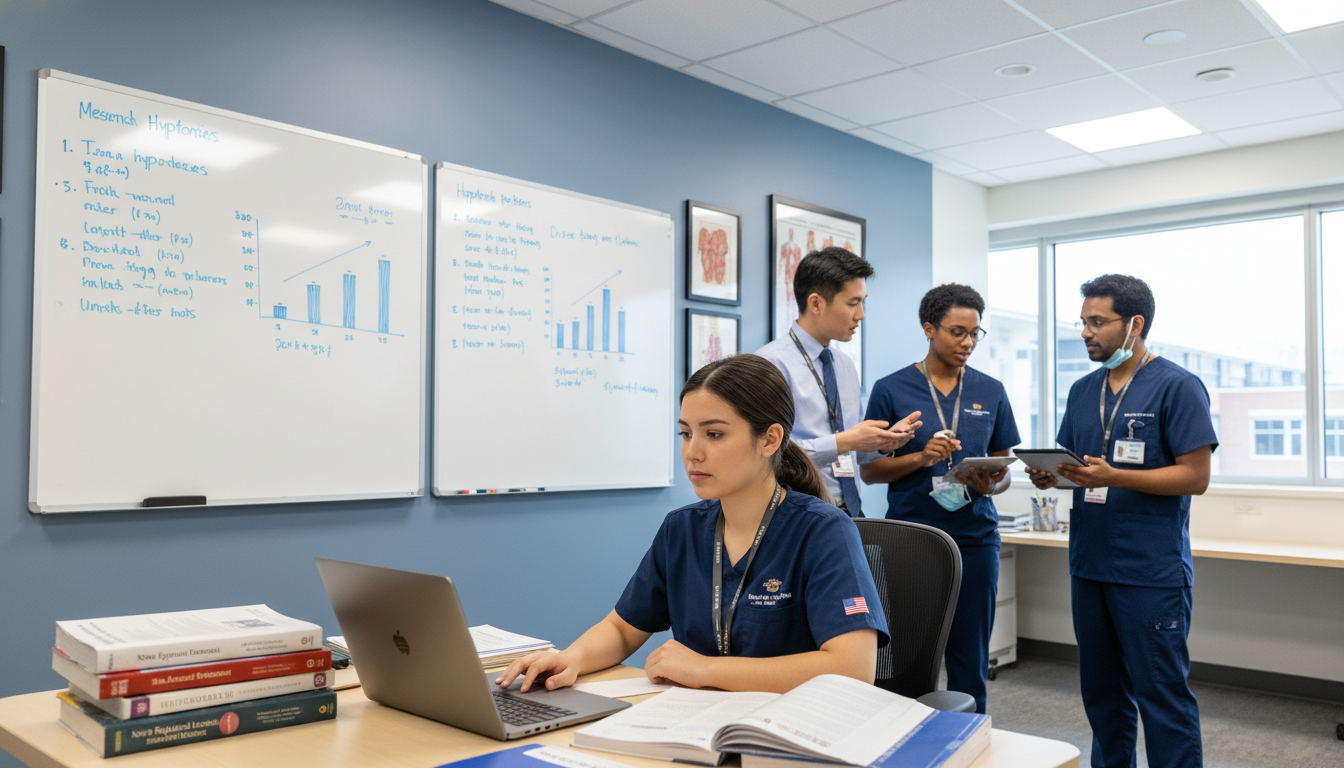
Understanding Research During Pathology Residency as a Non‑US Citizen IMG
Research during residency is one of the most powerful ways for a non-US citizen IMG to stand out in pathology. For many foreign national medical graduates, residency is the first sustained opportunity to work in a well-resourced research environment, to build a US-based academic record, and to develop mentors who can support fellowship and job applications.
This article explains how research fits into pathology training, how you can realistically build a research portfolio while managing service and exams, and how to strategically use resident research projects to advance your career—especially if you are considering an academic residency track or long‑term practice in the United States.
While the focus is on pathology, most principles also apply across specialties—but the examples and strategies here are tailored specifically for pathology residents who are non‑US citizen IMGs.
1. Why Research Matters in Pathology Residency for Non‑US Citizen IMGs
1.1 Unique value of research for foreign national medical graduates
As a non-US citizen IMG in pathology, you often start residency at a disadvantage compared with US graduates:
- Limited US clinical/research experience
- Less access to US-based mentors before residency
- Visa-related constraints that can make some programs hesitant to hire you after training
- Less familiarity with US-style academic expectations (IRB, grant structures, authorship norms, etc.)
Research during residency helps offset these challenges by:
Building a US-based academic footprint
Peer-reviewed publications, abstracts, and posters from a US institution demonstrate that you can compete academically in this environment. This is especially important for fellowship applications in competitive subspecialties (e.g., dermatopathology, hematopathology, molecular pathology).Creating strong mentorship connections
Working closely with faculty on research projects often leads to:- Detailed letters of recommendation
- Advocacy for you in fellowship or job selection meetings
- Access to their professional networks
Differentiating your application for fellowships and early career jobs
Program directors and division chiefs in academic pathology emphasize:- Sustained scholarly activity
- Evidence you can complete projects and publish
- Clear academic interests (e.g., GI pathology research, digital pathology, quality improvement)
Mitigating visa concerns with academic value
When departments consider sponsorship for H‑1B, O‑1, or permanent roles, residents with a strong research portfolio often have a clearer “value proposition”: you are not just a service provider but also an academic contributor.
1.2 Why pathology is uniquely well-suited to research during residency
Pathology offers several structural advantages for doing research in residency:
- Regular “bench time” or scheduled academic time
Many programs reserve blocks for scholarly activity, especially in PGY‑3 and PGY‑4. - Data-rich environment
Every case—biopsies, resections, cytology, autopsies, lab results, digital slides—is potential research material. - Embedded in multi-disciplinary care
You can collaborate with surgeons, oncologists, radiologists, and basic scientists on clinically relevant questions. - Integration with lab medicine
Opportunities for translational, molecular, quality improvement, and informatics research are abundant.
Because of this, engaging in research during residency is not only possible for pathology residents—it is often expected, especially in larger academic programs.
2. Types of Research Opportunities for Pathology Residents
Not all residents will pursue laboratory-based projects. That’s completely acceptable. The key is to pick research that matches your interests, your program’s resources, and your visa/residency constraints.
2.1 Common research modalities in pathology
Retrospective clinical and anatomic pathology studies
- Chart review and slide review of cases over a defined period
- Example: “Clinicopathologic features and outcomes of rare breast spindle cell lesions over a 10-year period”
- Pros: Feasible, lower cost, often faster; suitable for first projects
- Cons: Requires robust IRB support and data management
Case reports and small case series
- Detailed description of unusual or instructive cases
- Example: “Unusual presentation of IgG4-related disease in the pancreas”
- Pros: Great starting point; builds writing skills; achievable in 3–6 months
- Cons: Lower impact; limited value on their own if not followed by larger work
Quality improvement (QI) and laboratory management projects
- Focused on process, safety, turnaround time, or diagnostic accuracy
- Example: “Reducing mislabeled specimens through barcode implementation and staff training”
- Pros: Highly valued by program leadership; often faster to complete; supports CAP inspection roles and future lab director credentials
- Cons: May be less publishable in high-impact journals unless well designed
Translational or basic science projects
- Tissue-based, molecular, or bench research
- Example: “Genomic characterization of unusual pediatric sarcomas”
- Pros: Excellent for academic residency track and long-term academic careers; can lead to major publications
- Cons: Time-intensive; may require extended protected time or research electives; can be harder to finish during residency alone
Informatics and digital pathology research
- Using digital slides, AI tools, or LIS data for research questions
- Example: “Deep learning model to assist in grading prostate biopsies”
- Pros: High-growth area in pathology; attractive skill set; aligns with future job markets
- Cons: Requires basic programming or data skills—or a collaborator who has them
Educational research
- Assessment of teaching methods, evaluation of residents, curriculum design
- Example: “Effectiveness of virtual slide teaching modules in resident training”
- Pros: Good for residents interested in medical education; feasible with surveys and test scores
- Cons: May require institutional education review approval and careful design
2.2 Mapping research type to your goals
If you aim for an academic residency track or academic job
Prioritize:- Retrospective studies with significant sample sizes
- Translational/molecular projects if possible
- Multi-institutional collaborations
- Work that leads to first-author publications
If you plan a community practice career but want options open
Focus on:- Case reports, QI projects, and a couple of retrospective studies
- Projects that demonstrate reliability and completion
- Practical, clinically relevant topics
If you are uncertain about your path
Start small (case report or QI) in PGY‑1/PGY‑2, then move into more substantive retrospective or translational work once you’re more comfortable with pathology workflow.

3. Finding and Starting Resident Research Projects
3.1 How to identify research mentors as a non‑US citizen IMG
As an IMG, you may not initially know who the key researchers are in your department. Use a structured approach:
Scan faculty profiles
- Visit your department website.
- Note faculty with active publications in your areas of interest (GI, heme, neuropath, molecular, etc.).
- Pay attention to those with recent papers featuring residents as co-authors.
Ask senior residents
- They know which attendings:
- Are resident-friendly
- Help residents publish
- Have ongoing projects that need help
- Ask: “Who in our department is particularly good to work with for research during residency?”
- They know which attendings:
Attend departmental research seminars or journal clubs
- Watch who presents regularly.
- Those who present or moderate are often active researchers and good mentors.
Approach more than one mentor
- Don’t put all your hopes on one faculty member.
- Develop a small “mentorship team”:
- Primary research mentor
- Secondary content mentor (e.g., subspecialty expert)
- Career/visa advisor (often PD or senior faculty)
3.2 How to start the conversation
When you reach out:
- Send a focused email:
- Introduce yourself as a non-US citizen IMG and current PGY level.
- Express your interest in pathology research, specifying any subspecialty interests.
- Ask whether they have ongoing projects where a resident could contribute meaningfully.
- Offer to meet briefly (15–20 minutes) to discuss possibilities.
Example email structure:
“I am a PGY‑1 pathology resident with a strong interest in hematopathology and academic practice. As a non‑US citizen IMG, I am especially keen on developing research skills early in residency. I read your recent paper on [topic] and would love to learn whether you have any ongoing or upcoming research projects where I could contribute. Would you be available for a brief meeting to discuss potential involvement?”
3.3 Choosing the right first project
For your first research project during residency, prioritize:
- Feasibility over ambition
- Clear timelines (6–12 months from start to submission)
- Well-defined role (e.g., data extraction, case review, literature review, drafting manuscript)
Strong first-project candidates:
- Case series from a single institution
- QI project with measurable endpoints
- Retrospective cross-sectional or cohort study with available data
Avoid as your very first project:
- Very large multi-center studies where your role is unclear
- High-risk bench research that depends on many experiments and external funding
- Projects without a clear senior author who has successfully published with residents before
3.4 Navigating IRB and approvals
As a foreign national medical graduate, you may be less familiar with US regulatory processes. Learn the basics early:
- Complete institutional human subjects research training (CITI or equivalent).
- Ask your mentor:
- “Is IRB approval needed for this project?”
- “Can I see a prior IRB application as a template?”
- Offer to help draft IRB documents—it’s time-consuming but valuable experience.
- Keep careful records of:
- IRB protocol number
- Approval dates
- Any data use agreements
This knowledge will help you in future academic roles and strengthens your credibility as a researcher.
4. Balancing Research with Pathology Training and Visa Considerations
4.1 Time management during busy rotations
Pathology training can be intense (frozen sections, grossing, call, exams). To realistically do research during residency:
Aim for consistent small blocks of time
- 2–4 hours per week is enough to move a project forward if used efficiently.
- Schedule it like a rotation task: “Friday 3–5 pm: research data entry and literature review.”
Use rotation structure strategically
- Heavy service months (e.g., busy surgical pathology rotations): focus on reading and planning.
- Lighter months (electives, CP rotations with more predictability): schedule tasks like chart abstraction, writing, or analysis.
Use technology efficiently
- Reference managers (Zotero, EndNote, Mendeley).
- Shared documents (Google Docs, OneDrive) to draft manuscripts.
- Spreadsheet templates for data collection with clearly labeled variables.
4.2 Communicating boundaries and expectations
As a resident, service commitments come first. To avoid conflicts:
- Clarify with your mentor:
- “My call schedule and surgical pathology rotations are heavy this month. Is it okay if we set realistic interim goals?”
- Keep them updated:
- If you are delayed due to exams, call, or visa emergencies, send a short email update.
- Be honest about availability rather than over-committing.
4.3 Visa and funding implications
As a non-US citizen IMG, think ahead about visa interactions:
J‑1 vs H‑1B during residency
- Most non-US citizen IMGs are on J‑1; some on H‑1B.
- Visa status generally does not limit your ability to participate in unfunded research as part of residency duties.
- If you are applying for paid research fellowships, check with your GME office:
- Is a new visa petition required?
- Will it count toward residency duration limits?
O‑1 visa potential for later
- Strong research productivity (publications, presentations, awards) can later support O‑1 “extraordinary ability” petitions.
- Keep organized records:
- Full citations of publications
- Conference abstracts and posters
- Awards or research grants
- Let your mentors know if O‑1 may be part of your long-term plan; some have experience helping prior IMGs.
Funding restrictions
- Certain federal grants may require US citizenship or permanent residency.
- As a resident, you’re more likely to be involved in projects funded through existing faculty grants, departmental funds, or institutional resources—these usually don’t add visa complications.
5. Maximizing the Impact of Research During Residency
5.1 Turning projects into presentations and publications
Research during residency only fully counts when it leads to disseminated output:
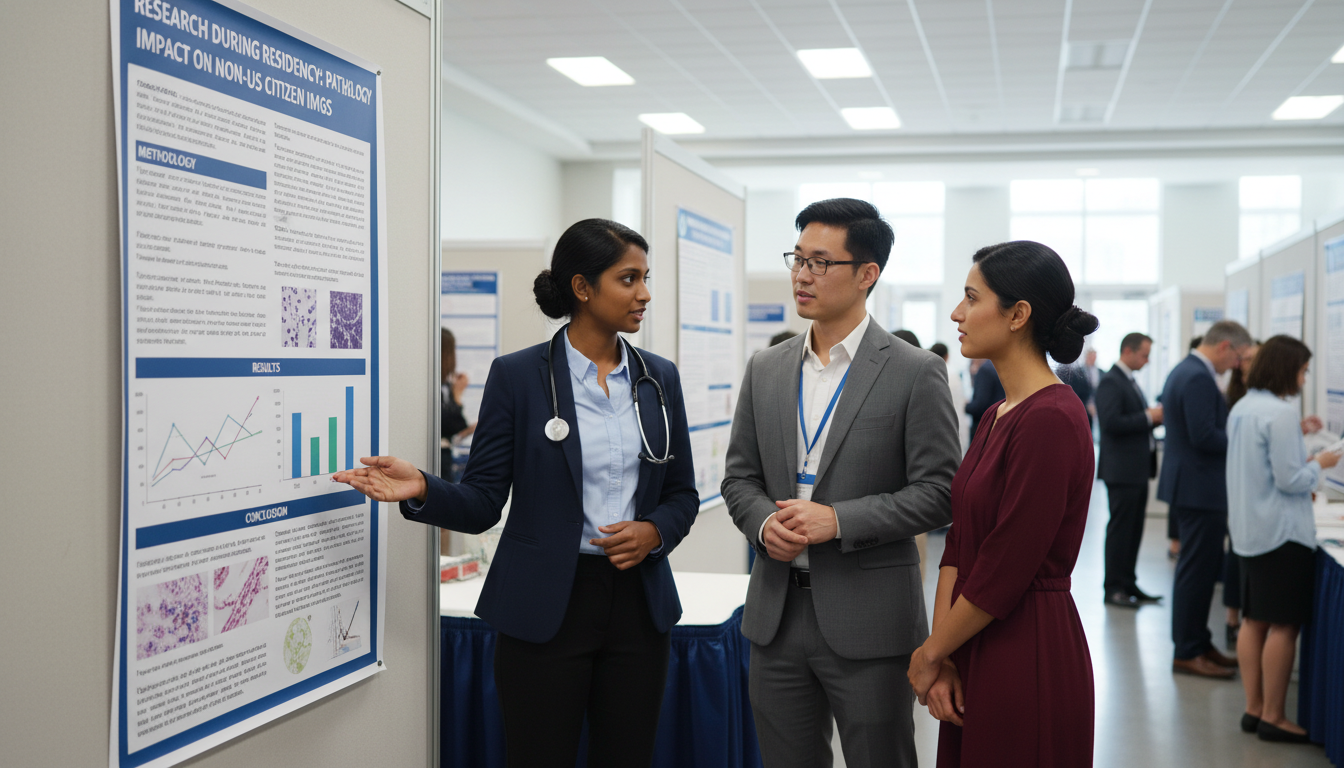
Abstracts and posters
- Target regional, national, and international pathology meetings:
- USCAP, CAP, ASCP, subspecialty societies
- Ask your mentor about abstracts with resident-friendly categories or awards.
- Presenting at conferences:
- Builds your CV
- Expands your network
- Strengthens fellowship applications
- Target regional, national, and international pathology meetings:
Oral presentations
- More competitive but highly valued.
- Practice thoroughly; your performance can leave a strong impression on potential future colleagues and fellowship directors.
Peer-reviewed publications
- Aim to convert at least some resident research projects into full manuscripts.
- Seek journals appropriate to the project’s scope:
- High-impact for large, novel studies
- More specialty or practice-focused journals for QI and case series
Local presentations
- Departmental grand rounds
- Interdisciplinary tumor boards
- Hospital QI conferences
These may not always be indexed, but they demonstrate leadership and communication skills.
5.2 Documenting academic productivity for the pathology match and beyond
If you are still in early training or considering a transfer to another pathology residency or academic residency track, document your output clearly:
Maintain an updated CV with:
- “Publications (Published / In Press)”
- “Manuscripts Under Review or In Preparation” (clearly labeled and honest)
- “Abstracts and Posters”
- “Oral Presentations”
- “Research Grants / Awards” (if any)
For fellowship applications:
- Highlight 2–3 key projects, your role, and outcomes.
- Ask mentors to describe your research work in their letters.
For job applications:
- Emphasize projects aligned with your target role:
- QI and lab operations for community/lab leadership positions
- Translational and high-impact publications for academic institutions
- Emphasize projects aligned with your target role:
5.3 Choosing an academic residency track vs research electives
Some programs offer an academic residency track or extended research time options.
As a non-US citizen IMG, consider:
Pros of an academic track
- More protected research time
- Structured mentorship and expectations
- Stronger positioning for academic fellowships and faculty positions
- Chance to build a substantial scholarly portfolio (multiple publications)
Cons or challenges
- Potential reduction in service exposure (be sure you still meet case requirements).
- Visa timing considerations if research adds time to your overall training period.
- Expectation of continued academic productivity after training.
Research electives
- Even in non-academic tracks, you can often request 1–3 months of protected research elective during PGY‑3 or PGY‑4.
- Plan electives early with your program director so that:
- They align with project critical phases (e.g., data analysis or manuscript writing).
- They don’t conflict with major exam preparation (board exams).
6. Practical Tips and Common Pitfalls for Non‑US Citizen IMG Pathology Residents
6.1 Practical tips for success
Start early
- Initiate your first project by mid-PGY‑1 or early PGY‑2.
- Early work gives time for revisions, resubmissions, and follow-up studies.
Be reliable
- If you commit to extracting data on 150 cases, do it accurately and on time.
- Reliability is the fastest way to gain trust—and to be invited into better projects.
Develop basic statistics literacy
- Learn foundational concepts (p-values, confidence intervals, survival analysis).
- Make friends with a biostatistician or data scientist at your institution.
- Take advantage of free or low-cost online biostatistics courses if available.
Leverage your unique background
- As a non-US citizen IMG, you may have experience with disease patterns less commonly seen in the US.
- This can inspire unique comparative or global pathology projects, especially in infectious disease, hematopathology, or cancer subtypes.
Protect your authorship position
- Discuss expectations early: “If I do X, Y, and Z, would I be first author?”
- Understand that authorship should reflect genuine intellectual and practical contribution.
6.2 Common pitfalls and how to avoid them
Overcommitting to too many projects
- Managing 1–2 projects well is better than being marginally involved in 6 unfinished ones.
- Avoid “CV inflation” that never materializes into actual output.
Ignoring the IRB and data privacy rules
- Never take identifiable patient data outside approved channels.
- Never store PHI on personal devices without encryption and institutional approval.
Poor communication with mentors
- Long periods of silence can lead to your role being reassigned.
- Even short email updates (“I’ve completed 80% of data collection, aiming to finish by next week”) maintain engagement.
Not tailoring research toward your career goals
- If you know you want hematopathology, but all your work is GI, consider adding at least one heme-focused project.
- If you are leaning toward community practice, emphasize QI and practical diagnostic studies.
Underestimating the learning curve
- Manuscript writing, statistical analysis, and study design are skills that improve with practice.
- Seek feedback, accept revisions, and view criticism as part of training.
Frequently Asked Questions (FAQ)
1. I’m a non‑US citizen IMG starting PGY‑1 in pathology. When should I begin research?
Aim to start exploring research during your first year, once you’ve adjusted to the basics of grossing, sign‑out, and call.
A realistic timeline:
- First 3–6 months: Learn workflow, attend journal clubs, observe research presentations.
- Months 6–12: Join a small project (case report, QI, or retrospective study).
- PGY‑2 onward: Take on more substantial projects, potentially as first author.
Starting by late PGY‑1 gives you enough time to see projects through to publication before graduation.
2. How many publications do I need to be competitive for academic pathology fellowships?
There is no fixed number, but patterns matter:
- 1–2 solid first-author publications plus several abstracts/posters are often sufficient for many subspecialty fellowships.
- Highly competitive areas (dermatopathology, molecular pathology, some heme programs) may favor applicants with multiple peer-reviewed papers, especially in relevant fields.
- Program directors value quality and completion over raw quantity—well-executed projects with clear roles are better than many incomplete ones.
3. Can I do basic science or bench research if I’m on a J‑1 visa?
Yes, you can generally participate in bench or basic science research as part of your residency or as a structured research year within your GME program. Visa status usually becomes more complex only when:
- You extend training significantly beyond standard residency length, or
- You seek separate research fellow roles outside clinical GME.
Always confirm details with your GME office and institutional international office before committing to multi-year funded research positions.
4. What if my residency program has limited research infrastructure?
If you are in a smaller or more community-focused program:
- Focus on feasible projects:
- Case reports and case series
- QI projects
- Single-center retrospective studies with available data
- Seek external collaborations:
- Contact faculty at nearby academic centers who may partner with your program.
- Use national societies (USCAP, CAP, ASCP) to network with potential collaborators.
- Consider electives at academic institutions during PGY‑3 or PGY‑4, if your program allows it, to access additional resources.
By approaching research during residency strategically, non-US citizen IMG pathology residents can transform potential disadvantages into strengths. With thoughtful project selection, reliable work habits, and strong mentorship, research can open doors to academic residency tracks, competitive fellowships, and long-term career stability in the United States.